You hire someone who seems like a perfect fit, only to realize months later that subtle performance gaps or cultural misalignments are draining your team’s momentum. For C-level leaders in American tech firms, these invisible hiring mistakes quietly undermine growth and increase turnover. Understanding the true scope of these costs—and how they ripple across productivity, morale, and financial resources—sets the stage for smarter, evidence-based hiring and retention strategies that tackle issues before they escalate.
Table of Contents
- Defining Invisible Hiring Mistakes And Costs
- Early Warning Signs Of Employee Disengagement
- How Traditional Tools Miss Hidden Risks
- Quantifiable Insight For Predicting Retention Risk
- Transforming Leadership Decisions With Data
Key Takeaways
| Point | Details |
|---|---|
| Recognize Invisible Hiring Mistakes | Subtle misalignments can lead to significant productivity loss months after hiring. Acknowledge performance gaps, cultural fit issues, and disengagement early on. |
| Track Leading Indicators | Monitor employee engagement scores and project participation proactively to catch signs of disengagement before they lead to turnover. |
| Shift to Data-Driven Decisions | Move from traditional hiring methods to data-driven approaches to identify at-risk employees early and make informed retention strategies. |
| Foster Data Fluency in Leadership | Equip your leadership team with skills to interpret data effectively, ensuring responses to disengagement are timely and supported by evidence. |
Defining Invisible Hiring Mistakes and Costs
You hire someone. They seem solid in interviews. Three months pass, and suddenly you’re realizing the role is bleeding productivity with no clear reason why. That’s an invisible hiring mistake.
These aren’t glaring failures—no massive scandal or immediate crisis. Instead, they’re the subtle misalignments that only surface months into employment, after significant investment has already been made. By then, the damage accumulates quietly.
Invisible hiring mistakes fall into three primary categories:
- Performance gaps that emerge slowly: Skills look good on paper but don’t translate to your specific workflow or tech stack
- Cultural and team friction: The person doesn’t mesh with how your team operates, despite having the right credentials
- Disengagement creeping in: Motivation fades after the initial honeymoon period, leading to quiet resignation before actual resignation
The True Cost Behind the Scenes
Here’s what most executives underestimate: the financial damage extends far beyond salary. A single misaligned hire in a mid-sized tech firm creates a ripple effect that touches multiple areas.

When traditional hiring processes exclude candidates with unconventional backgrounds, you’re not just missing diversity—you’re missing proven talent pools like veterans, caregivers returning to work, and people with disabilities who often bring exceptional loyalty and performance.
The real costs include:
- Lost productivity from the entire team managing around one underperforming person
- Manager time spent coaching or documenting performance issues
- Decreased morale among high performers who notice the gap
- Replacement hiring and training when you eventually part ways
- Knowledge gaps and project delays during the transition
Most leaders don’t connect these fragmented costs to a single hiring decision made months earlier.
You might see a spike in turnover, attribute it to market conditions, and move on. You notice a project slipped its timeline and assume it was scope creep. A team member leaves suddenly and you chalk it up to better compensation elsewhere. But invisible hiring errors compound across these areas, creating what looks like random dysfunction rather than a systemic problem.
The gap between hiring and its true impact is where problems hide. Retention is a lagging indicator. By the time you see the damage, months of productivity loss have already happened.
Pro tip: Start tracking leading indicators now—employee engagement scores, project velocity, manager feedback on team dynamics—rather than waiting for exit interviews to reveal hiring mistakes.
Early Warning Signs of Employee Disengagement
Disengagement doesn’t announce itself with a resignation letter. It whispers first—in small behavioral shifts that most leaders miss because they’re focused on output metrics, not the human signals underneath.
You notice it sideways. A top performer stops volunteering for stretch projects. Someone who used to chat at standup now keeps their camera off. The person who owned their work suddenly goes through the motions. These aren’t coincidences. They’re early warning signs that something has shifted.
The challenge is connecting the dots before it’s too late. Most organizations only see the problem when someone’s already checking out.
What Disengagement Actually Looks Like
Disengagement has recognizable behavioral patterns you can spot if you’re paying attention:
- Increased absenteeism: Unexpected time off, frequent illness, or arriving late becomes the norm
- Withdrawn participation: Stops speaking up in meetings, declines social events, avoids collaboration
- Reduced initiative: Waits for direction instead of solving problems, doesn’t propose ideas anymore
- Negative attitude shifts: Complains more, expresses skepticism about company direction, seems frustrated
- Productivity dips: Work quality drops or deadlines slip without clear external reasons
The problem? These signs often fly under the radar because they’re not dramatic. No one’s screaming or failing spectacularly. Instead, good people just gradually disengage.
The table below summarizes key early warning signals of disengagement and corresponding leadership actions:
| Warning Signal | What It Indicates | Leadership Action |
|---|---|---|
| Increased absenteeism | Potential loss of motivation | Have a one-on-one conversation |
| Withdrawn participation | Disconnection from team | Re-engage through collaborative work |
| Declining engagement score | Growing loss of interest | Address concerns in regular check-ins |
| Reduced initiative | Feeling undervalued or stuck | Offer new, meaningful opportunities |
| Negative attitude shift | Frustration or loss of trust | Explore causes, clarify expectations |
The Data-Driven Approach to Detection
Waiting for gut feel is how you miss disengagement. A predictive framework like the DIS-SCAN model uses behavioral and perceptual data—attendance patterns, sentiment surveys, learning participation—to identify at-risk employees before traditional methods would catch them.
This approach gives you measurable signals to track:
- Monitor attendance trends and patterns of absences
- Survey sentiment regularly, not just annually
- Track participation in training, team events, and projects
- Watch for communication changes in one-on-ones with managers
- Notice shifts in peer relationships and collaboration
Early detection creates a window to intervene before someone mentally checks out completely.
The real leverage is catching warning signs of disengagement while the person still cares enough to be turned around. Once they’ve mentally left, they’re on their way out regardless of your intervention.
Pro tip: Establish a monthly dashboard tracking attendance, engagement survey scores, and project participation by team member so patterns become visible before they become critical.
How Traditional Tools Miss Hidden Risks
Your resume screening process looks professional. Your interview questions are thoughtful. Your hiring managers have years of experience. Yet somehow, you still end up with misaligned hires who looked great on paper but faltered in reality.
The problem isn’t your process rigor. It’s that traditional hiring tools were never designed to catch what actually matters for long-term fit and retention. They optimize for the obvious, missing the invisible.
Manual resume review and subjective interviews focus on surface credentials—years of experience, technical skills, job titles. But these tell you almost nothing about whether someone will stay engaged, mesh with your team’s dynamics, or adapt when the unexpected happens.
What Traditional Tools Actually Miss
Conventional hiring methods have predictable blind spots:
- Cultural and team fit: Interviews can’t reliably assess whether someone will thrive in your specific environment
- Engagement potential: Resume screening has zero visibility into motivation, work style, or what drives fulfillment
- Adaptability: Traditional tools focus on past experience, not capacity to learn or pivot in new contexts
- Hidden talent pools: Rigid criteria systematically exclude qualified candidates outside conventional profiles who often bring exceptional loyalty and performance
- Retention signals: Nothing in a typical interview predicts whether someone will stay two years or two months
You’re filtering for credentials while ignoring the factors that actually determine success and retention.
Here’s a comparison of traditional vs. data-driven hiring and retention approaches:
| Aspect | Traditional Hiring | Data-Driven Approach |
|---|---|---|
| Focus | Resumes and interviews | Behavioral and engagement data |
| Risk Detection | After problems surface | Early warning signals |
| Candidate Pools | Conventional only | Broader, hidden talent pools |
| Decision Basis | Manager intuition | Quantifiable metrics |
| Impact on Retention | Reactive, delayed | Proactive, predictive |
The Deeper Problem: Surface-Level Assessment
Traditional hiring tools focus on credentials, not character. Manual resume screening and subjective interviews lack predictive power because they’re inherently limited to what candidates present about themselves.
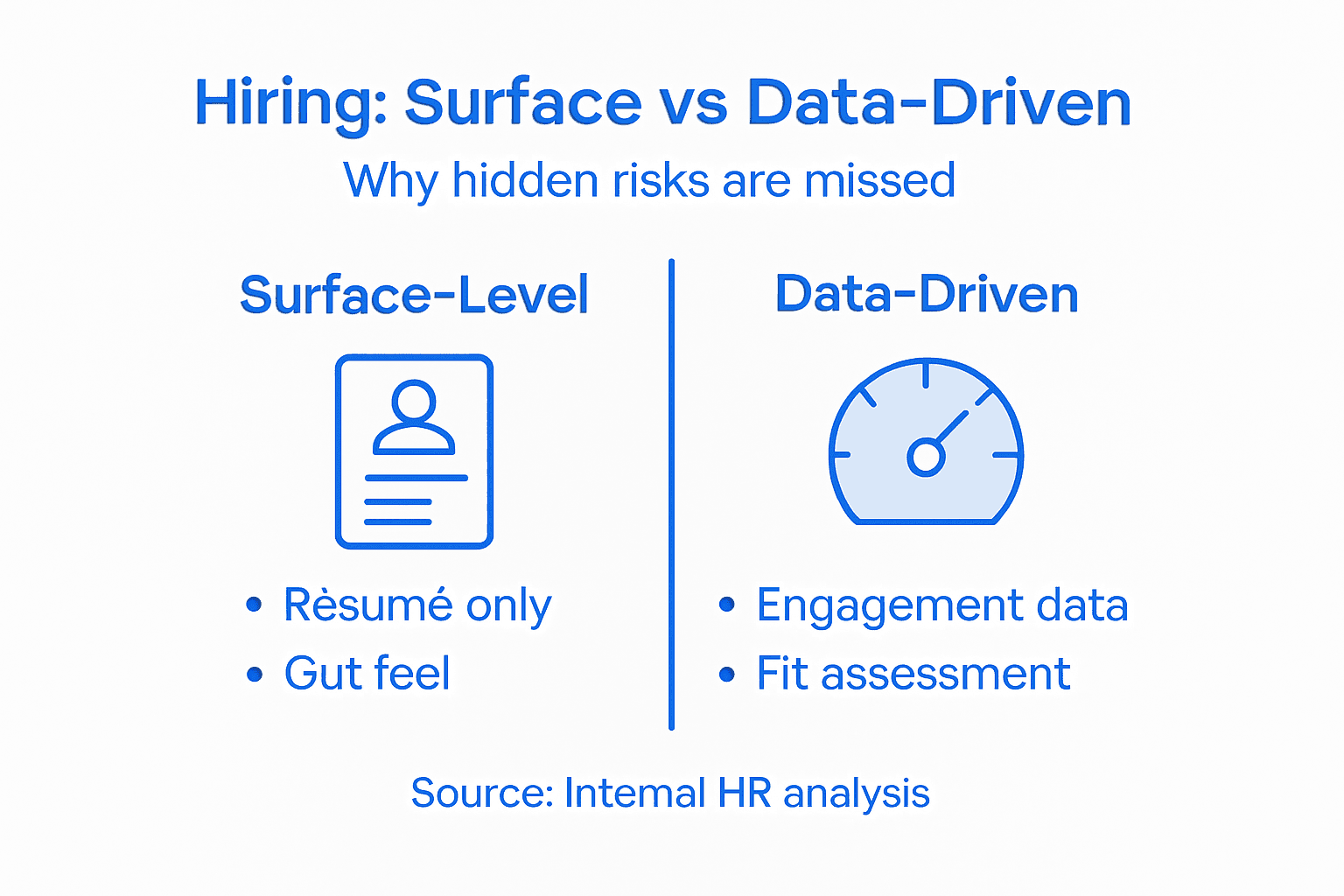
This creates a false confidence. The person interviews well. Their background checks out. So you assume they’ll perform. But interviews are theater. People are good at presenting versions of themselves they think you want to see.
Meanwhile, the actual risks—cultural misalignment, disengagement patterns, poor fit with team dynamics—remain completely invisible until months into employment when the cost of being wrong has already mounted.
You’re making seven-figure decisions based on signals that have minimal predictive validity.
The gap between hiring decisions and their outcomes is where risk hides. By the time poor fit becomes obvious, you’ve invested significantly in onboarding, training, management attention, and lost productivity.
Pro tip: Audit your last five problematic hires and identify what signals were present during the interview process that you overlooked, then redesign your screening to surface those specific red flags earlier.
Quantifiable Insight for Predicting Retention Risk
Gut feel is expensive. When you sense something’s off with an employee but can’t articulate why, you’re operating blind. By the time the problem becomes obvious, months of disengagement and productivity loss have compounded silently.
The shift from intuition to data changes everything. Instead of waiting for behavioral red flags to become glaring, you can identify retention risk before it becomes critical.
Quantifiable insight means moving beyond anecdotes. You’re measuring actual signals—attendance patterns, engagement scores, project participation, communication shifts—that correlate with who stays and who leaves.
What Data Actually Predicts Retention Risk
Not all data matters equally. Effective prediction focuses on signals that correlate with real outcomes:
- Behavioral patterns: Absenteeism changes, meeting participation, response times, collaboration frequency
- Engagement indicators: Survey sentiment, learning participation, project volunteering, peer interactions
- Performance trends: Productivity velocity, work quality consistency, deadline adherence
- Team dynamics: One-on-one frequency with managers, peer feedback sentiment, cross-team collaboration
- External factors: Role changes, compensation movements, market activity for their skill set
When you layer these data types together, you see patterns individual metrics miss. Someone with steady productivity but declining engagement is at risk. Another person with perfect attendance but withdrawn communication is disengaging.
The Power of Predictive Analytics
Advanced analytics don’t predict the future perfectly. They identify which employees statistically resemble those who have left or become disengaged in the past.
Predictive analytics models analyze behavioral indicators and performance data to quantify who’s at risk early, enabling targeted intervention before someone mentally checks out. This shifts your advantage from reactive damage control to proactive retention.
The real power is timing. Early warning systems let you act while the person still engages with their work and cares about the role.
You can’t fix what you can’t see. Quantifiable insight makes the invisible visible.
When you combine multiple data types through predictive analytics, you move from hunches to defensible decisions. You know which five people need manager attention this quarter. You understand which team dynamics need addressing. You can allocate resources where they actually prevent turnover.
This transforms retention from a surprise crisis into a managed outcome.
Pro tip: Start by identifying your last three unexpected departures and reverse-engineer what data signals were present six months prior, then build your first retention risk dashboard around those proven indicators.
Transforming Leadership Decisions With Data
Traditional leadership relies on experience, instinct, and pattern recognition from past situations. You’ve led teams for years. You know talent when you see it. You can feel when something’s off.
But instinct has a shelf life. It fails when situations are novel, when biases creep in undetected, or when the complexity exceeds what one person can hold in their head.
Data-driven leadership embeds analytics into decision-making processes, enabling more informed and transparent choices. It doesn’t replace your judgment. It augments it with evidence.
From Gut Feel to Defensible Decisions
Here’s what changes when data enters your leadership:
- Transparency: You can articulate why you made a decision, not just that it felt right
- Speed: You identify problems faster because data signals emerge before human observation catches them
- Consistency: You apply the same criteria across all hiring and retention decisions, reducing favoritism
- Accountability: Your decisions can be reviewed, audited, and improved over time
- Predictability: You move from reactive crisis management to proactive intervention
The shift from “I think they’re disengaged” to “Here’s the data showing three signals of disengagement” changes everything about how you act.
Building Data Fluency in Your Leadership Team
Data-driven leadership isn’t a solo skill. Leaders equipped with data analytical skills and the ability to interpret data can drive strategic initiatives more successfully.
This means your managers need to understand what the data means, not just accept it blindly. They need to ask smart questions about the signals they’re seeing.
When a manager sees that an employee’s engagement score dropped 23 points in two months, they know to have a genuine conversation, not assume the worst. When they see meeting participation declining while productivity holds steady, they understand possible context and can respond accordingly.
Data informs decisions. It doesn’t make them for you.
The real power emerges when your entire leadership layer speaks the same language about retention risk, early warning signals, and intervention timing. No more debating whether someone’s actually disengaged. You’re discussing what the evidence shows and how to respond.
This transforms retention from a reactive scramble into a managed, predictable outcome where you catch problems months earlier and have time to address them while people still care.
Pro tip: Train your management team on interpreting three core metrics this quarter—engagement trends, behavioral patterns, and retention risk scores—then hold weekly discussions about at-risk individuals using only data-backed observations.
Gain Clear Visibility Into Hidden Hiring Risks Before They Cost You
Hiring mistakes often stay invisible until costly damage has already built up. This article highlights how disengagement, cultural misalignment, and lack of early warning signs quietly drain productivity and morale before anyone realizes. If you have felt the frustration of elusive retention issues and the gap between hiring decisions and their true impact, you are not alone.
OpenElevator offers a powerful way to turn invisible hiring mistakes into actionable insights. With clear, quantifiable visibility into retention risk, team dynamics, and candidate fit, leaders can stop reacting to turnover after the fact and instead intervene early when it matters most. This goes beyond intuition and surface credentials to surface the behavioral patterns and engagement signals critical for long-term success.
Start your journey to data-driven leadership and prevent hiring mistakes from becoming expensive surprises. Discover how to confidently identify early signs of disengagement and hire better by visiting OpenElevator. For a deeper understanding of how to transform your leadership decisions with data, explore our landing page and experience the insight that changes everything.
Don’t wait until turnover disrupts your team and drains resources. Take control of hidden risks now with OpenElevator and make hiring and retention decisions that truly stick. Visit OpenElevator today and lead with clarity and confidence.
Frequently Asked Questions
What are invisible hiring mistakes?
Invisible hiring mistakes are subtle misalignments that only surface months into employment, often leading to significant productivity loss without immediate identification.
How can I identify early warning signs of employee disengagement?
Early warning signs of disengagement include increased absenteeism, withdrawn participation in meetings, declining initiative, negative attitude shifts, and dips in productivity.
What are the financial costs of a hiring mistake?
The financial costs of a hiring mistake extend beyond salary and include lost productivity, managerial time spent addressing performance issues, decreased team morale, and costs related to replacement hiring and training.
Why do traditional hiring tools fail to catch hidden risks?
Traditional hiring tools focus on surface credentials and past experiences, which often overlook the essential factors like cultural fit, engagement potential, and adaptability needed for long-term success.