
Over half of American employees say they would consider leaving their jobs if their core needs are not met. Retaining top talent is now more complicated than ever with workplace expectations constantly shifting. Companies looking for results cannot rely on generic answers or surface-level perks. This practical guide explores proven approaches that help organizations truly connect with their teams and create a culture where every American worker feels valued and motivated to stay.
Table of Contents
- 1. Assess Employee Needs for Retention Success
- 2. Use Data to Identify High-Risk Employees
- 3. Ensure Values Alignment Across Teams
- 4. Foster Interpersonal Fit Between Employees
- 5. Deliver Targeted Solutions for At-Risk Employees
- 6. Promote Employee Growth and Career Pathways
- 7. Monitor Progress and Refine Retention Strategies
Quick Summary
| Takeaway | Explanation |
|---|---|
| 1. Understand Employee Motivations | Conduct personalized assessments to grasp individual aspirations and motivations for better retention strategies. |
| 2. Use Data for Predictive Insights | Analyze employee data to identify high-risk individuals and anticipate turnover, allowing for proactive interventions. |
| 3. Align Values for Engagement | Ensure that personal and organizational values resonate to enhance workplace culture and employee commitment. |
| 4. Foster Meaningful Interpersonal Connections | Build strong workplace relationships to improve job satisfaction and reduce turnover rates among employees. |
| 5. Implement Continuous Feedback Mechanisms | Establish ongoing check-ins to adapt and refine retention strategies based on real-time employee feedback. |
1. Assess Employee Needs for Retention Success
Successful employee retention starts with understanding what truly motivates your workforce. Forget generic surveys and annual check-ins. Modern organizations must dive deep into the core needs that drive employee engagement and satisfaction.
Research reveals that employee motivation goes far beyond simple financial incentives. Comprehensive employee motivation studies demonstrate that workers prioritize multiple factors including career development, workplace atmosphere, and interpersonal relationships. These elements create a holistic framework for understanding retention challenges.
Key Needs Assessment Strategies:
- Individual Motivation Mapping: Conduct personalized interviews to understand each employee’s unique professional aspirations and personal motivations.
- Psychological Safety Evaluation: Create environments where employees feel comfortable sharing honest feedback without fear of repercussions.
- Systematic Engagement Tracking: Implement regular pulse surveys that measure emotional and professional satisfaction across different organizational levels.
The most successful retention strategies recognize that employee needs are nuanced and dynamic. What motivates a junior team member might differ dramatically from an experienced senior professional. By treating each employee as an individual with distinct aspirations, you transform retention from a reactive process to a proactive talent development strategy.
Practically speaking, this means moving beyond traditional performance reviews. Instead, develop ongoing dialogue mechanisms that continuously assess and respond to emerging employee needs. Targeted retention solutions can help organizations create personalized engagement approaches that significantly reduce turnover risks.
Remember. Not all employees want the same things. Your job is to listen. Understand. Adapt.
2. Use Data to Identify High-Risk Employees
Employees are not static resources. They are dynamic individuals whose likelihood of leaving can be predicted with remarkable accuracy through intelligent data analysis. Modern organizations are transforming retention strategies by leveraging machine learning techniques that reveal hidden turnover risks.
Advanced predictive analytics have revolutionized how companies understand workforce dynamics. By analyzing multiple data points, organizations can now anticipate potential employee departures before they happen.
Key Data Points for Turnover Prediction:
- Work history and tenure
- Current compensation levels
- Job position and career trajectory
- Training and professional development opportunities
- Age and professional stage
- Workplace engagement metrics
Predictive Modeling Strategies:
The systematic review of machine learning techniques highlights that random forest algorithms are particularly effective in identifying turnover risks. These sophisticated models can process complex interactions between various employee characteristics more accurately than traditional statistical methods.
Implementing a data driven retention approach means moving beyond gut feelings and anecdotal observations. You need systematic processes that transform raw employee information into actionable insights. This requires collecting comprehensive data through regular surveys, performance reviews, and engagement tracking.
Practically speaking, start by establishing a baseline dataset that captures multiple dimensions of employee experience. Look for patterns of disengagement, stagnation, or reduced productivity that might signal potential flight risks.
The goal is not surveillance. It is understanding. Compassionate, intelligent workforce management that respects individual potential while protecting organizational stability.
3. Ensure Values Alignment Across Teams
Successful organizations understand that employee retention is not just about compensation but about creating a workplace where individual values resonate with the broader organizational culture. Job embeddedness research reveals that employees are more likely to stay when their personal and professional values align with their workplace environment.
The concept of values alignment goes beyond superficial mission statements. It is about creating a genuine connection between what employees believe and what the organization represents. The Job Demands-Resources model suggests that when organizational resources and employee expectations are synchronized, motivation and engagement naturally increase.
Key Strategies for Values Alignment:
- Transparent Communication: Clearly articulate organizational values during recruitment and onboarding
- Cultural Assessment: Regularly evaluate how well current practices reflect stated organizational principles
- Individual Value Mapping: Conduct one-on-one conversations to understand each employee’s core professional motivations
- Adaptive Leadership: Train managers to recognize and support diverse value systems within teams
Practical implementation means moving beyond generic corporate rhetoric. It requires creating spaces where employees can authentically express their professional aspirations and see how those connect with broader organizational goals.
Think of values alignment like a complex musical ensemble. Each team member brings a unique instrument and perspective. The magic happens when these different sounds harmonize into a compelling collective performance. Your job as a leader is to be the conductor who helps these diverse talents create something extraordinary together.
Remember. Values are not static. They evolve. Your retention strategy must be flexible enough to grow with your team.
4. Foster Interpersonal Fit Between Employees
Workplace relationships are not just social niceties. They are critical infrastructure that determines organizational health and employee retention. Affective Events Theory demonstrates that positive interpersonal interactions directly influence job satisfaction and performance.
Most leaders underestimate the power of human connection. Job embeddedness research reveals that strong interpersonal links make employees significantly less likely to leave an organization. It is not just about individual skills but how those skills harmonize within a team.
Strategic Interpersonal Alignment Techniques:
- Personality Mapping: Use validated assessment tools to understand team dynamics
- Collaborative Problem Solving: Design cross functional projects that require genuine teamwork
- Structured Social Interactions: Create intentional opportunities for meaningful connections beyond work tasks
- Psychological Safety Training: Teach teams how to communicate authentically and respectfully
Think of your workforce like an orchestra. Individual musicians might be talented. But true magic happens when they learn to play together. Some team members are violins. Others are percussion. Your job is to help them create music that sounds remarkable.
Implementation means moving beyond superficial team building. You are crafting an environment where professionals do not just work together. They genuinely understand and appreciate each other.
Remember. Connection is not a luxury. It is the fundamental currency of human potential.
5. Deliver Targeted Solutions for At-Risk Employees
Generic retention strategies are dead. Modern organizations need precision interventions that address individual employee risks with surgical accuracy. Machine learning research demonstrates that targeted solutions can dramatically reduce turnover by understanding unique employee challenges.
Key Components of Personalized Retention Strategies:
- Comprehensive Risk Profiling: Analyze multiple data points including work tenure, compensation, job satisfaction, and career trajectory
- Individualized Development Plans: Create custom growth pathways that align with each employee’s professional aspirations
- Proactive Intervention Mechanisms: Design specific support systems before disengagement becomes irreversible
- Continuous Feedback Loops: Implement regular check ins that allow real time adjustments to employee experience
Systematic literature reviews of machine learning techniques reveal that predictive models can identify potential flight risks with remarkable precision. This is not about surveillance. It is about compassionate, intelligent workforce management.
Practical implementation means transforming data into meaningful human experiences. When an employee shows early signs of disengagement. Do not wait. Reach out. Understand. Adapt.
Your goal is not just retention. It is creating an environment where talented professionals choose to grow with your organization. Every intervention is an opportunity to demonstrate that you see them. Understand them. Value them.
Remember. Numbers tell a story. But people live the narrative.
6. Promote Employee Growth and Career Pathways
Career development is not a luxury. It is the oxygen that keeps talented professionals breathing and engaged within your organization. Research on employee motivation reveals that meaningful growth opportunities are critical for sustained workforce commitment.
Most organizations treat career paths like rigid highways. Smart companies understand they are more like dynamic river systems constantly adapting and flowing. Work life policy studies demonstrate that flexible career development directly correlates with enhanced employee well being and organizational loyalty.
Strategic Career Development Approaches:
- Personalized Learning Roadmaps: Design individual growth trajectories matching employee aspirations
- Skill Ecosystem Mapping: Identify internal mobility opportunities across different departments
- Continuous Learning Budgets: Allocate resources for professional development and external certifications
- Mentorship and Sponsorship Programs: Create structured pathways for knowledge transfer and career guidance
Successful implementation means transforming career development from a transactional HR process into an organic cultivation of human potential. Your goal is not just filling roles. It is nurturing extraordinary professional journeys.
Practical wisdom says people do not leave companies. They leave opportunities. By creating a landscape of continuous growth. You make leaving unthinkable.
Remember. A career is not a destination. It is an evolving conversation between potential and opportunity.
7. Monitor Progress and Refine Retention Strategies
Retention is not a one time event. It is a continuous dialogue between organizational strategy and human potential. Machine learning studies on employee attrition demonstrate that successful retention requires constant monitoring and adaptive strategies.
Think of your retention approach like a living organism. It needs regular check ups. Diagnostics. Adjustments. Research on young employee retention reveals that organizations must remain agile and responsive to emerging workforce dynamics.
Continuous Improvement Framework:
- Quarterly Retention Audits: Systematically review turnover metrics and engagement indicators
- Predictive Analytics Integration: Leverage data models to anticipate potential retention challenges
- Feedback Mechanism Design: Create multiple channels for employees to share unfiltered insights
- Experimental Retention Interventions: Test targeted strategies and measure their effectiveness
Successful monitoring is not about surveillance. It is about creating a transparent ecosystem where employee experiences are valued and systematically understood.
Practical wisdom suggests tracking both quantitative metrics (turnover rates) and qualitative signals (team morale. individual satisfaction). Your goal is to transform retention from a reactive process to a proactive cultivation of organizational health.
Remember. The most powerful retention strategy is listening. Truly listening.
This table provides a comprehensive summary of strategies and concepts for effective employee retention as discussed in the article.
| Strategy/Concept | Implementation | Benefits/Outcomes |
|---|---|---|
| Assess Employee Needs | Conduct personalized interviews, psychological safety evaluations, and engagement tracking. | Transforms retention from reactive to proactive. |
| Use Data to Identify High-Risk Employees | Analyze data points such as tenure and engagement using predictive analytics. | Anticipates potential departures and reduces turnover. |
| Ensure Values Alignment | Implement transparent communication, cultural assessments, and adaptive leadership. | Increases motivation and engagement. |
| Foster Interpersonal Fit | Utilize personality mapping, collaborative problem solving, and structured interactions. | Enhances job satisfaction and reduces turnover. |
| Deliver Targeted Solutions | Develop individualized development plans and proactive interventions based on risk profiling. | Significantly reduces turnover risks. |
| Promote Employee Growth | Create personalized learning roadmaps and mentorship programs. | Sustains workforce commitment through continuous growth. |
| Monitor Progress and Refine | Conduct quarterly audits and integrate predictive analytics for retention strategy adjustments. | Cultivates organizational health with proactive adjustments. |
Unlock the Power of Targeted Retention Strategies Today
Employee turnover is a complex challenge that demands more than one-size-fits-all solutions. This article highlights how addressing values alignment, interpersonal fit, and risk prediction are crucial to reducing turnover and fostering lasting engagement. If you want to move beyond guessing who might leave and start making data-driven decisions that protect your talent, OpenElevator is the solution crafted for you.
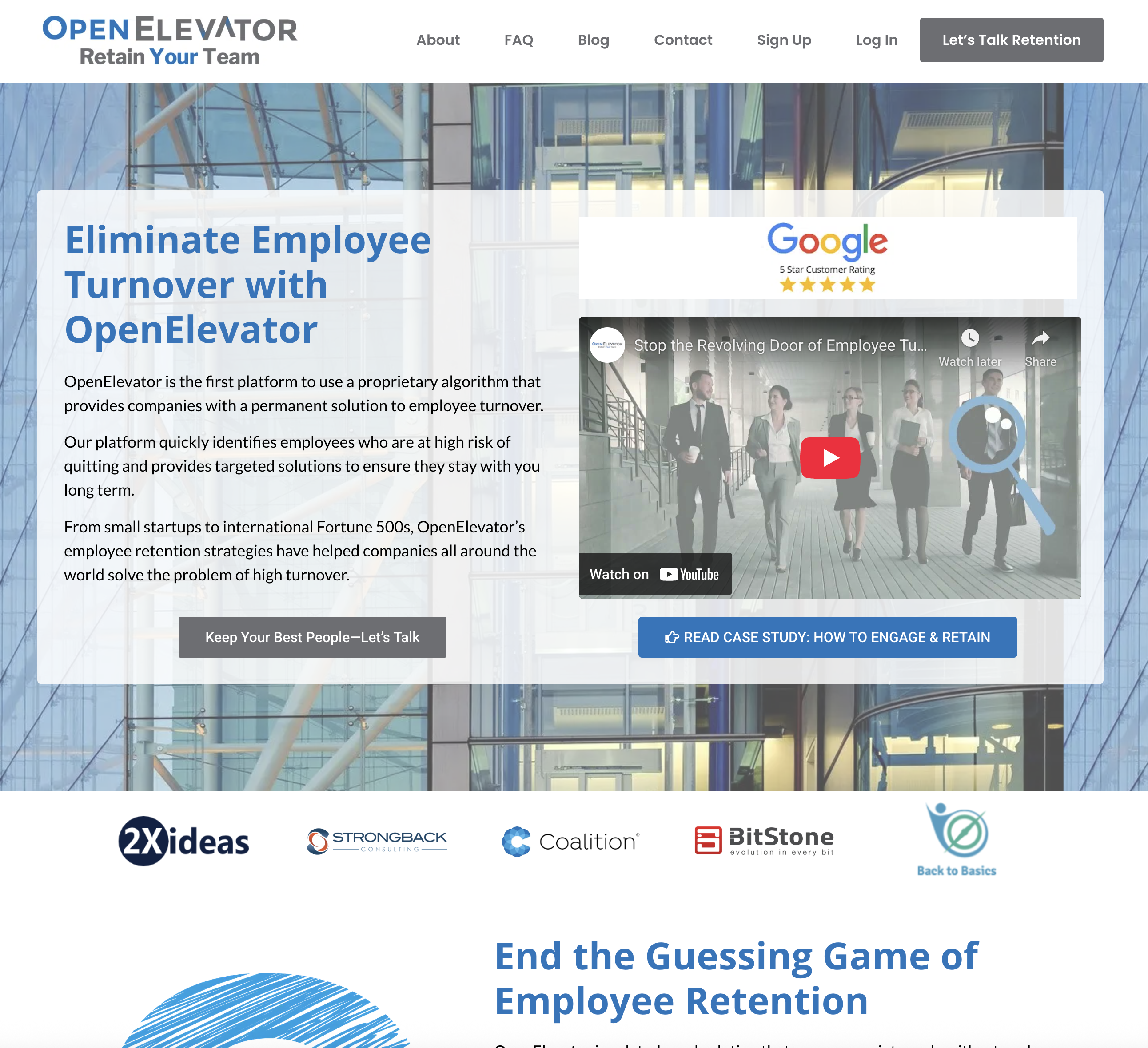
OpenElevator uses a proprietary algorithm to quickly identify employees at high risk of quitting by measuring key factors like values alignment and interpersonal collaboration through a simple five-minute bias-free survey. Our platform empowers leaders with actionable insights to tailor retention efforts and promote career growth effectively. Don’t wait until your top performers consider leaving. Visit OpenElevator now to experience how precision retention strategies can transform your workforce stability and create a culture where employees choose to stay and thrive.
Explore how you can take control of turnover with targeted retention solutions and join the growing community of companies worldwide solving employee turnover the smart way.
Frequently Asked Questions
What are the key steps to reduce employee turnover?
Successful turnover reduction involves assessing employee needs, using data for predictions, ensuring values alignment, fostering interpersonal fit, delivering targeted solutions, promoting employee growth, and continuously monitoring progress. Start by conducting individual motivation assessments within the first month to identify core drivers of engagement.
How can I identify high-risk employees for turnover?
Utilize predictive analytics to analyze employee data points such as work history, engagement metrics, and job satisfaction levels. Set up regular data tracking to identify potential flight risks and take proactive steps, like engaging in one-on-one conversations, within 30 days.
What strategies can I implement for values alignment in my organization?
Focus on transparent communication of organizational values during recruitment and onboarding, and regularly evaluate how current practices reflect those values. Implement a check-in process every quarter to assess alignment and adapt your communication accordingly.
How can I foster better interpersonal relationships among team members?
Create structured social interactions and encourage team-building activities that promote meaningful connections beyond work tasks. Organize at least one team bonding activity every quarter to strengthen relationships and enhance collaboration.
What should I include in personalized development plans for at-risk employees?
In personalized development plans, include individual growth paths that align with employee aspirations and provide opportunities for skill development. Ensure that these plans are updated every six months to keep them relevant and supportive of employee goals.
How do I monitor the effectiveness of my retention strategies?
Systematically conduct quarterly retention audits to review turnover metrics and gather employee feedback. Use this information to make informed adjustments, ensuring your approach remains adaptive and responsive to employee needs.