Most leaders have felt it: something is off inside the team, but they cannot prove it yet.
A strong employee seems quieter. A team feels less connected. A manager says everything is fine, but the energy has shifted. Work is still getting done, so there is no obvious crisis.
That is exactly where retention risk hides.
By the time someone resigns, the signs often make sense in hindsight. They had pulled back, stopped offering ideas, seemed less invested, or no longer talked about their future inside the company.
The problem is not that leaders lack instinct. The problem is that instinct alone does not create enough visibility to act with confidence.
This guide explains what to do when you sense something is off but cannot prove it yet, including which signals to watch, how to validate them, how to intervene without overreacting, and how better visibility helps leaders reduce avoidable turnover.
Table of Contents
Key Takeaways
| Point | Details |
|---|---|
| Gut instinct is a signal, not proof | Leaders should treat concern as a reason to look deeper, not as a final conclusion. |
| Disengagement often starts quietly | Employees may keep performing while becoming less connected or committed. |
| Multiple signals matter | One behavior may mean little, but patterns across communication, energy, alignment, and participation matter. |
| Intervention should be targeted | Leaders need to understand the source of risk before acting. |
| Visibility improves confidence | Better data helps leaders move from guessing to knowing where support may be needed. |
Prerequisites: What You Need Before You Start
Before leaders can act on hidden retention risk, they need a better way to separate instinct from evidence.
A vague feeling that “something is off” is not enough. It may be accurate, but it may also be incomplete. Leaders need signals that help them understand whether the issue is disengagement, manager friction, team tension, workload pressure, values misalignment, or something else.
Before you start, make sure you have:
– A regular rhythm of manager check-ins
– A way for employees to share honest feedback
– Visibility into manager-employee alignment
– Visibility into team friction
– Clear role expectations
– Some view of employee growth goals
– A way to track changes in engagement or participation
– Leadership willingness to act on what is found
The goal is not to create surveillance. The goal is to create earlier visibility.
Leaders should not wait until an employee says, “I am leaving,” to understand that risk has been building. They need a way to see patterns while there is still time to respond.
If you cannot yet measure the risk, start by asking better questions and looking for repeated signals.
Understanding Early Warning Signs of Disengagement
Disengagement does not always look dramatic.
A disengaged employee may still be polite, productive, and responsive. They may still attend meetings and complete work. That is why leaders often miss the early signs.
The shift may be subtle.
Early warning signs can include:
– Less participation in meetings
– Lower initiative
– Shorter or less thoughtful communication
– Reduced interest in growth opportunities
– Less connection with the manager or team
– More visible frustration
– Increased absenteeism
– Less willingness to collaborate
– Pulling back from long-term planning
– Avoiding optional team conversations
One signal by itself may not mean much.
A person may be quiet because they are busy, tired, or focused. The risk becomes more meaningful when several signals appear together or continue over time.
A realistic scenario: a high performer is still delivering work, but they stop volunteering ideas, avoid future-focused conversations, and seem less connected to the team. The manager assumes they are busy. In reality, the employee may already be questioning whether they still belong.
The most dangerous mistake is waiting until performance drops.
Performance can stay acceptable while commitment is already weakening.

Tools and Methods to Gain Clear Visibility
Leaders need more than gut instinct.
Instinct can tell you where to look. It cannot always tell you what is really happening or what to do next.
Better visibility comes from combining several inputs:
– Manager conversations
– Employee feedback
– Engagement signals
– Team dynamics
– Role clarity
– Growth path visibility
– Workload pressure
– Values alignment
– Interpersonal alignment
– Changes in behavior over time
Do not rely on one source.
Manager impressions can be biased. Engagement surveys can hide individual risk. Performance reviews can miss declining commitment. Exit interviews arrive too late.
A stronger visibility system helps leaders answer:
– Who may be quietly disengaging?
– Where is manager friction affecting commitment?
– Where is team tension building?
– Which employees feel blocked from growth?
– Which roles or teams carry hidden risk?
– What support may be needed before resignation happens?
Technology can help, but only if it produces actionable insight.
The goal is not more dashboards. The goal is clearer decisions.
| Visibility Method | What It Can Reveal | Limitation |
|---|---|---|
| Manager check-ins | Direct employee concerns | Employees may withhold the real issue |
| Engagement surveys | Broad sentiment patterns | Averages can hide individual risk |
| Performance reviews | Output and goals | Performance can stay steady while commitment drops |
| Anonymous feedback | Hidden frustrations | Feedback may lack context |
| Team scan data | Alignment, friction, and risk patterns | Leaders still need to act on the signal |
Step-by-Step Intervention Strategy for Executives
When something feels off, do not ignore it. But do not overreact either.
Use a structured approach.
Step 1: Validate the pattern
Look for more than one signal. Has participation dropped? Has communication changed? Is the employee less connected? Is there manager friction, workload pressure, or growth frustration?
Step 2: Ask better questions
Avoid vague questions like “Is everything okay?” They usually produce vague answers.
Ask:
– What feels harder than it should right now?
– Where do you feel blocked?
– What support would make your work more sustainable?
– What part of your role feels most aligned?
– What part feels least aligned?
– Is anything making you less likely to see a future here?
Step 3: Listen for the root cause
The first answer may not be the real issue. Stress may point to unclear priorities. Low energy may point to lack of growth. Frustration may point to manager misalignment or team friction.
Step 4: Take targeted action
Do not use a generic retention fix. If the issue is growth, create a growth path. If the issue is workload, adjust priorities. If the issue is manager friction, address alignment.
Step 5: Follow up
One conversation does not solve retention risk. Check whether clarity, trust, connection, or engagement improved.
The point is not to prove the employee is at risk.
The point is to understand whether support is needed before the risk becomes a resignation.
Common Mistakes and How to Avoid Them
Leaders often mishandle early retention risk in predictable ways.
The first mistake is ignoring instinct because there is no hard proof.
If something feels off, it may be a signal worth investigating. Waiting for proof often means waiting until the employee is already disengaged or leaving.
The second mistake is acting on instinct alone.
A leader may assume the issue is compensation, burnout, or attitude without understanding the real cause. That leads to the wrong intervention.
The third mistake is asking vague questions.
“How are things going?” is too easy to answer with “fine.” Leaders need questions that reveal friction, alignment, and future commitment.
The fourth mistake is treating every risk the same.
Different employees leave for different reasons. A generic retention program will miss the specific issue.
The fifth mistake is waiting for exit interviews.
Exit interviews explain what went wrong after the company has already lost the employee.
Avoid these mistakes by:
– Looking for patterns, not isolated moments
– Asking specific questions
– Separating symptoms from root causes
– Acting on the issue that actually matters
– Following up after intervention
– Using data to strengthen leadership judgment
The absence of proof does not mean the absence of risk. It may mean leaders do not yet have enough visibility.
Expected Outcomes and Measurable Benchmarks
The goal of early visibility is not to eliminate all turnover.
Some turnover is normal. Some may even be healthy. The goal is to reduce avoidable loss of strong employees by seeing risk earlier.
Leaders should measure whether their visibility efforts improve:
– Retention of strong employees
– Manager-employee alignment
– Team stability
– Employee participation
– Role clarity
– Growth path visibility
– Workload sustainability
– Follow-through on feedback
– New hire retention
– Reduction in surprise resignations
The best benchmark is not just a lower turnover rate.
Turnover rate is a lagging indicator. It tells leaders what already happened.
Better benchmarks include:
– Are leaders identifying risk earlier?
– Are managers having better conversations?
– Are employees raising concerns sooner?
– Are teams showing less hidden friction?
– Are high-value employees staying longer?
– Are interventions happening before resignation?
A company that improves visibility should see fewer “surprise” resignations over time.
That is the real win.
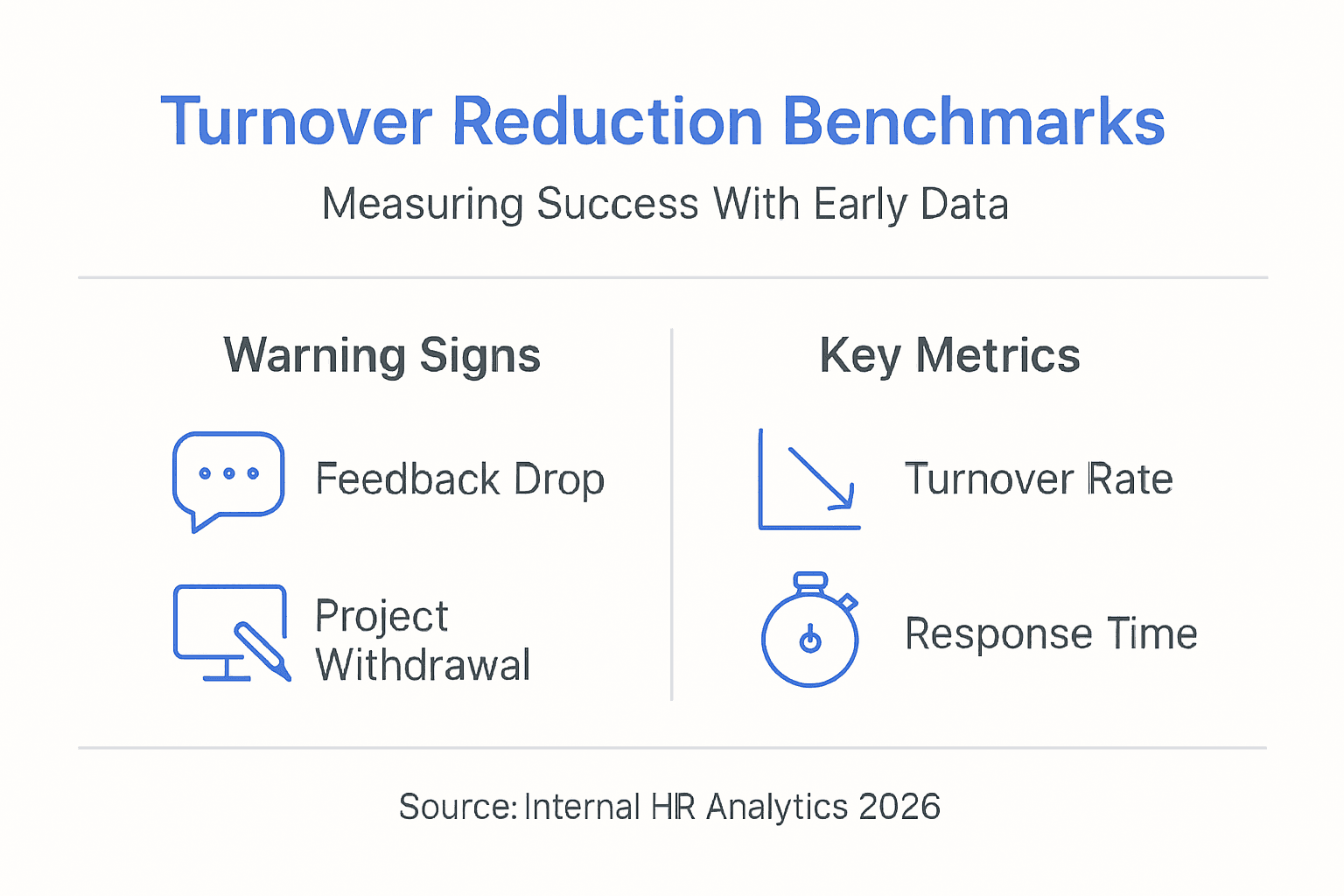
Key performance indicators to track:
| Metric | What It Shows | Why It Matters |
|---|---|---|
| Surprise resignations | Whether leaders saw risk too late | Fewer surprises mean better visibility |
| Manager-employee alignment | Quality of the daily employee experience | Poor alignment often drives disengagement |
| Team friction | Hidden tension inside teams | Friction can weaken commitment before performance drops |
| Growth path clarity | Whether employees see a future | Lack of growth can push strong people out |
| Retention of strong employees | Whether the company keeps people it values | This is more useful than turnover rate alone |
See What Is Off Before It Becomes Turnover
If you sense something is off but cannot prove it yet, do not wait for resignation to confirm the risk.
A team can look stable while disengagement, manager-employee misalignment, values disconnect, or hidden friction is already building beneath the surface. By the time someone leaves, the company is already reacting.
OpenElevator helps CEOs, founders, senior leaders, and managers detect retention risk, team misalignment, and hidden friction before they become costly resignations. The platform uses a short, bias-free team scan and a proprietary algorithm to reveal where leaders may need to act earlier.
Start with a free team scan for up to 10 team members and see what may be hidden inside your own team.

Frequently Asked Questions
What should I do when I sense something is off with an employee?
Do not ignore it, but do not jump to conclusions. Look for patterns, ask specific questions, and try to understand whether the issue is manager friction, workload pressure, lack of growth, values misalignment, or declining connection.
What are early signs of employee disengagement?
Early signs can include reduced participation, lower initiative, shorter communication, less interest in growth, more frustration, increased absenteeism, and weaker connection with the manager or team.
Why is gut instinct not enough for retention?
Gut instinct can tell leaders where to look, but it does not always reveal the root cause. Leaders need better visibility into engagement, alignment, friction, workload, and growth concerns.
How can leaders validate retention risk before someone resigns?
Leaders can validate risk by looking for repeated patterns across behavior, feedback, manager alignment, team dynamics, role clarity, and growth conversations.
What questions should managers ask when something feels off?
Managers should ask what feels harder than it should, where the employee feels blocked, what support would help, what feels most and least aligned, and whether anything is making them less likely to see a future with the company.
Why are exit interviews too late?
Exit interviews happen after the employee has already decided to leave. They may explain the loss, but they rarely give leaders the chance to prevent it.
How does OpenElevator help leaders spot hidden risk?
OpenElevator helps leaders detect retention risk, team misalignment, and hidden friction before they become costly resignations. It gives CEOs, founders, senior leaders, and managers clearer visibility into where they may need to act earlier.
Is there a free way to try OpenElevator?
Yes. OpenElevator offers a free team scan for up to 10 team members so leaders can see retention risk, alignment gaps, and hidden friction inside their own team.