
Over half of American companies report that employee retention costs impact their bottom line each year. High turnover drains resources, disrupts team morale, and stalls growth in organizations of every size. Knowing how to assess risks, pinpoint value alignment, and implement real retention solutions makes all the difference. With the right data and continuous monitoring, any American business can strengthen its workforce and reduce the cycle of costly departures for good.
Table of Contents
- Step 1: Assess Turnover Risks With Reliable Data
- Step 2: Identify Value And Interpersonal Alignment
- Step 3: Implement Targeted Retention Solutions
- Step 4: Monitor Engagement And Adjust Strategies
- Step 5: Verify Retention Improvements Continuously
Quick Summary
| Key Point | Explanation |
|---|---|
| 1. Assess turnover risks using comprehensive data | Gather quantitative and qualitative workforce data to identify potential employee departure indicators and trends effectively. |
| 2. Ensure value alignment between employees and organization | Map employee priorities with organizational values to enhance trust and engagement, addressing any misalignments early. |
| 3. Implement personalized retention strategies | Develop tailored interventions based on unique employee motivations like career growth and workplace flexibility to improve retention. |
| 4. Continuously monitor employee engagement | Establish an ongoing feedback system to track employee satisfaction and address issues proactively to prevent turnover. |
| 5. Regularly verify and refine retention efforts | Use systematic evaluation tools to assess the effectiveness of retention strategies and adjust them based on evolving workforce dynamics. |
Step 1: Assess Turnover Risks with Reliable Data
Assessing turnover risks demands a strategic approach grounded in comprehensive data analysis. In this critical stage, you will transform raw workforce information into actionable insights that predict potential employee departures.
Starting with workforce data collection requires methodical precision. Begin by gathering quantitative metrics such as resignation rates, tenure lengths, performance evaluations, and department specific turnover statistics. Research indicates significant correlations between occupational stress and actual employee turnover, underscoring the importance of capturing nuanced workforce indicators beyond simple resignation numbers.
The most effective risk assessment involves triangulating multiple data sources. Implement anonymous employee surveys, conduct exit interviews, track internal mobility patterns, and analyze compensation benchmarks. Pay special attention to departments with historically higher turnover rates or teams experiencing leadership transitions. Create visualization dashboards that highlight potential risk zones and emerging patterns. Remember that data interpretation requires context raw numbers alone cannot provide insight into complex human motivation.
Warning: Avoid making hasty conclusions based on isolated data points. Employee retention is a multifaceted challenge requiring holistic understanding of workplace dynamics, individual employee experiences, and organizational culture.
Step 2: Identify Value and Interpersonal Alignment
Understanding employee retention requires more than traditional metrics. In this crucial step, you will explore the deeper psychological connections that determine whether an employee feels genuinely aligned with your organization.
Shared ethical values between leaders and employees can significantly enhance mutual trust and organizational identification, creating a foundational framework for long term engagement. Start by mapping individual employee priorities against organizational core values. This involves conducting comprehensive alignment assessments that go beyond surface level discussions. Develop structured surveys and one on one conversations that reveal an employee’s fundamental motivations, personal growth expectations, and sense of purpose.

Focus on four key dimensions of alignment: professional goals, personal values, team dynamics, and organizational mission. Create scoring mechanisms that objectively measure how closely an employee’s aspirations match the company’s trajectory. Pay special attention to potential disconnects in expectations around career development, workplace culture, and professional autonomy. Leaders who proactively identify and address these alignment gaps can dramatically reduce turnover risks.
Warning: Value alignment is not about forcing conformity but creating genuine connections. Authentic alignment emerges from mutual understanding and respect, not rigid compliance.
Step 3: Implement Targeted Retention Solutions
Transforming employee retention from a theoretical concept to practical action requires strategic and personalized interventions. In this critical phase, you will design targeted solutions that address individual and collective workforce needs.
Research highlights job satisfaction and organizational commitment as fundamental drivers of employee retention, demanding a nuanced approach to workforce engagement. Begin by categorizing employees into distinct retention risk groups based on your previous alignment assessments. Develop customized intervention strategies that address specific motivational triggers such as professional development opportunities, compensation adjustments, workplace flexibility, and meaningful recognition programs.
Prioritize mental health and holistic well being as core retention strategies. Implement comprehensive support systems that go beyond traditional employee assistance programs. This might include targeted coaching, mentorship initiatives, stress management workshops, and creating pathways for internal career mobility. Pay special attention to high potential employees who may be experiencing early signs of disengagement. Regular check ins, transparent communication channels, and demonstrating genuine investment in their professional growth can dramatically reduce turnover risks.
Warning: Retention solutions are not one size fits all. What motivates one employee might disengage another. Continuous adaptation and personalized approach are key to successful workforce retention.
Step 4: Monitor Engagement and Adjust Strategies
Engagement monitoring transforms retention from a static process to a dynamic, responsive system. In this critical stage, you will develop a proactive approach to understanding and responding to your workforce’s evolving needs.
Ongoing monitoring of adverse working conditions plays a crucial role in predicting and mitigating potential turnover risks, making continuous assessment essential. Implement a comprehensive engagement tracking system that combines quantitative metrics and qualitative feedback. Utilize regular pulse surveys, sentiment analysis tools, one on one check ins, and performance data to create a holistic view of workforce engagement. Develop real time dashboards that highlight emerging patterns in employee satisfaction, stress levels, and potential disengagement indicators.
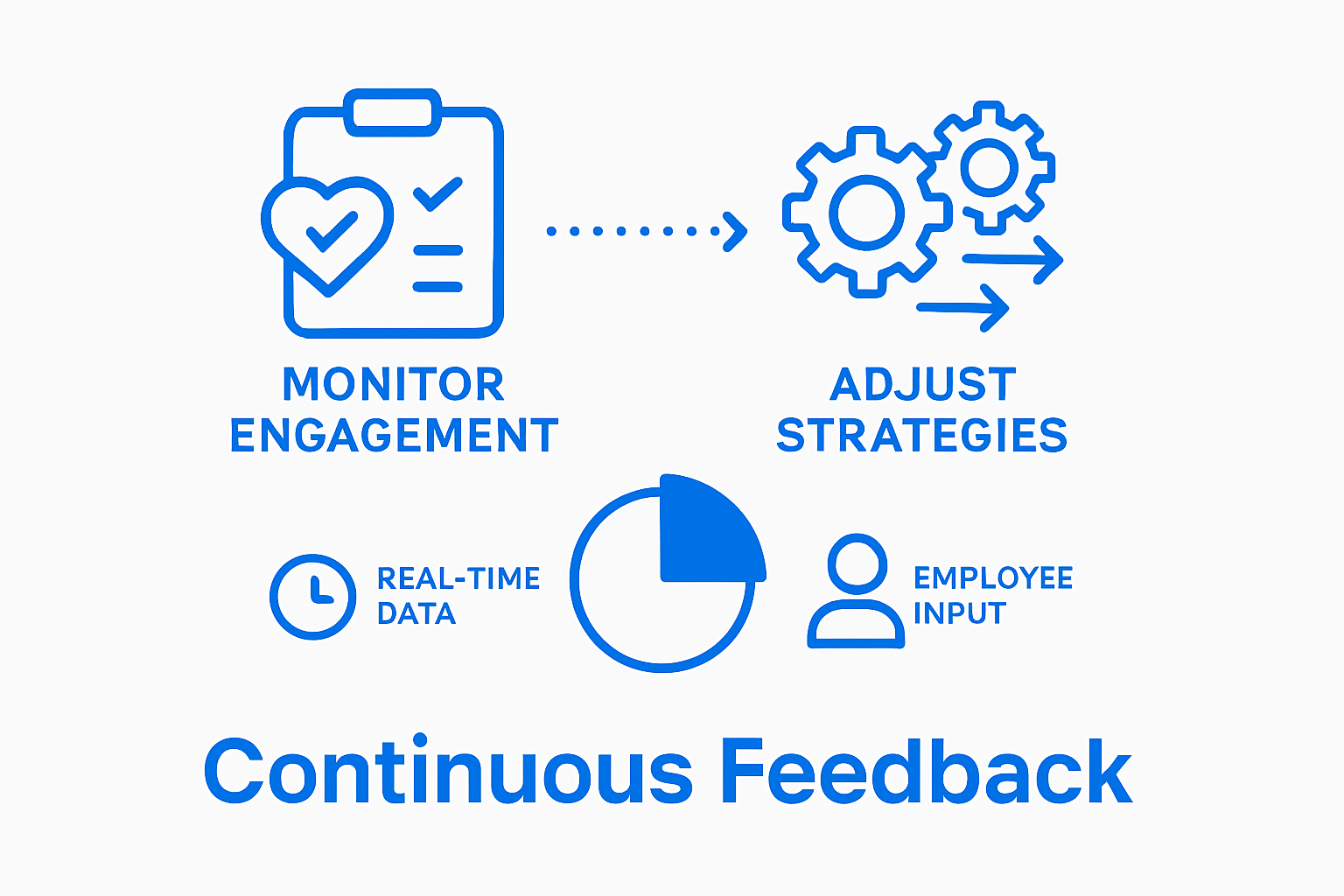
Create a responsive feedback loop that allows for rapid strategy adjustments. This means establishing clear protocols for interpreting engagement data and implementing targeted interventions. Pay special attention to team level dynamics, understanding that engagement challenges often emerge within specific departments or under particular leadership structures. Develop a nimble approach that can quickly address emerging issues before they escalate into full scale retention problems.
Warning: Monitoring is not about surveillance but understanding. Transparency and genuine intent are critical to making employees feel heard and valued throughout the process.
Step 5: Verify Retention Improvements Continuously
Continuous verification transforms retention strategies from static interventions to dynamic, adaptive solutions. In this final stage, you will establish systematic approaches to validate and refine your workforce engagement initiatives.
The development of comprehensive turnover assessment tools enables organizations to precisely measure and track retention improvement efforts, providing actionable insights into workforce dynamics. Implement a multidimensional evaluation framework that goes beyond traditional metrics. This involves creating comparative benchmarks across different organizational levels, tracking longitudinal engagement trends, and establishing clear performance indicators that reflect both quantitative and qualitative aspects of employee retention.
Design a robust verification process that includes regular comprehensive reviews, cross functional feedback mechanisms, and data driven performance assessments. Integrate advanced analytics that can predict potential future retention challenges before they manifest. Pay special attention to tracking the effectiveness of your previously implemented interventions, understanding that successful retention requires constant refinement and a willingness to pivot strategies based on emerging workforce insights.
Warning: Verification is not about finding fault but discovering opportunities. Approach continuous improvement with curiosity and an open mind, recognizing that workforce dynamics are complex and ever evolving.
Strengthen Your Employee Retention Strategy with Data-Driven Insights
Employee turnover remains one of the most complex challenges for organizations seeking lasting success. This article highlights the crucial steps of assessing turnover risks, identifying value and interpersonal alignment, and implementing targeted retention strategies. If you struggle with understanding which employees are at risk or how deeply aligned your team is with your company values, you are not alone. Many leaders face difficulty turning raw workforce data into meaningful actions that improve engagement and reduce costly departures.
OpenElevator offers a proven solution that directly addresses these challenges. Our platform uses a proprietary algorithm to measure values alignment and interpersonal alignment through a simple five-minute, bias-free survey. This powerful insight reveals exactly who is at risk of quitting, who is engaged, and how team dynamics influence overall productivity. With OpenElevator, you no longer have to guess or rely on incomplete data when making retention decisions.
Discover how businesses from startups to Fortune 500 companies are turning retention challenges into competitive advantages with OpenElevator’s employee retention platform.
Take the first step toward a workforce that stays and thrives. Visit OpenElevator today to learn how you can quickly identify turnover risks and implement customized strategies that work. Don’t wait until your best talent walks away—find the truth behind employee engagement and transform your retention approach now.
Frequently Asked Questions
How can I assess turnover risks in my organization?
To assess turnover risks, gather workforce data such as resignation rates, tenure lengths, and performance evaluations. Collect data from anonymous employee surveys and exit interviews to identify patterns and potential risk zones.
What should I focus on when identifying employee value and interpersonal alignment?
Focus on understanding how individual employee priorities align with your organization’s core values. Conduct structured surveys and one-on-one conversations to reveal employees’ motivations and professional goals.
What are some targeted retention solutions I can implement?
Implement customized intervention strategies based on your retention risk groups. Prioritize mental health support, professional development opportunities, and meaningful recognition programs that cater to individual employee needs.
How do I monitor employee engagement effectively?
To monitor employee engagement, utilize regular pulse surveys, sentiment analysis, and performance data. Create real-time dashboards to track satisfaction and disengagement indicators, allowing for quick adjustments to your strategies.
How can I verify the effectiveness of my retention improvements?
Establish a systematic approach to evaluate your workforce engagement initiatives by tracking retention metrics and gathering cross-functional feedback. Conduct regular reviews to fine-tune your strategies and ensure they adapt to evolving workforce dynamics.
What should I avoid when assessing employee retention?
Avoid jumping to conclusions based solely on isolated data points and do not enforce conformity among employees. Focus on building genuine connections and understanding the complex motivations behind employee experiences.