
Every year, more than 40 million american workers either join or leave their jobs, revealing just how much turnover shapes the workforce. Understanding why employees leave a company—and how often this happens—can make or break an organization’s stability and growth. If you want to know what employee turnover really means in the american job market and how its rates affect your business or career, this guide delivers the clear answers you need.
Table of Contents
- Defining Employee Turnover Rates in The U.S.
- Types of Employee Turnover and Key Differences
- How to Measure and Interpret Turnover Rates
- Impacts of High Turnover on Organizations
- Proven Strategies to Reduce Employee Turnover
Key Takeaways
| Point | Details |
|---|---|
| Understanding Turnover Rates | Employee turnover rates measure the percentage of staff who leave an organization, which can be voluntary or involuntary, providing insights into workforce dynamics. |
| Types of Turnover | Distinguishing between voluntary and involuntary turnover helps organizations craft targeted retention strategies that address different workforce challenges. |
| Impacts of High Turnover | High turnover incurs significant costs and operational disruptions, including increased recruitment expenses and loss of institutional knowledge. |
| Strategies to Reduce Turnover | Implementing competitive compensation, fostering a positive workplace culture, and providing career development opportunities are vital for retaining talent. |
Defining Employee Turnover Rates in the U.S.
Employee turnover represents the rate at which workers leave an organization and are replaced by new employees. According to the U.S. Bureau of Labor Statistics, this metric is critical for understanding workforce dynamics and organizational health across different industries.
Turnover rates quantify the percentage of employees who exit a company within a specific timeframe, typically measured annually. These rates can be voluntary (employees choosing to leave) or involuntary (terminations, layoffs), each carrying distinct implications for business performance and workplace culture. The BLS tracks these fluctuations meticulously, providing insights into employment trends nationwide.
In the United States, turnover rates vary significantly across sectors. Industries like hospitality and retail often experience higher turnover compared to more specialized fields such as healthcare and technology. Factors influencing these rates include compensation, workplace environment, career development opportunities, and overall job satisfaction. By understanding these nuanced dynamics, companies can develop targeted strategies to retain top talent and minimize disruption to their operational workflows.
Key Characteristics of Employee Turnover Rates:
- Measured as a percentage of total workforce
- Calculated by dividing number of departures by average total employees
- Reflects organizational health and employee engagement
- Differs across industries and company sizes
Businesses that proactively monitor and address their turnover rates can create more stable, productive work environments that attract and retain skilled professionals.
Types of Employee Turnover and Key Differences
Employee turnover is a complex phenomenon with multiple distinct categories, each carrying unique implications for organizational strategy. The U.S. Bureau of Labor Statistics provides a comprehensive framework for understanding these different types of workforce separations, distinguishing between voluntary and involuntary departures.
Voluntary Turnover represents employees who independently choose to leave their organization. This category includes professionals who resign for career advancement, better compensation, workplace culture misalignment, or personal reasons. Within voluntary turnover, researchers typically identify several subcategories: functional turnover (losing low-performing employees) and dysfunctional turnover (losing high-performing talent). Understanding these nuances helps companies develop targeted retention strategies that address specific workforce dynamics.
Involuntary Turnover encompasses workforce reductions initiated by employers. This includes layoffs due to economic constraints, performance-related terminations, and organizational restructuring. According to BLS data, involuntary separations can significantly impact workplace morale and require careful management to minimize negative organizational consequences. Companies must balance operational efficiency with maintaining employee confidence and engagement.
Key Types of Employee Turnover:
- Functional Voluntary Turnover
- Dysfunctional Voluntary Turnover
- Performance-Related Involuntary Turnover
- Economic Layoff Turnover
- Retirement-Based Turnover
By understanding these employee turnover types, organizations can develop more sophisticated workforce management approaches that proactively address potential talent retention challenges.

How to Measure and Interpret Turnover Rates
Measuring employee turnover requires a systematic approach that goes beyond simple calculations. The U.S. Bureau of Labor Statistics provides a standardized methodology through their Job Openings and Labor Turnover Survey (JOLTS), which offers a comprehensive framework for understanding workforce dynamics.
Turnover Rate Calculation involves dividing the number of employee separations by the average total number of employees during a specific period, typically expressed as a percentage. This metric provides critical insights into workforce stability and organizational health. The BLS recommends tracking both total separations and distinguishing between voluntary quits, layoffs, and discharges to gain a nuanced understanding of workforce trends.
Interpreting turnover rates requires context and careful analysis. Different industries experience varying baseline turnover rates, making benchmarking essential. For instance, retail and hospitality sectors often see higher turnover compared to technology or healthcare fields. Organizations must consider factors such as company size, geographical location, compensation structures, and workplace culture when evaluating their turnover metrics. Employee retention strategies become crucial when turnover rates exceed industry standards.
Key Steps for Measuring Turnover:
- Collect precise employee separation data
- Calculate total number of separations
- Determine average total employees
- Divide separations by average employees
- Multiply result by 100 to get percentage
- Segment turnover by type (voluntary/involuntary)
By implementing a rigorous approach to measuring and interpreting turnover rates, companies can transform workforce data into actionable insights that drive strategic talent management.
Impacts of High Turnover on Organizations
The U.S. Bureau of Labor Statistics reveals that high employee turnover represents a critical challenge with far-reaching consequences for organizational performance and financial stability. Beyond the immediate disruption of losing skilled workers, companies face substantial economic and operational challenges that can undermine long-term strategic objectives.
Financial Consequences of high turnover are profound and multifaceted. Organizations typically spend between 50% to 200% of an employee’s annual salary to recruit, train, and replace them. These costs include direct expenses like recruitment advertising, interviewing, and onboarding, as well as indirect costs such as lost productivity, reduced team morale, and potential workflow interruptions. Smaller businesses are particularly vulnerable, as they often lack the financial cushion to absorb these substantial replacement expenses.
Beyond monetary impacts, high turnover significantly erodes organizational knowledge and institutional memory. When experienced employees depart, they take critical understanding of company processes, client relationships, and nuanced operational insights. This knowledge drain can create competitive disadvantages, especially in industries requiring specialized skills or deep institutional understanding. High-performing teams become destabilized, with remaining employees experiencing increased workload and potential burnout.
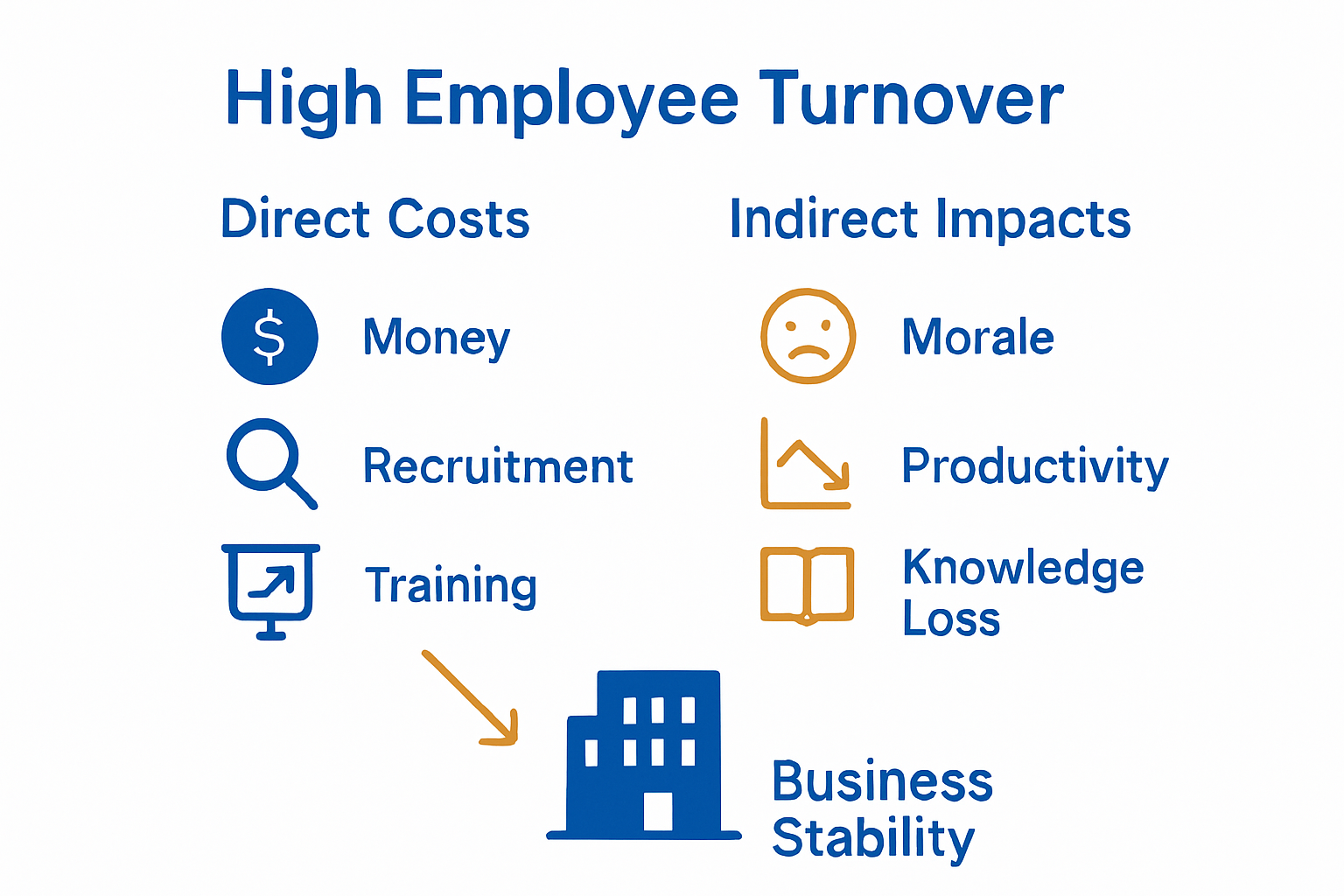
Key Organizational Impacts of High Turnover:
- Increased recruitment and training costs
- Reduced team productivity
- Lower employee morale
- Diminished institutional knowledge
- Potential disruption of strategic initiatives
- Increased stress on remaining employees
Employee retention solutions become critical for organizations seeking to mitigate these comprehensive challenges and build a stable, high-performing workforce.
Proven Strategies to Reduce Employee Turnover
The U.S. Bureau of Labor Statistics highlights that successful organizations implement comprehensive strategies to combat workforce attrition, recognizing that employee retention requires a multifaceted approach beyond simple monetary incentives.
Compensation and Benefits represent the foundational layer of employee retention. Companies must develop competitive salary structures that not only match market rates but also include comprehensive benefits packages. This goes beyond traditional health insurance and retirement plans. Innovative organizations are now offering flexible work arrangements, professional development opportunities, mental health support, and personalized wellness programs that demonstrate genuine investment in employee well-being and career growth.
Cultural transformation emerges as a critical strategy for reducing turnover. Creating an environment of psychological safety, transparent communication, and meaningful recognition can dramatically improve employee engagement. Leaders must focus on developing management practices that prioritize regular feedback, create clear career progression pathways, and foster a sense of belonging. This approach requires consistent effort to build trust, acknowledge individual contributions, and create workplace cultures where employees feel valued and understood.
Key Strategies for Reducing Turnover:
- Implement competitive compensation packages
- Develop robust professional development programs
- Create transparent communication channels
- Offer flexible work arrangements
- Provide meaningful recognition
- Build clear career progression pathways
Employee retention solutions can help organizations systematically address workforce challenges and create environments where top talent chooses to thrive long-term.
Stop Employee Turnover Before It Starts
Employee turnover can drain your resources and disrupt your team’s momentum. This article explains the critical challenges of understanding turnover types and measuring rates. Many organizations struggle with pinpointing which employees are at risk and how to effectively stop the costly cycle of losing top talent. If your goal is to reduce voluntary and involuntary turnover, improve employee engagement, and protect your company culture then you need a smarter solution than just traditional retention methods.

Discover how OpenElevator uses a proprietary algorithm to quickly identify high-risk employees and deliver targeted retention strategies tailored to your workforce. With proven success helping companies from small startups to Fortune 500s, our platform gives you the power to act before valued employees decide to leave. Don’t let high turnover impact your productivity and team morale any longer. Schedule a free consultation now to transform your employee retention approach at OpenElevator 30-minute Meeting. Learn more about our employee retention solutions and take the first step toward a stable and high-performing workforce.
Frequently Asked Questions
What is employee turnover rate?
Employee turnover rate is the percentage of employees who leave an organization within a specific timeframe, usually measured annually. It includes both voluntary exits (employees choosing to leave) and involuntary separations (terminations or layoffs).
How do you calculate employee turnover rates?
To calculate employee turnover rates, divide the number of employee separations by the average total number of employees during that period, and multiply the result by 100 to get a percentage.
What are the main types of employee turnover?
The main types of employee turnover are functional voluntary turnover, dysfunctional voluntary turnover, performance-related involuntary turnover, economic layoffs, and retirement-based turnover.
Why is high employee turnover considered a problem for organizations?
High employee turnover can lead to increased recruitment and training costs, reduced team productivity, lower employee morale, loss of institutional knowledge, and potential disruption of strategic initiatives.