
You expect stability from your American tech workforce, but sudden resignations disrupt your plans and leave unanswered questions. Turnover rarely follows the visible cues leaders rely on, and most patterns operate beneath routine interactions. Research proves that complex combinations of factors drive departures, not just one bad boss, making traditional leadership instincts unreliable. This article uncovers hidden turnover patterns and delivers practical retention strategies executives need for predictable results.
Table of Contents
- Turnover Surprises: The Hidden Patterns
- Where Leadership Instincts Fall Short
- Disengagement Signals Leaders Often Miss
- Gaining Predictable Retention With Data
Key Takeaways
| Point | Details |
|---|---|
| Understanding Turnover | Turnover is influenced by various complex factors, not just management style. Leaders must look beyond surface-level observations to identify hidden patterns. |
| Proactive Measurement | Establish a systematic approach to track key metrics such as engagement, compensation, and behavioral signals to predict turnover risks. |
| Recognizing Disengagement | Monitor subtle signs of disengagement, like reduced participation and communication, to intervene before resignations occur. |
| Balancing Intuition and Data | Relying solely on intuition can be misleading; combining it with data-driven insights provides a clearer picture of employee retention. |
Turnover Surprises: The Hidden Patterns
You think everything’s fine. Your team shows up, delivers solid work, attends meetings without obvious complaints. Then someone resigns, and you’re left wondering what went wrong.
This isn’t bad luck. It’s a visibility problem.
Turnover patterns are rarely what leaders think they are. The narrative that “people leave managers, not companies” captures some truth but oversimplifies reality. Complex combinations of factors—not just one bad boss—drive most departures.
Why the Surprise Happens
You’re likely missing the signals because they’re hidden underneath normal work operations.
Employees disengage months before they hand in their resignation. That disengagement builds quietly. You notice they seem less engaged in meetings, their Slack messages get shorter, they stop volunteering for new projects. But these signals feel like background noise when you’re managing a 200-person tech company juggling product deadlines and quarterly targets.
Here’s what actually happens:
- The early signs stay invisible. A talented engineer realizes the growth trajectory doesn’t match her ambitions. She doesn’t say anything; she starts interviewing.
- Context matters more than you realize. An external opportunity emerges, a colleague leaves, or a promotion goes to someone else. These shifts compound quietly.
- Leadership dynamics interact with timing. A frustration with management combines with a market opportunity and suddenly resignation becomes inevitable.
The factors driving turnover operate in combinations that vary by person and situation. Missing even one pattern leaves you blindsided.
The research shows that hidden organizational factors shape departures beyond what leaders can observe from status meetings and performance reviews.
What You’re Actually Not Seeing
Think of turnover patterns like an iceberg. Your 1:1s and performance data show you the tip. The bulk remains underwater.
Three categories of hidden patterns emerge consistently:
-
Misaligned expectations about growth. Your team member expected a promotion timeline; you didn’t communicate the actual progression path. Neither of you knew the other’s expectation had drifted.
-
Team dynamics beneath the surface. A talented person feels isolated after a reorganization. She’s not complaining, but she’s checking out. Her work output stays solid, masking the disengagement.
-
Market conditions and external pulls. Competitor hiring, industry shifts, or personal circumstances shift when opportunities surface. Your visibility stops at your organization’s boundary.
Good leaders sense something’s off. You pick up on tone changes or reduced enthusiasm. But sensing and seeing are different. Sensing relies on intuition and anecdote. Seeing requires data you probably don’t have access to.
Pro tip: Start asking your team open questions about career ambitions, team dynamics, and work experience monthly—not just during formal reviews. Record patterns across multiple conversations to spot what you’re missing.
Here’s a summary of visible vs. hidden turnover signals leaders should monitor:
| Signal Type | Examples Leaders Observe | Hidden Details | Business Impact |
|---|---|---|---|
| Visible Signals | Missed deadlines, complaints | Short comments, withdrawal | Losses appear as sudden exits |
| Hidden Signals | Subtle disengagement cues | External job seeking, market shifts | Costly replacement cycles |
| Data-Driven Metrics | Engagement scores, promotion timelines | Team sentiment, compensation gaps | Early interventions possible |
Where Leadership Instincts Fall Short
You’ve built your reputation on reading people. You know when someone’s struggling. You notice who thrives in pressure and who needs more support. Your instincts have served you well climbing the ladder.
But instinct has a blind spot when it comes to turnover.
The Gut Feel Isn’t Enough
Your direct observation captures only a fraction of what drives departures. You see performance, engagement in meetings, and how people interact with you. You miss everything else.

Research shows that leadership style alone cannot predict departures. Employees leave good bosses all the time. That contradicts the intuitive narrative that better management solves turnover.
Here’s why your instincts fail:
- You only see what happens at work. A talented engineer’s spouse gets a job offer across the country. You have no visibility into that decision until resignation day.
- Personal rapport masks deeper issues. Someone genuinely likes you and respects your leadership. But they’re burned out, underpaid compared to market rates, or see no path forward. Liking their boss doesn’t override those factors.
- You interpret silence as contentment. No complaints in 1:1s feels like everything’s fine. In reality, people stop complaining when they’ve mentally checked out.
Strong relationships with your team matter. But they’re insufficient without understanding the full spectrum of factors influencing their decisions.
What Instinct Misses
You make decisions based on patterns you can observe. The problem: the most important patterns are invisible.
Broader workforce challenges like skill development, career expectations, and market dynamics shape retention more than most leaders realize. These operate outside your direct control and often outside your awareness.
Consider these hidden drivers:
-
Compensation and market positioning. You think your salary is competitive because you don’t know what your competitor across town is offering.
-
Career trajectory clarity. Your team member sees three promotions in five years among peers. She doesn’t see a realistic path for herself and stops investing effort.
-
Team composition shifts. A reorganization moved her away from close collaborators. The work feels isolating now, but she hasn’t mentioned it to you.
-
Skill obsolescence anxiety. Technology evolves. Your engineer worries she’s not learning what she needs to stay marketable. You assume her work satisfaction hasn’t changed.
Your gut tells you the team’s healthy. Your data tells you something different entirely—if you’re actually measuring it.
Pro tip: Stop relying on how people seem in meetings. Start collecting baseline data on turnover risk factors—compensation alignment, growth perception, team satisfaction, and skill development—then track changes quarterly to catch shifts before resignations happen.
Compare the strengths and weaknesses of intuition and data-driven approaches for reducing turnover risk:
| Approach | Strengths | Weaknesses |
|---|---|---|
| Manager Instinct | Quick detection of obvious distress | Prone to bias, misses silent patterns |
| Data-Driven Measurement | Reveals hidden and emerging trends | Requires consistent process, initial setup effort |
| Combined Tactics | Balances empathy and analytics | Needs both skill sets to be effective |
Disengagement Signals Leaders Often Miss
Disengagement doesn’t announce itself. It creeps in quietly, masking itself as normal work behavior. By the time it becomes obvious, your best people are already gone.
The problem: you’re not watching for the right signals.
The Signals Are There
Your team member used to light up talking about new features. Now she gives one-word answers in standups. You notice it, but you categorize it as stress or a bad day. You move on.
That’s the signal you missed.
Research confirms that disengagement precedes turnover and shows measurable warning signs. The signals exist. Leaders simply don’t recognize them as turnover predictors.
Here’s what actually happens:
- Enthusiasm drops first. Comments in meetings shift from questions to silence. Ideas stop flowing. Energy flattens.
- Withdrawal becomes the pattern. They skip optional team events. Lunch conversations disappear. They work heads-down, minimizing interaction.
- Productivity stays deceptively steady. They deliver what’s asked but nothing more. Extra effort vanishes. You think performance is fine because you’re only measuring output, not engagement.
Decreased job engagement is the critical precursor to turnover. Miss it, and departures feel sudden when they’re actually the final step of a months-long process.
The Specific Signals to Track
You need to shift from intuition to observation. Watch for these concrete changes:
-
Reduced voluntary participation. They stop volunteering for stretch projects or cross-team initiatives.
-
Shortened communication. Email responses get clipped. Slack messages drop to logistics only. Casual banter disappears.
-
Meeting behavior shifts. They stop asking clarifying questions. Cameras stay off. They check out mentally during discussions.
-
Visible stress or resignation. Body language changes noticeably. They seem tired or frustrated. You pick up on it but attribute it to project pressure.
-
Skill-building stops. No new certifications. No conference requests. They’re not investing in their own development.
Each signal alone might mean nothing. Together, they spell disengagement. The challenge: you’re not systematically tracking these changes because you’re relying on memory and impression.
Data beats intuition here. Early detection requires noticing withdrawal behaviors and reduced enthusiasm before they accumulate into resignation.
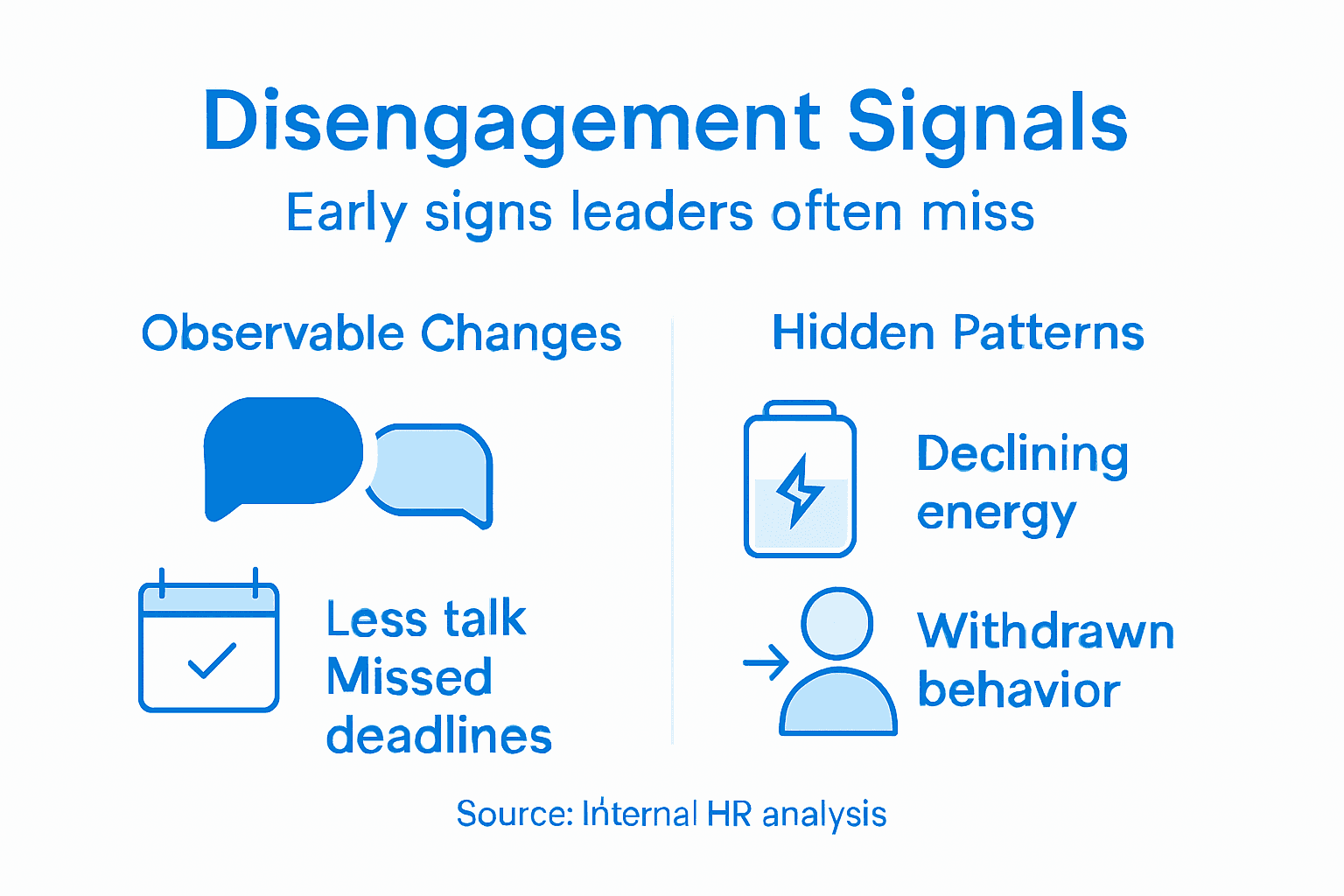
Pro tip: Document specific behavioral observations monthly for each team member—engagement level, participation patterns, communication style changes—so you can spot trends rather than writing off individual incidents as isolated events.
Gaining Predictable Retention With Data
Stop guessing. Start measuring.
The shift from reactive to informed leadership requires one thing: visibility into what’s actually driving departures. That comes from data, not intuition.
Why Data Changes Everything
You can’t manage what you don’t measure. Right now, you’re managing turnover with incomplete information and past events.
Data-driven approaches transform retention from a mystery into a solvable problem. Combining qualitative insights with quantitative workforce data reveals the specific factors influencing who stays and who leaves—leadership style, culture, compensation alignment, growth clarity.
Here’s what changes when you measure:
- You see patterns instead of incidents. Three departures from one team in eight months isn’t random. Your data shows it.
- You identify at-risk people before they resign. Engagement scores, participation changes, skill-building gaps—these metrics predict departures weeks or months ahead.
- You target interventions where they matter most. You stop applying generic retention strategies and focus on what actually impacts your specific situation.
Tracking detailed, position-specific data uncovers trends and instability previously invisible. This converts unpredictable turnover into manageable retention challenges.
What to Measure
You don’t need complex dashboards. You need the right metrics tracked consistently.
Focus on these critical data points:
-
Turnover by department and role. Where are you losing people? Is it concentrated in one team or spread across the organization?
-
Time-to-exit after disengagement signals. How long between behavioral changes and actual resignations? This shows your intervention window.
-
Compensation versus market rates. Are your salaries tracking industry benchmarks for specific roles in your region?
-
Promotion velocity and clarity. How long do people typically wait for advancement? What’s the realistic path from entry to senior roles?
-
Team stability and collaboration changes. Has reorganization disrupted high-performing groups? Tracking these position-specific metrics reveals critical periods with elevated risk.
The data itself tells you where problems exist. Your job is to listen.
Once you measure consistently, patterns emerge that intuition alone misses. You spot the department bleeding talent. You see the role nobody wants. You notice compensation gaps before they trigger departures.
Then you act—not reactively, but proactively.
Pro tip: Start with three metrics: monthly engagement scores for each team member, quarterly compensation benchmarking against your local market, and documented behavioral observations. Track these for three months to establish baseline patterns before attempting interventions.
Gain Clear Visibility Into Turnover Before It Happens
The article highlights a common challenge leaders face: turnover rarely comes as a complete surprise if you have the right insights. Many managers sense that something is off but lack clear visibility into the hidden disengagement and external factors quietly building beneath the surface. These unseen patterns often lead to sudden resignations that feel like surprises rather than inevitable outcomes. If you want to transform your leadership from reactive to informed and stop relying on instinct alone, it is crucial to track measurable warning signs early and make data-driven retention decisions.
OpenElevator provides that critical visibility layer leaders need. Unlike typical HR systems, it delivers quantifiable insight into retention risk, team dynamics, and hiring fit so you can act confidently before disengagement becomes resignation. With clear recommendations based on real-time data, you can spot hidden signals like changing communication styles, growth misalignment, and market shifts that your instincts might miss.
Explore how to turn employee experience into defensible insight with OpenElevator.
Take control of your team’s retention now. Visit our website to learn how OpenElevator helps leaders catch turnover risks early and improve hiring decisions with predictive insights. Stop being surprised by resignations and start leading with clarity today.
Frequently Asked Questions
What are the common reasons leaders are surprised by employee turnover?
Employee turnover often surprises leaders because the signals of disengagement are subtle and can be mistaken for other issues. Misaligned expectations, shifts in team dynamics, and external job opportunities often occur beneath the surface, making it challenging for leaders to anticipate departures.
How can leaders identify hidden signs of employee disengagement?
Leaders can identify hidden signs of disengagement by observing changes in team behavior, such as reduced enthusiasm in meetings, shorter communication responses, and decreased participation in optional projects. Regularly checking in on employees’ career ambitions and team dynamics can also help uncover these signs.
Why is relying on intuition inadequate for predicting turnover?
Relying on intuition is inadequate because it often misses the broader factors influencing employee decisions. While a leader may notice changes in performance or behavior, these observations only represent a fraction of the underlying issues, such as personal circumstances or market conditions that may compel an employee to leave.
What data should leaders track to effectively manage employee turnover?
Leaders should track several critical data points, including turnover rates by department, time-to-exit after disengagement signals, compensation versus market rates, promotion timelines, and changes in team stability. Collecting this data consistently can provide insights into turnover patterns and help predict potential resignations.