
Employee disengagement rarely announces itself. Long before someone submits a resignation letter, misalignment between their values and your organization’s culture has already begun eroding their commitment. This silent process costs companies millions annually in preventable turnover. Most executives sense when something feels off, but lack concrete data to pinpoint which employees are at risk or why. Understanding how poor organizational fit triggers turnover intentions months in advance gives you the visibility needed to intervene early. This guide reveals how fit impacts retention, identifies warning signs, and provides actionable strategies to strengthen hiring practices and team dynamics before costly departures occur.
Table of Contents
- Understanding How Poor Fit Drives Turnover In Advance
- The Hidden Costs Of Poor Hiring Fit On Organizational Performance
- Proven Screening Techniques To Improve Hiring Fit And Reduce Turnover
- Integrating Fit Evaluation Into Leadership And Team Management Practices
- How Openelevator Can Help Reduce Turnover Through Better Fit
Key takeaways
| Point | Details |
|---|---|
| Fit predicts turnover intentions | Misalignment in person-organization and person-job fit directly influences whether employees plan to leave, often months before they resign. |
| Strategic screening improves retention | Behavioral assessments and skills-based evaluations identify candidates likely to thrive long-term, reducing costly hiring mistakes. |
| Ethical climate amplifies fit impact | Organizations where employees can act according to their moral codes see stronger connections between fit and meaningful work. |
| Turnover escalates silently | Disengagement builds quietly through decreased productivity and withdrawal before formal resignations surface. |
| Proactive evaluation reduces churn | Regular fit assessments during hiring and performance reviews catch misalignment early, strengthening engagement and lowering turnover costs. |
Understanding how poor fit drives turnover in advance
Poor fit operates on multiple levels within organizations. Person-organization fit (P-O fit) refers to alignment between an employee’s values and your company’s culture. Person-job fit (P-J fit) measures how well someone’s skills match their role requirements. Person-group fit (P-G fit) evaluates compatibility with immediate team members. When any of these alignments break down, employees begin questioning whether they belong.
Research confirms that person-organization fit is directly and indirectly related to turnover intentions through meaning in work. Employees who feel their values clash with organizational priorities experience diminished purpose. This erosion happens quietly. No dramatic confrontations occur. Instead, engagement slowly declines as people mentally prepare to leave.
The process manifests through subtle behavioral changes:
- Reduced participation in team discussions and strategic planning sessions
- Decreased initiative on projects requiring discretionary effort
- Withdrawal from informal social interactions that build team cohesion
- Minimal engagement with professional development opportunities
Ethical climate plays a critical moderating role. When employees feel empowered to make decisions aligned with their moral codes, the positive relationship between P-O fit and meaningful work strengthens. Organizations that suppress ethical autonomy amplify the negative effects of poor fit, accelerating turnover intentions.
Undetected misfit creates cascading organizational damage. Teams lose institutional knowledge. Remaining employees absorb additional workload, increasing their own burnout risk. Recruitment costs multiply as positions cycle repeatedly. Client relationships suffer when account managers or project leads depart unexpectedly.
“The silent nature of fit-related disengagement makes it particularly dangerous. By the time leaders recognize the problem, top performers have already mentally checked out and begun job searching.”
Proactive employee retention solutions address this visibility gap by quantifying fit and surfacing early warning signals before resignation letters arrive.
The hidden costs of poor hiring fit on organizational performance
Hiring mistakes stemming from inadequate fit assessment produce financial and operational consequences that extend far beyond replacement costs. When new hires leave within their first year, organizations lose their entire recruitment investment plus onboarding expenses. More significantly, they face extended vacancy periods that strain existing teams.

Effective hiring processes are critical determinants of organizational competitiveness and long-term performance outcomes. Companies that fail to evaluate fit systematically experience higher turnover rates, lower team morale, and diminished productivity. These outcomes compound over time as reputation damage makes attracting quality candidates increasingly difficult.
The cost structure of poor hiring fit includes:
- Direct expenses: recruitment advertising, agency fees, interview time, background checks, and onboarding programs
- Productivity losses: reduced output during vacancy periods and new hire ramp-up phases
- Team disruption: knowledge gaps, workflow interruptions, and increased burden on remaining employees
- Opportunity costs: delayed projects, missed revenue targets, and strategic initiatives put on hold
A flawed recruitment system creates cascading consequences including extended vacancies that strain existing teams and damaged employer brands that repel top talent. When word spreads that an organization experiences high turnover, qualified candidates question whether accepting an offer represents a wise career move.
Employer brand damage proves particularly costly in competitive talent markets. Negative reviews on platforms like Glassdoor influence candidate perceptions before they ever speak with your recruiters. Each poor-fit hire who leaves dissatisfied potentially shares their experience publicly, compounding reputational harm.
“Organizations that treat hiring as a transactional process rather than a strategic investment pay exponentially more in the long run through perpetual recruitment cycles and diminished team performance.”
Pro Tip: Calculate your true cost per hire by including productivity losses during vacancies and ramp-up periods, not just direct recruitment expenses. This full picture justifies investment in comprehensive fit assessment tools and employee retention strategies that prevent costly turnover cycles.
Strategic, evidence-based hiring processes that prioritize fit evaluation reduce these hidden costs substantially. The upfront investment in thorough screening pays dividends through longer tenure, higher engagement, and stronger team cohesion.
Proven screening techniques to improve hiring fit and reduce turnover
Identifying candidates likely to succeed long-term requires moving beyond resume reviews and generic interviews. Skills-based assessments verify job readiness by testing actual capabilities rather than relying on self-reported proficiency claims. Skills-based assessments are essential for ensuring candidates are prepared from day one, reducing the learning curve and increasing early productivity.
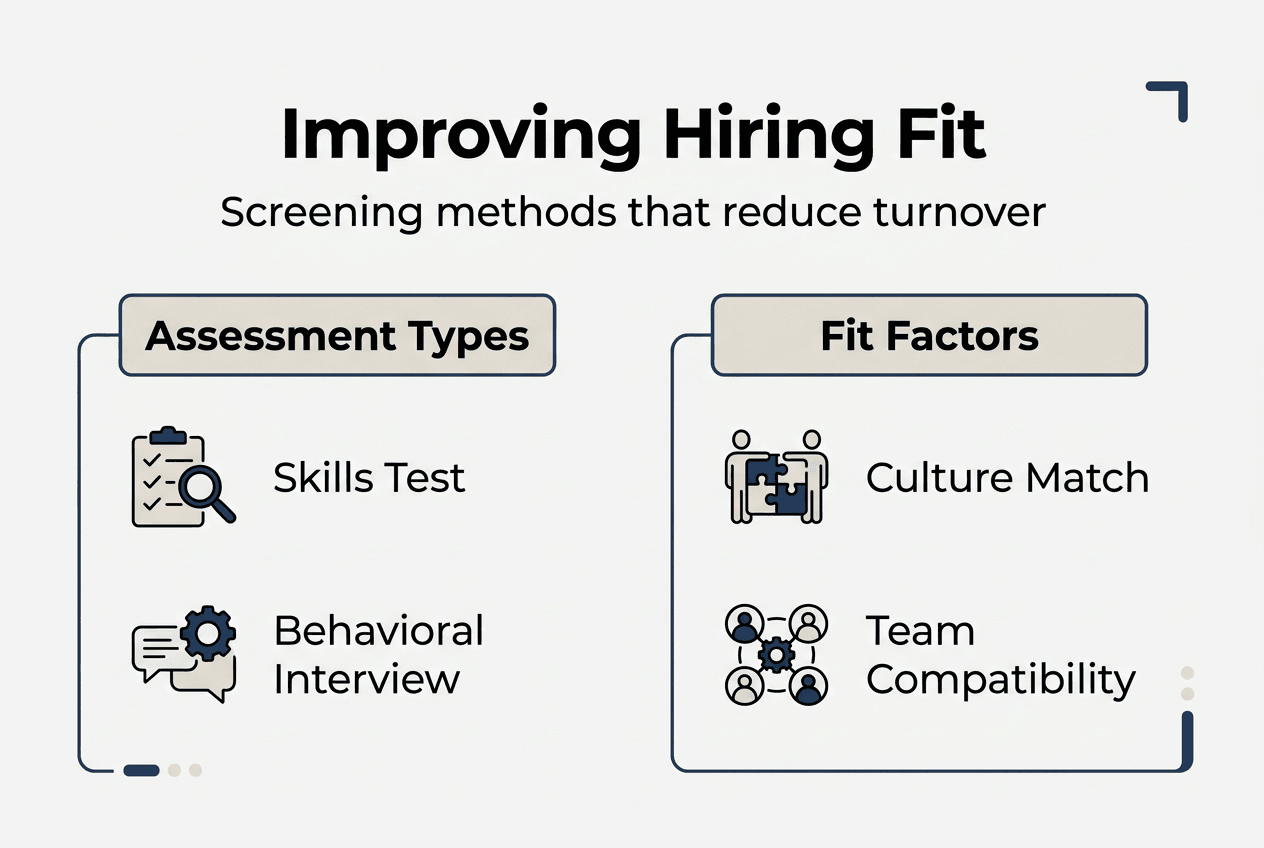
Behavioral interviews complement technical assessments by revealing how candidates handle real workplace challenges. Rather than asking hypothetical questions, these interviews probe past experiences to understand decision-making patterns and interpersonal skills. Behavioral interviews assess soft skills like reliability and adaptability by examining how candidates navigated previous conflicts, deadlines, and team dynamics.
| Screening Technique | Strengths | Limitations |
|---|---|---|
| Skills assessments | Objective capability verification, reduces resume inflation | May not capture cultural fit or soft skills |
| Behavioral interviews | Reveals past behavior patterns, assesses adaptability | Requires trained interviewers, time intensive |
| Personality assessments | Identifies cultural alignment, predicts team compatibility | Can be gamed, may introduce bias if misused |
| Work sample tests | Simulates actual job tasks, high predictive validity | Resource intensive to create and evaluate |
| Reference checks | Provides external validation, uncovers red flags | Limited candor, time lag in responses |
Implementing effective screening requires a structured approach:
- Define role requirements clearly, distinguishing between must-have skills and nice-to-have attributes that can be developed.
- Select assessment tools aligned with specific competencies, ensuring they measure capabilities directly relevant to job success.
- Train interviewers on behavioral questioning techniques, focusing on open-ended prompts that encourage detailed responses.
- Standardize evaluation criteria across all candidates, using scoring rubrics that reduce subjective bias.
- Combine multiple data points from assessments, interviews, and references to form comprehensive candidate profiles.
- Validate screening effectiveness by tracking new hire performance and tenure over time, refining tools based on outcomes.
Pro Tip: Prioritize fit in your candidate evaluation criteria by weighting cultural alignment and team compatibility alongside technical skills. Candidates who excel technically but clash with organizational values rarely succeed long-term. Retention-focused hiring techniques that balance both dimensions produce measurably better outcomes.
Organizations that implement rigorous, multi-method screening see significant reductions in first-year turnover. The investment in comprehensive evaluation pays for itself through longer tenure and higher productivity from employees who genuinely fit their roles and teams.
Integrating fit evaluation into leadership and team management practices
Hiring represents just the beginning of fit management. Leaders must continuously evaluate and reinforce alignment between employees and organizational culture throughout the employment lifecycle. Regular check-ins provide opportunities to surface concerns before they escalate into resignation decisions. Pulse surveys capture sentiment trends that reveal emerging fit issues across teams or departments.
Ethical climate significantly influences whether fit translates into retention. Ethical decisions rooted in employees’ moral codes amplify the positive link between P-O fit and meaningful work. When leaders create environments where people can act according to their values without fear of reprisal, organizational alignment strengthens naturally. Conversely, cultures that demand ethical compromises drive away employees whose values clash with prevailing practices.
Research distinguishes between how different fit types impact engagement. Person-job fit predicts job engagement, while person-organization fit predicts organizational engagement. Employees might love their specific role but feel disconnected from broader company mission, or vice versa. Effective leaders diagnose which dimension needs attention and intervene accordingly.
Leadership actions that promote positive fit conditions include:
- Articulating organizational values clearly and modeling them consistently in decision making
- Providing autonomy for employees to approach work in ways aligned with their strengths
- Recognizing and rewarding behaviors that exemplify cultural values
- Facilitating team-building activities that strengthen interpersonal connections
- Addressing toxic behaviors promptly to preserve healthy team dynamics
- Creating forums for employees to voice concerns about organizational direction
Performance reviews offer structured opportunities to assess ongoing fit. Rather than focusing exclusively on output metrics, incorporate discussions about value alignment, role satisfaction, and team dynamics. These conversations surface misalignment early, when interventions like role adjustments or additional support can prevent turnover.
“Retention is not an HR problem to be solved through exit interviews and counter-offers. It is a leadership responsibility requiring continuous attention to the alignment between what your organization values and what your people experience daily.”
Sustaining fit demands intentional effort from leadership at all levels. Team management and engagement practices that prioritize alignment create environments where employees choose to stay because they genuinely belong, not because they lack alternatives.
How OpenElevator can help reduce turnover through better fit
Addressing fit proactively requires visibility that most organizations lack. OpenElevator provides the missing layer between your instincts and your data, turning employee experience into quantifiable insight you can act on with confidence. Our platform identifies retention risks before resignations occur, giving you early warning signals and clear recommendations on where to intervene.
OpenElevator’s retention analytics reveal which employees face fit challenges and why. Predictive models assess how well new candidates will integrate with existing teams, reducing hiring mistakes that lead to early turnover. Instead of reacting to departures, you gain the visibility needed to prevent them.
Key platform capabilities include:
- Retention risk scoring that quantifies individual and team-level turnover probability
- Hiring fit assessment that predicts candidate success within your specific culture
- Team dynamics analysis that surfaces interpersonal friction points affecting engagement
- Actionable recommendations prioritized by impact on retention outcomes
OpenElevator complements your existing HR systems by adding the critical visibility layer they lack. Good leadership should be informed, not reactive. Explore our employee retention solutions to see how quantifiable insight into fit and engagement transforms your ability to retain top talent.
FAQ
What early signs indicate poor fit before resignation?
Decreased engagement, withdrawal from team activities, rising absenteeism, and reduced productivity often signal poor fit early. Employees may stop volunteering for projects, participate less in meetings, or show declining enthusiasm for work they previously enjoyed. Addressing these signs promptly through one-on-one conversations and role adjustments can prevent resignation.
How can behavioral interviews improve hiring fit?
Behavioral interviews focus on real-life situations to understand past challenges handled, revealing reliability and adaptability patterns. By asking candidates to describe specific experiences rather than hypothetical scenarios, you gain insight into how they actually behave under pressure. This reduces hiring mistakes caused by cultural misfit, as past behavior predicts future performance more accurately than generic interview responses.
What role does ethical climate play in retaining employees?
Employees feeling empowered to act ethically find their work more meaningful, strengthening organizational fit and reducing turnover intentions. Ethical decisions rooted in employees’ moral codes amplify the link between P-O fit and meaningful work. Organizations that suppress ethical autonomy or demand moral compromises drive away talent whose values clash with prevailing practices, accelerating turnover among your most principled employees.
How often should organizations assess fit to prevent turnover?
Regular check-ins and pulse surveys at least quarterly help catch misfit early, before disengagement becomes irreversible. Integrating fit assessment into performance reviews enhances retention by surfacing concerns during structured conversations. Continuous fit assessment solutions provide ongoing visibility into alignment trends, enabling leaders to intervene proactively rather than reactively addressing turnover after resignations occur.