
Losing top talent without warning can disrupt even the strongest American tech organizations. The real challenge is often not obvious resignations, but the impact of passive turnover, where valuable employees slip away due to subtle disengagement or overlooked concerns. For C-level executives in competitive US markets, understanding the hidden patterns behind these exits is key to building stronger retention. This article brings clarity to passive turnover, debunks common myths, and offers actionable insights for meaningful culture change.
Table of Contents
- Defining Passive Turnover And Common Myths
- Types Of Turnover And Passive Distinction
- Key Signs And Causes Of Passive Turnover
- Business Impacts And Cost Considerations
- Proactive Strategies To Reduce Passive Turnover
Key Takeaways
| Point | Details |
|---|---|
| Understanding Passive Turnover | Passive turnover involves unintentional employee departures that can arise from subtle workplace dynamics rather than clear dissatisfaction. |
| Warning Signs | Decreased engagement, minimal participation, and reduced communication are key indicators of potential passive turnover. |
| Cost Implications | Both direct and indirect costs associated with passive turnover can significantly impact organizational performance and morale. |
| Proactive Strategies | Implementing recognition programs, clear career paths, and regular check-ins can help mitigate the risk of passive turnover. |
Defining Passive Turnover and Common Myths
Passive turnover represents a subtle yet significant organizational challenge that many executives misunderstand. Unlike voluntary turnover where employees actively choose to leave, passive turnover involves unintended or unplanned departures that can catch companies off guard. Research on employee turnover complexities highlights the nuanced nature of these workforce transitions.
Understanding passive turnover requires dispelling several prevalent myths about employee departures. Many organizational leaders incorrectly assume that all turnover is inherently negative or stems from employee dissatisfaction. In reality, passive turnover encompasses a more complex spectrum of workforce dynamics:
- Not all departures indicate workplace problems
- Some turnover can facilitate organizational renewal
- Unplanned exits don’t always reflect negative experiences
- Individual differences significantly impact turnover patterns
Turnover Classification helps organizations develop more sophisticated retention strategies. Comprehensive turnover research reveals multiple categorization approaches:
- Internal vs. External Turnover
- Voluntary vs. Involuntary Turnover
- Functional vs. Dysfunctional Turnover
- Avoidable vs. Unavoidable Turnover
The key distinction in passive turnover is its unintentional nature. Employees might leave due to subtle workplace dynamics, personal circumstances, or gradual disengagement rather than a dramatic, planned exit. This subtlety makes passive turnover particularly challenging to predict and manage.
Contextual Factors play a crucial role in understanding passive turnover. Social network influences, individual personality traits, and organizational culture can all contribute to these unexpected departures. Recognizing these nuanced triggers requires a sophisticated, data-driven approach to workforce management.
Pro tip: Develop comprehensive tracking mechanisms that go beyond traditional exit interviews to capture the subtle signals of potential passive turnover.
Types of Turnover and Passive Distinction
Understanding the intricate landscape of employee turnover requires a nuanced approach to categorization. Comprehensive turnover classifications reveal multiple dimensions that go far beyond simple employee departures. Organizations must recognize that turnover is not a monolithic concept, but a complex interplay of organizational and individual dynamics.
Turnover can be strategically categorized across several key dimensions:
-
Internal vs. External Turnover
- Internal: Employees move within the organization
- External: Employees leave the organization entirely
-
Voluntary vs. Involuntary Turnover
- Voluntary: Employee initiates departure
- Involuntary: Organization initiates separation
-
Functional vs. Dysfunctional Turnover
- Functional: Departures that benefit the organization
- Dysfunctional: Departures that harm organizational performance
Passive Turnover represents a unique subset within these categories. Unlike clear-cut voluntary or involuntary departures, passive turnover involves subtle, often unintended workforce transitions that can catch organizations off guard.
The distinguishing characteristic of passive turnover lies in its underlying mechanisms. Employees experiencing passive turnover might gradually disengage, become less productive, or silently seek opportunities elsewhere without making an immediate, dramatic exit. This gradual process makes passive turnover particularly challenging to detect and address.
Passive turnover is less about a sudden departure and more about a slow, almost imperceptible disconnection from the organizational ecosystem.
Contextual factors significantly influence passive turnover, including workplace culture, management practices, individual career aspirations, and broader economic conditions. Recognizing these nuanced triggers requires sophisticated monitoring and proactive engagement strategies.
Pro tip: Implement regular, structured check-ins and engagement surveys to identify early warning signs of potential passive turnover before they escalate.
Key Signs and Causes of Passive Turnover
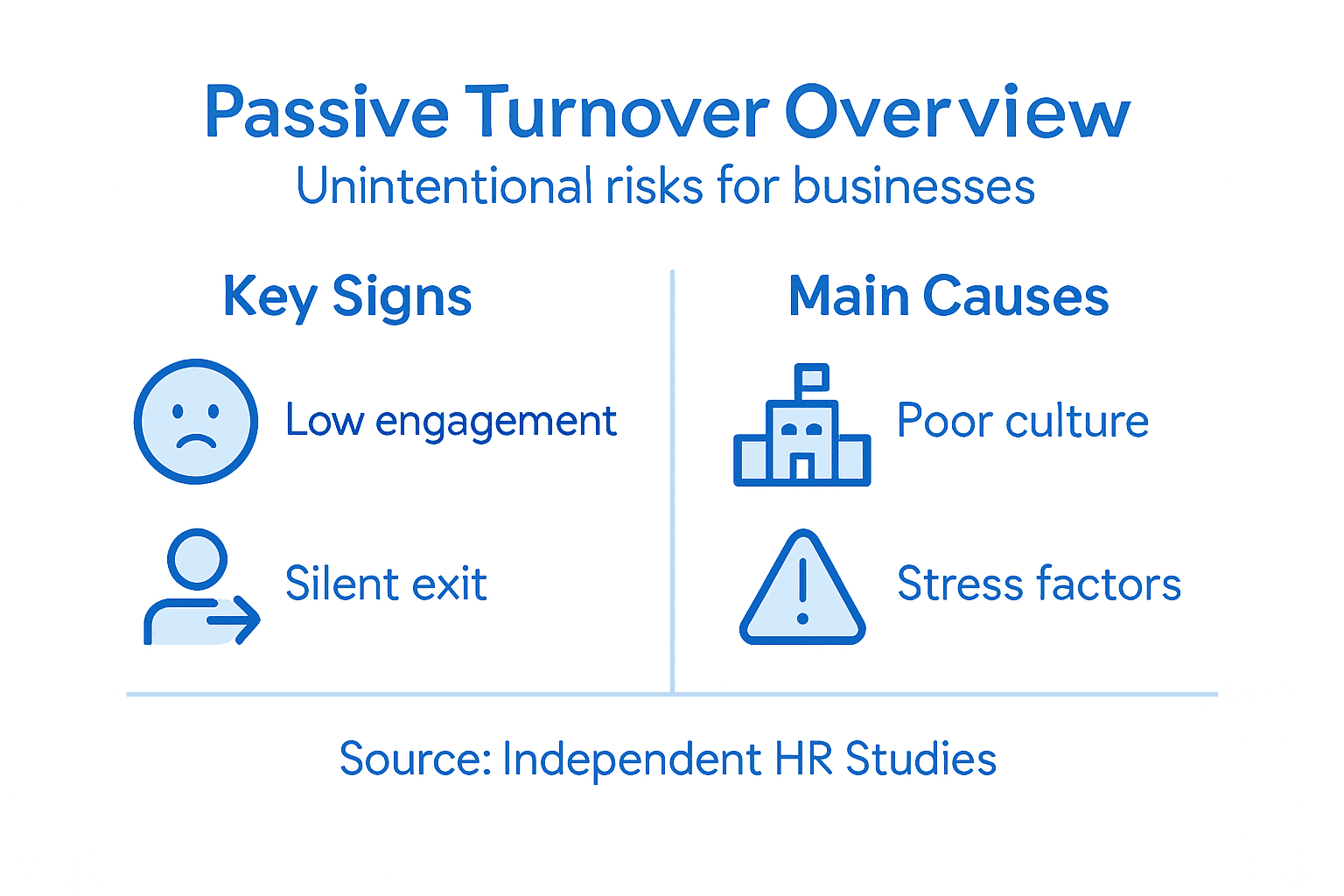
Recognizing passive turnover requires a keen understanding of subtle workplace dynamics. Comprehensive employee turnover research reveals that the signs often emerge long before an actual departure, making early detection critical for organizational health.
Warning Signs of Passive Turnover manifest through various behavioral and performance indicators:
- Decreased productivity and engagement
- Minimal participation in team activities
- Reduced communication with managers and colleagues
- Lack of enthusiasm for new projects
- Increased absenteeism or tardiness
- Minimal professional development interest
The root causes of passive turnover are multifaceted and deeply interconnected. Organizations frequently experience passive turnover due to several key factors:
- Insufficient Career Development Opportunities
- Poor Management Practices
- Inadequate Compensation Structures
- Limited Recognition and Feedback
- Non-Inclusive Workplace Culture
Psychological Disengagement represents a critical mechanism in passive turnover. Employees gradually disconnect emotionally and professionally from their workplace, creating an invisible exit trajectory that managers often miss until it’s too late.
Passive turnover occurs when employees mentally check out long before they physically leave the organization.
Contextual factors play a significant role in driving passive turnover. Job stress, misalignment between personal values and organizational culture, and unmet professional aspirations can silently erode an employee’s commitment. Workplace engagement research emphasizes that these underlying issues require proactive, nuanced intervention.

Pro tip: Conduct regular, confidential stay interviews to uncover potential disengagement signals before they transform into unexpected departures.
Business Impacts and Cost Considerations
Comprehensive turnover cost analysis reveals that passive turnover represents a significant financial challenge for organizations beyond simple replacement expenses. The economic impact extends far deeper than most executives initially recognize, creating complex ripple effects throughout the entire organizational ecosystem.
Direct Cost Components of passive turnover include:
- Recruitment expenses
- Onboarding and training investments
- Temporary productivity losses
- Potential recruitment agency fees
- Administrative processing costs
The financial burden of replacing employees varies dramatically across different roles and industries. Workforce replacement research suggests that replacing a worker can range from 20% to 150% of their annual salary, depending on the position’s complexity and organizational level.
Indirect Cost Dimensions prove even more challenging to quantify:
Here’s a comparison of direct and indirect costs associated with passive turnover:
| Cost Type | Financial Impact | Business Consequence |
|---|---|---|
| Direct Costs | Recruitment expenses | Immediate financial outlay |
| Onboarding investment | Delayed productivity | |
| Training costs | Increased operational expenses | |
| Indirect Costs | Morale decline | Lower employee engagement |
| Knowledge loss | Service quality risks | |
| Disrupted efficiency | Missed growth opportunities |
- Reduced team morale
- Knowledge transfer disruptions
- Decreased operational efficiency
- Potential customer relationship impacts
- Increased workload for remaining team members
Passive turnover creates invisible economic damage that extends far beyond immediate financial calculations.
Strategic leaders must recognize that passive turnover represents more than a human resources challenge—it’s a critical business performance issue. The cumulative effect of unaddressed workforce disengagement can dramatically undermine organizational competitiveness and long-term strategic objectives.
Pro tip: Develop a comprehensive turnover tracking system that monetizes both direct and indirect costs to create a true economic picture of workforce transitions.
Proactive Strategies to Reduce Passive Turnover
Effective retention strategies provide a comprehensive framework for addressing passive turnover before it becomes a critical organizational challenge. Proactive approaches focus on creating an environment where employees feel valued, connected, and motivated to remain with the organization.
Key Strategic Interventions for reducing passive turnover include:
- Implementing robust recognition programs
- Creating clear career advancement pathways
- Developing competitive compensation structures
- Establishing meaningful communication channels
- Offering continuous professional development
Managerial practices play a crucial role in mitigating passive turnover. Organizational retention research suggests that managers must actively engage in strategies that foster employee connection and commitment:
- Conduct regular stay interviews
- Personalize career development plans
- Provide transparent feedback mechanisms
- Create flexible work arrangements
- Build inclusive team environments
Engagement Drivers represent the core mechanisms for preventing passive turnover. Organizations must move beyond traditional retention tactics and develop holistic approaches that address fundamental employee needs.
Passive turnover is not just about preventing exits, but about creating an environment where employees genuinely want to stay and contribute.
Successful retention requires a multifaceted approach that combines psychological, professional, and organizational strategies. By understanding individual employee motivations and creating tailored engagement plans, companies can significantly reduce the risk of unexpected workforce transitions.
The following table summarizes key interventions with their primary benefits:
| Intervention | Main Benefit | Example Practice |
|---|---|---|
| Recognition Programs | Boosts employee motivation | Monthly awards |
| Career Pathways | Enhances retention potential | Personalized growth plans |
| Flexible Work Options | Improves work-life balance | Remote work allowances |
| Stay Interviews | Identifies disengagement early | Confidential check-ins |
| Feedback Mechanisms | Raises trust and transparency | Regular performance reviews |
Pro tip: Develop a comprehensive employee engagement dashboard that tracks leading indicators of potential passive turnover, enabling proactive intervention.
Turn Insight into Action: Stop Passive Turnover Before It Starts
Passive turnover creates hidden risks that drain productivity and morale without warning. This article reveals how subtle disengagement and unplanned departures can silently disrupt your business. If you want to move beyond guesswork and identify exactly which employees are at risk before they mentally check out, you need data you can trust. OpenElevator’s proprietary algorithm pinpoints high-risk employees through a simple five-minute survey that measures values alignment and interpersonal fit — the very factors driving passive turnover. This powerful insight lets you take targeted action to keep your team motivated and committed.
Discover how OpenElevator helps leaders stop costly passive turnover by providing clear, actionable insights into employee engagement and retention. Visit OpenElevator now to learn how our platform provides lasting solutions that protect your workforce and boost your organization’s performance. Take control today with OpenElevator’s employee retention strategies and ensure your talent stays productive and connected for the long term.
Frequently Asked Questions
What is passive turnover?
Passive turnover refers to unintended or unplanned employee departures that can occur without prior notice or clear indications from the employees, often leaving organizations unprepared.
What are the signs of passive turnover?
Signs of passive turnover include decreased productivity, minimal engagement in team activities, reduced communication, lack of enthusiasm for projects, and increased absenteeism or tardiness.
What are the main causes of passive turnover?
Key causes of passive turnover can include insufficient career development opportunities, poor management practices, inadequate compensation, limited recognition, and a non-inclusive workplace culture.
How can organizations prevent passive turnover?
Organizations can prevent passive turnover by implementing recognition programs, creating clear career advancement pathways, ensuring competitive compensation, establishing meaningful communication, and offering continuous professional development.