
Most leaders believe restructuring strengthens their organizations. Yet fewer than one in four reorganizations succeed in improving performance, while many actively harm productivity. This disconnect between intention and outcome reveals critical insights about team stability and organizational risk. Understanding what restructuring actually exposes about your workforce can mean the difference between strategic renewal and costly disruption. This article provides data-driven guidance to help you navigate restructuring effectively while protecting the stability that keeps your best people engaged.
Table of Contents
- Understanding Restructuring: Success Rates And Impact On Team Stability
- The Employee Perspective: Balancing Agility With Workers’ Need For Stability
- How Repeated Restructuring Creates Risk: Erosion Of Trust And Team Performance
- Practical Frameworks For Leaders: Reducing Risk And Enhancing Stability During Restructuring
- Enhance Team Stability With Proven Retention Solutions
Key takeaways
| Point | Details |
|---|---|
| Most restructurings fail | Less than 25% improve performance, while over half reduce productivity during implementation |
| Employees prioritize stability | 75% of workers desire greater stability even as organizations push for constant agility |
| Repeated changes damage trust | Chronic restructuring erodes psychological safety, institutional knowledge, and long-term loyalty |
| Communication protects culture | Transparent, values-driven restructuring maintains morale and reinforces organizational integrity |
| Root causes matter most | Effective retention addresses growth opportunities, management quality, and work-life balance |
Understanding restructuring: success rates and impact on team stability
Restructuring encompasses organizational changes from layoffs and departmental mergers to leadership reshuffles and operational redesigns. Leaders typically pursue these changes to cut costs, improve efficiency, or respond to market pressures. The reality rarely matches expectations.
Fewer than one in four reorganizations succeed in delivering promised performance improvements. Even more concerning, more than half experience productivity declines during implementation. These aren’t minor dips. They represent measurable losses in output, quality, and momentum that can persist for months.
Short-term disruption might seem acceptable if long-term gains materialize. But many organizations never recover their pre-restructuring performance levels. Teams lose institutional knowledge when experienced employees leave. Remaining staff face increased workloads and ambiguity about roles and expectations. Trust erodes as people question leadership decisions and worry about future changes.
| Restructuring Outcome | Impact on Team Stability | Risk Level |
|---|---|---|
| Failed performance improvement | Wasted resources, continued problems | High |
| Productivity decline | Reduced output, missed deadlines | High |
| Knowledge loss | Skill gaps, process breakdowns | Critical |
| Trust erosion | Disengagement, turnover risk | Critical |
| Role ambiguity | Confusion, inefficiency | Medium |
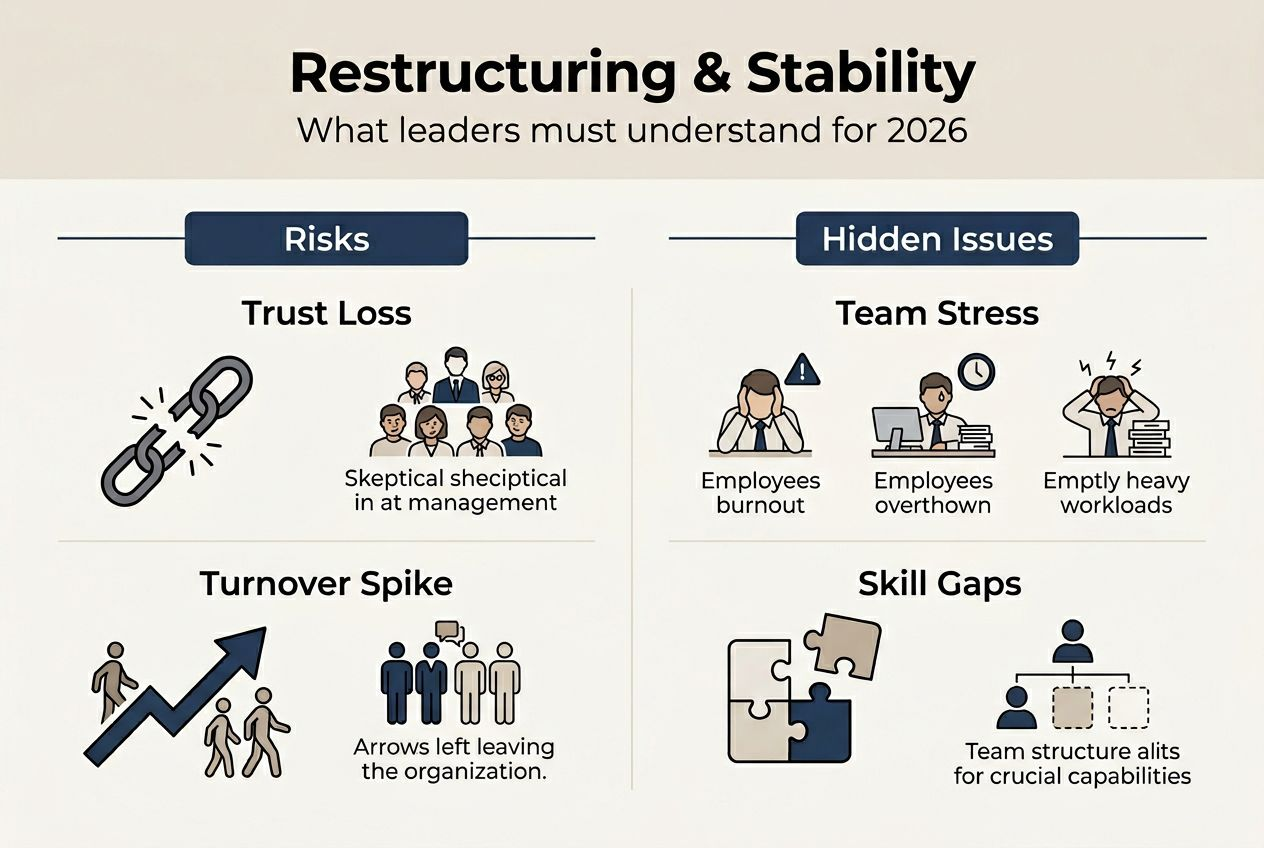
The pattern reveals something crucial. Restructuring doesn’t solve underlying problems with team stability. It exposes them. When employee retention solutions aren’t already in place, organizational changes amplify existing weaknesses in culture, management, and engagement.
Pro Tip: Before restructuring, assess whether you’re addressing root causes or just rearranging surface-level symptoms. If turnover stems from poor management or lack of growth opportunities, reshuffling departments won’t fix it.
Common restructuring triggers include:
- Financial pressure requiring cost reductions
- Market shifts demanding new capabilities
- Leadership changes bringing different priorities
- Competitive threats requiring faster execution
- Technology adoption changing work processes
Each trigger creates legitimate pressure for change. But the method matters enormously. Restructuring without understanding current team dynamics and retention risks creates more problems than it solves.
The employee perspective: balancing agility with workers’ need for stability
Organizations prize agility. Employees crave stability. This tension defines modern workplace dynamics and explains why restructuring so often backfires. Leaders see change as strategic necessity. Workers experience it as destabilizing threat.
The concept of stagility attempts to bridge this gap by balancing organizational agility with employee stability. Yet 72% of organizations recognize this importance while only 39% take meaningful action. The gap between awareness and execution leaves employees bearing the psychological cost of constant change.
Research shows about two-thirds of workers feel overwhelmed by workplace change pace, while 75% desire greater stability. These aren’t minor preferences. They represent fundamental human needs for predictability, security, and psychological safety that enable people to perform their best work.
Repeated restructuring creates cumulative stress that manifests as:
- Anxiety about job security and future changes
- Reduced commitment to long-term projects and goals
- Hesitation to invest in relationships with colleagues
- Cynicism toward leadership communications and initiatives
- Active job searching as a protective measure
When organizations ignore these human responses, they lose their best people first. High performers have options. They leave for competitors offering greater stability and clearer career paths. The organization retains those with fewer choices, creating a negative selection effect that compounds over time.
Well-managed restructuring that prioritizes transparent communication and demonstrates genuine care for employee welfare can actually reinforce loyalty and trust, turning a potential crisis into a moment that validates company values.
This outcome requires intentional employee retention strategies that acknowledge emotional realities alongside operational necessities. Leaders must recognize that agility without stability creates chaos, not competitive advantage. Effective change management best practices build bridges between organizational needs and employee experience.
Pro Tip: Create stability anchors during periods of change by clearly defining what will remain constant. Communicate these anchors repeatedly. People can adapt to change when they understand which foundations remain secure.
The employee perspective matters because retention depends on it. You can’t force people to stay engaged through organizational turbulence. You can only create conditions where staying feels safer and more rewarding than leaving.
How repeated restructuring creates risk: erosion of trust and team performance
Single restructuring events create temporary disruption. Repeated restructuring creates permanent damage. The distinction matters enormously for understanding long-term organizational risk and team stability.

Chronic restructuring undermines relational depth, trust, and psychological safety essential for sustained performance. Each successive change compounds previous damage, creating a downward spiral that becomes increasingly difficult to reverse.
Key risks from repeated restructuring include:
- Trust erosion as employees question leadership competence and intentions
- Burnout from constant adaptation and increased workload demands
- Loss of institutional knowledge as experienced employees depart
- Decreased loyalty and commitment to organizational success
- Reduced innovation as people avoid risks during uncertainty
- Damaged employer brand making future recruitment harder
These risks accumulate silently. Leaders often don’t recognize the depth of damage until a crisis forces visibility. By then, recovery requires years of consistent, trust-building behavior.
| Factor | Short-Term Impact | Long-Term Risk |
|---|---|---|
| Cost savings | Immediate budget relief | Reduced capability, quality decline |
| Efficiency gains | Streamlined processes | Knowledge loss, process brittleness |
| Strategic alignment | Clearer priorities | Cynicism, disengagement |
| Market responsiveness | Faster adaptation | Exhaustion, turnover |
The table reveals a pattern. Short-term wins often mask long-term risks to culture and performance. Leaders focused on immediate results miss the erosion happening beneath the surface until retention problems become acute.
Psychological safety serves as the foundation for real organizational agility. When people feel secure enough to take risks, share ideas, and challenge assumptions, organizations adapt effectively. Repeated restructuring destroys this foundation by teaching people that speaking up or investing effort leads to disruption and loss.
Organizations that ignore the cumulative psychological and cultural costs of repeated restructuring discover too late that they’ve traded short-term flexibility for long-term fragility, creating exactly the opposite of what they intended.
Research on the downsizing experience and sequence shows that event order and nature heavily influence employee outcomes including loyalty and performance. First restructurings handled poorly create lasting damage. Subsequent changes face higher skepticism and resistance.
This creates a vicious cycle. Poor restructuring execution damages trust. Damaged trust makes future changes harder. Harder changes produce worse outcomes. Worse outcomes further erode trust. Breaking this cycle requires fundamentally different approaches that prioritize team stability insights and long-term organizational health.
The risk isn’t just losing individual employees. It’s losing the collaborative capacity, shared understanding, and mutual trust that enable teams to perform at high levels. These intangible assets take years to build and months to destroy.
Practical frameworks for leaders: reducing risk and enhancing stability during restructuring
Knowing the risks isn’t enough. Leaders need practical frameworks for managing restructuring in ways that reduce turnover risk and build long-term stability. The difference lies in approaching organizational change as a strategic opportunity rather than just a cost-cutting exercise.
| Traditional Restructuring | Values-Driven Approach |
|---|---|
| Announce changes with minimal warning | Communicate early with context and rationale |
| Focus solely on financial metrics | Balance financial needs with human impact |
| Minimize transparency to control narrative | Maximize transparency to build trust |
| Treat employees as resources to optimize | Treat employees as stakeholders to engage |
| Rush implementation for quick results | Phase changes to allow adaptation |
Restructuring handled with empathy and transparency can maintain morale, loyalty, and reinforce company values. This isn’t soft management. It’s strategic risk reduction that protects your most valuable assets during vulnerable transitions.
Key elements of values-driven restructuring include:
- Clear, honest communication about reasons, timeline, and expected impacts
- Demonstrated fairness in how decisions are made and applied
- Visible support for affected employees including transition assistance
- Consistent follow-through on commitments and promises
- Opportunities for employee input and questions
- Recognition of emotional responses as legitimate and normal
These elements cost little but deliver enormous returns in preserved trust and sustained engagement. They transform restructuring from a crisis that drives turnover into a moment that validates organizational integrity.
Beyond restructuring itself, effective retention tactics include career development programs, competitive compensation, and strong organizational culture. These foundations must exist before restructuring begins. You can’t build retention infrastructure during a crisis.
Internal actions to reduce turnover risk:
- Implement clear career progression pathways with regular advancement opportunities
- Conduct regular compensation reviews to ensure market competitiveness
- Invest in management development so supervisors build rather than erode engagement
- Create work-life balance policies that acknowledge employee needs beyond productivity
- Establish feedback mechanisms that give employees genuine voice in decisions
Pro Tip: Audit your current retention infrastructure before announcing restructuring. If career development, compensation, or management quality need improvement, address those gaps first. Restructuring will only amplify existing weaknesses.
Successful restructuring strengthens agility and future readiness, not only cuts costs. This requires viewing organizational change as strategic renewal rather than reactive crisis management. Leaders who adopt this perspective make different decisions that produce better outcomes.
The framework isn’t complicated. Communicate honestly. Act fairly. Support people through transitions. Follow through on commitments. These basics protect team stability during necessary changes and position your organization for stronger performance afterward. Retention strategies for leaders build on these foundations to create sustainable competitive advantage.
Enhance team stability with proven retention solutions
Restructuring reveals what’s working and what’s broken in your retention approach. But you don’t have to navigate these challenges alone. OpenElevator specializes in helping leaders reduce turnover rates and build stable, high-performing teams even during organizational change.
Our data-driven approach provides:
- Real-time visibility into retention risks before they become departures
- Predictive insights showing which teams and individuals face highest turnover probability
- Actionable recommendations for where to focus retention efforts for maximum impact
- Clear metrics tracking how interventions affect stability and engagement over time
When restructuring forces difficult decisions, having quantifiable insight into team dynamics and retention risks helps you protect your most valuable assets. Employee retention solutions from OpenElevator give you the visibility to act with confidence rather than instinct.
Frequently asked questions
What is the typical success rate of corporate restructuring?
Less than 25% of restructurings successfully improve organizational performance. More than half experience productivity declines during implementation that can persist for months. These statistics reveal that restructuring often creates more problems than it solves, particularly when organizations fail to address underlying issues with management, culture, or employee engagement before making structural changes.
How does restructuring affect employee turnover rates?
Employee turnover typically spikes after restructuring announcements and during implementation phases. The increase stems from reduced trust, heightened anxiety about future changes, and perceived threats to job security. Organizations that manage restructuring with transparency, fairness, and genuine support for affected employees can minimize these turnover spikes and sometimes even strengthen loyalty among remaining staff.
How can leaders balance agility with team stability during change?
Balancing agility and stability requires setting clear priorities for what remains constant while changes occur. Only 39% of organizations actively work on this balance despite widespread recognition of its importance. Leaders should communicate stability anchors repeatedly, integrate empathy into change management practices, and create feedback mechanisms that give employees genuine voice during transitions.
What are the primary causes of high employee turnover after restructuring?
Key causes include lack of growth opportunities, poor management quality, and work-life imbalance. Restructuring amplifies these existing problems by adding uncertainty and increased workload. Organizations that address professional development, improve management effectiveness, and support work-life balance before restructuring experience lower turnover rates during and after organizational changes.
What role do communication and company values play in restructuring?
Transparent, fair communication reinforces trust and employee loyalty during difficult organizational shifts. Restructuring executed with empathy and transparency turns a moment of truth into a display of organizational integrity. Values-driven restructuring that prioritizes honest communication, demonstrates care for employee welfare, and follows through on commitments maintains authentic culture and prevents the turnover spikes that typically follow organizational changes.