
Every tech leader faces a moment of truth when a promising engineer hands in their notice and you ask yourself what could have convinced them to stay. The link between training and retention is not just theory—continuing professional training programs are associated with lower employee turnover and a stronger commitment to your organization. This guide breaks down how strategic training investments bridge gaps in skill, engagement, and loyalty, giving your company a real advantage in holding onto top talent.
Table of Contents
- Defining Training’s Role in Employee Retention
- Types of Workplace Training and Their Impact
- How Training Addresses Employee Engagement Needs
- Best Practices for Implementing Retention-Focused Training
- Common Mistakes That Undermine Retention Efforts
Key Takeaways
| Point | Details |
|---|---|
| Invest in Employee Growth | Training is essential for retaining top talent; it signals organizational commitment and fosters job satisfaction and commitment for employees. |
| Tailored Training Approaches | Different stages of an employee’s career require customized training programs to meet varying engagement needs effectively. |
| Connect Training to Business Outcomes | Training should align with company goals to enhance perceived value and relevance for employees, thereby increasing retention. |
| Measure and Adjust Training Impact | Ongoing evaluation of training programs is crucial to ensure they are effective and connected to increased employee satisfaction and reduced turnover. |
Defining Training’s Role in Employee Retention
Here’s the reality that most tech leaders won’t admit: you can’t retain top talent without investing in their growth. When engineers, product managers, and developers join your company, they’re not just signing up for a paycheck. They’re making a bet on whether you’ll help them become better at what they do. Training is the mechanism that either fulfills that promise or breaks it.
The data backs this up. Continuing professional training programs are directly linked to decreased intention to leave jobs and lower employee turnover. But here’s what makes this interesting: training doesn’t work through some mysterious magic. It operates through specific pathways. When your team members gain new skills, their job satisfaction increases. When they see a clear path to advancement, their commitment to your company strengthens. These two factors, job satisfaction and commitment, mediate the relationship between training and retention. Translation? Training doesn’t keep people around by accident. It keeps them around because they feel valued, equipped, and positioned for growth.
Consider what happens at most mid-sized tech companies. A developer joins, gets onboarded, then gets assigned to projects. Weeks pass. Months pass. That developer realizes no one is investing in their skills beyond what’s required for today’s work. They start thinking about what’s possible elsewhere. The music stops. Within 18 months, they’re gone. You’re back to square one: recruiting, hiring, training someone new. The cost of that turnover is staggering. But more than that, you’ve lost momentum. You’ve lost institutional knowledge. You’ve lost someone who was finally becoming productive.
This pattern is especially pronounced with younger employees. The research shows training’s retention impact is more influential for younger workers, which means your Gen Z and millennial engineers are actively evaluating whether your company invests in their development. They’re comparing you to competitors. They know that five years at Company A with focused skill development could position them completely differently than five years at Company B where they’re just heads-down on tickets.
So what does training’s role actually entail in a retention strategy?
Bridging the gap between current state and future potential. Your developers know what they can do today. Training shows them what they could do in six months, two years, five years. That vision of growth is the primary thing holding ambitious people in place.
Creating measurable progress. When someone completes a certification, ships a project using a new technology, or leads a training session for peers, they have tangible proof they’re advancing. This isn’t abstract growth. It’s concrete.
Signaling organizational investment. When your company allocates budget, time, and leadership attention to employee development, it sends a clear message: we’re betting on you. We think you’re worth it. That signal changes how people perceive their role and their future with you.
Addressing skill gaps before they become resentment. Frustration often stems from people feeling unprepared for their roles. Training resolves that before it festers into disengagement.
The trap most executives fall into is thinking training is only for new hires or for people struggling in their roles. That’s backwards. Training should be a constant, normalized part of how your organization operates. It’s not remedial. It’s aspirational.
Pro tip: _Map out your training investments by employee tenure and career level. Employees in their first two years should have significantly different development focus than those at year five. One-size-fits-all training programs dilute impact and waste budget.
Types of Workplace Training and Their Impact
Not all training is created equal. This is where many leaders stumble. They implement a generic training program, measure participation rates, then wonder why retention hasn’t improved. The problem is that different types of training produce vastly different outcomes. Understanding which training methods actually move the needle on retention is critical before you invest significant budget.
The landscape of workplace training includes several distinct approaches, each with specific strengths. On-the-job training, classroom sessions, e-learning programs, and mentoring represent the primary methods available to organizations. But knowing they exist isn’t enough. You need to understand what each one accomplishes and when to deploy it.
On-the-job training works because it’s immediately practical. An engineer shadows a senior developer, learns the actual codebase, understands how decisions get made in real time. There’s no translation gap between classroom theory and workplace reality. The challenge? It depends heavily on the quality of whoever’s doing the training. If your senior developers are burned out or rushed, the mentee gets a watered down version of knowledge. The retention impact comes from the relationship building and the sense of being invested in, not just from the technical content.

Classroom training creates structure and consistency. Everyone learns the same material at the same pace. It works well for foundational knowledge, compliance training, or introducing new frameworks across your organization. The downside is that it can feel disconnected from daily work. People sit through a session, get back to their desks, and struggle to apply what they learned because there’s no immediate context. The retention benefit here is moderate unless you pair it with follow-up support.
E-learning offers flexibility and scalability. Your team members can complete training modules at their own pace, from anywhere. For distributed teams, this is invaluable. The problem is completion rates and engagement. People start courses and abandon them. The isolation of online learning means there’s no peer support or instructor presence to push through difficult material. E-learning works best for compliance, reference materials, and skill refreshers, not for deep skill development.
Mentoring is the retention heavyweight. When someone has a dedicated mentor who invests time in their growth, provides feedback, opens doors, and models how to navigate your organization, that person’s commitment deepens significantly. Mentoring addresses all four of the basic human needs: safety (someone has your back), growth (targeted development), contribution (your mentor helps you see how your work matters), and connection (the relationship itself). The challenge is that mentoring requires cultural commitment and can’t be easily scaled.
Here’s a concise comparison of the main workplace training types and how they impact employee retention:
| Training Type | Core Benefit | Effectiveness for Retention | Typical Limitation |
|---|---|---|---|
| On-the-job | Immediate skill application | High, builds relationships | Quality varies with mentor |
| Classroom | Consistent knowledge transfer | Moderate, supports foundational | May lack real-world context |
| E-learning | Flexible, scalable | Low for deep skills, high for basic | Engagement and completion rates |
| Mentoring | Personalized growth | Very high, addresses all needs | Difficult to scale widely |
What drives the real retention impact, though, is alignment. The most effective organizations don’t choose one training type and stick with it. They use a blended approach. Cognitive, technical, and soft skills training all contribute to employee motivation, satisfaction, and productivity. A software engineer might receive technical training through e-learning, cognitive training through classroom sessions on system design thinking, and soft skills development through mentoring relationships. When these three types work together, the effect compounds.
Here’s what actually matters for retention decisions: the training must be clearly connected to business outcomes. If you’re teaching skills that don’t apply to your company’s direction or strategy, people feel like they’re wasting time. But when training directly supports where your organization is headed, people see themselves as part of that future. They’re invested.
Consider a concrete example. Your tech team is transitioning from monolithic architecture to microservices. You send engineers to a course on microservices architecture (classroom). They get hands on time applying it in a sandbox environment (e-learning with practice). They have a senior architect review their work and discuss design decisions (on-the-job mentoring). Now that skill development is actually strategic. It’s not just professional development. It’s organizational transformation, and your people are the ones driving it.
The other critical factor is evaluation. Training without follow-up assessment is just activity. Did people actually learn? Are they applying it? Did satisfaction or retention improve? Organizations with strong evaluation processes see better outcomes because they can identify which training methods work for which groups and adjust accordingly.
Pro tip: _Start by mapping your current turnover by role and tenure, then audit which training types each cohort receives. You’ll likely discover that your highest-risk groups are getting the least targeted development. Reallocate budget to mentoring and on-the-job training for those populations first.
How Training Addresses Employee Engagement Needs
Engagement is the invisible thread connecting training to retention. You can offer all the development opportunities in the world, but if they don’t address what actually matters to your people, they’ll sit unused. Understanding the specific engagement needs that training fulfills is the difference between programs that work and programs that gather dust.
Let’s anchor this in something concrete. Employees have fundamental needs at work. They need to feel safe in their roles and confident they can perform well. They need to see a path forward and understand how they contribute to something larger than themselves. They need to feel connected to their team and trusted by leadership. Training, when designed correctly, directly addresses every single one of these needs. When you provide training programs that meet job satisfaction and security needs, employees feel valued and supported. They start to believe the organization is actually investing in them, not just extracting productivity from them.
Here’s how this works in practice. A backend engineer in your organization feels stuck. She’s competent at her current responsibilities, but she’s uncertain whether she could handle more complex architectural decisions. That uncertainty creates anxiety. She starts checking job boards. Within weeks, disengagement sets in. The music stops. But if you had proactively offered training on systems design, mentoring from senior architects, and opportunities to lead smaller projects with support, the entire trajectory changes. Now she’s not anxious. She’s growing. She sees herself advancing. Engagement spikes. She’s not looking at other companies anymore.
The engagement mechanism operates through several pathways. First, training creates clarity about expectations and capability. When someone completes training and successfully applies it, they’ve proven to themselves that they can handle new challenges. That confidence is transformative. Second, training signals organizational investment. When budget gets allocated to someone’s development, when leadership makes time for their growth, that sends a message: we believe in you. You’re worth developing. That signal changes how people perceive their role and their future. Third, training builds connection through shared learning. Group training sessions, peer learning cohorts, and collaborative projects create bonds. People feel less isolated. They realize others are learning too. They build relationships around growth.
But here’s where most organizations miss the mark. They treat training as transactional. Employee takes course. Employee gets certificate. Done. That’s not engagement. That’s compliance. Real engagement happens when training connects to the employee’s personal aspirations and the organization’s actual direction. When a product manager completes training on data driven product strategy, and then immediately gets to apply those skills on your highest-priority initiative, engagement erupts. She’s not just learning. She’s contributing. She’s part of something meaningful.
The research confirms this. Combining learning opportunities with engagement initiatives creates positive work environments that foster retention. Notice the language: combining learning with engagement initiatives. This isn’t training in isolation. It’s training embedded in a broader engagement strategy. Your company might offer online courses, but if employees never get time to actually use those skills at work, the engagement benefit evaporates. The training becomes theater. But if learning is coupled with real projects, leadership visibility, peer collaboration, and clear career progression, the impact multiplies.
Consider what happens with a holistic approach. You implement a technical leadership training program. Sounds standard, right? But you pair it with the following. Participants work through the curriculum as a cohort, building relationships with peers. They mentor junior engineers as a practicum exercise. Their managers are trained to recognize and reward behaviors learned in the program. They get visible promotion opportunities within six months. They present what they learned to executive leadership. Now training isn’t abstract. It’s connected to advancement, to contribution, to visibility, to belonging.
The engagement needs most neglected in tech organizations are connection and contribution. Engineers often feel disconnected from business outcomes. They code features that get built, but they don’t see whether those features actually matter to customers. Contribution feels hollow. Training can bridge this gap. When you pair technical training with product strategy training, when you involve engineers in customer interviews, when you show the impact of their work, engagement transforms. Training becomes the vehicle for helping people understand their contribution.
There’s also a timing element here. Early career employees have different engagement needs than senior engineers. Junior developers crave rapid skill growth and mentorship. They want to learn from experts. Senior engineers want leadership opportunities and influence over direction. Training that ignores these differences feels irrelevant. But training calibrated to career stage feels like the organization actually understands where people are and what they need.
The table below summarizes how different career stages benefit most from targeted training approaches:
| Career Stage | Greatest Engagement Need | Most Effective Training Approach |
|---|---|---|
| Early Career | Rapid skill growth, mentorship | On-the-job and group mentoring |
| Mid Career | Advancement opportunities | Project-based and leadership tracks |
| Senior Level | Influence, strategic alignment | Peer mentoring and executive coaching |
Pro tip: _Before designing your next training program, survey your team on what engagement needs feel unmet. Lack of clarity on career paths? Insufficient opportunities to lead? Disconnection from business impact? Let those gaps determine your training focus. Training designed to address actual engagement gaps has three times the impact of generic skill development programs.
Best Practices for Implementing Retention-Focused Training
Having the right training program means nothing if you implement it poorly. This is where execution matters more than strategy. You can design the most brilliant curriculum on the planet, but if you don’t align it with career goals, get leadership buy-in, and measure outcomes, it becomes expensive busywork. The difference between training that moves the needle on retention and training that wastes budget comes down to how you actually execute.
Start with alignment. Training aligned with employee career goals increases organizational identification and intent to stay. This sounds obvious, but most organizations get it backwards. They identify skill gaps based on current job requirements, then build training around those gaps. That’s tactical. What you need instead is to ask each person: where do you want to be in three years? What skills do you need to get there? Then design training that directly supports that trajectory. When a junior engineer knows that completing a specific course puts her on track for a senior engineering role, the engagement is completely different than when she’s just told to take it because the company says so.
This requires a shift in how you approach training design. Instead of top down, make it personalized. Instead of one-size-fits-all, make it career stage appropriate. Instead of annual, make it continuous. Using data-driven HR practices that emphasize continuous skill development and employee feedback produces sustainable retention improvement. The data part is critical. You need to know: who’s at risk of leaving? What skills are they lacking? What training would actually move the needle for that person? This is where many companies fail. They implement training broadly, hoping it helps, rather than targeting it strategically.
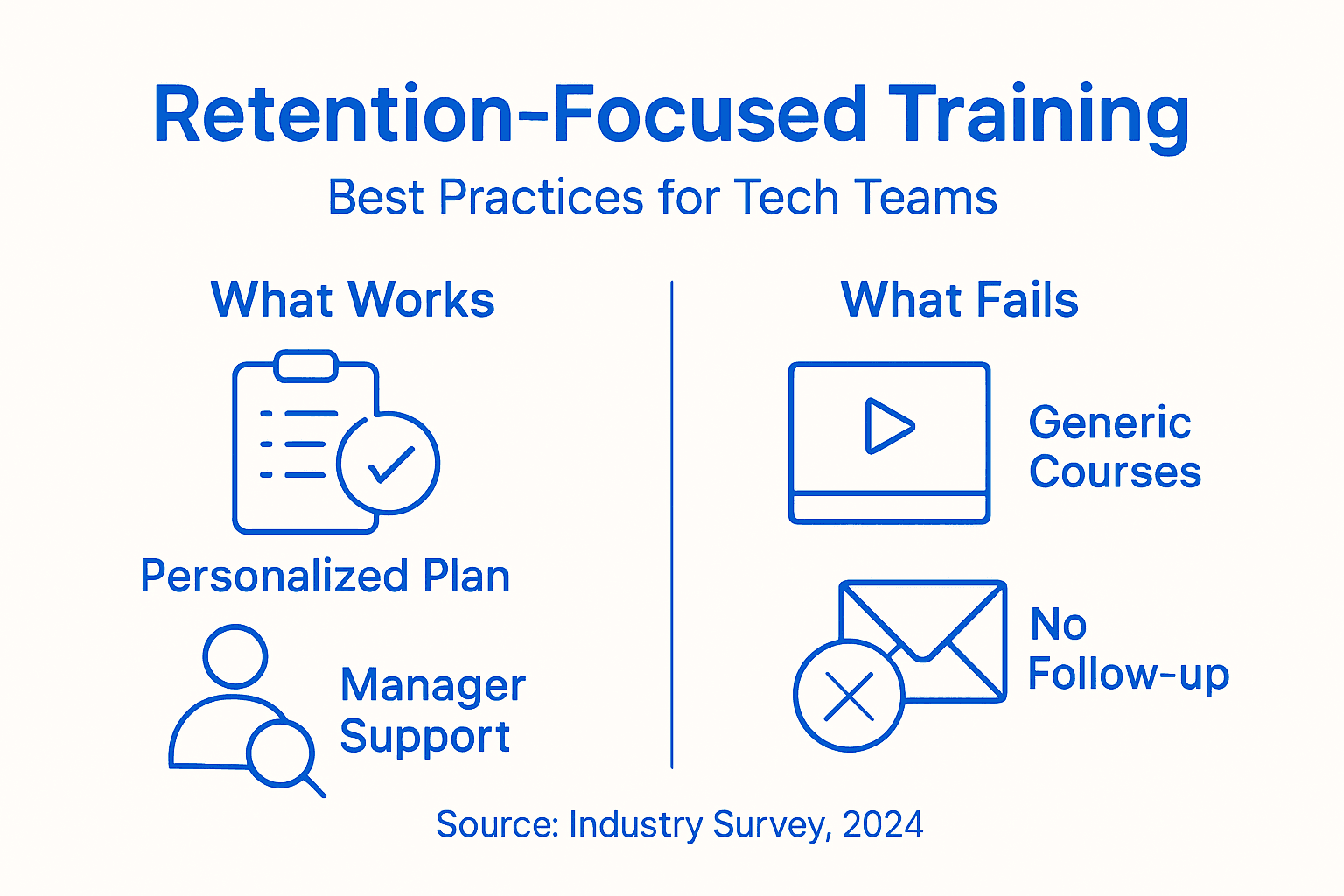
Leadership involvement is non negotiable. If your executives don’t visibly participate in training, don’t prioritize it in their team’s schedules, and don’t reference it in performance reviews, your team members will correctly interpret it as unimportant. But when a VP takes the same leadership training as their direct reports, when managers explicitly reserve time for their people to complete development, when training completion and application are discussed in one on ones, the message is crystal clear: we mean this. This matters. Invest time in it.
Here’s a specific implementation framework that works in tech organizations:
-
Conduct individual career conversations. Meet with each person on your team and ask about their aspirations. Where do they see themselves in two, five, and ten years? What are they afraid of in their career? What excites them? Document this. It becomes your foundation for training decisions.
-
Map training to career progression. For each career level, identify what skills are required to advance. Create a transparent pathway. Let people see exactly what they need to develop. This transparency drives engagement because people understand the connection between training and advancement.
-
Build cohorts around learning. Instead of assigning individuals to courses, create cohorts of people at similar career stages. They learn together, support each other, and build peer relationships. The social element increases completion rates and application.
-
Integrate training with real work. Don’t separate learning from doing. Assign projects that require application of newly learned skills. Give people permission to practice. Celebrate early wins. When someone completes training and then immediately gets to use those skills, the learning sticks and engagement soars.
-
Measure and adjust continuously. Track whether people are applying training. Assess whether satisfaction and retention improved. Gather feedback on whether the training met expectations. Use that data to refine your approach. Training without measurement is just hope.
-
Foster strong organizational culture alongside training. Training alone won’t retain people if they don’t feel a sense of belonging. Pair skill development initiatives with community building. Create mentoring programs. Celebrate learning. Make growth part of your cultural identity.
The timing of implementation matters too. Don’t launch a massive training initiative and expect magic. Start with a pilot. Take a cohort of people in a specific role or level. Implement the full framework with them. Measure results. Learn. Then expand. This reduces risk and increases the chances of success.
There’s also a psychological element. When people complete training, acknowledge it. Have their manager recognize the effort. Create visibility. Let the team see that people who invest in development get rewarded, promoted, and recognized. That peer visibility is powerful. It signals that development is truly valued, not just mentioned in company values documents.
Pro tip: _Start measuring the retention impact of each training program by comparing turnover rates one year after completion between people who completed training and those who didn’t in the same role. You’ll quickly identify which training investments actually work and can reallocate budget accordingly.
Common Mistakes That Undermine Retention Efforts
You can have the best intentions around training and retention, but one critical misstep can collapse your entire strategy. The painful reality is that most organizations sabotage their retention efforts without even realizing it. They invest in training, check a box, then wonder why people still leave. Understanding where organizations typically stumble is half the battle toward avoiding those pitfalls.
The first and most costly mistake is treating training as a compliance checkbox rather than a strategic retention tool. Companies implement mandatory courses, track completion rates, then pat themselves on the back. But completion isn’t learning. Learning isn’t application. Application isn’t engagement. And engagement is what actually changes retention. When your organization measures training success by how many people finished the course, you’re measuring the wrong thing. You’re optimizing for the easiest metric to track, not the outcome that matters. A developer can complete a course on cloud architecture and walk away having learned nothing if the training wasn’t designed for them, wasn’t reinforced by their manager, and wasn’t connected to work they actually do. That’s a waste of budget and time. The real metric is whether people apply what they learned and whether their satisfaction and commitment improved as a result.
The second mistake is perhaps even more damaging: ignoring what employees actually need. Ignoring employee feedback and underinvesting in training programs undermines retention despite efforts to boost productivity. This happens because leaders design training based on their perception of skill gaps rather than asking people what they actually need to grow. A VP of Engineering might believe the team needs more training on code quality and testing practices. But if the engineers themselves feel anxious about their ability to design systems at scale, that’s what they need to learn. The disconnect is fatal. People feel unheard. They perceive the organization doesn’t understand them. Engagement plummets. The solution is simple: ask. Survey your team. Have one-on-one conversations about their development goals. Use that feedback to shape your training strategy. When people see their input reflected in the programs offered, the reception is completely different.
Another critical mistake is providing disconnected training. Providing irrelevant or inconsistent training that fails to align with employee career paths reduces motivation and perceived organizational support. This plays out constantly in tech organizations. Someone completes a course on a technology that has nothing to do with their role or career aspirations. Or they complete training for a skill required at the next level, but then their manager never gives them opportunities to use it. Or training is sporadic, unavailable when people need it, inconsistent in quality. All of this signals: we don’t actually care about your development. We’re just going through the motions. When that’s the message people receive, they start looking elsewhere.
Here are the most common mistakes that appear across failing training programs:
One and done training. You send someone to a conference or course, they come back, and nothing happens. No follow up. No peer learning groups. No mentoring on how to apply it. No project assignment using new skills. The knowledge decays rapidly. What you need instead is continuous reinforcement. Have people teach what they learned to peers. Assign projects immediately. Check in weekly on application. Sustain the learning over months, not days.
Generic programs for diverse needs. A course designed for junior engineers doesn’t serve senior engineers. Training created for a stable workforce might miss what distributed teams need. One-size-fits-all approaches fail because people are not one size. Customize based on role, career stage, and individual aspirations.
Silence after completion. Someone finishes training. Nothing happens. Their manager doesn’t acknowledge it. They don’t get new opportunities. There’s no celebration. The message is clear: this doesn’t matter. Instead, celebrate. Give opportunities. Promote. Recognition drives engagement.
Treating training as independent from culture. You can offer all the skill development in the world, but if the culture doesn’t support growth, learning, and development, training becomes theater. People complete courses and then return to an environment where they can’t use new skills, where mistakes aren’t tolerated, where growth is blocked by politics or hierarchy. This is death to retention.
Neglecting ongoing development. Training early in tenure but then nothing for years is a classic mistake. Early career development matters, but so does continuous growth throughout someone’s tenure. Senior engineers need challenging development too. They need opportunities to build new skills, take on leadership, influence strategy. Without that, they stagnate and leave.
The pattern underneath all these mistakes is the same: organizations talk about investing in training and development but don’t actually invest the time, resources, or cultural commitment it requires. They want retention without the actual work. That’s not how it works in real life.
Pro tip: _Before launching your next training initiative, audit your last three training programs. For each one, ask: Did people apply what they learned? Did satisfaction increase? Did turnover decrease for that cohort? If you can’t answer yes to all three, you know exactly what’s broken and can fix it in the next round.
Unlock the Power of Targeted Training to Boost Retention in Your Tech Team
The article highlights a critical challenge tech leaders face: keeping top talent engaged and committed through effective, personalized training that connects skill development to real career growth. When training is disconnected from employees’ needs or career aspirations, disengagement and turnover rise. The key pain points are lack of clarity on career paths, missing organizational investment signals, and insufficient alignment between training and business strategy.
OpenElevator directly addresses these challenges by providing a platform that identifies employees at risk of leaving and uncovers whether their core engagement needs — safety, growth, contribution, and connection — are being met. Our proprietary algorithm measures values alignment and interpersonal fit through a brief, unbiased survey. This data equips leaders to personalize development plans and retention strategies that resonantly connect with each employee’s ambitions and needs.
Take control of your retention strategy now by integrating data-driven insights from OpenElevator with your training initiatives. Discover exactly who needs targeted growth opportunities and craft meaningful career pathways that inspire loyalty. Don’t let top talent slip away because of guesswork. Visit OpenElevator to learn how our platform can transform your employee retention approach and create lasting engagement in your tech teams.
Explore how data-backed alignment improves retention here and start turning your training investments into measurable business outcomes today.
Frequently Asked Questions
What is the role of training in employee retention for tech teams?
Training plays a crucial role in employee retention by enhancing job satisfaction and commitment. When employees acquire new skills through training, they feel valued and see a clear path for growth within the organization, which can significantly reduce turnover rates.
How can organizations effectively implement training programs to improve retention?
Organizations can improve retention by aligning training with employee career goals, creating personalized development paths, offering ongoing support, and ensuring training is integrated with real work projects. Continuous measurement and feedback are also essential to refine these programs.
What types of training are most effective for retaining employees in the tech industry?
On-the-job training, mentoring, classroom sessions, and e-learning are among the most effective types of training. A blended approach that combines these methods based on employee needs tends to yield the best results in retention.
How does training impact employee engagement in tech companies?
Training enhances employee engagement by fulfilling essential needs such as safety, growth, contribution, and connection. When employees see that their organization invests in their development, they are more likely to feel committed and engaged in their work.