
Nearly half of American employees say they would consider leaving their jobs within a year, highlighting a growing concern for businesses aiming to keep their teams intact. Retention rate is more than just a number, shaping the stability, culture, and success of every workplace. By understanding what drives employees to stay, companies can uncover practical insights for building trust, reducing costly turnover, and maintaining a competitive edge.
Table of Contents
- Defining Retention Rate In The Workplace
- Key Methods For Calculating Retention Rate
- Common Variations And Industry Benchmarks
- Factors Influencing Employee Retention Rate
- Impact Of Retention Rate On Business Outcomes
- Proven Strategies To Boost Retention Rates
Key Takeaways
| Point | Details |
|---|---|
| Understanding Retention Rate | Retention rate measures the percentage of employees an organization retains over a specific timeframe, critical for assessing workplace stability. |
| Impact of Retention on Business | High retention rates lead to improved team cohesion and operational efficiency, while low rates can harm financial performance and organizational culture. |
| Factors Influencing Retention | Employee retention is influenced by workplace culture, leadership quality, and professional development opportunities, which must be prioritized for success. |
| Strategies to Boost Retention | A multifaceted retention strategy should include career development, supportive workplace culture, and data-driven insights to enhance employee engagement. |
Defining Retention Rate in the Workplace
Retention rate represents the percentage of employees an organization successfully keeps within a specific timeframe. At its core, retention rate is a critical metric that quantifies an organization’s ability to maintain its workforce and minimize turnover. When calculated, this percentage reveals how many employees remain with a company during a defined period, offering leaders profound insights into workplace stability and employee engagement.
Understanding retention requires examining the ability of an organization to keep its employees. A retention rate of 80%, for instance, indicates that 80% of workers remained employed during a specific evaluation period. This metric goes beyond simple numbers, serving as a powerful diagnostic tool that helps business leaders identify potential workplace challenges and develop targeted strategies to improve employee satisfaction and commitment.
Businesses track retention rates across different timeframes – annually, quarterly, or even monthly – depending on their specific industry and organizational needs. High retention rates typically signal positive workplace environments characterized by strong leadership, competitive compensation, meaningful work, and opportunities for professional growth. Conversely, low retention rates can expose systemic issues like poor management, inadequate compensation, limited career development, or misalignment between employee expectations and workplace realities.
Retention rate calculation involves straightforward mathematics. Organizations determine this metric by dividing the number of employees who remain with the company during a specific period by the total number of employees at the start of that period, then multiplying by 100. While the calculation seems simple, the implications are profound. A robust retention strategy doesn’t just reduce recruitment costs – it preserves institutional knowledge, maintains team productivity, and creates a workplace culture that attracts top talent.
Key Methods for Calculating Retention Rate
Calculating retention rate requires precision and a systematic approach to tracking employee movements within an organization. Retention rate calculation involves dividing the number of employees who remain with the company during a specific period by the total number of employees at the start of that period, then multiplying by 100. This straightforward mathematical formula provides a clear snapshot of workforce stability.
Businesses typically employ several standard methods for tracking retention. The most common approach is the annual retention rate, which measures the percentage of employees who remain with the company from one year to the next. Some organizations break this down into more granular periods, calculating quarterly or monthly retention rates to gain more immediate insights into workforce dynamics. These calculations help leaders understand employee stability and identify potential issues before they become critical.
To ensure accuracy, companies must establish clear parameters for their retention calculations. This includes defining what constitutes an employee (full-time, part-time, contract), determining the specific time period for measurement, and consistently applying the calculation method. Key considerations include accounting for planned departures like retirements, managing seasonal workforce fluctuations, and distinguishing between voluntary and involuntary turnover.
Advanced retention rate calculations go beyond simple percentage tracking. Progressive organizations now incorporate nuanced metrics that provide deeper insights into workforce health. These may include segmented retention rates by department, job level, or demographic groups, allowing leaders to identify specific areas of strength or concern. By breaking down retention data, businesses can develop targeted strategies to improve employee engagement, address workplace challenges, and create more supportive organizational environments that encourage long-term employee commitment.
Common Variations and Industry Benchmarks
Retention rates demonstrate significant variation across different industries, reflecting unique workforce dynamics and challenges. Employee turnover patterns reveal critical insights into organizational health, with some sectors experiencing dramatically different retention challenges compared to others. A desirable attrition rate typically ranges below 10%, though this benchmark fluctuates depending on specific industry characteristics and market conditions.
Industry-specific retention benchmarks highlight fascinating workforce trends. Technology, hospitality, retail, and call center industries frequently experience higher turnover rates due to intense competition and rapidly changing work environments. In contrast, sectors like healthcare, government, education, finance, and insurance tend to demonstrate more stable workforce retention. These variations stem from multiple factors including job complexity, compensation structures, career advancement opportunities, and overall workplace culture.
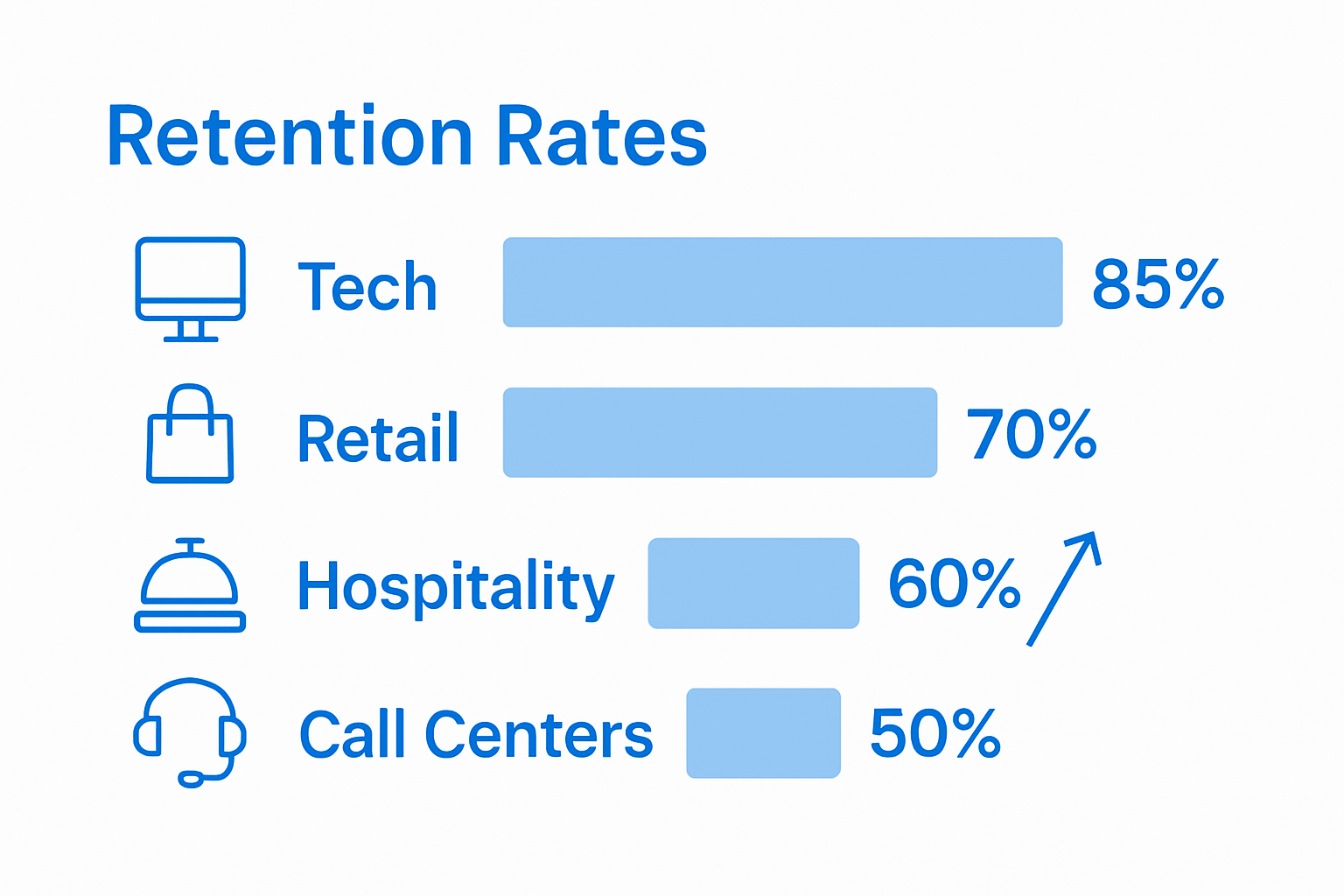
Companies can leverage industry benchmarks to develop targeted retention strategies. By comparing their retention rates against sector-specific standards, organizations gain valuable perspective on their workforce stability. Some industries might consider a 15% annual turnover rate acceptable, while others view anything above 5% as problematic. Understanding these nuanced benchmarks allows business leaders to set realistic retention goals, identify potential systemic issues, and implement proactive measures to improve employee engagement.
Advanced retention analysis goes beyond simple percentage comparisons. Sophisticated organizations now examine retention through multiple lenses, including segmentation by job role, department, demographic groups, and tenure. These granular insights help companies pinpoint specific areas of workforce vulnerability, develop tailored retention programs, and create more supportive work environments that encourage long-term employee commitment. By transforming retention data into actionable intelligence, businesses can build more resilient, stable, and productive workforces.
Factors Influencing Employee Retention Rate
Employee retention is a complex ecosystem influenced by multiple interconnected factors that extend far beyond simple compensation. Understanding the reasons employees leave their jobs reveals a nuanced landscape of workplace dynamics that organizations must carefully navigate. While competitive salary remains important, modern employees seek comprehensive workplace experiences that address their professional and personal development needs.
Workplace culture emerges as a critical determinant of retention, with significant implications for employee engagement and long-term commitment. Organizational environment plays a pivotal role in determining whether talented professionals choose to stay or seek opportunities elsewhere. Key cultural elements include leadership quality, communication transparency, opportunities for professional growth, recognition of achievements, and a sense of meaningful contribution. Toxic workplace cultures can rapidly erode employee loyalty, while positive, supportive environments create powerful emotional connections that transcend traditional employment transactional relationships.
Beyond cultural considerations, retention hinges on several strategic elements. Compensation remains fundamental, but employees now evaluate total rewards packages that include flexible work arrangements, professional development opportunities, health and wellness programs, and meaningful career progression paths. Leadership quality dramatically impacts retention, with employees consistently citing poor management as a primary reason for voluntary departure. Effective leaders who provide clear communication, demonstrate genuine care for their team’s professional growth, and create inclusive work environments can significantly reduce turnover rates.
The most successful organizations adopt a holistic approach to retention, recognizing that employee engagement is a multifaceted challenge. This involves continuous feedback mechanisms, personalized professional development plans, competitive compensation structures, and a genuine commitment to creating supportive work environments. By understanding and proactively addressing the complex factors that influence employee satisfaction, companies can create workplace ecosystems that not only retain top talent but also foster innovation, productivity, and long-term organizational success.
Impact of Retention Rate on Business Outcomes
Retention rates serve as a critical barometer of organizational health, directly influencing multiple dimensions of business performance. High employee turnover can dramatically undermine an organization’s operational effectiveness, creating a cascading series of financial and strategic challenges that extend far beyond simple workforce management. The economic implications of poor retention are substantial, with direct and indirect costs that can significantly erode a company’s competitive positioning.
The financial impact of employee turnover is profound and multifaceted. Replacement costs typically range between 50% to 250% of an employee’s annual salary, encompassing recruitment expenses, training investments, reduced productivity during transition periods, and potential lost business opportunities. Beyond monetary considerations, high turnover disrupts team dynamics, erodes institutional knowledge, and creates persistent instability that can undermine long-term strategic initiatives. Organizations experiencing frequent workforce disruptions often struggle to maintain consistent performance levels, innovation capacity, and competitive momentum.

Beyond immediate financial consequences, retention rates fundamentally shape organizational culture and strategic capabilities. Companies with consistently high retention rates demonstrate enhanced team cohesion, deeper institutional knowledge, more robust internal talent pipelines, and improved overall operational efficiency. Employees in stable work environments tend to be more engaged, collaborative, and committed to achieving organizational objectives. This psychological and professional continuity translates into tangible business advantages, including higher productivity, more effective knowledge transfer, and a more resilient organizational infrastructure.
Strategic leaders increasingly recognize retention as a critical performance metric that extends well beyond human resources considerations. By developing comprehensive retention strategies that address compensation, professional development, workplace culture, and employee engagement, organizations can transform workforce stability into a sustainable competitive advantage. The most successful companies view retention not as a reactive challenge, but as a proactive opportunity to build adaptive, high-performing teams that can navigate complex business environments with agility and sustained excellence.
Proven Strategies to Boost Retention Rates
Building a robust retention strategy requires a comprehensive, multifaceted approach that addresses the complex needs of modern workplace professionals. Effective employee retention strategies encompass far more than traditional compensation models, demanding nuanced, holistic interventions that recognize the evolving expectations of today’s workforce. Successful organizations understand that retention is not a singular action but a continuous, dynamic process of engagement and alignment.
Career development emerges as a critical cornerstone of retention efforts. Professional growth opportunities play a pivotal role in maintaining employee motivation and commitment. This involves creating clear career progression pathways, implementing mentorship programs, offering continuous learning initiatives, and providing challenging assignments that expand employees’ skill sets. Organizations that invest in their employees’ professional development signal a genuine commitment to individual growth, which dramatically increases the likelihood of long-term retention. Strategic learning and development programs should be tailored to individual career aspirations, combining organizational needs with personal professional objectives.
Workplace culture and leadership quality represent another fundamental dimension of retention strategy. Creating an environment of psychological safety, transparent communication, and genuine recognition transforms workplace dynamics. This includes implementing robust feedback mechanisms, ensuring fair and equitable treatment, promoting work-life balance, and developing leadership capabilities that prioritize empathy, active listening, and meaningful employee support. Managers must transition from traditional supervisory roles to becoming career coaches who are genuinely invested in their team members’ professional and personal success.
The most successful retention strategies adopt a personalized, data-driven approach. This involves regularly collecting and analyzing employee engagement metrics, conducting comprehensive exit and stay interviews, and developing adaptive retention programs that respond to evolving workforce needs. By treating retention as a strategic imperative rather than an HR function, organizations can create workplace ecosystems that not only attract top talent but also cultivate an environment where employees feel valued, challenged, and intrinsically motivated to contribute their best work.
Boost Your Employee Retention with Data-Driven Insights
Understanding your retention rate is just the first step toward building a more stable and engaged workforce. This article highlights the importance of measuring and improving employee retention to reduce costly turnover and boost productivity. If you struggle with identifying who is at risk of quitting or want to create a culture that nurtures growth, contribution, safety, and connection, relying on guesswork is no longer enough.
OpenElevator offers a revolutionary platform that uses a proprietary algorithm to uncover critical insights on values alignment and interpersonal fit in just a 5-minute bias-free survey. These insights empower leaders to target retention efforts precisely where they matter most by predicting turnover risks and strengthening team cohesion. Whether you run a startup or a Fortune 500 company, OpenElevator helps you transform employee retention from a challenge into a lasting competitive advantage.
Take control of your retention rate today by visiting OpenElevator. Discover how our tool can identify employees at high risk of leaving, improve engagement, and boost long-term workforce stability. Don’t wait until turnover costs impact your bottom line. Get started now with OpenElevator retention solutions and move from uncertainty to actionable retention strategy.
Frequently Asked Questions
What is retention rate in the workplace?
Retention rate is the percentage of employees an organization successfully retains over a specific timeframe, indicating the organization’s ability to maintain its workforce and minimize turnover.
Why is retention rate important for businesses?
Retention rate is crucial as it provides insights into workforce stability, employee engagement, and overall organizational health, ultimately affecting productivity, culture, and financial performance.
How do you calculate retention rate?
To calculate retention rate, divide the number of employees who remain with the company during a specific period by the total number of employees at the start of that period, then multiply by 100.
What factors influence employee retention rates?
Employee retention rates are influenced by several factors, including workplace culture, compensation, career development opportunities, leadership quality, and the overall employee experience.