
Exit interviews rarely reveal anything new. By the time you sit down with a departing employee, the concerns they share are usually ones you have heard before, often multiple times from different people. The real issue is not discovery but action. 61% of employees voiced unresolved concerns before leaving, yet those concerns went unaddressed until resignation became inevitable. For SME leaders facing high turnover, the path forward requires shifting focus from reactive exit conversations to proactive retention strategies that catch problems while you still have time to fix them.
Table of Contents
- Why Exit Interviews Mostly Confirm What You Already Know
- Stay Interviews: The Proactive Alternative To Exit Interviews
- Understanding Us Turnover Causes And Costs For Smes
- How To Use Exit Interview Data Strategically Despite Its Limits
- Explore Tailored Employee Retention Solutions For Smes
- Frequently Asked Questions
Key takeaways
| Point | Details |
|---|---|
| Exit interviews confirm known issues | Most departing employees repeat concerns they raised earlier but were ignored. |
| Stay interviews prevent turnover | Proactive check-ins can reduce turnover by 33% by addressing issues early. |
| US turnover averages 13% | Nearly 42% is preventable through better management and career development. |
| Turnover costs are substantial | Replacement expenses range from 40% to 200% of salary, hitting SMEs hardest. |
| Strategic exit data analysis works | Companies acting on patterns see 20-25% retention improvement when they follow through. |
Why exit interviews mostly confirm what you already know
The uncomfortable truth about exit interviews is that they function more like autopsies than diagnoses. Employees typically raise concerns about workload, career progression, or management style long before they decide to leave. Yet these signals get buried under daily operations, dismissed as isolated complaints, or acknowledged without meaningful follow-up. When the resignation letter arrives, the exit interview simply documents what went wrong, not what you did not know.
Research shows that 61% of employees voiced unresolved concerns before making their exit decision. These are not new revelations surfacing in a final conversation. They are repeated feedback that leadership either missed or chose not to prioritize. For SMEs operating with lean teams and limited HR infrastructure, this pattern becomes especially damaging because losing even one key player disrupts operations and morale across the entire organization.
Common themes emerge consistently in exit interviews:
- Lack of career advancement opportunities despite verbal commitments
- Management behaviors that erode trust and psychological safety
- Cultural misalignment between stated values and daily practices
- Workload imbalances that burn out high performers
- Compensation falling behind market rates without transparent communication
The problem is not that exit interviews fail to capture these issues. The problem is that by the time you are conducting the interview, the employee has already mentally checked out, often weeks or months earlier. Their decision calculus is complete. The concerns they share are the same ones they mentioned in performance reviews, team meetings, or casual conversations that never triggered substantive change.
“Exit interviews tell you what you failed to act on, not what you failed to hear.”
SME leaders face a unique challenge here. Without dedicated people operations teams, concerns often reach leadership through informal channels or not at all. Managers may filter feedback, believing they can handle issues locally. Employees may self-censor, worried about repercussions in a small organization where everyone knows everyone. By the time someone resigns, the limitations of exit interviews become painfully clear. You are collecting data on problems you could have solved if you had addressed them when they first surfaced. The real opportunity lies in creating systems that surface and resolve concerns before resignation becomes the only option employees see. That requires shifting from reactive exit conversations to proactive engagement strategies that give you visibility into team health while you still have the ability to intervene. Tools like employee retention solutions help leaders spot patterns and risks early, turning retention from a guessing game into a manageable priority.

Stay interviews: the proactive alternative to exit interviews
Stay interviews flip the retention conversation on its head. Instead of asking why someone left, you ask why they stay and what might change that calculus. These structured check-ins happen during employment, when you still have the opportunity to address concerns, adjust roles, or clarify career paths. The goal is simple: identify retention risks before they become resignation letters.
The data supporting stay interviews is compelling. Organizations implementing regular stay interview programs can prevent 75% of turnover causes and reduce company turnover by 33%. That is not marginal improvement. For an SME losing three people per year at significant replacement cost, preventing even one departure pays for the program many times over. The return comes from catching issues early, when solutions are still straightforward and relationships are intact.
Effective stay interviews require more than good intentions. Managers need training on how to create psychological safety, ask open-ended questions, and respond to feedback without defensiveness. The conversation should feel collaborative, not interrogative. Questions focus on what energizes the employee, what frustrates them, and what would make them consider opportunities elsewhere. The key is consistency. One-off conversations feel performative. Quarterly or biannual check-ins signal genuine commitment to employee experience.
Consider these core stay interview questions:
- What aspects of your role do you find most engaging right now?
- What would make your work more fulfilling or impactful?
- Are there skills you want to develop that your current role does not utilize?
- What concerns, if unaddressed, might lead you to explore other opportunities?
- How well does your workload align with your capacity and priorities?
Pro Tip: Schedule stay interviews as calendar events, not ad hoc conversations. Treating them with the same priority as performance reviews signals that retention matters as much as productivity.
The power of stay interviews lies in their preventive nature. When an employee mentions feeling stuck in their role, you can explore lateral moves, project assignments, or skill development before frustration builds. When workload concerns surface, you can redistribute responsibilities or adjust timelines before burnout sets in. These interventions cost far less than replacement.
For SME leaders, stay interviews also build trust in ways that annual surveys cannot. Employees see that leadership cares enough to ask and, more importantly, to act on what they hear. This creates a feedback loop where people feel safer raising concerns early, knowing they will be taken seriously. Over time, this cultural shift reduces the number of issues that fester into resignation triggers. Implementing stay interviews does not require sophisticated HR systems. It requires commitment from managers to listen actively and follow through on what they learn. When combined with visibility tools like employee retention solutions, stay interviews become part of a broader retention strategy that gives leaders real-time insight into team health and engagement.
Understanding US turnover causes and costs for SMEs
Voluntary turnover in the United States averages 13%, but that figure masks significant variation by industry, role, and organization size. What matters more for SME leaders is that 42% of this turnover is preventable through better management practices, clearer career paths, and stronger work-life balance. Nearly half of the people walking out your door did not have to leave. They chose to because staying felt worse than the uncertainty of starting over.
The top reasons employees quit tell a consistent story. Career development stagnation ranks first. People want to grow, and when they see no path forward, they find one elsewhere. Work-life balance issues come next, particularly as remote and hybrid work reset expectations around flexibility. Management quality rounds out the top three. Employees do not leave companies; they leave managers who micromanage, fail to recognize contributions, or create toxic team dynamics.
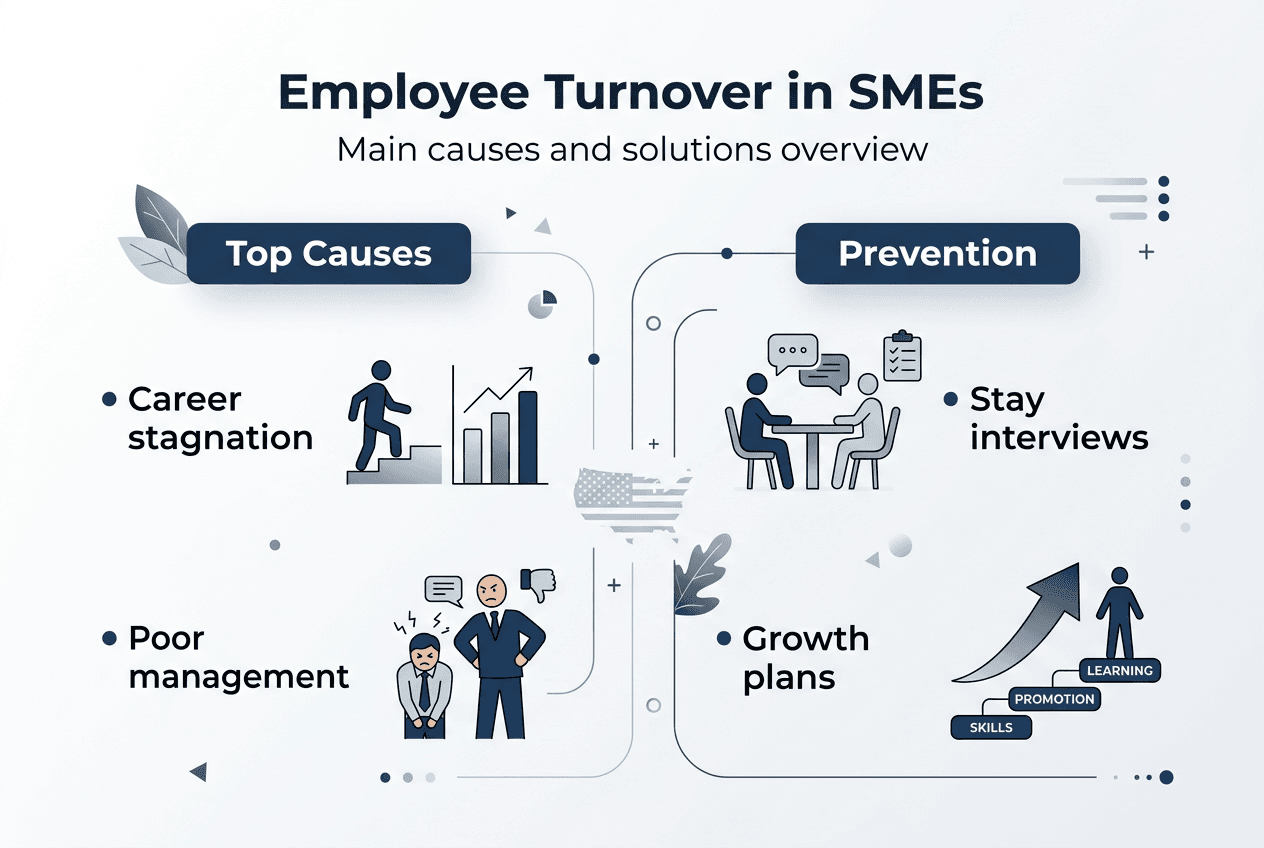
| Turnover Driver | Impact on SMEs | Prevention Strategy |
|---|---|---|
| Career stagnation | High performers leave fastest | Create visible growth paths and skill development opportunities |
| Work-life imbalance | Burnout drives sudden departures | Set realistic workloads and respect boundaries |
| Poor management | Erodes trust across teams | Train managers on coaching and feedback skills |
| Compensation gaps | Lose talent to competitors | Conduct regular market benchmarking |
The financial impact of turnover hits SMEs disproportionately hard. Replacement costs range from 40% to 200% of annual salary depending on role complexity and seniority. For a $60,000 position, you are looking at $24,000 to $120,000 in recruiting, onboarding, training, and lost productivity. First-year turnover accounts for roughly 40% of all departures, meaning poor hiring decisions compound the damage.
Beyond direct costs, turnover disrupts institutional knowledge, client relationships, and team morale. When a key player leaves, remaining employees absorb extra work while you search for a replacement. Customer service suffers. Projects stall. Other team members start questioning whether they should update their resumes too. This ripple effect is harder to quantify but equally damaging, especially in organizations where trust and collaboration drive results.
Pro Tip: Track turnover costs by role to identify where prevention efforts deliver the highest return. Losing an entry-level coordinator hurts differently than losing a senior account manager with client relationships.
For SME leaders, understanding these causes and costs is not academic. It shapes where you invest time and resources. If career development is your biggest risk, create mentorship programs and cross-training opportunities. If management quality is the issue, invest in leadership coaching and 360-degree feedback. If compensation lags the market, get transparent about what you can offer and where non-monetary benefits fill gaps. The key is diagnosing your specific retention challenges rather than applying generic solutions. US turnover statistics provide benchmarks, but your organization’s data tells the real story. Exit interviews, stay interviews, and engagement surveys all contribute pieces of the puzzle. When analyzed together, they reveal patterns that point toward targeted interventions with measurable impact. Platforms like employee retention solutions help SME leaders connect these dots, turning scattered feedback into actionable retention strategies.
How to use exit interview data strategically despite its limits
Exit interviews may not reveal new problems, but they can still drive retention improvements if you treat the data as pattern recognition rather than isolated incidents. The value emerges when you analyze themes across multiple departures, identify systemic issues, and commit to addressing root causes. Without this disciplined approach, exit interviews become performative exercises that waste everyone’s time.
Start with structured, consistent questions focused on the factors that actually drive turnover. Ask about management effectiveness, career development opportunities, workload sustainability, and cultural alignment. Avoid vague questions like “What could we have done better?” in favor of specific prompts like “Did you feel your manager provided clear expectations and regular feedback?” Standardized questions enable comparison across interviews and reveal patterns that individual responses might obscure.
- Conduct exit interviews within the first week of notice to capture honest feedback before the employee mentally checks out.
- Use a neutral third party or HR representative rather than the direct manager to increase candor.
- Record responses in a centralized database that allows quarterly or annual analysis.
- Look for recurring themes across at least five to ten interviews before drawing conclusions.
- Share aggregated findings with leadership and commit to specific action plans with timelines.
- Close the loop by communicating changes made in response to exit feedback, even to current employees.
Pro Tip: Outsource exit interviews to an external firm if your SME lacks internal HR capacity. Departing employees often speak more freely to someone outside the organization, especially in small companies where relationships are personal.
The real power of exit data comes from acting on what you learn. Companies that analyze exit interview patterns and implement targeted changes see 20-25% retention improvement in subsequent periods. This is not magic. It is closing the feedback loop. When employees see that leadership takes exit feedback seriously enough to change policies, improve manager training, or adjust compensation structures, current employees notice. Trust builds. Retention improves.
| Exit Data Analysis Approach | Outcome | Implementation Difficulty |
|---|---|---|
| Ad hoc review of individual interviews | Minimal impact, reactive only | Low |
| Quarterly theme analysis across departures | Identifies patterns, enables targeted fixes | Medium |
| Integration with stay interviews and engagement data | Comprehensive retention strategy | High but highest ROI |
Combining exit data with other signals creates a fuller picture. If exit interviews highlight management issues and stay interviews confirm that current employees share the same concerns, you have validation that demands action. If engagement surveys show declining scores in career development and exit interviews cite lack of growth as a primary departure reason, the pattern is undeniable. This triangulation moves retention from guesswork to evidence-based decision making.
For SME leaders juggling multiple priorities, the temptation is to collect exit data and move on. Resist that impulse. Schedule quarterly reviews where leadership examines exit themes, compares them to current employee feedback, and commits to specific interventions. Track whether those interventions reduce turnover in the targeted areas. Treat retention as a measurable business outcome, not an HR checkbox. The exit interview best practices that separate high-performing organizations from the rest come down to discipline and follow-through. Exit interviews alone will not fix retention. But when combined with proactive engagement strategies and supported by tools like employee retention solutions, they become one input in a broader system that gives you visibility into team health and the ability to intervene before valuable people walk out the door.
Explore tailored employee retention solutions for SMEs
Reducing turnover requires more than good intentions. It demands visibility into what is actually happening below the surface of your teams, early warning signals when disengagement starts building, and practical frameworks for addressing concerns before they become resignation letters. OpenElevator provides exactly that: clear, quantifiable insight into retention risk, team dynamics, and hiring fit designed specifically for SME leaders who cannot afford to lose key talent. Instead of relying on instinct or reacting to exits after the fact, you get defensible data that shows where to focus attention and what interventions will actually move the needle. This includes stay interview frameworks, manager training resources, and pattern analysis that connects feedback to action.
Partner with retention experts who understand the unique challenges SMEs face. Explore employee retention solutions that turn employee experience into actionable insight, helping you act earlier, retain top performers, and build the stable, engaged teams your business needs to thrive.
Frequently asked questions
Why are exit interviews often unhelpful?
Exit interviews typically confirm issues employees already raised rather than uncovering new problems. By the time someone resigns, they have mentally moved on, and their feedback reflects unresolved concerns leadership heard but did not address. The conversation happens too late to change the outcome, making it more of a post-mortem than a diagnostic tool.
How can stay interviews improve retention in SMEs?
Stay interviews identify concerns while employees are still engaged, giving leaders time to intervene with role adjustments, development opportunities, or workload changes. Organizations using structured stay interview programs see up to 33% turnover reduction because they address retention risks proactively. For SMEs, this prevents costly departures before they happen.
What are the main reasons employees quit in US SMEs?
Career stagnation, poor work-life balance, and ineffective management drive most voluntary turnover. Employees leave when they see no growth path, feel burned out by unsustainable workloads, or lose trust in leadership. Addressing these factors proactively can prevent 42% of voluntary turnover, significantly reducing both costs and operational disruption.
How much does employee turnover cost SMEs?
Replacement costs range from 40% to 200% of salary depending on role complexity and seniority. A $60,000 position can cost $24,000 to $120,000 to replace when you factor in recruiting, onboarding, training, and lost productivity. First-year turnover makes up about 40% of all departures, compounding the financial impact on SMEs with limited budgets.
What best practices make exit interviews more effective?
Use structured questions focused on management quality, career development, and cultural fit to enable pattern analysis across multiple departures. Analyze exit data quarterly to identify systemic issues rather than treating each interview as an isolated event. Follow up with specific action plans and communicate changes to current employees, which builds trust and can improve retention by 20-25% when done consistently.