
Most American companies face a startling challenge—annual turnover costs can reach as high as 150% of an employee’s salary. The impact goes beyond financial strain, shaking team morale and disrupting performance across every department. With so much at stake, understanding how retention tools transform employee engagement is now a top priority for business leaders who want to keep their teams strong and productive.
Table of Contents
- Defining Retention Tools And Their Purpose
- Key Drivers Of Employee Turnover In The Us
- How Retention Tools Identify At-Risk Talent
- Aligning Core Needs For Sustained Engagement
- Financial And Competitive Impact Of Using Retention Tools
Key Takeaways
| Point | Details |
|---|---|
| Retention tools enhance employee engagement | These tools provide actionable insights that help organizations understand and improve workforce satisfaction and mitigate turnover risks. |
| Proactive strategies are essential | Advanced retention tools use predictive analytics to identify potential flight risks, allowing for timely interventions. |
| Holistic workplace experiences matter | Companies need to prioritize flexible work arrangements and employee well-being to meet modern workforce expectations and reduce attrition. |
| Retention tools lead to financial savings | Implementing effective retention strategies minimizes recruitment costs and preserves valuable institutional knowledge, offering a competitive advantage. |
Defining Retention Tools and Their Purpose
Retention tools represent strategic resources designed to help organizations understand, manage, and improve employee experience and workplace engagement. These sophisticated solutions go beyond traditional human resources approaches by providing actionable insights into workforce dynamics. Stay tools are strategic initiatives that systematically address workplace satisfaction and reduce potential turnover risks.
At their core, retention tools encompass multiple interconnected strategies focused on understanding employee needs. These typically include comprehensive feedback mechanisms, performance tracking systems, engagement surveys, professional development platforms, and advanced analytics that predict potential workforce challenges. Practical resources like checklists and questionnaire templates help organizations develop targeted retention strategies that address specific workplace dynamics.
Effective retention tools share several critical characteristics. They provide real-time insights into employee sentiment, identify potential flight risks before they become critical, enable personalized engagement strategies, and create data-driven pathways for improving workplace culture. By integrating advanced analytics with human-centric approaches, these tools transform traditional retention methods from reactive measures to proactive workforce management solutions.
Here is a comparison of traditional retention methods versus advanced retention tools:
| Approach | Traditional Methods | Advanced Retention Tools |
|---|---|---|
| Data Utilization | Limited to basic reports | Uses predictive analytics and real-time metrics |
| Personalization | Generalized policies | Tailored engagement strategies |
| Response Speed | Reactive to turnover | Proactive, early intervention |
| Business Impact | Higher turnover risk | Lower attrition, stronger culture |
Pro Tip for HR Leaders: Create a comprehensive retention strategy by combining quantitative data insights with qualitative employee feedback, ensuring a holistic approach to understanding and addressing workforce engagement challenges.
Key Drivers of Employee Turnover in the US
Employee turnover represents a complex challenge for American businesses, driven by multifaceted workplace dynamics that extend far beyond simple job dissatisfaction. High employee attrition rates emerge from inadequate compensation, work/life imbalance, and unrealistic workload expectations, creating significant operational disruptions for organizations across various industries.
The primary drivers of workforce attrition in the United States typically encompass several critical dimensions. Compensation remains a fundamental factor, with employees consistently seeking competitive salaries that reflect their skills and market value. Beyond monetary considerations, workplace culture, professional growth opportunities, management relationships, and emotional engagement play equally significant roles in an employee’s decision to remain with or leave an organization.

Modern American workers prioritize holistic workplace experiences that transcend traditional employment models. They seek environments offering flexible work arrangements, meaningful professional development pathways, robust mental health support, and organizational cultures that demonstrate genuine commitment to employee well-being. Companies that fail to recognize and adapt to these evolving expectations risk experiencing higher turnover rates and diminished talent retention.
Pro Tip for Business Leaders: Conduct regular, anonymous employee sentiment surveys to proactively identify potential retention risks and develop targeted strategies that address specific workforce needs before talented professionals consider leaving.
How Retention Tools Identify At-Risk Talent
Interactive resources like checklists and questionnaire templates help organizations systematically identify at-risk talent by developing sophisticated diagnostic approaches that go beyond traditional performance assessments. These advanced tools analyze complex workplace dynamics, measuring employee engagement, sentiment, and potential flight risks through comprehensive data collection and nuanced interpretation.
The identification process typically involves multi-dimensional assessment strategies that examine psychological, professional, and organizational factors. Key metrics include performance consistency, communication patterns, professional development trajectory, interpersonal relationships, compensation satisfaction, and alignment between individual career goals and organizational opportunities. By integrating quantitative performance data with qualitative employee insights, retention tools create holistic profiles that predict potential workforce disruptions.
Predictive analytics play a critical role in modern talent retention strategies. Stay tools collect targeted employee insights to pinpoint growth opportunities and shape supportive work environments, enabling proactive interventions before talented professionals consider leaving. These sophisticated systems analyze behavioral patterns, engagement metrics, and sentiment indicators to generate early warning signals about potential employee disengagement.
Pro Tip for HR Strategists: Implement regular, anonymous pulse surveys with actionable follow-up mechanisms to transform employee feedback into meaningful organizational improvements, creating a culture of continuous listening and responsive management.
Aligning Core Needs for Sustained Engagement
Employee engagement hinges on understanding and strategically addressing fundamental workplace needs, transforming traditional management approaches into dynamic, human-centered strategies. Modern organizations recognize that engagement is not a one-size-fits-all proposition, but a nuanced interplay of psychological, professional, and organizational factors that require personalized attention and continuous adaptation.
The core dimensions of sustainable employee engagement encompass multiple interconnected elements. These include psychological safety, professional growth opportunities, meaningful work alignment, interpersonal connections, and a sense of organizational purpose. By creating environments that systematically address these fundamental human needs, companies can develop workforce ecosystems that naturally promote retention, productivity, and intrinsic motivation.
Strategic engagement approaches involve encouraging open communication, supporting employee well-being, and implementing robust recognition mechanisms. Successful organizations move beyond transactional employment models, instead cultivating workplace cultures that treat employees as integral partners in organizational success. This means developing transparent communication channels, providing meaningful feedback mechanisms, and creating environments where individual contributions are genuinely valued and celebrated.
Pro Tip for Leadership Teams: Conduct quarterly comprehensive engagement assessments that go beyond traditional surveys, using multi-dimensional evaluation tools to capture subtle shifts in employee sentiment and proactively address potential retention challenges.
Financial and Competitive Impact of Using Retention Tools
Strategic employee training and development practices help minimize the substantial financial impact of workforce turnover, revealing the critical role of retention tools in organizational financial health. The economic consequences of employee attrition extend far beyond simple replacement costs, encompassing productivity disruptions, knowledge loss, and institutional memory erosion that can significantly impair competitive positioning.
The direct financial burden of employee turnover is staggering. Companies can expect to invest between 50% to 150% of an employee’s base salary in recruiting, onboarding, and training replacement talent. This economic drain is particularly pronounced in knowledge-intensive industries where specialized skills and institutional understanding take months or even years to develop fully. High-performance retention tools provide a strategic mechanism for identifying and addressing potential workforce disruptions before they escalate into costly talent migrations.
Beyond immediate financial metrics, retention tools deliver profound competitive advantages by stabilizing organizational knowledge, maintaining team cohesion, and creating environments of sustained performance. They enable businesses to transform traditional human resources approaches from reactive administrative functions into proactive strategic capabilities. By providing granular insights into workforce dynamics, these tools help leaders make data-driven decisions that optimize talent management, reduce organizational friction, and create more resilient, adaptive workplace ecosystems.
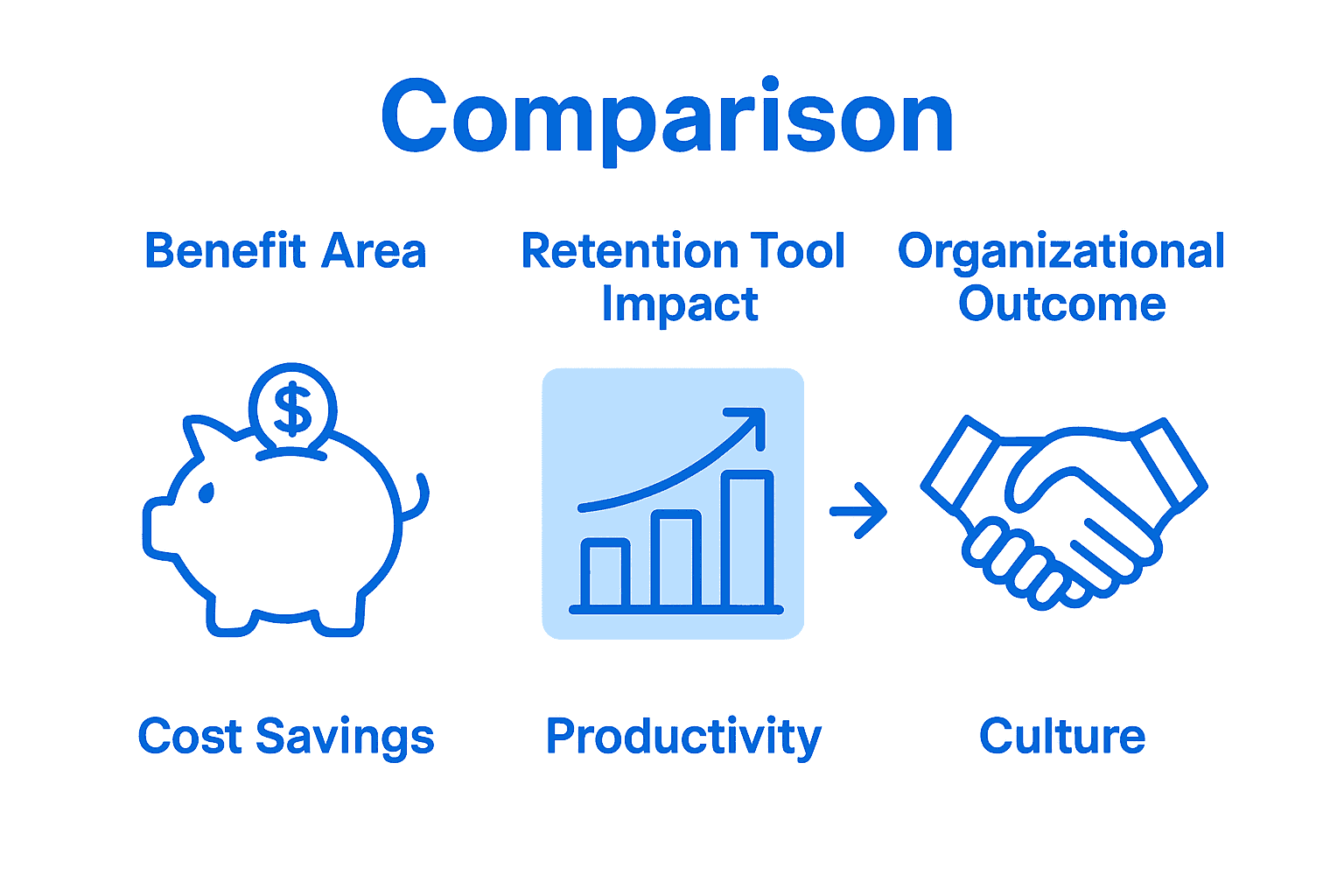
This summary highlights the primary financial and competitive benefits of using retention tools:
| Benefit Area | Retention Tool Impact | Organizational Outcome |
|---|---|---|
| Cost Control | Reduces hiring and onboarding expenses | Significant long-term savings |
| Productivity | Minimizes disruption from turnover | Maintains performance standards |
| Knowledge Management | Preserves critical in-house expertise | Protects institutional memory |
| Competitive Edge | Stabilizes workforce for growth | Enhances talent strategy success |
Pro Tip for Business Strategists: Implement a comprehensive talent retention dashboard that tracks key performance indicators, including turnover rates, replacement costs, and engagement metrics, to develop a holistic understanding of your organization’s human capital investment strategy.
Unlock Lasting Employee Engagement with Data-Driven Retention Tools
Employee turnover remains one of the most costly challenges for U.S. companies unable to proactively identify who’s at risk of leaving. This article highlights that retention tools equipped with predictive insights help address core employee needs such as safety, growth, and connection—key factors for sustained engagement. If you are seeking to move beyond guesswork and traditional reactive retention strategies, understanding values alignment and interpersonal fit within your teams is crucial to improving long-term retention and productivity.
Experience how OpenElevator transforms your retention efforts by using a proprietary algorithm that identifies employees at risk through a simple 5-minute bias-free survey. Our platform reveals how well your employees’ core needs are met and predicts flight risks based on alignment with company values and team dynamics. Join businesses from startups to Fortune 500s who have drastically lowered turnover costs and boosted workplace engagement. Take the first step toward data-powered retention—discover your workforce’s hidden insights now with OpenElevator.
Learn more about how identifying at-risk talent and aligning employee needs drives engagement in this insightful article on Why Invest in Retention Tools for U.S. Companies.
Frequently Asked Questions
What are retention tools and their purpose?
Retention tools are strategic resources that help organizations manage and improve employee experience and engagement. They provide insights into workplace dynamics, enabling companies to address employee needs and reduce turnover risks.
How do retention tools identify at-risk employees?
Retention tools assess various factors, such as performance consistency, communication patterns, and engagement metrics. By analyzing these elements, they can predict potential flight risks and help organizations intervene proactively before talent decides to leave.
What are the key benefits of investing in retention tools?
Investing in retention tools can lead to significant cost savings, minimize productivity disruptions, preserve critical institutional knowledge, and enhance competitive advantage by stabilizing the workforce and improving employee engagement strategies.
How can organizations effectively use retention tools to improve employee retention?
Organizations can effectively use retention tools by combining quantitative data insights with qualitative employee feedback. Regularly conducting engagement assessments and employee sentiment surveys can help address evolving workforce needs and foster a supportive work environment.