
Most american tech companies underestimate the impact of onboarding on employee retention. While many leaders view it as a brief formality, research shows that comprehensive onboarding can improve retention by as much as 82 percent. The ongoing talent war means every C-level executive must reconsider how new hires experience their first months. Understanding the true role of onboarding will reveal practical strategies for turning fresh recruits into committed, high-performing team members.
Table of Contents
- Defining Onboarding And Common Misconceptions
- Key Dimensions And Stages Of Onboarding
- How Onboarding Enhances Employee Engagement
- The Link Between Onboarding And Long-Term Retention
- Measuring Success And Avoiding Common Pitfalls
Key Takeaways
| Point | Details |
|---|---|
| Comprehensive Onboarding | Onboarding is a strategic process essential for long-term employee engagement and retention, extending beyond mere administrative tasks. |
| Continuous Process | Effective onboarding should continue for several months, not just days or weeks, to truly integrate new hires into the organization. |
| Four Key Dimensions | Focus on compliance, clarification, connection, and culture to enhance the employee experience and improve retention rates. |
| Measuring Effectiveness | Use specific metrics such as retention rates and satisfaction surveys to evaluate the success of your onboarding initiatives. |
Defining Onboarding and Common Misconceptions
Most leaders get onboarding fundamentally wrong. What they perceive as a quick paperwork shuffle is actually a nuanced, strategic process critical for long-term employee engagement and retention. According to the Society for Human Resource Management (SHRM), onboarding represents a comprehensive integration journey, not merely a single orientation event.
Traditionally, organizations have treated onboarding as a transactional checklist. New hires complete tax forms, receive their login credentials, and sit through a few introductory meetings. But true onboarding goes far beyond administrative tasks. It’s a deliberate, structured approach to help employees understand their role, connect with company culture, build crucial relationships, and develop a sense of belonging. The goal isn’t just compliance – it’s creating an emotional connection that transforms new hires into committed team members.
Common misconceptions about onboarding persist across industries. Many leaders believe it should last only a few days or weeks. However, effective onboarding is an ongoing process that can extend several months, sometimes up to a year. Research demonstrates that comprehensive onboarding programs can improve employee retention by up to 82% and productivity by over 70%. These aren’t just numbers – they represent real organizational transformation through strategic human capital management.
Pro Tip for Effective Onboarding: Design a 90-day onboarding roadmap that goes beyond paperwork, focusing on relationship building, skill integration, and cultural immersion. Schedule regular check-ins, assign a mentor, and create structured opportunities for the new hire to contribute meaningfully from day one.
Key Dimensions and Stages of Onboarding
Onboarding isn’t a monolithic process, but a sophisticated journey with multiple interconnected dimensions. Research from leading organizational psychology studies reveals four critical content dimensions that shape the employee experience: compliance, clarification, connection, and culture. These dimensions represent a holistic approach to integrating new team members beyond mere administrative tasks.

The onboarding journey typically unfolds across several strategic stages. According to the Young Academy Leiden’s comprehensive position paper, these stages include pre-arrival preparation, first-day orientation, initial months of integration, and long-term organizational assimilation. Each stage serves a unique purpose – from initial paperwork and introductions to deeper cultural understanding and skill development. Successful organizations recognize that onboarding is not a one-time event, but a continuous process of engagement and professional development.
Each dimension plays a crucial role in transforming a new hire into a committed team member. Compliance ensures legal and procedural requirements are met. Clarification helps employees understand their specific roles and expectations. Connection focuses on building interpersonal relationships and professional networks. Culture immersion allows new hires to understand and internalize the organization’s core values, communication styles, and unwritten social norms. By addressing these dimensions systematically, companies can dramatically improve employee retention, engagement, and overall organizational performance.
Here’s a concise breakdown of the four key onboarding dimensions and their primary business benefits:
| Dimension | What It Focuses On | Impact on Business |
|---|---|---|
| Compliance | Legal requirements, policies | Reduces risk, ensures regulatory safety |
| Clarification | Role understanding | Boosts productivity, lowers confusion |
| Connection | Relationship building | Increases engagement, teamwork |
| Culture | Values and social norms | Strengthens loyalty, reduces turnover |
Pro Tip for Dimensional Onboarding: Create a comprehensive onboarding matrix that explicitly maps each dimension to specific activities, ensuring no critical aspect of employee integration is overlooked. Design targeted interventions for each stage that address compliance, role clarity, relationship building, and cultural alignment.
How Onboarding Enhances Employee Engagement
Employee engagement is not a passive outcome, but an active process strategically cultivated through thoughtful onboarding. Groundbreaking research from contemporary academic studies reveals that a robust onboarding process dramatically strengthens organizational identification, creating a profound psychological connection between new employees and their workplace. When employees feel genuinely understood and integrated, their motivation and commitment surge exponentially.
The mechanics of engagement are complex but measurable. Peer-reviewed research highlights that effective onboarding programs directly correlate with higher engagement rates by emphasizing three critical elements: personal identity, meaningful connection, and crystal-clear role expectations. Organizations that invest in extended, structured onboarding see remarkable transformations – new hires transition from uncertain newcomers to confident, committed team members more rapidly and consistently.
Psychologically, engagement emerges when employees experience genuine belonging. This means moving beyond transactional paperwork to create experiences that demonstrate the organization’s investment in their individual growth and potential. Successful onboarding transforms initial professional interactions from impersonal transactions into meaningful relationships, helping new team members understand not just their job responsibilities, but their unique value within the larger organizational ecosystem. By consistently communicating purpose, providing clear pathways for development, and fostering interpersonal connections, companies can unlock unprecedented levels of discretionary effort and emotional commitment.
Pro Tip for Engagement-Driven Onboarding: Design personalized onboarding journeys that go beyond standardized checklists, incorporating individual strengths assessments, mentorship matching, and targeted professional development milestones that make each new hire feel uniquely valued and understood.
The Link Between Onboarding and Long-Term Retention
Employee retention isn’t a mysterious phenomenon, but a direct result of strategic organizational practices. Comprehensive doctoral research investigating workforce dynamics reveals that well-structured onboarding programs are critical catalysts for reducing turnover and creating lasting employee commitment. By establishing meaningful connections early, organizations can transform initial professional interactions into sustained, mutually beneficial relationships that dramatically improve long-term workforce stability.
The empirical evidence is compelling. Critical academic reviews of multiple retention studies consistently demonstrate that systematic onboarding approaches directly correlate with increased employee tenure. When companies invest thoughtfully in their onboarding processes, they create psychological anchors that make employees feel valued, understood, and intrinsically connected to the organization’s broader mission. This emotional investment goes far beyond traditional orientation – it’s about crafting an experience that communicates the employee’s unique significance within the organizational ecosystem.
Retention isn’t just about preventing departures; it’s about creating an environment where talented professionals choose to grow and thrive. Successful onboarding programs function as comprehensive integration strategies that address multiple dimensions of employee experience. They provide clear pathways for professional development, establish robust support systems, and continuously communicate the organization’s commitment to individual growth. By transforming onboarding from a transactional process into a strategic relationship-building initiative, companies can create powerful psychological contracts that inspire loyalty and discretionary effort.
Pro Tip for Retention-Focused Onboarding: Develop a dynamic, personalized onboarding framework that extends beyond the first 90 days, incorporating regular check-ins, mentorship opportunities, and individualized career development plans that demonstrate your genuine investment in each employee’s long-term success.
Measuring Success and Avoiding Common Pitfalls
Onboarding effectiveness cannot be measured through intuition alone. According to the Society for Human Resource Management’s comprehensive measurement guide, organizations must track specific metrics that reveal the true impact of their integration strategies. These critical indicators include time-to-productivity, retention rates, new-hire satisfaction surveys, and performance benchmarks that provide tangible evidence of onboarding program success.
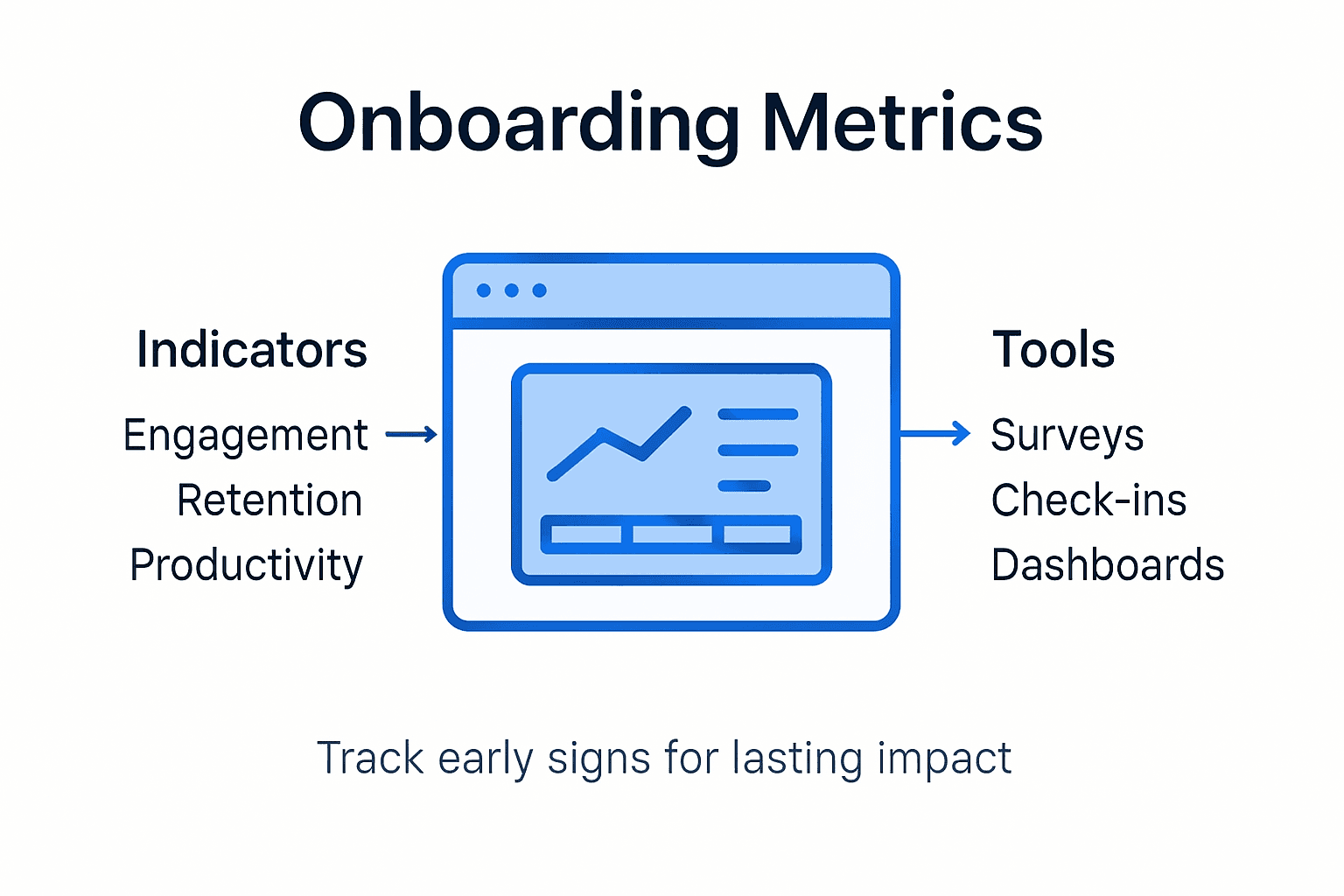
See how onboarding metrics compare in revealing program effectiveness at different stages:
| Metric | Measurement Focus | When to Use |
|---|---|---|
| Time-to-Productivity | Speed of new hire ramp-up | First 30-90 days |
| Retention Rate | Long-term employee stay | 6-12 months |
| Satisfaction Survey | Perceived onboarding value | After each key stage |
| Performance Benchmarks | Job skills and output | 30, 60, 90+ day reviews |
Detailed research from academic institutions highlights the most prevalent pitfalls that derail onboarding efforts. Common mistakes include overwhelming new employees with information, creating unclear expectations, neglecting ongoing support, and failing to establish meaningful connections. Successful organizations recognize that onboarding is not a linear process, but a dynamic journey requiring continuous feedback, adaptive strategies, and genuine commitment to employee integration.
Measuring onboarding success demands a holistic approach that goes beyond traditional metrics. It requires understanding the nuanced psychological transitions new employees experience. Sophisticated organizations develop multidimensional assessment frameworks that capture both quantitative performance data and qualitative engagement indicators. This means tracking not just operational metrics like time-to-productivity, but also capturing more subtle signals of organizational alignment, such as employee sentiment, interpersonal network development, and early indicators of cultural adaptation.
Pro Tip for Onboarding Measurement: Create a comprehensive 90-day assessment dashboard that combines hard metrics (productivity, retention) with soft metrics (employee sentiment, cultural alignment), using standardized surveys and structured feedback mechanisms to generate actionable insights into your onboarding program’s effectiveness.
Unlock Lasting Employee Retention Through Smart Onboarding and Data-Driven Insights
The article highlights how strategic onboarding is essential for long-term employee retention by building connection, clarifying roles, and aligning culture. Yet many organizations struggle to identify who is truly engaged or at risk of quitting early enough to intervene effectively. If you want to move beyond guesswork and leverage values alignment and interpersonal fit to reduce turnover, OpenElevator offers a breakthrough solution.
OpenElevator’s proprietary algorithm pinpoints employees at high risk of leaving by assessing how well their basic needs for safety, growth, contribution, and connection are met at work. This goes hand in hand with the article’s emphasis on connection and culture immersion being key onboarding dimensions that drive engagement and retention. Our platform empowers you to act proactively with targeted retention strategies based on precise data from a simple five-minute bias-free survey. Start transforming your onboarding into a strategic advantage today by learning more at OpenElevator’s platform. Secure your workforce future now before risks become costly departures.
Frequently Asked Questions
What is the purpose of onboarding in the workplace?
Onboarding is designed to integrate new employees into an organization, helping them understand their roles, connect with company culture, build relationships, and develop a sense of belonging rather than merely completing administrative tasks.
How long should the onboarding process last?
Effective onboarding should extend beyond a few days or weeks. Research indicates it can last several months, sometimes up to a year, to ensure comprehensive integration and support for new hires.
What are the key dimensions of successful onboarding?
The four key dimensions of effective onboarding are compliance, clarification, connection, and culture. These dimensions help shape the employee experience and are crucial for building engagement and retention.
How can companies measure the success of their onboarding programs?
Companies can measure onboarding success through metrics like time-to-productivity, retention rates, new-hire satisfaction surveys, and performance benchmarks, assessing both quantitative and qualitative aspects of the onboarding experience.