
Employee turnover costs mid-sized US companies between 30% to 150% of annual salary per departing employee. Despite heavy investments in retention software and AI-driven loyalty programs, many organizations see minimal returns or outright failure. The problem isn’t the technology itself, it’s the lack of real-time visibility into team dynamics and engagement patterns. This guide explains why continuous feedback systems and workforce analytics deliver measurable retention gains where traditional tools fall short, and how executives can implement visibility-driven strategies that actually work.
Table of Contents
- The High Cost Of Employee Turnover And Why Retention Tools Struggle
- Why Visibility Through Continuous Feedback Outperforms Traditional Retention Tools
- The Pitfalls Of Traditional Engagement Surveys And Ai Loyalty Programs
- How To Apply Visibility-Driven Retention Strategies In Your Organization
- Explore Employee Retention Solutions Tailored For Mid-Sized Companies
- Frequently Asked Questions About Retention Tools And Visibility
Key takeaways
| Point | Details |
|---|---|
| Retention tool ROI challenges | Many retention technologies fail due to implementation complexity, high costs, and unclear organizational strategy. |
| Visibility drives results | Real-time pulse surveys and analytics empower managers to act swiftly on engagement signals, reducing regrettable attrition. |
| Traditional surveys underperform | Annual engagement surveys suffer from low trust, biased responses, and minimal follow-through on employee feedback. |
| Continuous listening wins | Organizations using frequent pulse surveys see 75-90% response rates compared to 30-40% for annual surveys. |
| Manager enablement matters | Providing leaders with actionable insights and training delivers faster retention improvements than dashboards alone. |
The high cost of employee turnover and why retention tools struggle
The financial burden of losing employees extends far beyond recruitment expenses. Replacement costs include hiring, onboarding, lost productivity, and knowledge transfer failures. For specialized roles, these expenses quickly escalate toward the upper end of the 30% to 150% salary range.
Many organizations respond by purchasing sophisticated retention platforms, AI-powered engagement tools, or comprehensive HR analytics suites. Yet these investments frequently disappoint. A recent analysis found that most AI loyalty programs fail before deployment or cost more than they save. The mid-market faces unique challenges: limited IT resources, smaller budgets for experimentation, and less tolerance for expensive failures.
Why do these tools underdeliver? Implementation complexity ranks as the primary culprit. Organizations underestimate the effort required to integrate new systems with existing HR infrastructure, clean historical data, and train teams on proper usage. Even well-designed platforms become shelfware when adoption stalls.
Cost overruns compound the problem. Initial quotes rarely account for customization needs, ongoing maintenance, or the internal labor hours required to extract value from complex dashboards. One mid-sized manufacturing company spent $180,000 on an AI retention suite, only to discover their data quality issues prevented meaningful analysis. After six months, they abandoned the project entirely.
“Strategic misalignment kills more retention initiatives than bad technology. Companies deploy tools without clear objectives, measurable goals, or executive buy-in.”
Structural barriers also sabotage success:
- Turf wars between HR, IT, and department leaders over data ownership and access
- Lack of dedicated personnel to manage platforms and interpret results
- Resistance from managers who view new systems as bureaucratic overhead
- Insufficient budget for the training and change management required for adoption
The pattern repeats across industries. Organizations invest heavily in employee retention solutions expecting automated fixes, then struggle when technology alone doesn’t address underlying visibility gaps. The real issue isn’t whether retention tools work in theory. It’s whether they deliver practical value given organizational constraints and readiness.
Mid-sized companies need approaches that match their operational reality: limited resources, lean teams, and pressure to demonstrate ROI quickly. This requires rethinking what actually drives retention improvements.
Why visibility through continuous feedback outperforms traditional retention tools
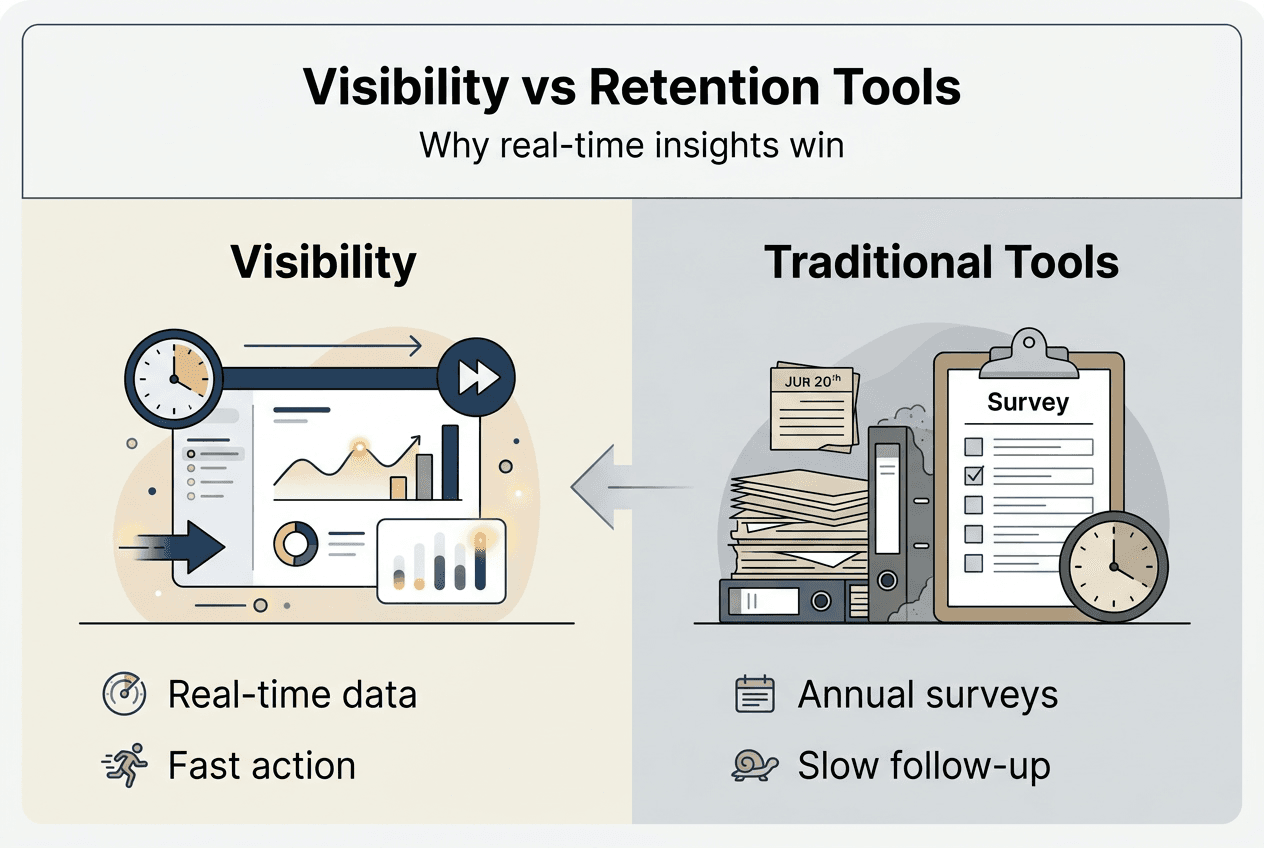
Real-time visibility into team dynamics changes how organizations identify and address retention risks. Unlike annual surveys or quarterly check-ins, continuous feedback systems capture engagement patterns as they develop, enabling swift intervention before employees disengage completely.
Pulse surveys exemplify this approach. These brief, frequent questionnaires achieve response rates of 75-90% compared to 30-40% for traditional annual surveys. Higher participation stems from reduced survey fatigue, perceived relevance, and visible follow-through on previous feedback.
The operational advantages extend beyond participation metrics. Continuous listening provides:
- Early warning signals when team morale declines or stress levels spike
- Trend analysis showing whether interventions actually improve engagement
- Department-level granularity revealing localized issues invisible in company-wide surveys
- Manager-specific insights enabling targeted coaching and support
This real-time intelligence enables timely interventions that reduce attrition. When a high-performing team suddenly reports decreased satisfaction, leaders can investigate immediately rather than discovering the problem months later during exit interviews.
Pro Tip: Configure pulse surveys to trigger manager alerts when individual or team scores drop significantly week over week, creating automatic escalation for potential retention risks.
The table below contrasts traditional and visibility-driven approaches:
| Approach | Frequency | Response Rate | Action Speed | Manager Enablement |
|---|---|---|---|---|
| Annual surveys | Once yearly | 30-40% | Slow (quarterly reviews) | Limited (aggregated data) |
| Pulse surveys | Weekly/biweekly | 75-90% | Fast (real-time alerts) | High (team-specific insights) |
| Exit interviews | At departure | 60-70% | Too late | Reactive only |
| Continuous listening | Ongoing | 70-85% | Immediate | Proactive coaching |
Manager effectiveness improves dramatically with better visibility. Instead of relying on intuition or waiting for problems to escalate, leaders receive objective data highlighting which team members need attention. This transforms retention from a reactive HR function into proactive leadership.

The trust factor matters enormously. When employees see their feedback driving tangible changes, participation and honesty increase. This creates a virtuous cycle where better data enables better decisions, which builds more trust and generates even better data. Organizations implementing employee retention solutions focused on continuous visibility report measurable improvements in both engagement scores and actual retention within quarters, not years.
Visibility tools succeed where traditional platforms struggle because they prioritize actionable insights over comprehensive features. Managers don’t need 47 dashboard views. They need clear signals about who needs support and specific recommendations for intervention.
The pitfalls of traditional engagement surveys and AI loyalty programs
Annual employee engagement surveys have dominated corporate HR practices for decades, yet their effectiveness continues declining. These lengthy questionnaires capture a single moment in time, creating a snapshot that’s often outdated before results reach leadership. The fundamental design creates multiple failure points.
Response bias severely compromises data quality. Employees provide safe, socially acceptable answers rather than honest feedback, particularly when they doubt confidentiality or fear retaliation. This “fake positive” phenomenon means leadership receives misleadingly optimistic data while real problems fester undetected.
The statistics reveal the trust deficit: only 12% of employees believe action follows from annual engagement surveys. When organizations repeatedly collect feedback then fail to implement changes, cynicism replaces engagement. Subsequent surveys see declining participation and increasingly superficial responses.
Timing compounds these issues. Annual surveys can’t detect rapid shifts in team dynamics. A department might experience a morale crisis in March, but if the survey runs in November, the damage accumulates for eight months before leadership even becomes aware. By then, top performers have already started interviewing elsewhere.
“Traditional surveys measure engagement as if it’s static, but workplace sentiment shifts weekly based on projects, leadership changes, and external pressures.”
AI-powered loyalty and retention programs promise sophisticated predictive analytics, but most initiatives fail due to non-technical barriers:
- Dirty or incomplete historical data preventing accurate model training
- Organizational turf wars over data access and interpretation authority
- Lack of clear success metrics or accountability for outcomes
- Insufficient change management to drive adoption across departments
- Unrealistic expectations about what AI can accomplish without human judgment
Mid-market companies face particular challenges with AI implementations. Unlike enterprises with dedicated data science teams, smaller organizations often lack the internal expertise to properly configure, validate, and maintain machine learning systems. Vendors promise turnkey solutions, but reality involves extensive customization and ongoing refinement.
The cultural dimension often receives insufficient attention. Deploying AI retention tools without addressing underlying trust issues or manager capability gaps yields minimal improvement. Technology amplifies existing organizational strengths and weaknesses. Companies with poor communication cultures don’t magically improve by adding algorithmic predictions.
Cost-benefit analysis frequently disappoints. Annual survey platforms and AI loyalty suites require substantial investment in licensing, implementation, and maintenance. Yet many organizations struggle to demonstrate clear ROI because these tools generate reports rather than driving action. Leadership receives sophisticated analytics showing retention risk scores, but lacks practical frameworks for intervention.
The disconnect between data and action represents the core failure. Employee retention solutions succeed when they bridge this gap, providing not just insights but clear recommendations and manager enablement. Traditional tools stop at analysis, leaving the hardest work—actually changing outcomes—entirely to already-stretched leaders.
How to apply visibility-driven retention strategies in your organization
Implementing effective visibility systems requires strategic planning and organizational commitment. Success depends on choosing the right tools, empowering managers, and building cultures where continuous feedback drives meaningful change.
Follow these steps to establish visibility-driven retention:
- Select pulse survey platforms that integrate with existing HRIS systems and offer real-time analytics dashboards. Prioritize tools with mobile accessibility and customizable question libraries.
- Design survey cadences matching your organizational rhythm. Weekly pulses work for fast-moving environments, while biweekly or monthly cycles suit more stable operations.
- Train managers on interpreting results and conducting effective follow-up conversations. Data without action capability wastes everyone’s time.
- Establish clear escalation protocols for concerning trends. Define thresholds triggering HR involvement or executive attention.
- Communicate survey results transparently to build trust. Share aggregate findings company-wide and department-specific insights with relevant teams.
- Create personalized retention plans for high-risk individuals identified through visibility tools. Generic interventions rarely address specific concerns.
- Budget appropriately for both technology and enablement activities. Savings often outweigh spend within 90 days through reduced regrettable attrition and improved manager effectiveness.
Pro Tip: Start with a pilot program in one department before rolling out organization-wide, allowing you to refine processes and demonstrate value to skeptical stakeholders.
Manager enablement deserves particular emphasis. Visibility tools only reduce turnover when frontline leaders know how to respond to insights. This requires training on:
- Recognizing early warning signals in engagement data
- Conducting productive one-on-one conversations about concerns
- Developing individualized retention strategies based on employee motivations
- Collaborating with HR on complex situations requiring specialized intervention
Technology selection matters less than implementation quality. Modern HR tech automates pulse surveys, trend tracking, and sentiment analysis, but success depends on organizational readiness. Assess your current state honestly before committing to new platforms.
Transparency accelerates adoption and trust-building. When employees see their feedback driving policy changes, schedule adjustments, or leadership coaching, participation and honesty increase. Document and communicate the connection between survey insights and organizational improvements.
Continuous improvement applies to visibility systems themselves. Regularly evaluate which questions generate actionable insights versus those producing noise. Refine survey design based on what actually helps managers reduce attrition. Track leading indicators like response rates and follow-up conversation frequency alongside lagging indicators like turnover.
Integration with broader talent strategies maximizes impact. Visibility data should inform hiring decisions, succession planning, compensation reviews, and leadership development. When employee retention solutions connect across the talent lifecycle, organizations gain compound benefits beyond retention alone.
Budget realistically for the full initiative, not just software licensing. Include costs for training, change management, potential process redesign, and dedicated personnel to manage the system. Organizations that underfund implementation rarely achieve meaningful results.
Explore employee retention solutions tailored for mid-sized companies
Reducing turnover requires more than good intentions and generic HR tools. Mid-sized organizations need specialized approaches matching their unique constraints: limited resources, lean teams, and pressure to demonstrate rapid ROI.
OpenElevator delivers precisely this capability. Our platform provides clear, quantifiable insight into retention risk, team dynamics, and hiring fit, so problems don’t surprise leadership. Instead of relying on instinct or post-exit explanations, you gain defensible data enabling confident action.
The system integrates real-time analytics with continuous feedback mechanisms, empowering managers to identify and address engagement issues before they escalate to resignations. Early warning signals, clear intervention recommendations, and predictive insights help leaders act earlier and focus attention where it matters most.
Discover how employee retention solutions designed specifically for mid-market companies can transform your approach to workforce stability and leadership effectiveness.
Frequently asked questions about retention tools and visibility
What makes visibility-driven retention tools more effective than traditional retention software?
Visibility tools provide real-time insights enabling swift intervention, while traditional software often generates reports without actionable recommendations. Continuous feedback systems achieve higher participation rates and build trust through demonstrated responsiveness, creating virtuous cycles that improve data quality and manager effectiveness simultaneously.
How quickly can companies expect to see ROI from investing in real-time pulse surveys?
Many organizations experience positive returns within 90 days through reduced regrettable attrition and improved manager effectiveness. The speed depends on implementation quality, manager training, and organizational readiness to act on insights. Companies that invest in enablement alongside technology see faster results than those focusing purely on platform deployment.
What are the common barriers when implementing AI for employee retention?
Most AI retention initiatives fail due to organizational rather than technical issues. Data quality problems, turf wars over access and interpretation, lack of clear success metrics, and insufficient change management kill more projects than algorithmic limitations. Mid-market companies also struggle with limited internal expertise for proper configuration and ongoing refinement of machine learning systems.
How can managers be empowered to reduce turnover with better visibility?
Effective manager enablement combines training, tools, and support systems. Leaders need education on interpreting engagement data, conducting productive conversations about concerns, and developing personalized retention strategies. Providing clear escalation protocols and HR partnership for complex situations ensures managers feel supported rather than overwhelmed by visibility insights.
Why do many annual employee engagement surveys fail to influence retention?
Annual surveys capture outdated snapshots, suffer from response bias, and rarely drive meaningful action. Only 12% of employees believe their feedback influences decisions, creating cynicism that reduces participation and honesty in subsequent surveys. The long gap between data collection and results delivery means problems accumulate undetected for months before leadership becomes aware.
What should mid-sized companies prioritize when selecting employee retention solutions?
Prioritize platforms offering real-time visibility, manager enablement features, and clear ROI tracking over those with comprehensive but complex dashboards. Integration with existing HRIS systems, mobile accessibility, and responsive vendor support matter more than feature quantity. Consider employee retention solutions designed specifically for mid-market constraints rather than enterprise platforms requiring extensive customization and dedicated data teams.