Employee turnover is not just a staffing metric. It is often the final visible sign of a problem that started much earlier.
By the time someone resigns, the risk may have been building for months through disengagement, manager-employee friction, values misalignment, lack of growth, unclear expectations, or loss of trust in leadership.
Most companies treat turnover as something that happens when an employee leaves. That is too late. The real issue begins when commitment starts weakening but leaders cannot see it clearly.
From the outside, the team may still look stable. People attend meetings, complete work, and avoid raising concerns. Underneath, some may already be checking out.
This guide explains what employee turnover is, the different types of turnover, why low engagement drives resignations, what turnover costs, and how leaders can reduce avoidable departures by seeing risk earlier.
Table of Contents
Key Takeaways
| Point | Details |
|---|---|
| Turnover is a lagging indicator | Employee turnover becomes visible after risk has already been building. |
| Not all turnover is equal | Some turnover is manageable, but losing strong people creates serious business disruption. |
| Low engagement creates hidden risk | Employees may keep performing while becoming less committed to the company. |
| Turnover costs more than hiring | Lost knowledge, delayed execution, team strain, and manager distraction often create the larger cost. |
| Earlier visibility improves retention | Leaders need to see misalignment, friction, and disengagement before resignation happens. |
Defining Employee Turnover and Common Myths
Employee turnover is the rate at which employees leave a company and are replaced by new employees.
But for leaders, turnover should not be treated as a simple HR number. It is a signal about the health of the business. When the wrong people leave, companies lose knowledge, customer context, momentum, team trust, and execution speed.
The biggest myth is that turnover starts when an employee resigns.
It does not.
Turnover often starts much earlier, when an employee begins to feel disconnected, misaligned, unsupported, or no longer convinced that the company is the right place for them.
Common myths about employee turnover include:
– Turnover is only an HR problem
– Low turnover means everyone is committed
– Employees always speak up before leaving
– Compensation is the only reason people resign
– Exit interviews reveal the full truth
– Engagement surveys catch the risk early enough
– All turnover is bad
Some turnover is healthy. If someone is deeply misaligned with the role or consistently underperforming, their departure may create room for a better fit.
The real risk is dysfunctional turnover: losing strong employees the business wanted to keep.
That is the turnover leaders need to see earlier.

Types of Employee Turnover and Their Drivers
Understanding employee turnover starts with knowing what kind of turnover you are dealing with.
Different types of turnover require different responses.
Voluntary Turnover
Voluntary turnover happens when an employee chooses to leave.
Common drivers include:
– Better external opportunity
– Poor manager relationship
– Lack of growth
– Values misalignment
– Team friction
– Burnout
– Compensation concerns
– Unclear future inside the company
This is the type of turnover leaders most often wish they had seen earlier.
Involuntary Turnover
Involuntary turnover happens when the company ends the employment relationship.
This may be due to:
– Poor performance
– Role mismatch
– Misconduct
– Restructuring
– Business changes
– Reduction in workforce
Involuntary turnover can be necessary, but it still creates disruption if the business is not prepared.
Functional Turnover
Functional turnover occurs when the departure may benefit the company. For example, an underperforming employee leaves and the company replaces them with someone better aligned to the role.
Dysfunctional Turnover
Dysfunctional turnover occurs when the company loses a strong employee it wanted to keep.
This is the expensive kind.
It can lead to:
– Lost institutional knowledge
– Delayed execution
– Customer disruption
– Lower morale
– Increased workload for remaining employees
– Manager distraction
– Higher hiring and onboarding costs
Most companies do not need to eliminate all turnover. They need to reduce avoidable, dysfunctional turnover before it damages the business.
How Low Engagement Fuels Turnover
The Engagement-Turnover Connection
Low engagement is one of the clearest warning signs of future turnover, but it is not always easy to see.
Disengaged employees do not always announce that they are unhappy. Many continue doing the job while slowly reducing emotional commitment. They may become quieter, less proactive, less connected, or less interested in solving problems.
Warning signs can include:
– Less participation in meetings
– Reduced initiative
– Shorter or less thoughtful communication
– Lower energy
– Missed deadlines
– Less interest in growth opportunities
– Increased frustration
– Less connection to the team or manager
The danger is that performance can stay acceptable for a while.
A realistic scenario: a strong employee continues delivering work, but they stop contributing ideas, avoid optional meetings, and no longer talk about future growth. The manager assumes they are busy. In reality, they are already distancing themselves.
Most companies assume engagement problems are obvious. That is why they miss early turnover risk.
Low engagement becomes dangerous when leaders cannot see what is causing it. The cause may be manager friction, lack of recognition, unclear expectations, workload pressure, or values misalignment.
If leaders only notice disengagement once performance drops, they may already be late.
Financial and Operational Impacts of Turnover
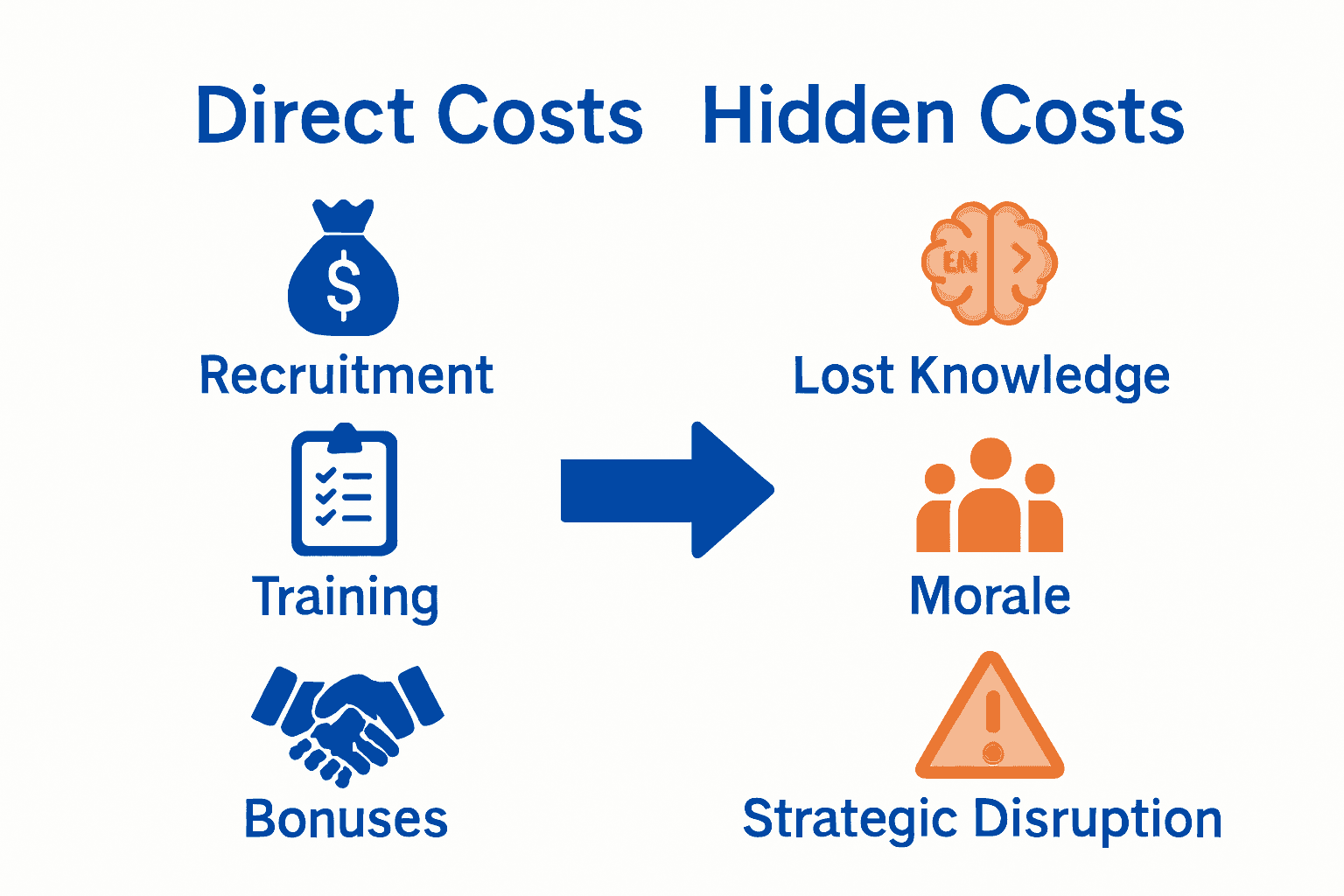
Employee turnover costs more than recruiting and replacing one person.
The visible costs are easy to identify:
– Job advertising
– Recruiting time
– Interviewing
– Background checks
– Onboarding
– Training
– Temporary productivity loss
The hidden costs are often more damaging:
– Lost customer context
– Lost institutional knowledge
– Delayed projects
– Lower team morale
– Increased workload for remaining employees
– Manager distraction
– Slower decision-making
– Disruption to team trust
Turnover also creates a secondary risk. When one strong employee leaves, others may begin questioning whether they should stay. Work gets redistributed. Stress rises. Confidence can drop. The team may become less stable even before the replacement is hired.
The financial question is not only, “What will it cost to replace this person?”
The better question is:
“What could we have seen earlier that might have helped us prevent this disruption?”
That is where retention becomes a leadership visibility issue.
Retention Strategies for Sustainable Growth
Strong retention strategies do not start with perks. They start with visibility.
Many companies respond to turnover after it happens. They improve benefits, run another survey, increase manager check-ins, or revisit compensation. Those actions may help, but they do not solve the deeper problem if leaders still cannot see where risk is forming.
Sustainable retention strategies include:
– Identifying retention risk before resignation
– Improving manager-employee alignment
– Addressing team friction early
– Creating clear growth paths
– Recognizing meaningful contribution
– Clarifying expectations
– Supporting workload sustainability
– Understanding values alignment
– Reviewing hiring fit before adding people to a team
– Acting on employee feedback quickly
The goal is not to keep every employee forever. The goal is to prevent avoidable loss of strong people who still could have been retained with earlier action.
Leaders should ask:
– Who would create the most disruption if they left?
– Which employees look stable but may be quietly disengaging?
– Where is manager-employee friction affecting commitment?
– Where are employees misaligned with the role, team, or company direction?
– What do we know too late today that we need to know earlier?
Retention improves when leaders stop relying on exit interviews and start seeing risk before resignation.
See Turnover Risk Before It Becomes a Resignation
Employee turnover is a lagging indicator. By the time someone leaves, the real risk may have been building for months.
A team can look stable while disengagement, manager-employee misalignment, values disconnect, or hidden friction is already forming beneath the surface.
OpenElevator helps CEOs, founders, senior leaders, and managers detect retention risk, team misalignment, and hidden friction before they become costly resignations. The platform uses a short, bias-complimentary Key Team Stay Survey and a proprietary algorithm to reveal where leaders may need to act earlier.
Start with a complimentary Key Team Stay Survey for up to 10 team members and see what may be hidden inside your own team.
Get your complimentary Key Team Stay Survey

Frequently Asked Questions
What is employee turnover?
Employee turnover is the rate at which employees leave a company and are replaced by new employees. It includes voluntary resignations, involuntary departures, and other workforce changes.
Why does employee turnover matter?
Employee turnover matters because it affects productivity, customer relationships, institutional knowledge, team morale, hiring costs, and business continuity. Losing strong employees can create disruption far beyond the open role.
What are the main types of employee turnover?
The main types of employee turnover are voluntary turnover, involuntary turnover, functional turnover, and dysfunctional turnover. Dysfunctional turnover is often the most damaging because it means losing strong employees the company wanted to keep.
What causes employee turnover?
Employee turnover can be caused by poor manager relationships, lack of growth, values misalignment, unclear expectations, team friction, burnout, compensation concerns, or better external opportunities.
How does low engagement lead to turnover?
Low engagement can lead to turnover when employees feel disconnected, unsupported, undervalued, or misaligned with the company. They may continue working while quietly becoming less committed.
How can leaders reduce employee turnover?
Leaders can reduce employee turnover by identifying retention risk earlier, improving manager-employee alignment, creating growth paths, addressing team friction, recognizing contribution, and acting on signs of disengagement before resignation happens.
How does OpenElevator help reduce employee turnover?
OpenElevator helps leaders detect retention risk, team misalignment, and hidden friction before they become costly resignations. It gives CEOs, founders, senior leaders, and managers clearer visibility into where they may need to act earlier.
Is there a free way to try OpenElevator?
Yes. OpenElevator offers a complimentary Key Team Stay Survey for up to 10 team members so leaders can see retention risk, alignment gaps, and hidden friction inside their own team.