
Employee retention platforms are not all solving the same problem.
Some measure engagement. Some manage performance. Some support HR operations. But for leaders trying to prevent surprise resignations, the real need is earlier visibility into what is changing below the surface.
Engagement surveys, turnover data, and exit interviews are lagging indicators. They often explain the problem after retention risk has already formed.
This guide compares OpenElevator, Culture Amp, Workday, and Lattice so leaders can see which platform best fits their need for retention-risk visibility, team insight, and earlier action.
Table of Contents
OpenElevator
At a Glance
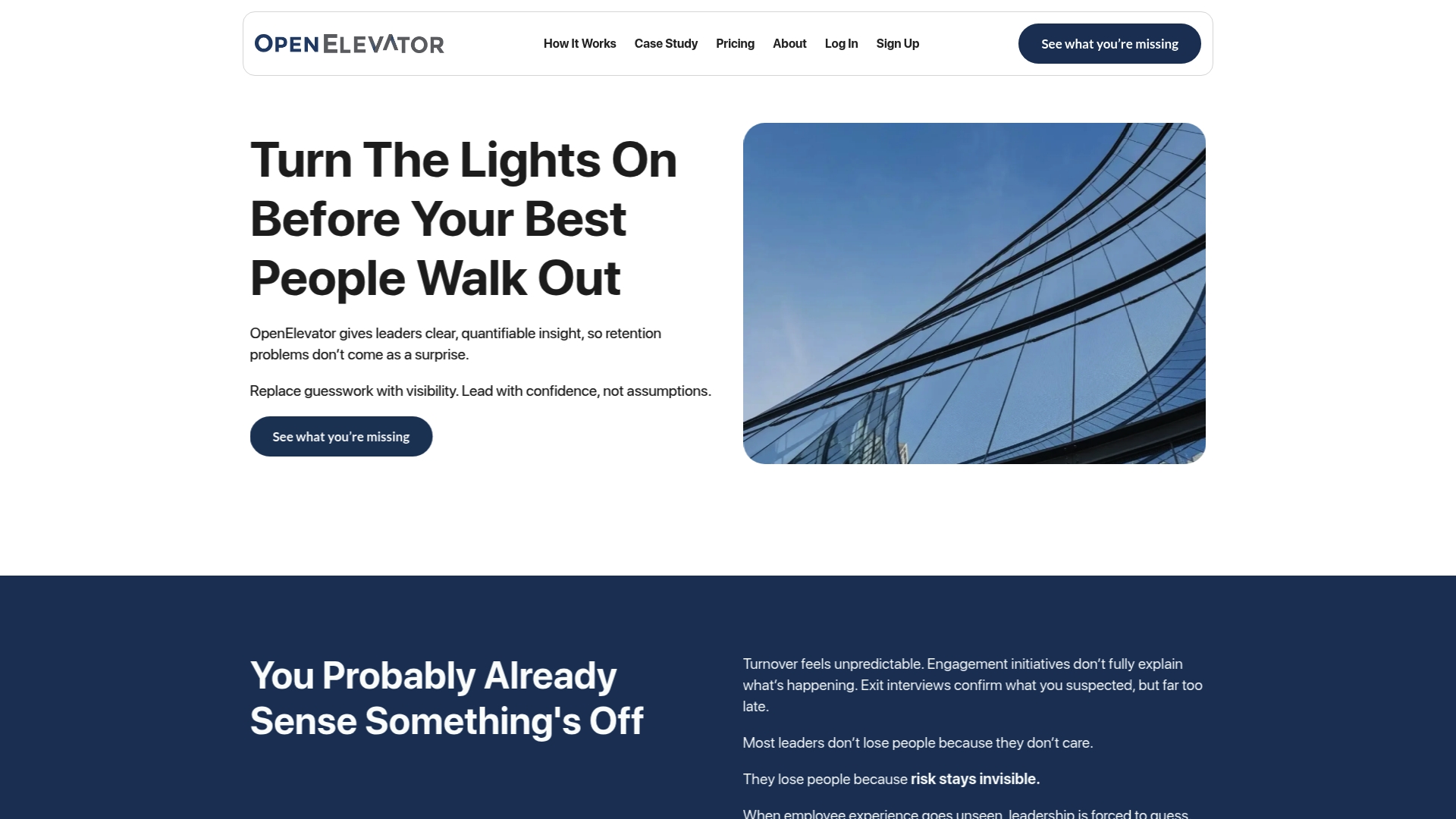
OpenElevator helps CEOs, founders, senior leaders, and managers see what is happening below the surface before engagement drops, turnover rises, or exit interviews explain the problem too late.
It is built to reveal shifting sentiment, hidden disengagement, manager-employee misalignment, values misalignment, team friction, and hiring fit before those issues become surprise resignations or disrupt performance.
Core Features
OpenElevator uses short stay surveys and measurable outputs to surface:
-
Retention risk
-
Hidden disengagement
-
Manager-employee fit
-
Values alignment
-
Team friction
-
Interpersonal alignment
-
Hiring and role fit
-
Early signals before turnover becomes visible
Key Differentiator
OpenElevator is not a broad HRIS, performance suite, or generic engagement platform.
Engagement surveys, turnover data, and exit interviews are lagging indicators. They help explain what employees said, how many people left, or why someone resigned after the risk had already formed.
OpenElevator gives leaders earlier visibility into what is happening now, so they can act before surprise resignations disrupt performance.
Pros
-
Helps leaders see retention risk before it becomes turnover
-
Surfaces hidden disengagement, values misalignment, and team friction
-
Focuses on manager-employee fit rather than blaming managers or employees
-
Designed for CEOs, founders, senior leaders, and managers
-
Offers straightforward pricing at $150 per employee
Fit Considerations
OpenElevator is best used when leaders need earlier visibility into retention risk, team dynamics, values alignment, and manager-employee fit before issues become visible in lagging data.
It is not meant to replace a full HRIS, payroll system, performance suite, or employee engagement platform.
Who It’s For
OpenElevator is best for leaders who cannot afford to be surprised by preventable turnover.
It is especially useful when:
-
Engagement surveys feel too slow or too averaged
-
Leaders sense something is changing but cannot see exactly where
-
A team looks stable while sentiment may be shifting below the surface
-
Managers are relying on gut feel instead of data on fit and alignment
-
Surprise resignations would disrupt execution, customers, or institutional knowledge
Pricing
OpenElevator lists pricing at $150 per employee and offers a complimentary Key Team Stay Survey for up to 10 people.
Website: https://openelevator.com
Culture Amp
At a Glance
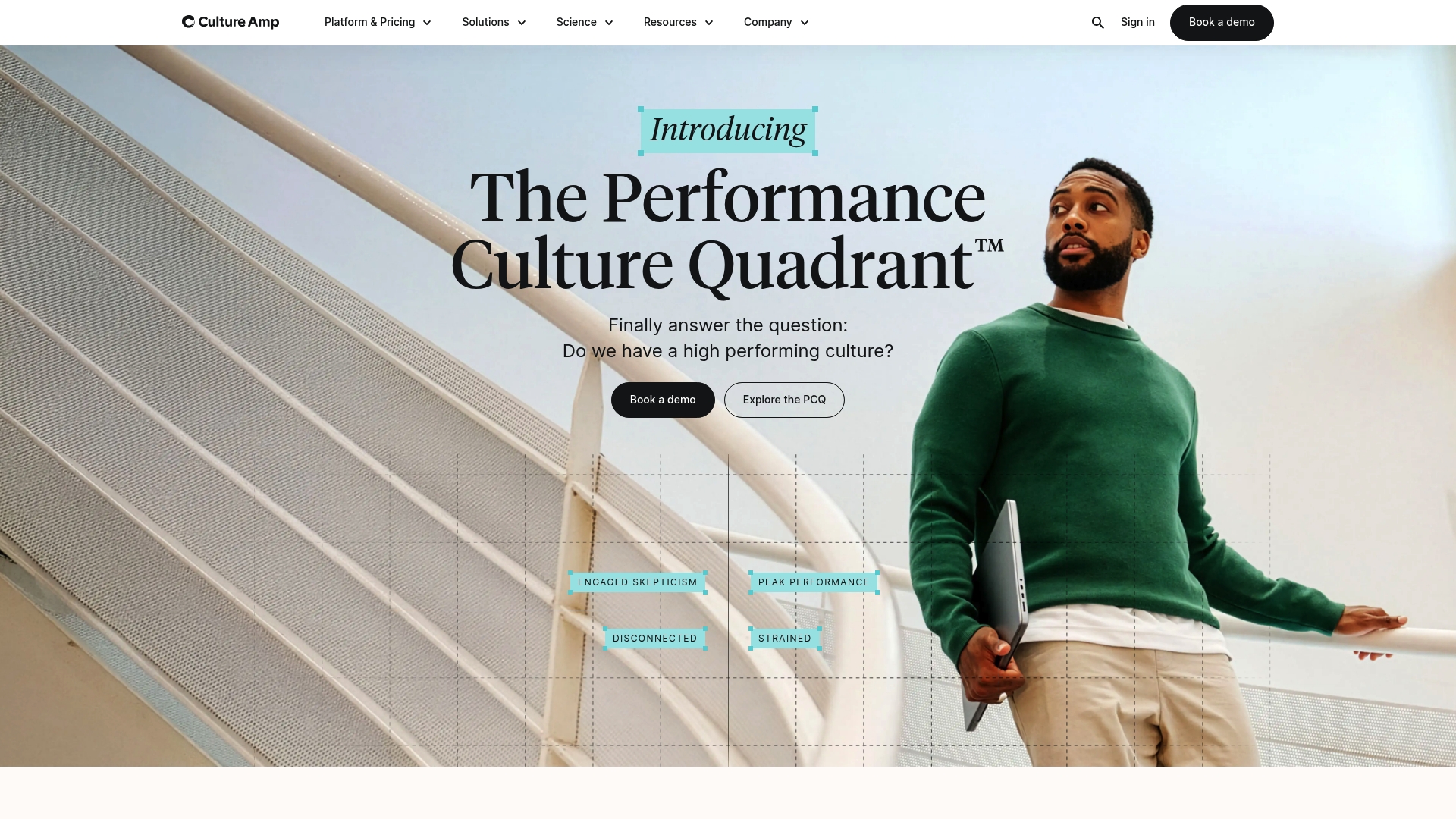
Culture Amp provides a unified platform for measuring and improving employee experience with a strong focus on Employee engagement and data driven recommendations. Its depth suits larger organizations that need rigorous survey science and integrated performance tools.
Core Features
The platform centers on Employee engagement & surveys, performance management, and leadership coaching powered by data and an AI Coach. Diagnostic tools surface retention risk and offer tailored guidance for managers and talent teams to act earlier with confidence.
Pros
-
Comprehensive employee experience platform: Culture Amp combines surveys, performance tools, and coaching into one product that reduces tool fragmentation for HR and People teams.
-
Science backed insights and data: The platform emphasizes validated measurement approaches and benchmarks that help you interpret results with greater confidence.
-
Customizable surveys and tools: Administrators can adapt surveys and diagnostic frameworks to match organizational priorities and segment results by team or role.
-
Strong integrations and security measures: The product connects with other HR systems while applying enterprise grade controls to protect sensitive employee data.
-
Trusted by thousands of companies: Wide adoption suggests the platform scales across regions and complex organizational structures.
Cons
-
Pricing requires contacting sales: The lack of transparent pricing means procurement cycles will need direct vendor engagement and internal budget estimation.
-
Platform complexity for smaller teams: Organizations without dedicated HR or People Operations staff may find setup and ongoing management resource intensive.
-
Search feature currently unavailable: Limited navigation tools can slow administrators who need to find historical surveys or specific insights quickly.
Who It’s For
Culture Amp suits medium to large organizations that want a rigorous, research based approach to retention, engagement, and performance. You should have at least one HR generalist or People Operations lead to configure surveys and act on insights.
Unique Value Proposition
Culture Amp stands out by combining measurement science, tailored development resources, and AI driven coaching into a single platform. That combination helps leaders replace anecdote with quantifiable signals and prioritized recommendations.
Real World Use Case
A multinational company uses Culture Amp to run quarterly engagement pulses, identify teams with rising churn risk, and deploy targeted leadership development programs. The result is clearer prioritization of interventions and a consistent way to track progress across regions.
Pricing
Pricing depends on the number of employees, product modules selected, and service tier and is billed annually. You will need to contact Sales for a tailored quote and procurement timeline.
Website: https://cultureamp.com
Workday
At a Glance
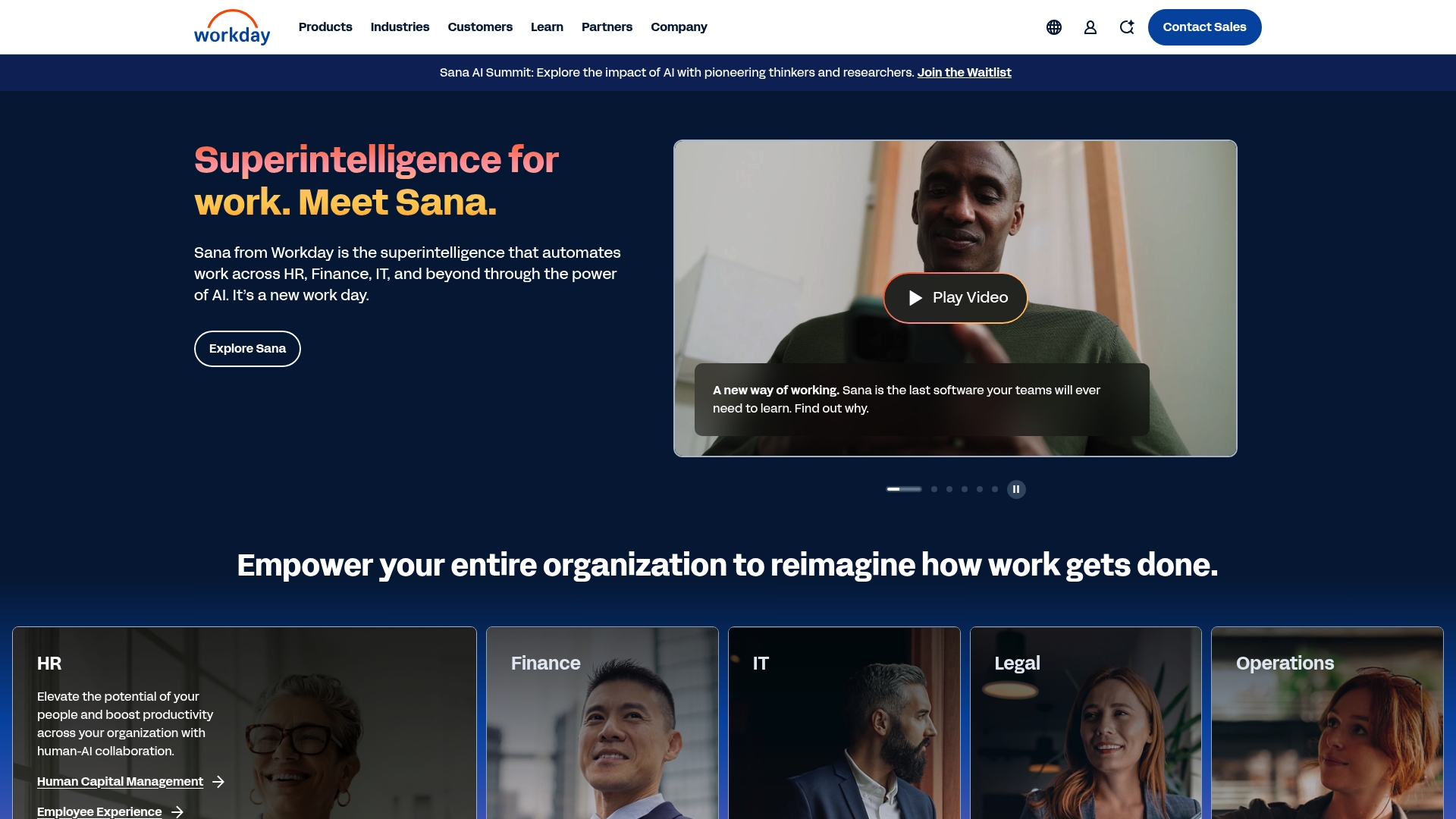
Workday is an enterprise cloud platform that combines AI-powered automation with broad HR and finance functionality to give leaders clearer visibility into workforce and financial signals. The suite is powerful for midsize to large organizations but can demand substantial change management to realize value.
Core Features
Workday centers on integrated solutions that connect HR, finance, planning, and analytics in a single platform to reduce data silos and manual reconciliation.
-
Human Capital Management for core HR and talent workflows.
-
Financial Management for planning, spend control, and reporting.
-
Sana from Workday for AI driven automation and decision support.
-
Platform tools for integrations and enterprise data management.
Pros
-
Integrated suite across HR and Finance: Workday combines workforce and financial systems so leaders see linked metrics rather than disconnected reports.
-
Strong AI and automation emphasis: The platform uses AI tools to reduce repetitive tasks and surface insights from large data sets.
-
Proven at scale: Over 11,000 organizations use Workday which validates its enterprise readiness and global capabilities.
-
Customizable and scalable: The product adapts to complex organizational structures and grows with expanding teams and geographies.
-
Industry tailored solutions: Workday provides configurations for Healthcare, Manufacturing, Public Sector, and other industries which reduces one size fits all tradeoffs.
Cons
-
The suite is complex and often requires significant training before teams extract full value from the tools.
-
Pricing is not published and typically requires direct sales engagement which can create uncertainty for smaller organizations.
-
Implementation and deployment can be resource intensive and may demand substantial internal project governance.
Who It’s For
Workday fits HR and Finance leaders at midsize to large enterprises that need an integrated cloud platform with AI capabilities and are ready to invest in change management. If your organization runs distributed teams and requires consolidated reporting across regions, Workday is worth evaluating.
Unique Value Proposition
Workday’s strength is its integrated enterprise scope paired with AI enabled automation. That combination lets leaders move from anecdote driven decisions to data informed actions across hiring, retention, and financial planning.
Real World Use Case
Large employers such as 7-Eleven used Workday’s AI capabilities to transform hiring workflows and increase operational efficiency. Snowflake accelerated growth and innovation by leveraging analytics while JLL addressed talent bottlenecks and scaled onboarding with AI driven support.
Pricing
Pricing is not publicly specified and typically requires direct contact with Workday sales for a tailored quote based on modules and scale.
Website: https://workday.com
Lattice
At a Glance
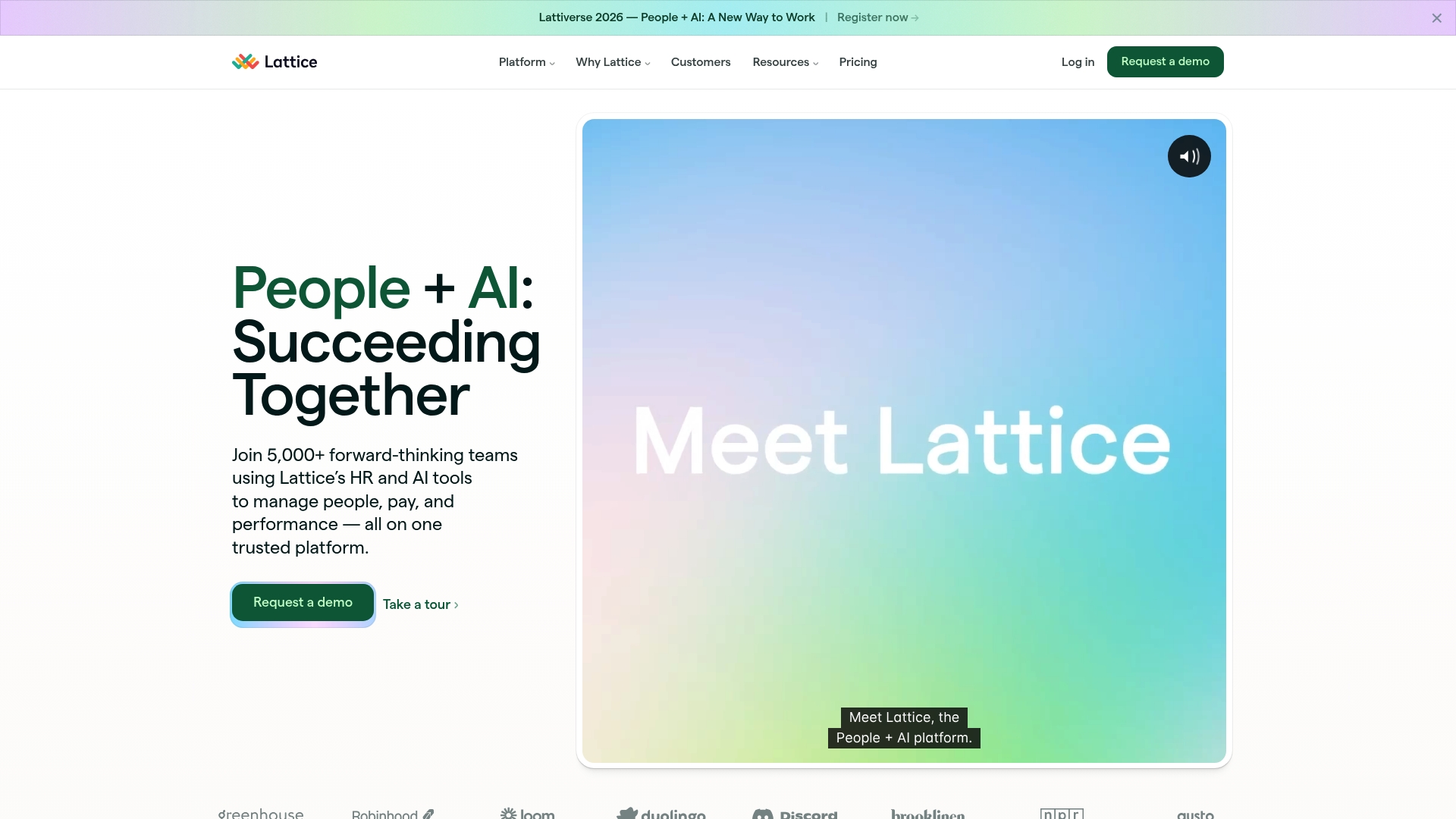
Lattice is a comprehensive HR platform that combines performance management, AI insights, and compensation tools to give leaders a single source of truth for people programs. The platform fits organizations that need scalable, data driven workflows rather than lightweight pulse tools.
Core Features
Lattice bundles performance reviews, talent reviews, PIPs, and succession planning with goal tracking and OKR management. It offers employee engagement surveys with AI analysis, career development plans, and compensation benchmarking. The platform also includes a resource center with templates and training and integrations with common HR systems.
Pros
-
Comprehensive coverage: Lattice covers performance, engagement, goals, career growth, and compensation in one suite which reduces tool sprawl for HR teams.
-
AI driven insights: The platform surfaces predictive signals and automation that help leaders spot engagement issues before they escalate.
-
Scalable for growth: Lattice supports mid sized and large organizations and adapts as headcount and program complexity increase.
-
Integrations: It connects with many HR and productivity systems which preserves existing workflows and reduces manual work.
-
Positive usability feedback: Customers report an intuitive interface that speeds adoption among managers and HR partners.
Cons
-
Pricing is customized and may be expensive for smaller organizations which can limit access for lean HR teams.
-
The feature set is extensive and may overwhelm teams looking for a simple engagement or review tool rather than a full people ops platform.
-
Implementation and onboarding require dedicated effort and coordination which can extend time to value for teams without project support.
Who It’s For
Lattice is aimed at mid sized to large organizations with dedicated HR functions that need a single platform to manage performance, engagement, and compensation. Choose Lattice if you want to align goals across teams and use data to guide retention and development decisions.
Unique Value Proposition
Lattice combines structured people processes with AI powered recommendations so leaders see both what is happening and why it matters. That combination turns lagging retention metrics into actionable insights and helps teams prioritize where to intervene.
Real World Use Case
A tech company used Lattice to automate performance cycles, align team OKRs to company objectives, and run engagement surveys with AI analysis. The result was clearer manager actions, faster review cycles, and measurable improvements in employee focus and retention.
Pricing
Enterprise pricing varies by seats, complexity, and scale and requires a custom quote from Lattice. Specific modules such as Performance and Goals and OKRs are available starting at $8 per user per month which allows selective adoption by teams with constrained budgets.
Website: https://lattice.com
Employee Retention Platforms Comparison
Each platform solves a different retention-related problem.
OpenElevator is the strongest fit when leaders need earlier visibility into retention risk, hidden disengagement, manager-employee misalignment, values misalignment, and team friction before surprise resignations disrupt performance.
Culture Amp is best for organizations that want a broad employee experience platform with engagement surveys, performance tools, benchmarking, and development features.
Workday is best for enterprise organizations that need integrated HR, finance, payroll, planning, and workforce infrastructure.
Lattice is best for companies that want performance management, goals, career development, engagement surveys, and compensation tools in one people platform.
The key question is whether you need an HR system, a performance platform, an engagement suite, or an earlier retention-risk visibility layer. If the priority is seeing what is changing below the surface before turnover data confirms the problem too late, OpenElevator is the most direct fit.
| Platform | Best For | Core Strength | Limitation |
|---|---|---|---|
| OpenElevator | CEOs, founders, senior leaders, and managers who need earlier retention-risk visibility | Shows shifting sentiment, hidden disengagement, manager-employee fit, values alignment, and team friction before turnover becomes visible | Not a broad HRIS, performance suite, or generic survey tool |
| Culture Amp | Larger companies running employee experience programs | Engagement surveys, performance tools, benchmarking, and coaching guidance | Broad platform, not focused only on early retention-risk visibility |
| Workday | Enterprise organizations needing HR, finance, payroll, planning, and workforce infrastructure | Unified HR, finance, workforce planning, and enterprise analytics | Heavyweight for leaders who need fast team-level retention visibility |
| Lattice | HR teams managing performance, goals, engagement, growth, and compensation | Reviews, OKRs, engagement surveys, career development, and compensation tools | More performance-management focused than retention-risk specific |
How OpenElevator Helps Leaders See Retention Risk Earlier
Employee retention platforms should help leaders act before turnover becomes visible.
OpenElevator helps CEOs, founders, senior leaders, and managers see what is happening now: shifting sentiment, hidden disengagement, manager-employee misalignment, values misalignment, and team friction before those issues become surprise resignations or disrupt performance.
Engagement surveys, turnover data, and exit interviews are lagging indicators. OpenElevator gives leaders earlier visibility into the risks forming below the surface.
Start your Stay Survey to experience the platform, gain real retention-risk visibility, and see what may be hidden below the surface — with zero cost and zero risk.
Frequently Asked Questions
What should leaders look for in an employee retention platform?
Leaders should look for a platform that helps them see retention risk before turnover happens. The most useful platforms reveal hidden disengagement, manager-employee fit, values alignment, team friction, and shifting sentiment before those issues become resignations.
Are engagement platforms the same as retention platforms?
Not always. Engagement platforms usually measure how employees feel through surveys and feedback tools. Retention-focused platforms should help leaders see where risk is forming before engagement drops, turnover rises, or exit interviews explain the issue too late.
Why are engagement surveys not enough to prevent turnover?
Engagement surveys are lagging indicators. They show how employees felt at a point in time, but they may miss whether sentiment, manager fit, values alignment, or team dynamics are already changing below the surface.
How is OpenElevator different from Culture Amp, Workday, or Lattice?
Culture Amp focuses on employee experience, Workday focuses on enterprise HR and finance infrastructure, and Lattice focuses on performance management and people programs. OpenElevator focuses on earlier visibility into retention risk, hidden disengagement, manager-employee fit, values alignment, and team friction.
Which employee retention platform is best for earlier risk visibility?
OpenElevator is the strongest fit when leaders need earlier visibility into hidden retention risk rather than a broad HRIS, performance suite, or engagement survey platform.
How does the complimentary OpenElevator Key Team Stay Survey work as a first step?
The complimentary Key Team Stay Survey lets leaders experience the platform with zero cost and zero risk while gaining real retention-risk visibility into hidden disengagement, manager-employee fit, values alignment, and team friction.