
Many leaders carry a quiet confidence that personality assessments tell them who will stay and who will walk out the door. It’s an understandable belief. The Big Five personality model is well-established for explaining general workplace behaviors and job performance, and when you’ve invested in assessments, it feels natural to lean on them for everything. But using personality scores to predict departures is a bit like reading a weather map to predict a car accident. The map is real and useful. It just isn’t designed for that question.
Table of Contents
-
What really predicts employee departure? Fit, alignment, and context
-
How leaders should use personality data without overrelying on it
-
How OpenElevator helps leaders see what personality tools miss
Key Takeaways
| Key point | What leaders should know |
|---|---|
| Personality explains behavior | The Big Five can help describe tendencies, but it does not show who is likely to leave. |
| Turnover is contextual | Employees leave when fit, values alignment, connection, or collaboration weakens. |
| One-sided assessments have limits | Personality scores do not measure the relationship between employee, manager, team, and environment. |
| Retention risk changes over time | Values, satisfaction, connection, and team dynamics can shift after hiring. |
| Leaders need fit visibility | OpenElevator shows what personality tools miss: values alignment, manager-employee fit, interpersonal alignment, and team friction. |
What the Big Five really measures in the workplace
Let’s be clear about something first: the Big Five is genuinely powerful. Conscientiousness, extraversion, openness, agreeableness, and neuroticism are not buzzwords. They are robust, research-backed dimensions of human personality that explain meaningful patterns in how people work, collaborate, and behave under pressure.
Here’s a quick look at what each trait actually predicts in a work context:
| Big Five trait | Key workplace predictions |
|---|---|
| Conscientiousness | Task performance, reliability, organizational citizenship |
| Extraversion | Team collaboration, leadership emergence, proactive behavior |
| Openness | Creativity, adaptability, learning agility |
| Agreeableness | Team cohesion, conflict avoidance, cooperative behavior |
| Neuroticism | Stress response, emotional stability, withdrawal risk |
The numbers here are worth pausing on. Conscientiousness predicts task performance variance at 4 to 6%, with higher explained variance in organizational citizenship and counterproductive behavior. That’s not trivial. It’s consistent and replicable across industries.
But here’s where many leadership teams quietly go wrong. They see that conscientiousness predicts performance and assume it must also predict who is likely to resign. That’s a logical leap that the data simply doesn’t support. The Big Five outcomes research is clear on what these traits explain well, and retention isn’t at the top of that list.
Personality tells you how someone tends to show up. It doesn’t tell you whether they’ll still want to show up six months from now.
Pro Tip: When hiring, prioritize conscientiousness for roles requiring reliability and extraversion for client-facing or collaborative positions. These two traits give you the most defensible signal for performance prediction. For employee retention beyond personality, you’ll need a different toolkit entirely.
The practical takeaway is this: use Big Five data to understand behavioral tendencies, team fit, and likely performance patterns. Treat it as a lens for understanding people, not a crystal ball for predicting who’s about to hand in their notice.
Why the Big Five falls short on predicting turnover
With a foundation in what the Big Five addresses, it’s important to distinguish its limits when it comes to predicting who leaves. And those limits are significant.
Research is fairly consistent on this point. Big Five traits show weak or mixed results for actual retention. The traits themselves don’t directly or strongly explain employee departure. What actually drives turnover risk are mediators, meaning the experiences and conditions that sit between someone’s personality and their decision to leave.

Here’s a comparison that makes this concrete:
| Big Five trait | Predicts task performance? | Predicts turnover directly? |
|---|---|---|
| Conscientiousness | Yes, consistently | Weakly, mixed results |
| Neuroticism | Modestly (negative) | Indirect, via stress |
| Extraversion | Yes, for social roles | Minimal direct effect |
| Agreeableness | Modestly | Minimal direct effect |
| Openness | For creative roles | Minimal direct effect |
The limitations in turnover prediction become obvious when you look at this side by side. A highly conscientious employee can still leave if they feel undervalued, disconnected from their team, or stuck in a role that no longer fits their life.
Traits are stable. But the conditions that make someone want to stay or go are anything but.
So what actually predicts departure?
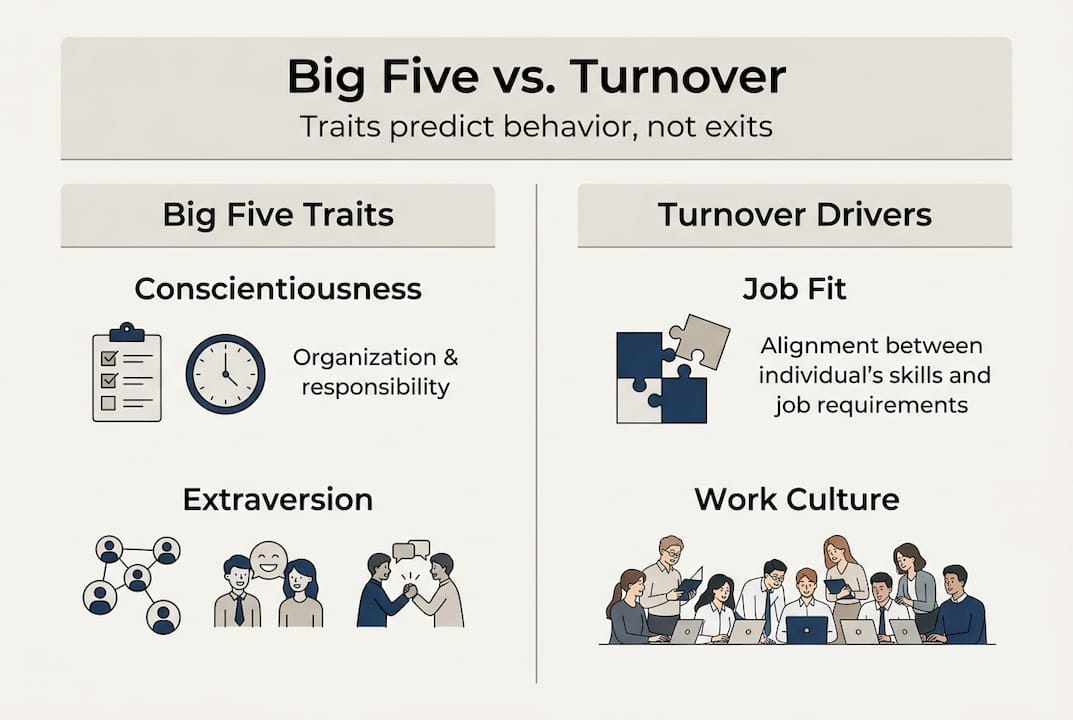
Not personality alone. Retention risk is more often shaped by whether the employee still fits the role, manager relationship, team, and environment.
Leaders need visibility into values alignment, manager-employee fit, interpersonal alignment, team friction, hidden disengagement, and whether the employee’s core needs are still being met.
What really predicts employee departure? Fit, alignment, and context
Personality traits can help explain how someone tends to behave. They do not explain whether that person is still aligned, connected, and likely to stay.
Retention risk is more often shaped by fit and context:
-
Whether the employee’s values are still being met
-
Whether manager-employee fit is strong or strained
-
Whether the person feels connected to the team
-
Whether collaboration feels smooth or difficult
-
Whether the role still offers the right balance of safety, purpose, growth, and connection
-
Whether team friction is forming below the surface
A highly conscientious employee can still leave if the role no longer fits what they value. An agreeable employee can still disengage if collaboration becomes frustrating. An open, adaptable employee can still lose connection if they no longer see a future in the organization.
The issue is not personality. It is whether the environment, manager relationship, team dynamics, and values still fit.
How leaders should use personality data without overrelying on it
Personality data can be useful, but it should not carry more weight than it can support.
Use Big Five insights to understand general behavioral tendencies. Do not use them as a substitute for retention-risk visibility.
A stronger approach is to pair personality insight with visibility into:
-
Values alignment
-
Manager-employee fit
-
Interpersonal alignment
-
Team friction
-
Hidden disengagement
-
Role and hiring fit
-
Whether employees are still satisfied with what matters most to them
The key difference is that personality assessments are usually one-sided. They describe the individual. But retention and collaboration depend on the relationship between the individual, the manager, the team, and the environment.
That is what leaders need to see.
Why behavior is not the same as retention risk
Behavior is useful information, but it is not the whole story.
A personality assessment may suggest how someone tends to communicate, collaborate, handle pressure, or approach tasks. But it does not show whether the person is still satisfied, aligned, connected, or likely to stay.
That is where leaders often get surprised.
The person’s personality has not changed. Their experience has.
Their values may no longer be met. Their manager-employee fit may have weakened. Collaboration may feel harder. The team may have changed. The role may no longer offer the same sense of growth, purpose, safety, or connection.
The Big Five can help leaders understand behavioral tendencies. It cannot show what is changing below the surface now.
How OpenElevator helps leaders see what personality tools miss
Personality tools can explain behavior. OpenElevator helps leaders see retention risk.
OpenElevator helps CEOs, founders, senior leaders, and managers see what is happening now: shifting sentiment, hidden disengagement, manager-employee misalignment, values misalignment, interpersonal alignment, and team friction before those issues become surprise resignations or disrupt performance.
Engagement surveys, turnover data, personality assessments, and exit interviews all have limits. OpenElevator gives leaders earlier visibility into fit, alignment, connection, and friction below the surface.
Get your free OpenElevator team scan to experience the platform, gain real retention-risk visibility, and see what may be hidden below the surface — with zero cost and zero risk.
Frequently asked questions
Does the Big Five model predict which employees will leave?
No. The Big Five can help explain general behavior patterns, but it does not directly show whether someone is becoming less aligned, less connected, or more likely to leave.
What does the Big Five model measure well?
The Big Five can help describe personality tendencies such as conscientiousness, openness, extraversion, agreeableness, and emotional stability. These traits may help explain behavior, but they do not replace retention-risk visibility.
What predicts retention better than personality traits?
Retention depends more on values alignment, manager-employee fit, interpersonal alignment, team friction, role fit, and whether the employee’s core needs are still being met.
Why are personality assessments limited for retention?
Most personality assessments describe the individual. Retention depends on the relationship between the individual, manager, team, role, and environment. That fit can change over time.
How does OpenElevator go beyond personality assessments?
OpenElevator helps leaders see values alignment, manager-employee fit, interpersonal alignment, hidden disengagement, and team friction before those issues become surprise resignations or performance disruption.