
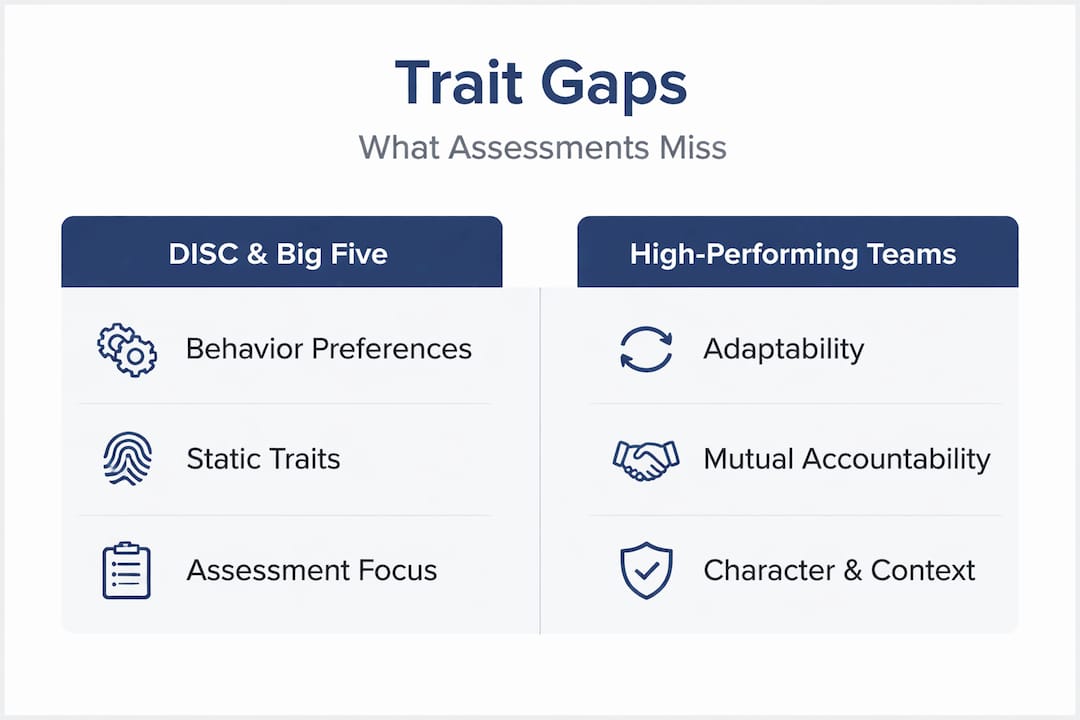
DISC and Big Five assessments can help leaders understand personality traits, communication styles, and behavioral preferences.
But they do not show the full picture of what is happening inside a team.
A person may have a clear DISC profile or Big Five result and still become a retention risk because manager alignment weakens, values feel misaligned, team friction grows, workload pressure increases, or the role no longer fits what they expected.
That is the gap.
Personality assessments describe tendencies. They do not fully explain whether a person is still aligned with the manager, team, role, and company environment they are working in now.
This matters because a team can look strong on paper while hidden friction is already forming beneath the surface.
This guide explains what DISC and Big Five miss about team potential, why personality traits are only one part of retention and performance, and how leaders can use deeper visibility into values alignment, interpersonal alignment, team dynamics, and hidden friction to reduce avoidable turnover.
Table of Contents
Key Takeaways
| Point | Details |
|---|---|
| Personality traits are only one layer | DISC and Big Five can explain preferences, but they do not fully reveal retention risk, team friction, or values alignment. |
| Team potential depends on context | The same person can thrive in one team and disengage in another depending on manager fit, team dynamics, workload, and role clarity. |
| Fit changes over time | A person may be aligned at hiring and become misaligned later as the manager, team, role, or company direction changes. |
| Hidden friction weakens retention | Team tension, weak interpersonal alignment, and values disconnect can build before performance drops. |
| OpenElevator adds deeper visibility | OpenElevator helps leaders see retention risk, values alignment, interpersonal alignment, and hidden team friction earlier. |
Why DISC and Big Five Fall Short for Team Performance
DISC and Big Five assessments are useful because they give leaders a structured way to understand personality and behavioral tendencies.
DISC can help explain how someone may communicate, respond to pressure, approach conflict, or work with others.
Big Five can help describe traits such as openness, conscientiousness, extraversion, agreeableness, and emotional stability.
That information can help with hiring, onboarding, coaching, and team conversations.
But it is not enough to predict team performance or retention.
Personality assessments do not fully show:
| What They Miss | Why It Matters |
|---|---|
| Manager-employee alignment | A strong employee can disengage if the manager relationship weakens. |
| Values alignment | Someone may perform well but feel increasingly misaligned with the company environment. |
| Team friction | Personality data may explain differences, but not whether those differences are creating tension. |
| Workload sustainability | An assessment does not show whether someone is quietly burning out. |
| Growth clarity | Strong employees may leave if they do not see a future inside the company. |
| Role fit over time | A role that fit at hiring may stop fitting as responsibilities change. |
| Hidden disengagement | People may keep performing while becoming less committed. |
This is the core problem.
DISC and Big Five describe how someone may tend to operate.
They do not tell leaders whether the employee experience is still working.
A person can look like a strong fit on paper and still become a flight risk because the environment around them has changed.
That is why personality assessments should be treated as a starting point, not a retention system.
The Missing Elements: Alignment, Context, and Commitment
What DISC and Big Five miss is not small.
They often miss the conditions that determine whether someone stays, grows, disengages, or leaves.
The missing elements usually fall into three categories.
1. Alignment
Alignment is about whether the person still fits the role, manager, team, and company environment.
Leaders need to understand:
-
Does this person feel aligned with the company’s values?
-
Does the role still fit their strengths and motivation?
-
Does the manager relationship support trust and clarity?
-
Does the employee feel connected to the team?
-
Does the person see a future inside the company?
Personality does not answer those questions.

2. Context
The same personality profile can produce different outcomes in different environments.
A highly conscientious employee may thrive in a clear, structured role but struggle in a chaotic environment with shifting priorities.
A highly collaborative employee may perform well on a healthy team but disengage inside a team with hidden tension.
A direct communicator may be valuable in one leadership culture and punished in another.
Context matters because retention risk is not only about the person.
It is about the relationship between the person and the environment.
3. Commitment
Commitment can weaken quietly.
An employee may still attend meetings, complete work, and respond professionally while feeling less connected to the company.
Early signs may include:
-
Lower initiative
-
Less participation
-
Shorter communication
-
Less interest in growth
-
Weaker connection to the manager
-
Avoidance of future-focused conversations
-
More visible frustration
-
Pulling back from team collaboration
DISC and Big Five do not reliably show when commitment is weakening.
Leaders need visibility into what is changing now, not only what a profile said at one point in time.
From Friction to Fit: Using Deeper Visibility to Reduce Turnover
Team friction often starts before leaders can clearly name it.
People may still be polite. Work may still get done. Meetings may still happen. But underneath, alignment may be weakening.
This is why leaders need deeper visibility.
Not more personality labels.
Not more static reports.
They need to understand where friction, misalignment, and retention risk may already be forming.
Useful visibility includes:
| Visibility Area | What It Helps Leaders Understand |
|---|---|
| Values alignment | Whether employees feel aligned with the company environment and direction |
| Interpersonal alignment | Whether manager-employee or team relationships may create friction |
| Team dynamics | Where hidden tension or weak connection may be forming |
| Retention risk | Where employees or teams may need earlier support |
| Role fit | Whether the current role still matches strengths and expectations |
| Growth clarity | Whether strong employees see a future inside the company |
| Workload sustainability | Whether pressure is creating burnout or withdrawal |
This is where many companies fall short.
They use DISC or Big Five to understand communication style, but they do not keep measuring whether fit is strengthening or weakening over time.
A realistic scenario: two employees both score high on conscientiousness. One is thriving because the manager provides clarity and recognition. The other is quietly disengaging because the workload is unsustainable and feedback is inconsistent.
Same trait.
Different context.
Different retention risk.
That is why deeper visibility matters.
It helps leaders move from “What type of person is this?” to “What is happening in this person’s work experience right now?”
Practical Framework for Leaders
Leaders do not need to throw out DISC or Big Five.
They need to stop expecting those tools to do the full retention job.
Use this framework.
| Step | What to Do | Why It Matters |
|---|---|---|
| 1. Use personality tools for what they do well | Use DISC or Big Five to understand communication style, preferences, and likely work patterns. | This supports better team conversations and manager awareness. |
| 2. Add values alignment | Understand whether the employee feels aligned with the company’s environment and direction. | Values disconnect can create disengagement even when personality fit looks strong. |
| 3. Measure interpersonal alignment | Look at manager-employee and team fit. | Poor interpersonal alignment can create friction before performance drops. |
| 4. Watch for changing signals | Look for lower participation, reduced initiative, weaker connection, or less interest in growth. | Retention risk changes over time. |
| 5. Match action to the real issue | Respond based on whether the risk is growth, workload, manager friction, role fit, or values misalignment. | Generic retention actions miss the actual cause. |
| 6. Follow up | Check whether alignment, trust, clarity, and connection improved. | Retention work is not complete after one conversation. |
The key is simple:
Use personality assessments to understand style.
Use retention visibility to understand risk.
Those are different jobs.
When leaders confuse them, they miss the issues that actually cause strong employees to leave.
What Assessments Cannot Measure
No assessment can fully capture what is happening inside a team.
DISC and Big Five may help explain how someone tends to behave, but they do not show the full lived experience of working on that team.
They may not reveal:
-
A manager taking credit for someone’s work
-
A strong employee feeling invisible
-
A team avoiding unresolved tension
-
A new hire quietly realizing the role is not what they expected
-
A high performer feeling blocked from growth
-
A values mismatch that is slowly weakening commitment
-
A team member who feels disconnected but keeps performing
That is where leaders need more than assessment data.
They need visibility into relationships, alignment, friction, and whether employees still feel connected to the work and the company.
The companies that retain strong people will not be the ones with the most personality profiles.
They will be the ones that see when fit is starting to break down and act before resignation becomes the signal.
How OpenElevator Helps Leaders See What Assessments Miss
DISC and Big Five can help leaders understand personality and work style.
But they do not show the full picture of retention risk.
A team can look stable while values misalignment, manager-employee friction, hidden team tension, or disengagement is already forming beneath the surface.
OpenElevator helps CEOs, founders, senior leaders, and managers detect retention risk, values alignment, interpersonal alignment, and hidden team friction before they become costly resignations.
The platform uses a short, bias-free team scan and a proprietary algorithm to reveal where leaders may need to act earlier.
If you already use DISC or Big Five, OpenElevator does not replace those tools. It adds the retention visibility layer they were never designed to provide.
Start with a free team scan for up to 10 team members and see what DISC and Big Five may be missing inside your own team.
Frequently Asked Questions
What do DISC and Big Five miss about teams?
DISC and Big Five can describe personality traits and behavioral preferences, but they may miss values alignment, manager-employee friction, team tension, workload pressure, growth clarity, and hidden retention risk.
Are DISC and Big Five useful for retention?
They can be useful, but they are incomplete. They help leaders understand work style, but retention depends on whether employees feel aligned with the manager, team, role, and company over time.
Why are personality assessments not enough to predict retention?
Personality assessments are usually static. Retention risk changes as managers, roles, workloads, teams, and company direction change.
What matters more than personality for retention?
Values alignment, interpersonal alignment, team dynamics, role fit, growth clarity, workload sustainability, recognition, and trust in leadership all affect whether employees stay.
Can someone be a good personality fit and still leave?
Yes. An employee can be a good personality fit and still leave if they feel unsupported, unseen, misaligned with their manager, blocked from growth, or disconnected from the company’s values.
How can leaders see team friction earlier?
Leaders can look for patterns in manager alignment, team dynamics, values alignment, participation, communication, workload pressure, and changes in engagement before performance drops.
How does OpenElevator go beyond DISC and Big Five?
OpenElevator helps leaders detect retention risk, values alignment, interpersonal alignment, and hidden team friction. It gives CEOs, founders, senior leaders, and managers clearer visibility into where risk may be forming.
Is there a free way to try OpenElevator?
Yes. OpenElevator offers a free team scan for up to 10 team members so leaders can see retention risk, alignment gaps, and hidden friction inside their own team.