
Most teams do not fall apart all at once. They usually look stable first.
Deadlines are still met. Managers still say things are fine. High performers still show up to meetings. But under the surface, retention risk, hidden disengagement, manager-employee friction, or values misalignment may already be forming.
That is the problem OpenElevator is built to help leaders see earlier.
Traditional engagement platforms can be useful, but many are designed around HR workflows, broad survey programs, or enterprise reporting cycles. OpenElevator is different. It is a leadership visibility platform for CEOs, founders, senior leaders, and managers who need to detect risk before it becomes a resignation, performance drop, or team disruption.
In this review, we compare OpenElevator with four alternatives: Culture Amp, 15Five, Peakon Employee Voice, and Workleap Officevibe. The goal is not to find the “biggest” platform. It is to understand which tool gives leaders the clearest early warning signals when team stability may already be weakening.
Key Takeaways
-
OpenElevator is best suited for leaders who need earlier visibility into retention risk, hidden disengagement, manager-employee fit, values alignment, and team friction.
-
Culture Amp, Peakon, 15Five, and Officevibe are stronger fits for organizations that want broader HR, engagement, performance, or people analytics workflows.
-
The real risk is not only employee turnover. It is the period of quiet disengagement before turnover becomes visible.
-
A team can look productive while trust, alignment, motivation, or manager fit is already declining.
-
The best tool depends on whether you need an HR engagement system or a leader-first risk-detection tool.
Table of Contents
OpenElevator
 At a Glance
 At a Glance
OpenElevator helps CEOs, founders, senior leaders, and managers detect retention risk, hidden disengagement, manager-employee misalignment, values misalignment, and team friction before those problems become expensive.
The platform is not designed to be another broad HR survey tool. It is built to give leaders earlier visibility into the risks that usually stay hidden until someone resigns, performance drops, or a team starts losing momentum.
Core Features
OpenElevator uses short, repeatable team scans to surface measurable signals around:
-
Retention risk
-
Hidden disengagement
-
Manager-employee fit
-
Values alignment
-
Interpersonal friction
-
Team alignment
-
Hiring and role fit
The goal is simple: help leaders see where attention is needed before the problem becomes obvious.
Key Differentiator
OpenElevator’s key differentiator is timing.
Most leaders learn about retention risk too late. They see the resignation, the performance decline, the conflict, or the customer disruption after the damage has already started. OpenElevator helps move that visibility earlier, while there is still time to intervene.
The resignation is not the beginning of the problem. It is often the final signal.
Pros
OpenElevator is built for leaders, not only HR teams. That makes it useful for CEOs, founders, senior leaders, and managers who need a clear view of where team risk may be forming.
It focuses on early detection instead of broad employee sentiment alone. Leaders can see where hidden disengagement, friction, or misalignment may already be affecting team stability.
The free team scan creates a low-friction starting point. Leaders can get a first read on risk without launching a long engagement survey or complex implementation.
The platform connects directly to business risk. Unexpected turnover affects execution speed, institutional knowledge, customer continuity, and manager capacity.
Cons
OpenElevator has less publicly available detail on integrations and automation than larger enterprise platforms. Teams that need deep HRIS connectivity or complex reporting workflows should validate those requirements during evaluation.
It is also not intended to replace a full HR suite, performance management system, or enterprise engagement platform. Its strength is focused leadership visibility.
Who It’s For
OpenElevator is best for leaders of growing teams who cannot afford to be surprised by preventable turnover or hidden disengagement.
It is especially relevant for companies where:
-
A few unexpected resignations would create real disruption
-
Managers rely too heavily on gut feel
-
Engagement issues are noticed only after they become obvious
-
Leaders need a clearer read on team alignment, trust, and friction
-
The business is scaling and informal visibility is no longer enough
Diagnostic Questions
Ask these before choosing a tool:
-
Are we learning about retention risk only after someone resigns?
-
Which employees look fine on the surface but may already be disengaging?
-
Do we know where manager-employee fit is strong, strained, or unclear?
-
Are values alignment and team friction visible early enough for leaders to act?
-
Could our team be hitting deadlines while commitment is quietly weakening?
Unique Value Proposition
OpenElevator gives leaders earlier visibility into the people risks that traditional metrics often miss.
It helps reveal where disengagement, misalignment, or friction may be forming before those issues become resignations, productivity loss, or team instability.
Real-World Use Case
A founder believes the team is stable because projects are moving and managers report no major issues. But the company has already lost two strong employees in the past year with little warning.
An OpenElevator scan reveals that risk is not spread evenly across the company. One team shows declining manager-employee fit. Another shows values misalignment. A third has interpersonal friction that has not yet affected output.
Instead of reacting after another resignation, leadership can focus attention where risk is already forming.
Pricing
OpenElevator pricing is listed at $150 per employee. The free team scan gives leaders a practical way to begin assessing hidden risk before committing more broadly.
Website: https://openelevator.com
Culture Amp
At a Glance
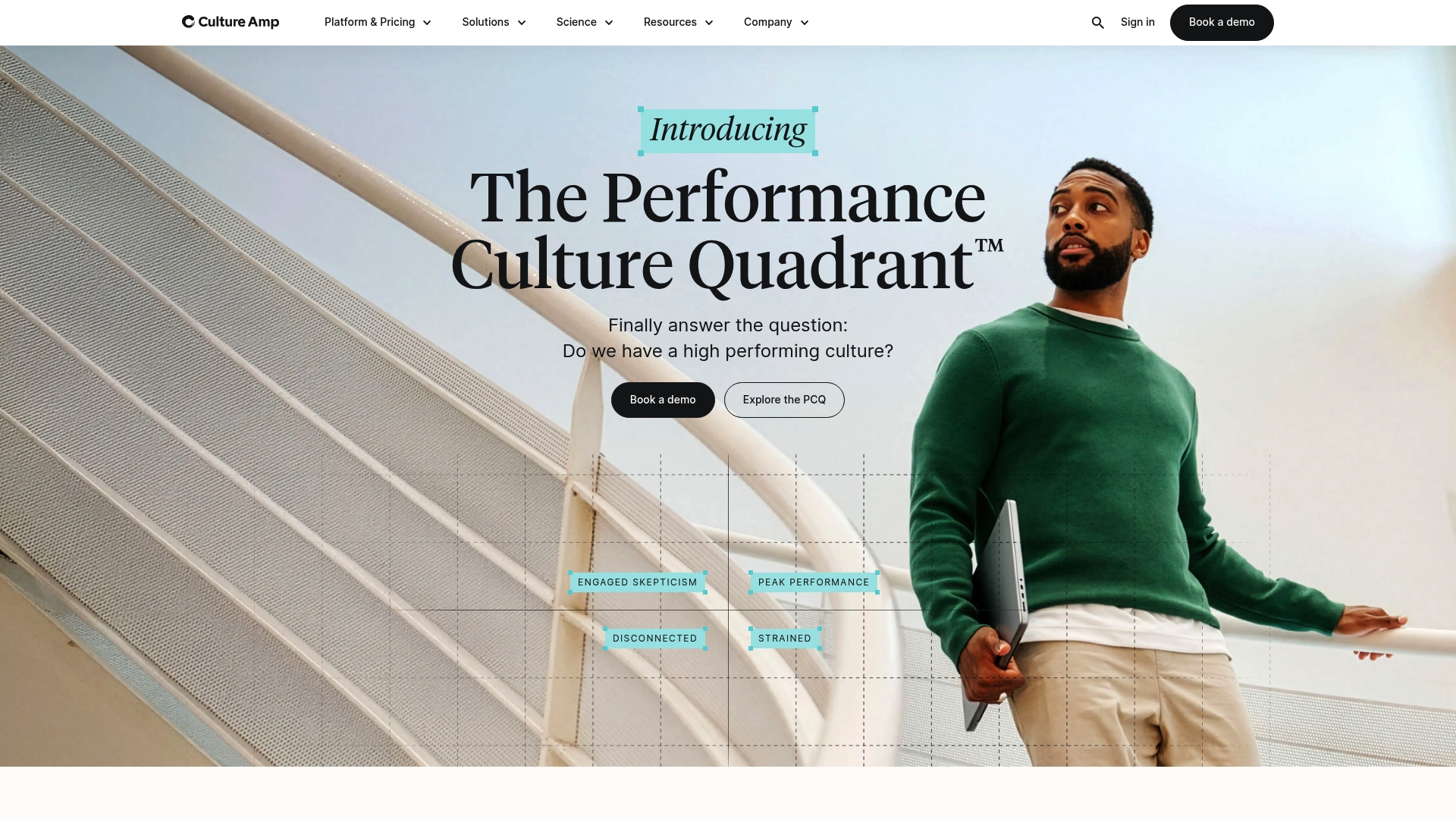
Trusted by over 6,800 companies, Culture Amp pairs people science with AI to surface retention signals and leadership development priorities across regions and teams.
Core Features
The platform centers on employee engagement surveys and recurring pulse surveys for ongoing visibility into mood and alignment.
It also supports performance reviews, calibration, 1-on-1s, goals and competencies, personalized growth plans, and AI-powered comment summaries to speed analysis.
Retention insights, DEI surveys, behavioral diagnostics, and an AI Coach round out the toolkit for development and cultural assessment.
Key Differentiator
Culture Amp’s most concrete edge is its research foundation: organizational psychology combined with AI-driven benchmarks that convert survey data into prioritized insights.
That focus on science-backed interpretation helps HR and people teams translate scores into programs rather than raw charts.
Pros
-
The survey engine is straightforward to launch and interpret once templates are in place. Leaders get usable engagement and pulse data quickly.
-
Reporting emphasizes comparatives and benchmarks, making cross-team and industry comparisons simpler for executive briefs.
-
Clear privacy practices reduce employee pushback during sensitive feedback cycles, helping drive honest responses.
-
Built-in coaching and AI summaries reduce the manual effort of synthesizing open-text feedback into themes.
-
The platform’s emphasis on organizational psychology gives recommendations that align with development and retention strategies.
Cons
-
Implementation can be time-consuming; teams report that launching, analyzing, and driving action requires dedicated bandwidth.
-
Navigation and report filtering frustrate some first-time users and can slow adoption among non-HR leaders.
-
A handful of users report lost work or system bugs, which raises concern for teams relying on uninterrupted workflows.
-
Product support speed and quality are uneven according to third-party feedback, risking delays during critical survey cycles.
When It May Not Fit
If you need a light, leader-first visibility tool that surfaces individual manager fit and early disengagement without heavy setup, Culture Amp can feel heavyweight.
Teams without a People Ops lead or limited implementation time will struggle to get full value immediately.
Notable Integrations
Culture Amp integrates with Slack, Microsoft Teams, Google Workspace, major HRIS platforms like Workday, SAP, and Oracle, plus Single Sign-On providers to streamline rollouts and reporting flows.
Who It’s For
Mid to large organizations with dedicated HR or People Ops resources aiming to build measurable culture programs and link engagement to performance and development.
This is more HR-centric than leader-first visibility tools used directly by CEOs and founders.
Unique Value Proposition
The research-backed benchmarks are the standout: they let you compare engagement and retention signals against thousands of peers and surface prioritized areas to address.
For People teams that can commit implementation time, Culture Amp transforms survey data into structured development plans and leadership coaching prompts.
Diagnostic leadership questions
-
Which team shows declining engagement while output and attendance remain steady?
-
Which managers have rising friction scores but stable retention so far?
Real World Use Case
A global tech company uses Culture Amp to run regionally tailored engagement programs, then applies AI summaries to prioritize manager coaching and targeted growth plans.
Example that looks stable but isn’t: a high-performing sales pod hits quota while engagement scores slide month over month; Culture Amp flagged the decline before resignations surged.
Pricing
Pricing is available upon request and not published publicly. Expect enterprise-style licensing that scales with modules and integration depth.
Website: https://www.cultureamp.com
15Five
At a Glance
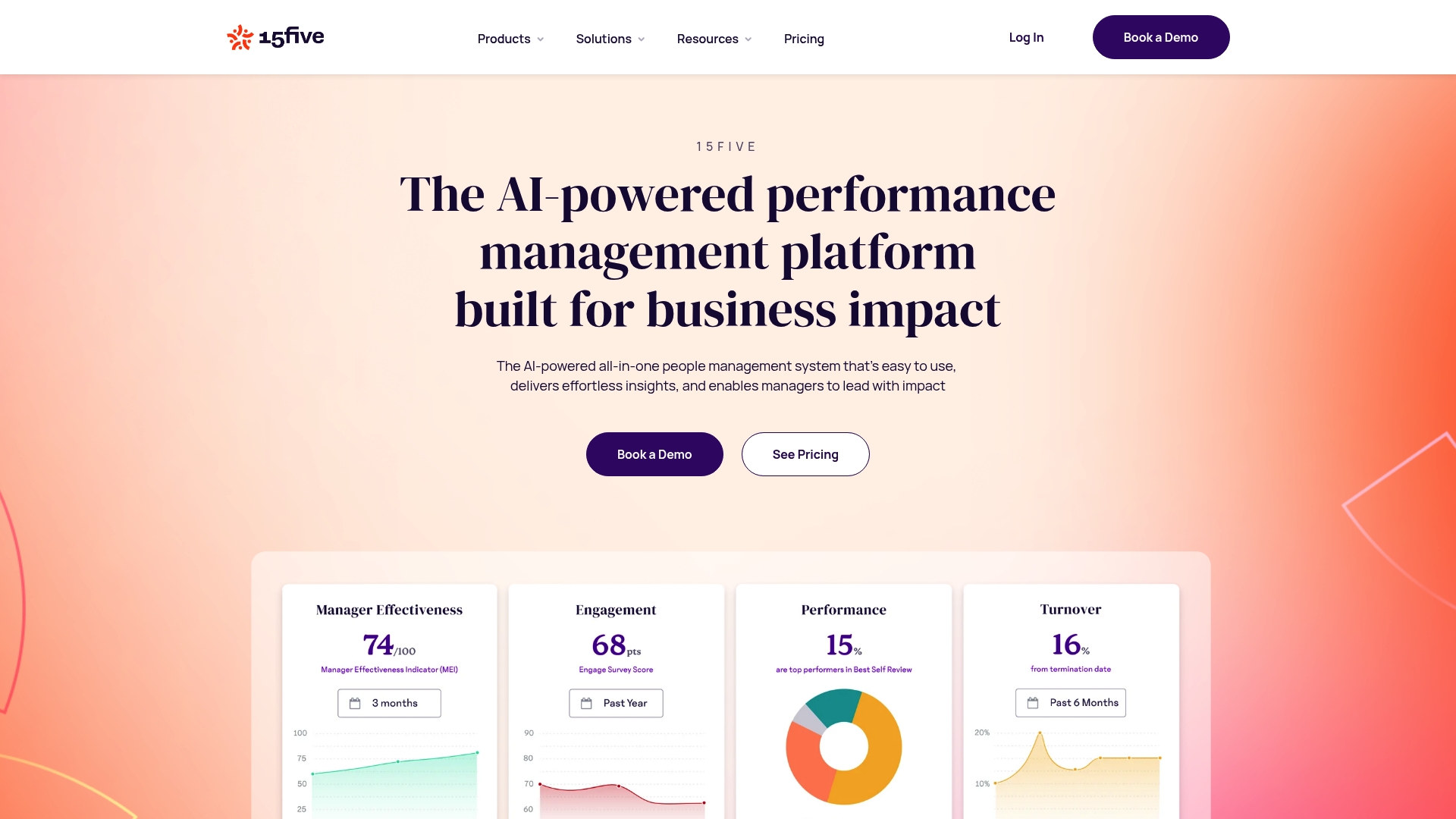
Trusted by over 3,000 organizations and 250,000 employees, 15Five pairs AI-driven review signals with engagement pulses to surface performance and retention indicators inside a single platform. It bundles reviews, OKRs, recognition, and talent planning under one subscription.
Core Features
-
AI-powered reviews and insights to summarize trends and surface risk indicators for managers and HR.
-
Engagement surveys and pulse checks for frequent signals on team morale and alignment.
-
Goal alignment and OKRs that connect individual objectives to company priorities.
-
Manager enablement tools, recognition, 360 feedback, and real-time dashboards for strategic decision making.
Key Differentiator
The platform’s AI review engine reduces manual synthesis of reviews and survey data into named trends and flags leaders can act on quickly. It is HR centric rather than a pure leadership visibility tool.
Are tasks completing while discretionary effort drops? Do engagement pulses show drift despite steady outputs?
Pros
-
Weekly check-ins streamline recurring manager touchpoints so conversations are recorded and follow ups are visible to managers.
-
Robust goal tools help align OKRs across teams and make quarterly priorities explicit for contributors and leaders.
-
Recognition and peer high fives keep cultural reinforcement visible and tied to engagement metrics.
-
Customizable review workflows let HR map annual and continuous review cycles without building them from scratch.
-
Slack integration nudges use into daily work and reduces the friction of logging check-ins.
Cons
-
Customer support has recurring complaints about responsiveness and helpfulness which can slow resolution for enterprise issues.
-
Pricing is layered and can become complex. Coaching content and advanced AI capabilities add additional fees beyond base per user costs.
-
Tracking one-on-one action items over long histories is limited and searchability across time is weak, complicating audits of development plans.
When It May Not Fit
If you need a leadership visibility tool focused on early manager fit and interpersonal friction rather than HR workflows, 15Five skews toward HR and manager development workflows. That narrower focus can leave leaders without the specific flags they want for hidden turnover risk.
A common scenario looks stable but is not. Teams that submit weekly updates on time while pulse scores and manager fit signals decline will not get the same early relational flags that a visibility-first product surfaces.
Notable Integrations
Integrates with common HRIS systems, Slack, Salesforce, Jira, and standard SSO providers to keep user and role data in sync and nudge adoption through existing communication flows.
Who It’s For
Mid-market to enterprise HR teams and people managers who need a single system for reviews, engagement surveys, goal alignment, and talent planning. Best when HR owns performance workflows and wants fewer tools to stitch together.
Unique Value Proposition
The AI review and insight engine highlights trends across reviews and pulses so HR can act without manual dashboards and spreadsheets. That automation makes rolling review programs and talent decisions faster for HR heavy organizations.
Real World Use Case
An enterprise centralizes continuous feedback and talent development in 15Five to track manager coaching, run engagement pulses quarterly, and feed talent planning for promotions and internal mobility.
Pricing
Engage starts at $4 per user per month, Perform at $11, and Total Platform at $16 per user per month billed annually. Expect extra costs for coaching, content, and advanced AI features.
Website: https://www.15five.com
Peakon Employee Voice
At a Glance
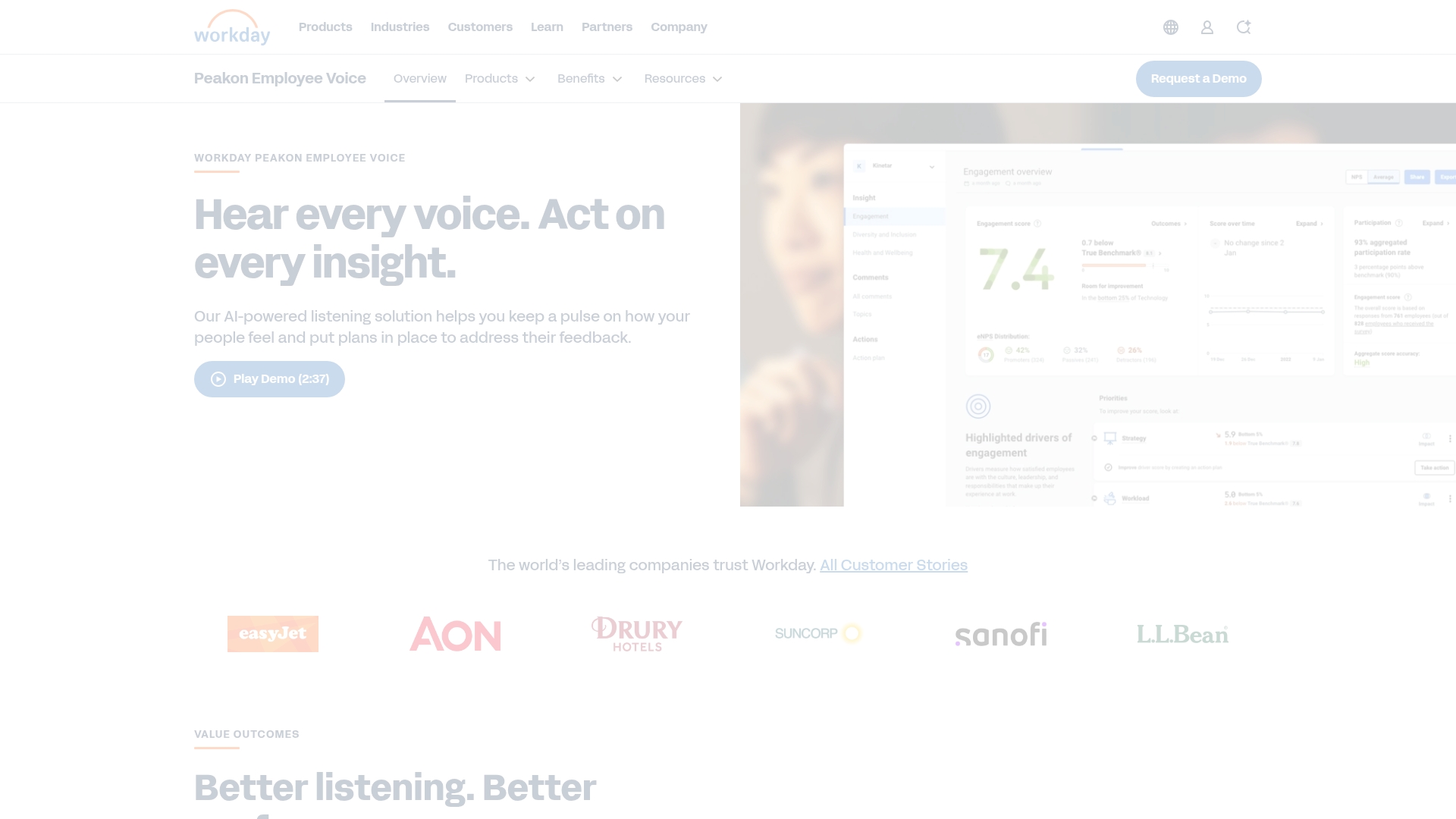
Peakon surfaces AI detected themes from confidential employee feedback in hours not weeks which accelerates insight to action for large organizations tracking culture across geographies.
The product leans into continuous listening with monthly pulses and real time dashboards that make trends visible as they form.
Core Features
Peakon uses AI powered listening and analytics to detect themes and sentiment across open comments and survey responses. Confidential channels let employees share feedback without identifying themselves.
Dashboards update in real time and include benchmarking so leaders can compare units, geographies, or role groups against internal and external norms.
Two diagnostic leadership questions
-
Which small management relationships show falling sentiment even though attendance and output remain steady
-
Which teams show widening variance between engagement scores and manager ratings
Key Differentiator
The platform’s standout mechanic is rapid theme detection driven by AI which groups qualitative feedback into themes you can act on quickly.
That focus makes Peakon better suited to organizations that need to convert large volumes of voice data into prioritized interventions rather than one off pulse checks.
Pros
-
Good continuous listening experience that keeps feedback flowing without annual survey fatigue which helps leaders spot trends earlier.
-
Easy, low pressure survey flow users can skip questions or respond in short form which increases response rates in practice.
-
Confidential feedback channels reduce fear of reprisal and improve candor in sensitive topics like manager relationships and inclusion.
-
Strong dashboards and reporting convert raw responses into visual trends leaders can present to the executive team.
-
Backed by research into motivation and engagement which supports interpretation and action planning.
Cons
-
Users sometimes find it hard to trace the reasoning behind anonymous comments so root cause work still needs facilitation.
-
Monthly surveys require cultural habituation so initial months demand attention from program owners.
-
Complex org charts make slicing results harder and can produce misleading comparisons without careful segmentation.
-
Perceived as expensive for very early stage or small companies which limits adoption below mid market.
When It May Not Fit
Peakon is optimized for medium and large companies with dedicated analytics capacity and governance to interpret themes. If you lead a small startup that needs lightweight, leader driven signals or you lack analytics bandwidth Peakon will feel heavyweight.
If your priority is a low cost entry tool for under 50 employees look elsewhere.
Notable Integrations
Peakon lists an association with Workday which helps sync org structures and people data in many enterprise deployments.
The integration supports automated population of employee attributes for more accurate benchmarking and segmentation.
Who It’s For
Peakon fits HR and people analytics teams inside medium to large enterprises that need continuous listening at scale and have resources to run insight to action programs.
It is less appropriate for CEOs of very small firms seeking a quick, low cost visibility check across a single team.
Unique Value Proposition
Rapid AI theme detection converts thousands of comments into named themes and priority signals within hours which shortens the feedback to action loop for distributed enterprises.
That velocity is valuable when you are trying to head off disengagement before it becomes visible in turnover or performance metrics.
Real World Use Case
An enterprise used Peakon to flag rising disengagement in a regional sales team despite steady quota attainment. The AI surfaced recurring manager communication themes which informed a targeted leadership intervention and training program.
Looks stable but isn’t. Attendance stayed high while commitment fell under the surface.
Pricing
Pricing is not published and the product is positioned toward medium to large organizations with HR analytics resources. Expect vendor conversations and custom quotes for enterprise scale deployments.
Website: https://www.peakon.com
Workleap Officevibe
At a Glance
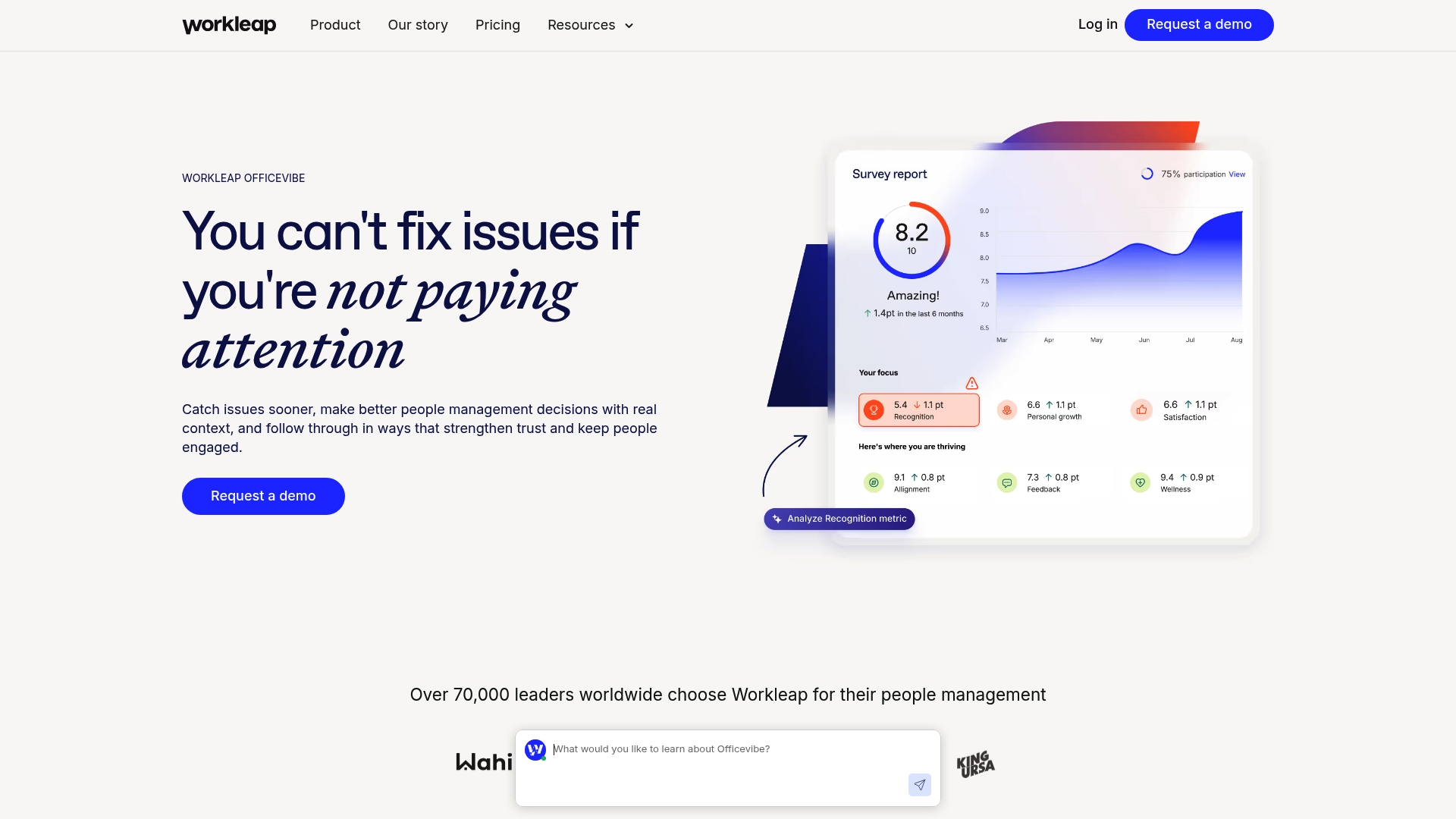
AI-powered insights and summaries convert open feedback and pulse responses into concise management recommendations, not raw charts. Officevibe pairs that with built-in recognition tools and turnover risk signals to give small and midsize leaders early warning signs of disengagement.
Core Features
Officevibe runs recurring pulse and custom surveys, collects anonymous feedback, and highlights turnover risk trends. It includes recognition and peer appreciation workflows and basic performance review management for small teams.
Real-time notifications and automated HRIS updates keep results current so managers see shifts quickly.
Key Differentiator
The platform’s most concrete edge is its AI summaries that synthesize comments into short recommendations for managers. That shortens the time from survey to manager action, which matters when disengagement builds under the surface.
Pros
-
Users report quick setup and high adoption, which reduces the time from rollout to usable insight for teams that cannot dedicate an operations lead.
-
The combination of recurring pulses and anonymous feedback makes it easier to spot declining engagement before resignations surface.
-
Recognition tools drive visible appreciation that supports manager coaching conversations and improves peer morale.
-
The interface and templates let managers run review cycles without building processes from scratch.
Cons
-
Feature depth is tailored to small and midsize organizations. Large enterprise needs for advanced analytics and custom workflows are not Officevibe’s focus.
-
The product description lists broad positives from reviews but does not surface many third-party criticisms, which makes independent gap spotting harder for critical buyers.
-
Reporting is practical rather than exhaustive. Teams that need heavyweight custom reports will hit limits.
When It May Not Fit
If you run a global enterprise with complex performance calibration, multi-level approvals, or bespoke analytics, Officevibe may feel constraining. Buyers who need deep HRIS engineering or large scale compliance reporting should look elsewhere.
Notable Integrations
Officevibe integrates with Slack, Microsoft Teams, Google Workspace, and common HRIS systems such as BambooHR and Workday. Those connections enable automated invites, real-time alerts, and roster sync so pulse coverage stays accurate as headcount changes.
Who It’s For
Small and midsize HR teams and managers who need a fast listening loop and visible recognition mechanics. If your leadership needs rapid, manager-facing summaries and you do not run complex enterprise workflows this fits.
Diagnostic questions for leaders:
-
When was the last time your leadership saw a concise summary linking anonymous feedback to manager fit and turnover risk?
-
Which manager would you coach this week if you had a one-page report showing declining engagement on their team?
A common “looks stable but isn’t” example: a team keeps completing tasks and hitting deadlines while weekly pulses show falling trust in one manager.
Unique Value Proposition
AI summaries that translate open responses into manager recommendations accelerate the move from insight to intervention. For leaders who need to protect execution speed and institutional knowledge, Officevibe reduces the analysis backlog so managers can act before disengagement turns into resignations.
Real World Use Case
A small tech startup used Officevibe weekly pulses and recognition cards to surface manager-employee misalignment. The AI summaries highlighted two teams with rising turnover risk and suggested focused one-on-one coaching steps. The result was more targeted manager support and fewer surprise departures.
Pricing
Plans start at $5 per user per month with enterprise pricing available on request. That per-seat entry point makes it affordable for growing teams that want continuous listening without a large upfront commitment.
Website: https://officevibe.com
Which Platform Fits Which Leadership Need?
Not every platform is solving the same problem.
Some tools are built for broad engagement measurement. Others are built for performance management, recognition, continuous listening, or enterprise people analytics. OpenElevator is more focused: it helps leaders see where hidden retention risk, disengagement, misalignment, and team friction may already be forming.
If You Need Earlier Retention-Risk Visibility
Choose OpenElevator if the priority is to detect risk before resignations happen. It is strongest when leaders need a fast, focused view of manager-employee fit, values alignment, team friction, and hidden disengagement.
If You Need Enterprise Engagement Benchmarks
Choose Culture Amp if your organization has a People Ops or HR team ready to manage broader engagement programs, benchmarking, performance reviews, and development workflows.
If You Need Performance Management and OKRs
Choose 15Five if your main priority is tying engagement, reviews, goals, recognition, and manager check-ins into a structured performance-management system.
If You Need Large-Scale Continuous Listening
Choose Peakon Employee Voice if you are a larger organization with enough HR analytics capacity to manage continuous employee listening, segmentation, benchmarks, and action planning.
If You Need Lightweight Pulse Surveys and Manager Summaries
Choose Workleap Officevibe if you want recurring pulse surveys, anonymous feedback, recognition features, and AI-generated manager recommendations for small to midsize teams.
The key decision is whether you need an HR engagement platform or a leadership visibility tool. If your concern is that team risk may already be forming below the surface, OpenElevator is the most direct fit.
| Product | Best For | Core Strength | Limitation |
|---|---|---|---|
| OpenElevator | CEOs, founders, senior leaders, and managers who need early visibility into retention risk | Detects hidden disengagement, manager-employee misalignment, values alignment issues, and team friction | Less public detail on enterprise integrations |
| Culture Amp | Mid-market and enterprise HR teams | Engagement surveys, benchmarks, performance, development, and people science | Can require more implementation time and HR ownership |
| 15Five | HR teams and managers managing performance, goals, and engagement | Reviews, OKRs, check-ins, recognition, and engagement pulses | More HR/performance-management oriented than risk-detection focused |
| Peakon Employee Voice | Larger organizations with people analytics resources | Continuous listening, AI theme detection, and enterprise-scale feedback analysis | Can feel too complex for lean leadership teams |
| Workleap Officevibe | Small to midsize teams wanting lightweight pulse surveys | AI feedback summaries, recognition, anonymous feedback, and manager recommendations | Less suited for complex enterprise analytics or deep customization |
See What Your Team May Not Be Saying Yet
Turnover rarely starts with a resignation letter.
It usually starts earlier, when an employee still looks productive but feels less aligned, less connected, less motivated, or less confident in their manager relationship. By the time the signal is obvious, the cost may already be building.
OpenElevator helps leaders see those risks earlier.
The free team scan gives CEOs, founders, senior leaders, and managers a clearer read on retention risk, hidden disengagement, manager-employee fit, values alignment, and team friction. It is designed to show where risk may be forming before it becomes a resignation, a performance issue, or a team stability problem.
Get your free OpenElevator team scan and see what may be hidden below the surface.
Frequently Asked Questions
What is OpenElevator used for?
OpenElevator is used to help leaders detect retention risk, hidden disengagement, manager-employee misalignment, values misalignment, and team friction earlier. It gives CEOs, founders, senior leaders, and managers clearer visibility into where team risk may be forming before it becomes turnover or performance decline.
How is OpenElevator different from an employee engagement survey?
Traditional engagement surveys often measure broad employee sentiment. OpenElevator focuses more directly on leadership visibility and early risk detection. It helps leaders understand where hidden friction, manager-employee fit issues, or alignment problems may already be affecting team stability.
Who is OpenElevator best for?
OpenElevator is best for leaders of growing teams who cannot afford surprise turnover, hidden disengagement, or unresolved team friction. It is especially useful for CEOs, founders, senior leaders, and managers who need a practical way to see risk before it becomes obvious.
What are the best OpenElevator alternatives?
Common OpenElevator alternatives include Culture Amp, 15Five, Peakon Employee Voice, and Workleap Officevibe. These tools may be better fits for broader HR engagement programs, performance management, continuous listening, recognition, or enterprise people analytics.
Is OpenElevator an HR platform?
OpenElevator can support HR conversations, but it is better understood as a leadership visibility platform. Its main value is helping CEOs, founders, senior leaders, and managers detect retention risk, disengagement, misalignment, and friction earlier so they can act before team instability becomes expensive.
When should a company use OpenElevator instead of Culture Amp or 15Five?
Use OpenElevator when the priority is early visibility into team risk, not broad HR program management. Culture Amp and 15Five may be better fits for engagement benchmarking, performance reviews, OKRs, or HR-led employee programs.
Why does early retention-risk detection matter?
The cost of turnover often starts before the resignation. A disengaged employee may still attend meetings and complete work while motivation, trust, or alignment is already declining. Earlier visibility gives leaders a chance to intervene before the damage becomes harder and more expensive to fix.