Here’s something that should make leaders pause: many employees who leave are not long-tenured team members. They are new hires.
These are people you just recruited, onboarded, trained, and expected to retain. On the surface, they may look fine. They attend meetings, complete tasks, and say the right things in early check-ins. But underneath, role confusion, manager friction, values misalignment, or stalled career momentum may already be forming.
Understanding why new hires leave quickly is not just an HR question.
By the time a new hire resigns, the risk has usually been building for weeks. This guide explains why early turnover happens, which warning signs leaders miss, and how to detect new hire retention risk before it becomes another costly exit.
Key Takeaways
| Key Point | What Leaders Should Know |
|---|---|
| Early turnover is often preventable | New hires usually leave because of unclear expectations, poor manager fit, weak onboarding, or limited career visibility. |
| The risk starts before resignation | A new hire can look productive while trust, motivation, or alignment is already weakening. |
| Manager fit matters early | The first 30 to 60 days often reveal whether the manager-employee relationship is creating clarity or friction. |
| Track early warning signals | 30-day and 60-day feedback, manager-level turnover patterns, and role clarity scores reveal issues faster than exit interviews. |
| Leaders need earlier visibility | OpenElevator helps surface retention risk, hidden disengagement, and alignment issues before new hires decide to leave. |
Table of Contents
-
Understanding early new hire departures: key drivers and risks
-
How onboarding gaps and role misalignment fuel early turnover
-
Manager effectiveness and career momentum: leadership’s leverage points
-
Diagnosing hidden retention risks: questions and metrics for leaders
-
Creating clarity and consistency: practical steps to reduce early turnover
-
Why most leaders underestimate early tenure turnover risks — and what to do differently
-
How OpenElevator Helps Leaders Detect New Hire Retention Risk Earlier
Understanding early new hire departures: key drivers and risks
Once leaders understand the cost of early departures, the next step is identifying what causes them. The reasons are often different from what leaders assume.
Most leaders assume new hires leave because of salary, or a competitor poaching them, or maybe they just weren’t a good fit. The data tells a different story. Career growth drives 17.4% of early-tenure separations, while management issues account for 8.8%. Together, those two factors represent a significant share of preventable exits. Not compensation. Not culture in the abstract. Career trajectory and manager quality.
That framing matters, because it shifts responsibility squarely onto your organization’s structure and your managers’ behaviors. These are leadership and management issues, not surface-level engagement problems.
The operational consequences of ignoring this are real and compounding:
-
Recruiting costs multiplied. Every early exit means you restart a hiring cycle, often within weeks of completing the last one.
-
Team friction. Remaining team members absorb extra work, lose trust in leadership’s ability to retain people, and start asking questions about their own futures.
-
Leadership distraction. You end up in reactive mode, managing the fallout of a departure instead of executing on strategy.
-
Reputational drag. High turnover in new hires signals something to the market, and candidates talk.
Nearly 75% of employee turnover is preventable. The reasons people leave are largely within an organization’s control — if leaders are willing to look.
The good news is that leaders are not helpless. But they cannot fix what they have not diagnosed. Reducing early turnover starts with understanding what is actually driving exits, not what is easiest to assume.
How onboarding gaps and role misalignment fuel early turnover
If career growth and management are the why, onboarding failures and role misalignment are often the how. They’re the delivery mechanism for early disengagement.
Think about it from the new hire’s perspective. They spent weeks, maybe months, imagining this role. They have a mental picture of their day-to-day, their growth path, their place on the team. Then day one arrives and reality doesn’t match the picture. The role is less defined than advertised. The manager is stretched thin. Nobody has a clear plan for their first 30 days. That gap between expectation and reality is where retention risk is born.

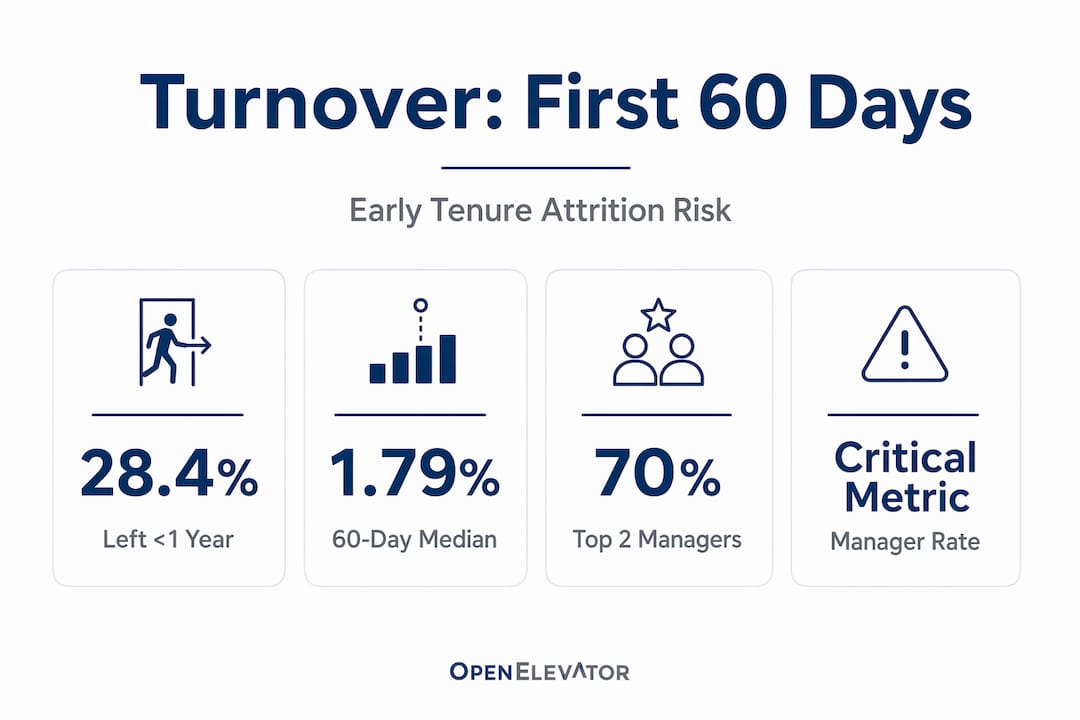
There’s a concrete benchmark worth knowing here. Median 60-day new hire turnover sits at 1.79%. When your rate climbs above 4.41%, you have a structural problem, not a one-off bad hire. That distinction matters. One person leaving in their first two months might be a mismatch. Five people leaving in that window is a systems failure.
60-day new hire turnover benchmarks
| Rate | What it signals |
|---|---|
| Below 1.79% | Healthy, within normal range |
| 1.79% to 4.41% | Monitor closely, investigate patterns |
| Above 4.41% | Structural onboarding or manager problem |
To move your numbers toward the healthy range, here’s where to start:
-
Audit your onboarding for role clarity. Can a new hire articulate exactly what success looks like in their first 90 days? If not, that’s on you, not them.
-
Prepare managers before the hire arrives. Not after. Managers should have a documented 30-60-90 day plan ready before day one.
-
Identify early feedback loops. Build in a structured check-in at week two and week six. Not a performance review. A genuine “how is this actually going?” conversation.
-
Align expectations at the offer stage. If the role is ambiguous or evolving, say so explicitly. Surprises breed resentment.
Using an employee retention case study as a reference point can help you calibrate what good onboarding actually looks like at a team level, rather than guessing.
Pro Tip: Track 60-day turnover by manager, not just by team or department. When one manager consistently loses new hires early, that’s your signal. The pattern is the data.
Manager effectiveness and career momentum: leadership’s leverage points
This is where the issue moves from hiring to leadership.
Research on early attrition has found that stalled career momentum and management friction can be stronger predictors of early exit than culture fit or compensation. Not culture. Not pay. The feeling that you’re not going anywhere, and that your manager isn’t helping you get there.
That insight should recalibrate how you think about new hire retention infrastructure. Career pathing isn’t a perk for high performers. It’s table stakes for anyone you want to keep past the 90-day mark.
Some specific things that signal stalled momentum to a new hire:
-
No promotion pathway discussed in the first month. Even a vague “here’s what growth could look like” conversation matters enormously.
-
Manager check-ins that feel like status updates, not development conversations. There’s a difference between “what are you working on?” and “what do you need to grow?”
-
Internal opportunities that go unannounced. If new hires only learn about open projects or internal moves through the grapevine, they assume the door is closed.
-
Lack of visible metrics for success. Without clear benchmarks, new hires can’t tell if they’re doing well or falling behind. That uncertainty is exhausting.
“New hires aren’t just evaluating their current role. They’re evaluating whether your organization is a place where they can build a career. If the answer feels uncertain, they start looking elsewhere — usually within the first 60 days.”
The fix is not another generic HR program. It starts with manager behavior. Weekly check-ins, clear success metrics from day one, and honest conversations about growth can reduce early friction before it hardens into disengagement.
Pro Tip: Ask every new hire at their 30-day mark: “Do you feel like you understand what success looks like in this role, and do you see a growth path here?” Two questions. If the answers are uncertain or negative, you have about 30 days to correct before disengagement solidifies.
Diagnosing hidden retention risks: questions and metrics for leaders
Here’s something that most leaders get wrong: they rely on exit interviews to understand why people leave. The problem is that exit interview data is often incomplete. People soften their answers because they don’t want to burn bridges, they’re tired, or they simply don’t trust that honesty will change anything. What you hear in an exit interview is usually the polished, conflict-averse version of the real story.
Objective, third-party feedback tools reveal the underlying, preventable causes that internal conversations tend to bury. The goal is to gather signal before someone hands in their notice, not after.
Here are two diagnostic questions worth asking new hires in a structured, ideally anonymous format during their first 60 days:
-
“Do you have a clear understanding of what success looks like in your role, and does your manager discuss your career growth with you regularly?”
-
“Do you see a realistic path to advancement or expanded responsibility within this organization in the next 12 months?”
Those two questions will surface role clarity issues and career momentum gaps faster than any engagement survey.
For the metrics side, here’s a practical diagnostic framework:
| Metric | Frequency | Action trigger |
|---|---|---|
| 60-day turnover rate by manager | Monthly | Rate above 4.41% |
| New hire check-in completion rate | Bi-weekly | Below 80% |
| Internal mobility requests from new hires | Quarterly | Decline trend |
| Anonymous early-tenure feedback score | 30 and 60 days | Score below baseline |
An employee retention case study can help benchmark what these metrics look like in practice. And if you want to go deeper on the engagement side, this guide to employee engagement consulting covers how to structure the feedback process for honest, actionable responses.
Creating clarity and consistency: practical steps to reduce early turnover
Here are practical steps leaders can implement this quarter.
Building a clear career system with defined progression and consistent manager conversations is one of the most direct ways to reduce preventable early exits. Here’s what that looks like in practice:
-
Create role progression frameworks for every position. Not a vague “you’ll grow over time” promise. Specific skills, milestones, and timeframes that define what moving forward looks like.
-
Equip managers to hold weekly check-ins that include a career element. This doesn’t have to be long. Five minutes at the end of a one-on-one where the manager asks “what’s one thing that would make your work more interesting or meaningful right now?” goes further than most leaders realize.
-
Make internal opportunities visible to new hires. Send a regular internal digest of open projects, cross-functional initiatives, or stretch roles. New hires should know these exist from day one.
-
Track leading indicators, not just lagging ones. Don’t wait for a resignation to measure retention health. Monitor 60-day turnover, early-tenure check-in scores, and manager completion rates on onboarding tasks.
The shift is from treating retention as something that happens to you to managing it through clearer expectations, stronger manager habits, and earlier visibility.
Pro Tip: Add “early tenure status” as a standing agenda item in your leadership team meetings for any new hire in their first 90 days. Not a deep review. Just a quick flag system: green, yellow, red. You’d be surprised how quickly patterns surface when you’re looking.
Why most leaders underestimate early tenure turnover risks — and what to do differently
This may be the most important point in the article.
Most leaders don’t underestimate early turnover because they’re careless. They underestimate it because the data they rely on is fundamentally biased toward false comfort. Internal exit data often lacks transparency, creating false confidence in retention stability. When someone leaves after three months, the internal narrative tends to crystallize around “it wasn’t a great fit” or “they had an outside opportunity.” That story is usually incomplete. And because it feels resolved, nobody digs deeper.
The uncomfortable truth is that early tenure departures are almost always pointing at something structural. A manager who doesn’t give clear direction. A role that was misrepresented in the hiring process. An onboarding experience that made someone feel invisible in their first week. These are fixable problems, but only if you’re willing to look past the comfortable narrative.
The leaders who get this right are the ones who treat retention as a leading indicator problem, not a lagging one. They don’t wait for resignations to tell them something is wrong. They build in feedback mechanisms, track early metrics, and create a culture where managers are accountable for the experience of their new hires from day one.
In some companies, early exits are concentrated under a small number of managers, but the pattern stays hidden because leaders only review aggregate turnover numbers. Nobody had connected the dots because they were looking at aggregate turnover numbers, not manager-level patterns. Visibility changes everything.
The shift isn’t from reactive to proactive. It’s from blind to clear. And that starts with being willing to ask harder questions about what’s actually happening inside your team before someone decides to leave.
How OpenElevator Helps Leaders Detect New Hire Retention Risk Earlier
Understanding why new hires leave quickly is useful. Seeing where risk may already be forming is more valuable.
OpenElevator helps CEOs, founders, senior leaders, and managers detect early retention risk, manager-employee misalignment, values misalignment, and hidden friction before those issues become resignations.
The free team scan gives leaders a clearer view of what new hires and team members may not be saying directly. Instead of waiting for exit interviews or relying only on surface-level check-ins, leaders can see where alignment, trust, or manager fit may already be weakening.
Get your free OpenElevator team scan and see where new hire retention risk may be forming.

Frequently Asked Questions
Why do new hires leave quickly?
New hires often leave quickly because the role does not match expectations, onboarding is unclear, manager support is weak, or they do not see a realistic path for growth. The problem often starts before performance drops or resignation becomes visible.
What are the early warning signs that a new hire may leave?
Early warning signs include reduced participation, unclear ownership, repeated confusion about priorities, weak connection with the manager, limited enthusiasm about future goals, and signs that the employee does not feel aligned with the role or team.
How can leaders reduce new hire turnover?
Leaders can reduce new hire turnover by clarifying expectations before day one, preparing managers, creating 30-60-90 day plans, checking for role alignment early, and asking direct questions about manager fit, career path, and team connection.
Why do new hires leave even when onboarding seems complete?
Onboarding may be complete administratively but still fail strategically. A new hire may have access to systems and documents but still lack role clarity, manager connection, values alignment, or confidence that the company is a place where they can grow.
How can OpenElevator help with new hire retention?
OpenElevator helps leaders detect retention risk, manager-employee misalignment, values misalignment, and hidden team friction earlier. The free team scan gives leaders visibility into where risk may be forming before a new hire resigns.