Growth feels like progress. You close funding, win new clients, add headcount, and assume the machine is accelerating. But for many founders and senior leaders, the months immediately following a scaling push reveal something unsettling: the team slows down. Decisions take longer, ownership blurs, and output lags behind expectations. Understanding why team performance drops right after you start scaling is not about finding fault in your people. The real culprit is structural, and it was already building before you noticed it.
Table of Contents
Key takeaways
| Point | Details |
|---|---|
| Complexity grows exponentially | Communication paths multiply faster than headcount, creating coordination saturation that slows execution. |
| Surface metrics lie | Engagement scores and attendance stay steady while hidden performance deterioration takes hold. |
| Structure must precede headcount | Adding people to a broken workflow builds a larger broken system. |
| Early signals are behavioral | Accountability gaps and stalled decisions appear long before turnover or output metrics deteriorate. |
| Visibility changes timing | Leaders who can see hidden friction, values misalignment, and engagement risk earlier can act before performance drops or resignations disrupt execution. |
Why team performance drops right after you start scaling
The math of team communication is unforgiving. Communication paths grow as n(n-1)/2, which means a team of 10 has 45 possible communication lines. A team of 50 has 1,225. You did not add five times the complexity when you grew from 10 to 50 people. You added more than 27 times the coordination surface area.
This is not a motivation problem or a people problem. It is a systems saturation problem. Coordination overhead and decision latency become the dominant bottlenecks once organizational saturation is reached, causing activity to shift from value creation to coordination. People become busy managing the work rather than doing it.
Brooks’s Law, first observed in software development, captures this precisely: adding people to a late project makes it later. The same principle applies to scaling teams in any function. New hires require onboarding time, create additional communication nodes, and consume attention from your highest-performing contributors. Hiring without absorption capacity creates negative leverage, increasing frustration and reducing velocity across the team.
| Organizational state | Characteristics |
|---|---|
| Pre-saturation (under 15 members) | Fast decisions, informal communication, high shared context |
| Early saturation (15-30 members) | Meeting load increases, ownership gaps form, coordination delays appear |
| Full saturation (30+ members) | Cascading delays, decision bottlenecks, output declines despite headcount growth |
Pro Tip: Before adding your next hire, audit how your current team spends time. If more than 30% of a senior contributor’s week goes to meetings and approvals rather than output, you are already operating in a saturated state.
Early warning signs hiding in plain sight
Most leaders watch the wrong signals. Turnover data, engagement survey scores, and project completion rates are lagging indicators. By the time they move, the damage is already done. The earlier, more telling signals are behavioral and operational.
-
Meetings multiply without producing decisions or clear next owners
-
Initiatives stall mid-execution because accountability was shared rather than assigned
-
Senior leaders get pulled into decisions that should have been resolved one or two levels below them
-
Engagement surveys measure perception, not behavior, missing the silent gaps that impair execution
-
Frustration rises among high performers who see the slowdown but cannot name its source
-
Handoffs get missed, and no one is certain who was responsible
Here is a scenario that plays out more often than leaders expect. A 35-person technology company adds six engineers over three months to accelerate a product roadmap. The team shows up to standups, completes assigned tickets, and reports feeling fine in the quarterly pulse survey. But sprint velocity drops 20%, two releases slip, and three senior engineers quietly begin interviewing elsewhere. The company looks stable. It is not.
Ask yourself two diagnostic questions. First: can every person on your team name the one person who owns each critical initiative right now, without checking a project tool? Second: when was the last time a decision was made and acted on within 48 hours without requiring your direct involvement?
Pro Tip: Silent performance degradation often appears first in cross-functional handoffs. Track how long it takes a decision to move from one team to another. That number, not your NPS score, tells you where friction is forming.
Common scaling pitfalls that erode performance
Scaling challenges rarely announce themselves. They accumulate through specific, recognizable mistakes that leaders make under growth pressure.
-
Keeping flat structures too long. Flat organizations work well under 15 people. Past that threshold, the absence of clear management layers forces founders and senior leaders to remain in the operational loop, becoming the bottleneck rather than the multiplier.
-
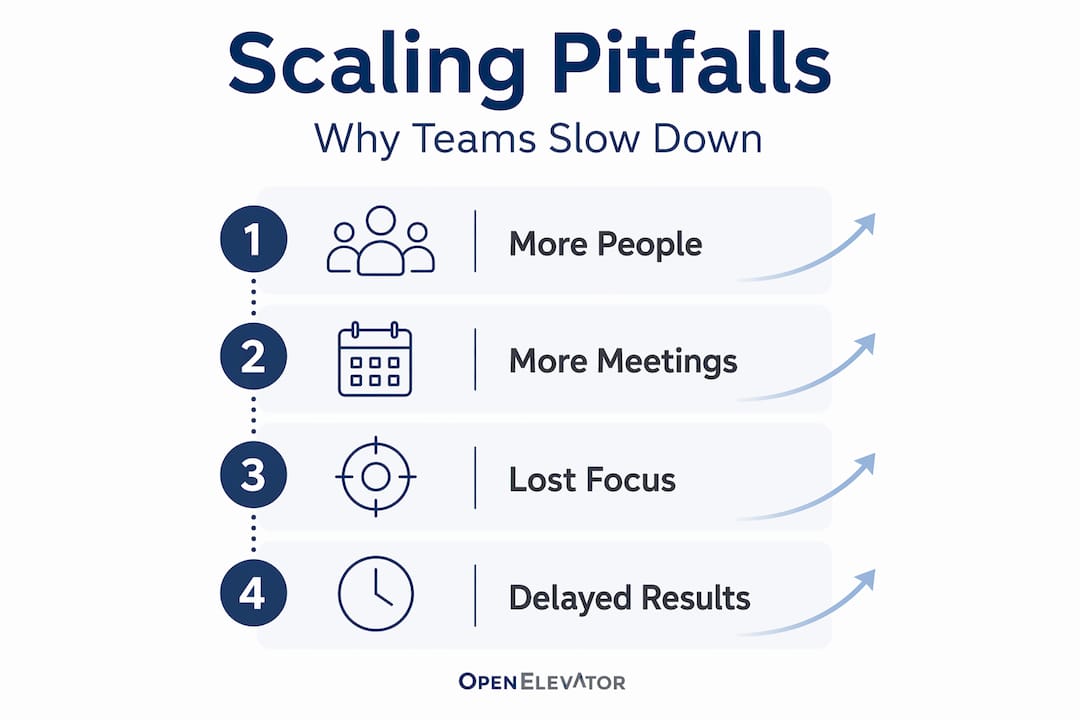
Adding tools and meetings instead of removing friction. Adding layers, meetings, and governance to gain visibility increases internal load and can worsen delivery delays. Every new approval step or reporting layer adds edges to the organizational graph.
-
Ramping headcount faster than onboarding capacity allows. Almost every engineering scaling crisis occurs between 15 and 50 team members, driven by the breakdown of informal communication and shared context. The same pattern appears in sales, operations, and client services.
-
Ignoring culture until it fractures. Implicit culture, the unwritten norms that govern how decisions get made and how people treat each other, stops scaling reliably around 25 to 30 people. Leaders who do not articulate and reinforce those norms explicitly often discover cultural cracks during a high-pressure delivery period.
-
Delaying management layers at critical thresholds. The leadership playbook changes at predefined scaling thresholds, requiring shifts from direct control to managing managers and demanding much clearer culture articulation. Leaders who miss these inflection points pay for it in execution slowdowns.
| Scaling mistake | Operational consequence |
|---|---|
| Flat structure past 15 members | Leader becomes bottleneck; decision speed collapses |
| Adding governance without removing steps | Internal coordination load rises; delivery slows |
| Hiring faster than onboarding allows | New hires underperform; senior contributors lose velocity |
| Unspoken culture past 30 members | Values drift; team friction increases silently |
Strategies for improving team efficiency through redesign
The path forward is not subtraction of ambition. It is redesign of structure before adding more inputs to a system that cannot absorb them.
-
Redesign authority frameworks before hiring. Define who decides, who executes, and who needs to be informed for every major workflow. This removes the approval loops that create decision latency.
-
Invest in mid-level managers and cross-team connectors. Leadership bridgers who collaborate across boundaries are critical to scaling, yet they are consistently overlooked. Identify and support the people who make cross-functional work happen.
-
Use alignment diagnostics, not just surveys. Visibility into values alignment, manager-employee fit, interpersonal alignment, and team friction helps leaders catch problems before they show up in output or turnover data.
-
Reduce meeting load before it becomes cultural. Meetings that multiply without producing owners or timelines are a tax on execution. Audit recurring meetings quarterly and eliminate any that do not produce a decision or a clear commitment.
-
Build psychological safety as a performance infrastructure. Teams that recover quickly from shocks share one structural advantage: relational trust that allows tensions to surface before they become crises. Speed of recovery, not absence of friction, separates high-performing teams from fragile ones.
-
Apply workflow redesign before technology adoption. Productivity gains from scaling are conditional on workflow redesign. Layering new tools onto inefficient processes accelerates the dysfunction rather than resolving it.
What leaders often miss until it’s too late
In my experience, the most dangerous phase of scaling is not the moment you bring on too many people at once. It is the quieter period after a hiring push, when everyone is technically present, the calendar is full, and output subtly declines. Leaders interpret this as a temporary integration period. Often, it is the beginning of a longer structural problem.

I have seen teams where the founder was involved in 80% of decisions a year into a 40-person company. Not because they were controlling, but because no one had been formally authorized to decide anything else. That is not a people problem. That is a design failure that was always going to limit the company at scale.
The uncomfortable truth is that adding process or people without restructuring the underlying system is negative leverage. You get more complexity in exchange for less output per person. The leaders who avoid this are not necessarily smarter. They are simply more willing to audit their own architecture before adding to it.
Early visibility into how teams actually operate, not how they report operating, is what makes that audit possible.
See what may already be forming inside your team
When team performance drops during scaling, the instinct is often to add more managers, more check-ins, or more tools. But the real opportunity is earlier visibility.
OpenElevator helps CEOs, founders, senior leaders, and managers see what is happening now: shifting sentiment, hidden disengagement, manager-employee misalignment, values misalignment, interpersonal alignment, and team friction before those issues become surprise resignations or disrupt performance.
The free team scan lets leaders experience the platform, gain real retention-risk visibility, and see what may be hidden below the surface — with zero cost and zero risk.
Get your free OpenElevator team scan to experience the platform, gain real retention-risk visibility, and see what may be hidden below the surface — with zero cost and zero risk.

Frequently asked questions
Why does team performance drop right after scaling starts?
Scaling increases coordination complexity faster than headcount grows. Communication paths multiply exponentially, creating saturation where decision-making slows, ownership blurs, and output declines even as the team size increases.
What are the first signs of performance degradation during growth?
Early signals often appear first: meetings that produce no decisions, stalled initiatives, accountability gaps, and leaders pulled into decisions that should resolve at lower levels. Engagement scores often remain steady while execution deteriorates.
How can leaders improve team efficiency during a scaling phase?
Redesign authority frameworks and workflows before adding headcount. Reduce approval layers, support cross-team connectors, and use alignment diagnostics rather than sentiment surveys to identify where friction is forming.
What is organizational saturation and why does it matter?
Organizational saturation occurs when coordination overhead consumes so much capacity that additional headcount reduces rather than increases output. It typically emerges between 15 and 50 team members and requires structural redesign, not more hiring, to resolve.
How does OpenElevator help leaders during scaling?
OpenElevator helps leaders see what is happening below the surface during scaling. The free team scan reveals values alignment, manager-employee fit, interpersonal alignment, hidden disengagement, and team friction before those issues become surprise resignations or performance disruption.