
Most retention dashboards tell leaders what already happened.
They show turnover rates, tenure, absenteeism, engagement scores, or exit themes after risk has already formed. That information can be useful, but it often arrives too late to prevent surprise resignations.
Retention insight is different.
The goal is not just to track behavior. It is to understand what may be changing below the surface: shifting sentiment, hidden disengagement, manager-employee misalignment, values misalignment, and team friction before those issues disrupt performance.
This article explains the difference between behavior insight and retention insight, why lagging indicators are not enough, and how leaders can see retention risk early enough to act.
Table of Contents
-
Understanding behavior insights: What visible signals can show
-
Behavior insight vs. retention insight: Why the difference matters
-
How leaders can use retention insight before turnover happens
Key Takeaways
| Key Point | What Leaders Should Know |
|---|---|
| Behavior insight tracks visible signals | Attendance, participation, communication, and engagement scores may show signs of change. |
| Retention insight explains risk | Leaders need to understand why sentiment, fit, alignment, or connection may be weakening. |
| Lagging indicators arrive too late | Turnover reports, exit interviews, and engagement surveys often explain problems after risk has already formed. |
| Fit and alignment matter | Manager-employee fit, values alignment, and team friction can shape whether employees stay or leave. |
| Visibility changes timing | Earlier visibility helps leaders act before surprise resignations disrupt performance. |
Understanding behavior insights: What visible signals can show
Behavior insight focuses on visible employee actions and patterns.
These signals may include attendance changes, participation shifts, communication patterns, responsiveness, or changes in how someone shows up in meetings and team activities. They can help leaders notice that something may be changing.
But behavior insight has limits.
A high performer may still attend every meeting, respond quickly, and deliver strong work while motivation or alignment is already weakening. A quiet employee may not be disengaged. A missed meeting may not mean risk. Behavior needs context before it becomes useful.
The real value is not in watching isolated actions. It is in seeing patterns and asking what those patterns may reveal about retention risk, manager-employee fit, values alignment, or team friction.
Behavior insight can be useful, but it should not become surveillance or over-interpretation. A missed meeting, slower response, or quieter week does not automatically mean someone is disengaged.
The value is in context.
Leaders should look for patterns that connect to deeper questions:
-
Is this person still aligned with the work?
-
Has their relationship with their manager changed?
-
Are their values still being met in the role?
-
Is team friction affecting how they show up?
-
Is sentiment shifting even though performance still looks stable?
Behavior may tell you something changed. Retention insight helps you understand what that change may mean.
What retention insight really shows
Retention insight should do more than track who stayed and who left.
Traditional retention metrics such as turnover rate, retention rate, tenure, and regrettable loss rate are useful, but they are mostly backward-looking. They help leaders understand what happened after the risk became visible.
Real retention insight helps leaders understand what is happening now.
It shows where sentiment may be shifting, where manager-employee fit may be strained, where values alignment may be weakening, and where team friction may be forming before those issues become resignations.

Retention insights focus on outcome metrics like turnover rates, retention rates, average tenure, and voluntary versus involuntary separations. They are retrospective by nature. They tell you what happened, not what is about to happen.
That does not make them useless. Far from it. Retention metrics are your scorecard. They validate whether your interventions are working and help you benchmark your organization against industry norms.
Key retention metrics every SME leader can benefit from tracking:
-
Voluntary turnover rate: The percentage of employees who chose to leave in a given period. This is your most telling number.
-
Retention rate: Calculated as (employees at end of period divided by employees at start) multiplied by 100. Simple, but powerful as a trend line.
-
Average tenure: How long people stay, broken down by team, role, or manager.
-
Separation type ratio: The split between voluntary and involuntary exits tells you whether you have a culture problem or a performance management problem.
-
Regrettable loss rate: Of the people who left voluntarily, how many did you genuinely not want to lose?
Here is a number worth sitting with. US SMEs average voluntary turnover of 13 to 23%, depending on industry. If you are above that range, you are not just losing people. You are losing institutional knowledge, team momentum, and real dollars.
For context on how these HR data analytics trends are reshaping what leaders track, the shift is clear: outcome metrics alone no longer cut it for organizations that want to stay competitive.
Retention insights are most useful during diagnostic reviews. After a wave of exits, they help you identify patterns. Was it one team? One manager? One tenure band? That kind of forensic clarity is genuinely valuable, even if it is backward-looking.
Behavior vs retention insight: Why the difference matters
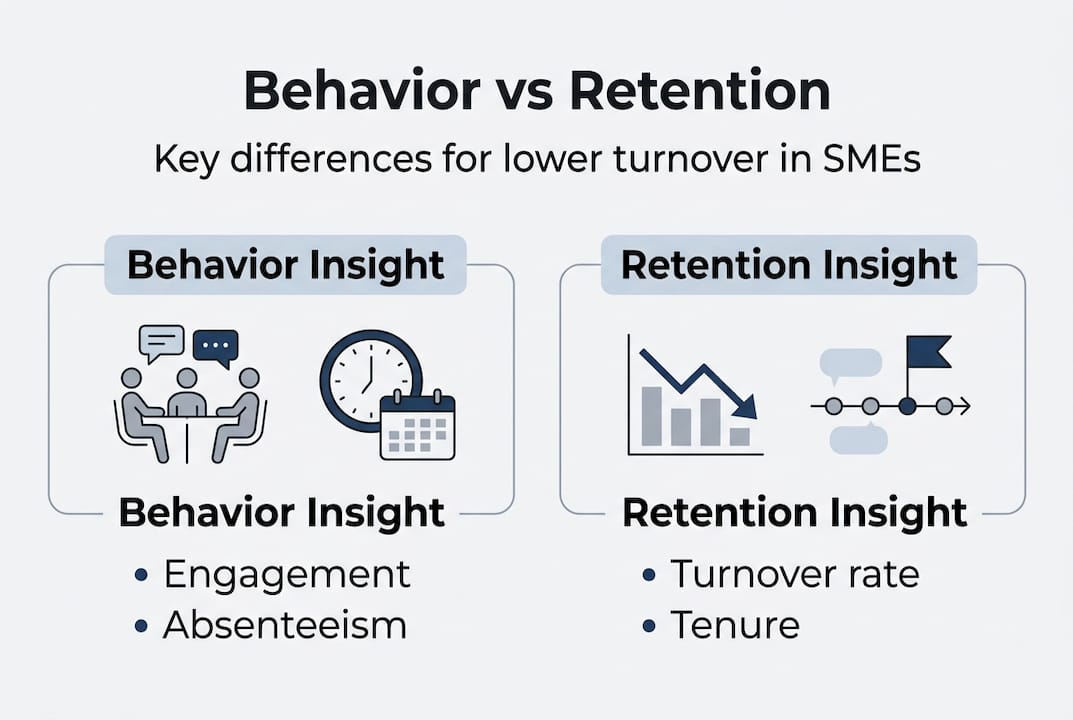
With a solid grasp of both types of insights, the side-by-side comparison reveals something most retention dashboards quietly ignore.
| Dimension | Behavior Insight | Retention Insight |
|---|---|---|
| What it tracks | Visible actions and patterns | Underlying retention risk and fit |
| Examples | Attendance, participation, responsiveness, engagement scores | Shifting sentiment, manager-employee fit, values alignment, team friction |
| Timing | Can be early, but often needs context | Designed to show risk before resignation |
| Main limitation | Behavior can be misread without deeper context | Requires a system that measures what is happening below the surface |
| Leadership value | Helps leaders notice possible change | Helps leaders understand where to act |
The key difference is that behavior insight can show visible changes, while retention insight helps leaders understand the underlying risk behind those changes. Combining them is what enables genuinely proactive strategies rather than reactive damage control.
Here is the truth: most SME leaders have retention dashboards. Very few have behavioral signal systems sitting alongside them. That gap is where turnover surprises live.
How leaders can use retention insight before turnover happens
The goal is not to collect more dashboards. The goal is to act earlier.
Leaders can use retention insight to identify where risk may be forming and then focus their attention where it matters most.
Start with these steps:
-
Look for changes in sentiment, not just changes in output
-
Review manager-employee fit before assuming a manager or employee is the problem
-
Check whether values alignment has shifted as the company grows
-
Look for team friction that may not show up in performance metrics
-
Treat engagement surveys, turnover reports, and exit interviews as lagging indicators, not early-warning systems
-
Use one-on-one conversations to explore what the data suggests, not to interrogate the employee
The most important shift is from asking, “Who left?” to asking, “What is changing before someone leaves?”
That is where retention insight becomes useful.
Why most retention dashboards miss the mark
Most retention dashboards are backward-looking.
They show turnover rates, tenure, exit reasons, engagement scores, or participation data. Those numbers may be accurate, but accuracy is not the same as early visibility.
The problem is timing.
By the time turnover rises, exit interviews are complete, or engagement survey results are reviewed, the risk may already have disrupted performance. Leaders may know more about what happened, but they still did not see it early enough to prevent it.
The better question is not, “What did our dashboard report?”
The better question is, “Can we see what is changing below the surface right now?”
That is the difference between reporting on retention and leading retention.
How OpenElevator helps leaders see retention risk earlier
Retention insight is not just about tracking behavior. It is about seeing what is changing before it becomes turnover.
OpenElevator helps CEOs, founders, senior leaders, and managers see what is happening now: shifting sentiment, hidden disengagement, manager-employee misalignment, values misalignment, and team friction before those issues become surprise resignations or disrupt performance.
Engagement surveys, turnover data, and exit interviews are lagging indicators. OpenElevator gives leaders earlier visibility into the risks forming below the surface.
Start your Stay Survey to experience the platform, gain real retention-risk visibility, and see what may be hidden below the surface — with zero cost and zero risk.
Frequently asked questions
What is behavior insight?
Behavior insight looks at visible employee actions and patterns, such as attendance, participation, responsiveness, or communication changes. These signals can be useful, but they need context before leaders can understand whether they point to retention risk.
What is retention insight?
Retention insight helps leaders see where employees may be becoming less aligned, less connected, or more likely to leave. It focuses on underlying risk such as shifting sentiment, manager-employee fit, values alignment, and team friction.
How are behavior insight and retention insight different?
Behavior insight tracks what employees appear to be doing. Retention insight helps explain what may be changing below the surface and whether those changes could lead to disengagement, performance disruption, or resignation.
Why are turnover reports and exit interviews not enough?
Turnover reports and exit interviews are lagging indicators. They explain what happened after someone has already left or after risk has already formed. Leaders need earlier visibility to prevent surprise resignations.
How does OpenElevator help leaders see retention risk earlier?
OpenElevator helps leaders see what is happening below the surface before turnover data, exit interviews, or engagement surveys reveal the problem too late. The complimentary Key Team Stay Survey lets leaders experience the platform with zero cost and zero risk while gaining real visibility into hidden team risk.