
TL;DR:
- Leaders often miss early signals of employee disengagement and retention risk until it’s too late.
- Proactive data review and integration of engagement, performance, and manager feedback improve retention strategies.
- Traditional methods like exit interviews and bonuses are outdated; continuous monitoring offers better prevention.
Losing a key employee rarely feels like a surprise in hindsight. Looking back, the signals were there: the quieter meetings, the missed deadlines, the sudden surge in vacation requests. But in the moment, most leaders are too buried in operations to connect the dots before it’s too late. Unexpected resignations don’t just create open headcount. They fracture team momentum, overload surviving colleagues, and trigger a costly, time-consuming scramble to backfill roles. For mid-sized companies where every senior contributor carries outsized responsibility, that kind of disruption can set a whole department back by months. This guide walks you through how to spot retention risk early, what tools actually help, and what most leaders get dangerously wrong.
Table of Contents
- Understanding retention risk factors
- Key tools and data sources for detecting risk
- Step-by-step: Detecting retention risk before it’s too late
- Common mistakes and how to avoid them
- Why conventional retention strategies fall short in 2026
- Take the next step: Lower your retention risk now
- Frequently asked questions
Key Takeaways
| Point | Details |
|---|---|
| Spot risk before it’s visible | Use a combination of data analytics and subtle behavior cues to uncover employees at risk of leaving early. |
| Leverage the right tools | Integrate HR platforms, surveys, and dashboards for continuous monitoring of retention signals. |
| Follow a step-by-step approach | Proactive routines for reviewing and acting on risk insights are crucial for reducing turnover. |
| Avoid common pitfalls | Don’t wait for resignations—address risks promptly and interpret engagement data accurately. |
Understanding retention risk factors
Retention risk is the probability that a given employee will leave your organization within a defined period. Simple enough in theory. In practice, it’s one of the hardest things to measure because the factors driving it are often invisible until they’ve already done serious damage.
Think of it like a slow leak in a pipe. The water pressure looks fine on the surface, but somewhere behind the wall, things are quietly deteriorating. By the time you see the damage, the repair is expensive and disruptive.
The top drivers of retention risk tend to cluster around a few familiar themes:
- Poor engagement: Employees who feel disconnected from their work or team are already halfway out the door.
- Lack of advancement: When people stop seeing a future for themselves at your company, they start looking elsewhere.
- Compensation misalignment: Feeling underpaid relative to market rates is a quiet but powerful motivator to leave.
- Management issues: Bad managers don’t just create unhappy employees. They create departing ones.
- Misalignment with company values or culture: This one is underestimated constantly. People leave environments that feel wrong to them, even when the pay is good.
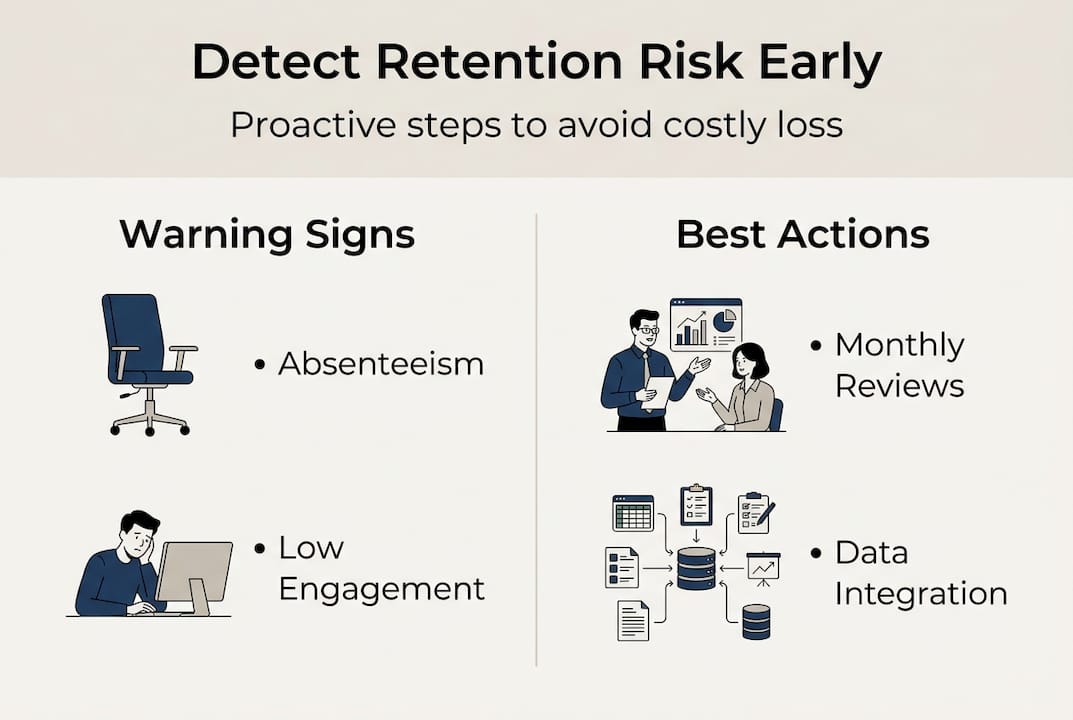
The warning signals are often subtle. Watch for withdrawal from team conversations, a drop in the quality or volume of work, sudden spikes in PTO usage, or a noticeable disengagement from company-wide initiatives. These aren’t guarantees someone is leaving. But they are the leading indicators most leaders miss because they’re focused on outputs, not patterns.
Turnover costs organizations up to 213% of annual salary for highly trained positions. That’s not a rounding error. That’s a business risk.
And yet, most organizations still rely on exit interviews as their primary source of retention intelligence. Exit interviews are useful, but they’re a postmortem. You’re learning why someone already decided to leave. That’s the equivalent of reading the accident report after the crash.
Pro Tip: Don’t wait for the exit interview. Build a habit of reviewing retention solutions and leading indicators monthly, so you’re catching risk signals while there’s still time to act on them.
Key tools and data sources for detecting risk
Now that you understand what to watch for, here’s how to equip your organization for proactive risk detection. The good news is that the data you need almost certainly already exists inside your organization. The challenge is connecting it in a way that surfaces meaningful patterns.
Here are five critical data sources every leader should be tapping:
- Engagement survey results: Not just the scores, but the trend lines. A score of 6.8 means less than a score that dropped from 8.2 to 6.8 over two quarters.
- Absenteeism and PTO patterns: Unusual spikes, especially in high performers, deserve a closer look.
- Manager feedback and one-on-one notes: Qualitative signals from direct managers are often the earliest and most accurate indicators.
- Performance review trajectories: Declining ratings or stalled development conversations are red flags.
- Tenure and role change data: Employees who haven’t moved in two or more years without a clear path forward are statistically more likely to seek growth elsewhere.
On the technology side, the landscape has matured considerably. Here’s how the major tool categories compare:
| Tool type | Primary strength | Key limitation |
|---|---|---|
| HRIS platforms | Centralized people data | Limited predictive analytics |
| Engagement survey tools | Captures employee sentiment | Often siloed from other data |
| Retention analytics dashboards | Identifies risk patterns | Requires data integration |
| Stay interview trackers | Qualitative depth | Time-intensive to scale |
Engagement surveys paired with advanced analytics can identify risk trends months before resignations actually happen. That window is everything. It’s the difference between a proactive conversation and an emergency backfill.
Pro Tip: Don’t let your tools operate in silos. Integrating your engagement data with your HRIS and performance systems creates a real-time risk dashboard that’s far more actionable than any single data source alone.
Step-by-step: Detecting retention risk before it’s too late
With the right tools in place, a structured detection routine is critical. Having data is not the same as using it well. Here’s a practical five-step framework that actually works in the real world, not just in a consulting deck.
- Gather data systematically: Pull engagement scores, absenteeism records, performance trends, and manager notes on a defined schedule. Monthly is ideal. Quarterly is the minimum.
- Assess signals by category: Don’t just look at individual data points. Look for patterns across categories. One missed deadline is noise. A pattern of missed deadlines plus declining engagement scores is a signal.
- Segment employees by risk level: Categorize your workforce into low, medium, and high retention risk. This focuses your limited attention where it matters most.
- Validate with direct managers: Data tells you what is happening. Managers often know why. A five-minute check-in with the right manager can confirm or reframe what the data is suggesting.
- Intervene with targeted action: Generic responses don’t work. A high performer who feels stagnant needs a different conversation than someone who feels undercompensated. Match the intervention to the signal.
Here’s how proactive and reactive approaches compare in practice:
| Approach | Timing | Outcome |
|---|---|---|
| Proactive check-ins | Before risk escalates | Higher retention, lower cost |
| Reactive response | After signals are obvious | Damage control, often too late |
Routine evaluation of risk metrics results in meaningfully better employee retention over time. It’s not glamorous work. But it’s the kind of disciplined habit that separates organizations that consistently retain top talent from those perpetually scrambling to replace it. Building lower turnover strategies into your operational rhythm is what makes the difference.

Common mistakes and how to avoid them
Even well-equipped leaders can fall into common traps. Here’s how to sidestep them.
The most expensive mistake is relying exclusively on lagging indicators. Exit interviews, turnover rates, and annual engagement surveys all tell you what already happened. They’re useful for understanding the past, but they won’t help you protect your team today.
Many organizations misinterpret engagement data or respond too late, which means even companies that invest in the right tools still end up reactive. The tool isn’t the problem. The interpretation and response cadence is.
Here are the most common mistakes and how to fix them:
- Relying on lagging indicators only: Supplement exit data with real-time engagement tracking and manager feedback loops. Build leading indicators into your regular review process.
- Poor data integration: When your HRIS, survey platform, and performance system don’t talk to each other, you get an incomplete picture. Prioritize integration, even if it requires some upfront investment.
- Generic interventions: Sending everyone a retention bonus when only three people are actually at risk is wasteful and often ineffective. Segment your risk population and tailor your response.
- Ignoring the manager layer: Managers are your earliest warning system. If they’re not trained to recognize and report risk signals, you’re flying blind on the most important data source you have.
When leaders misread turnover signals, they often intervene too late or in the wrong place entirely. That’s a double loss: you spend resources and still lose the person.
Pro Tip: Conduct regular management training focused specifically on how to recognize and escalate retention risk signals. Make it part of your leadership development program, not a one-time workshop.
Why conventional retention strategies fall short in 2026
Here’s something most retention guides won’t tell you: the standard playbook is increasingly outdated. Exit interviews, annual engagement surveys, and year-end retention bonuses were designed for a workforce and a pace of change that no longer exists.
The employees most likely to leave your organization in the next six months are probably not telling anyone they’re unhappy. They’ve already emotionally checked out. They’re updating their LinkedIn, taking recruiter calls, and doing just enough to avoid attention. By the time their disengagement shows up in your annual survey, they may already have an offer letter.
Real retention gains require ongoing, nuanced analysis, not one-time surveys. What that looks like in practice is cohort analysis, behavioral pattern tracking, and heatmaps of engagement across teams and tenure bands. It means using advanced retention analytics to see micro-patterns that aggregate scores will always obscure.
Retention is less about reacting to exits, more about confidently predicting them.
The organizations winning the retention game in 2026 aren’t doing more surveys. They’re building continuous visibility into the employee experience, so that by the time a risk becomes obvious, they’ve already intervened.
Take the next step: Lower your retention risk now
If this guide has made one thing clear, it’s that retention risk doesn’t announce itself. It builds quietly, and by the time it’s visible, it’s already expensive. The leaders who get ahead of it aren’t smarter or luckier. They’re simply better informed.

OpenElevator gives you the visibility layer your existing HR tools are missing. From predictive risk dashboards to tailored intervention guidance and hiring fit analytics, it’s built for leaders who want to act before problems become crises. If you’re ready to stop guessing and start leading with data, explore Employee Retention Solutions and see what early visibility actually looks like in practice.
Frequently asked questions
What are early warning signs of employee turnover?
Withdrawal, absenteeism, and performance declines often precede resignations by weeks or months, making them the most actionable early indicators leaders should monitor consistently.
How often should leaders review retention risk metrics?
Routine evaluation leads to better outcomes, so monthly reviews are ideal, with quarterly reviews as the minimum threshold for catching meaningful trends before they escalate.
Which analytics tools are most effective for detecting risk?
Integrated HRIS platforms combined with engagement analytics and survey tools provide the most robust, actionable picture of retention risk across your workforce.
Why do traditional retention bonuses fail?
Retention gains require ongoing analysis, not just financial incentives, because bonuses address symptoms after risk is already high rather than the root causes quietly driving employees toward the exit.