Employee retention trends in 2025 point to one clear reality: leaders need to see risk earlier.
Employees are no longer leaving only because of compensation. They leave when work feels misaligned, growth feels blocked, managers miss early friction, trust weakens, or the company no longer fits what they need.
The challenge is that those risks often build quietly. A team can look stable while disengagement, manager-employee misalignment, values disconnect, or burnout is already forming beneath the surface.
Most companies still treat retention as a response to turnover. That is too late. In 2025, stronger leaders will treat retention as a visibility problem.
This guide explains the employee retention trends shaping 2025, the major causes of turnover, the strategies leaders need now, the role of AI and data, and the risks of ignoring hidden retention issues.
Table of Contents
Key Takeaways
| Point | Details |
|---|---|
| Retention is becoming a visibility issue | Leaders need to see hidden risk before employees resign. |
| Employees expect more alignment | Growth, manager fit, values alignment, flexibility, and well-being all affect whether people stay. |
| Generic retention programs are weaker | Employees stay for different reasons, so broad programs miss individual risk signals. |
| AI and data matter more | Retention tools should help leaders detect friction, disengagement, and misalignment earlier. |
| Ignoring retention risk is expensive | Turnover can damage productivity, morale, customer relationships, and institutional knowledge. |
Defining Employee Retention Trends for 2025
Employee retention trends for 2025 are moving away from generic engagement programs and toward earlier visibility into retention risk.
The question is no longer only, “How do we keep employees happy?”
The better question is:
“Can we see which employees may be at risk before they decide to leave?”
In 2025, retention is being shaped by several forces:
– Higher employee expectations
– More demand for meaningful work
– Greater focus on manager-employee alignment
– More pressure on growth and career development
– More attention to mental health and workload sustainability
– Increased use of AI and data in workforce decisions
– Stronger need to identify hidden disengagement early
Retention is not just about perks, benefits, or flexibility. Those matter, but they are not enough if employees feel unseen, unsupported, misaligned, or disconnected.
The strongest retention strategies in 2025 will help leaders understand what is happening beneath the surface before turnover becomes visible.

Major Causes of Employee Turnover Today
Employee turnover rarely has one simple cause.
Most employees leave after multiple issues build over time. By the time they resign, the reason may sound simple, but the real risk often started earlier.
Major causes of turnover today include:
– Poor manager relationship
– Lack of career growth
– Values misalignment
– Team friction
– Workload pressure
– Burnout
– Low recognition
– Compensation concerns
– Unclear expectations
– Loss of trust in leadership
– Weak connection to the company’s direction
Most companies assume employees will speak up before they leave. That assumption is dangerous.
A realistic scenario: a strong employee is still performing, still polite in meetings, and still completing work. But they have stopped offering ideas, stopped talking about growth, and seem less connected to the team. Nothing looks urgent. The risk is already forming.
Turnover becomes easier to reduce when leaders stop waiting for resignation and start looking for the signals that come before it.
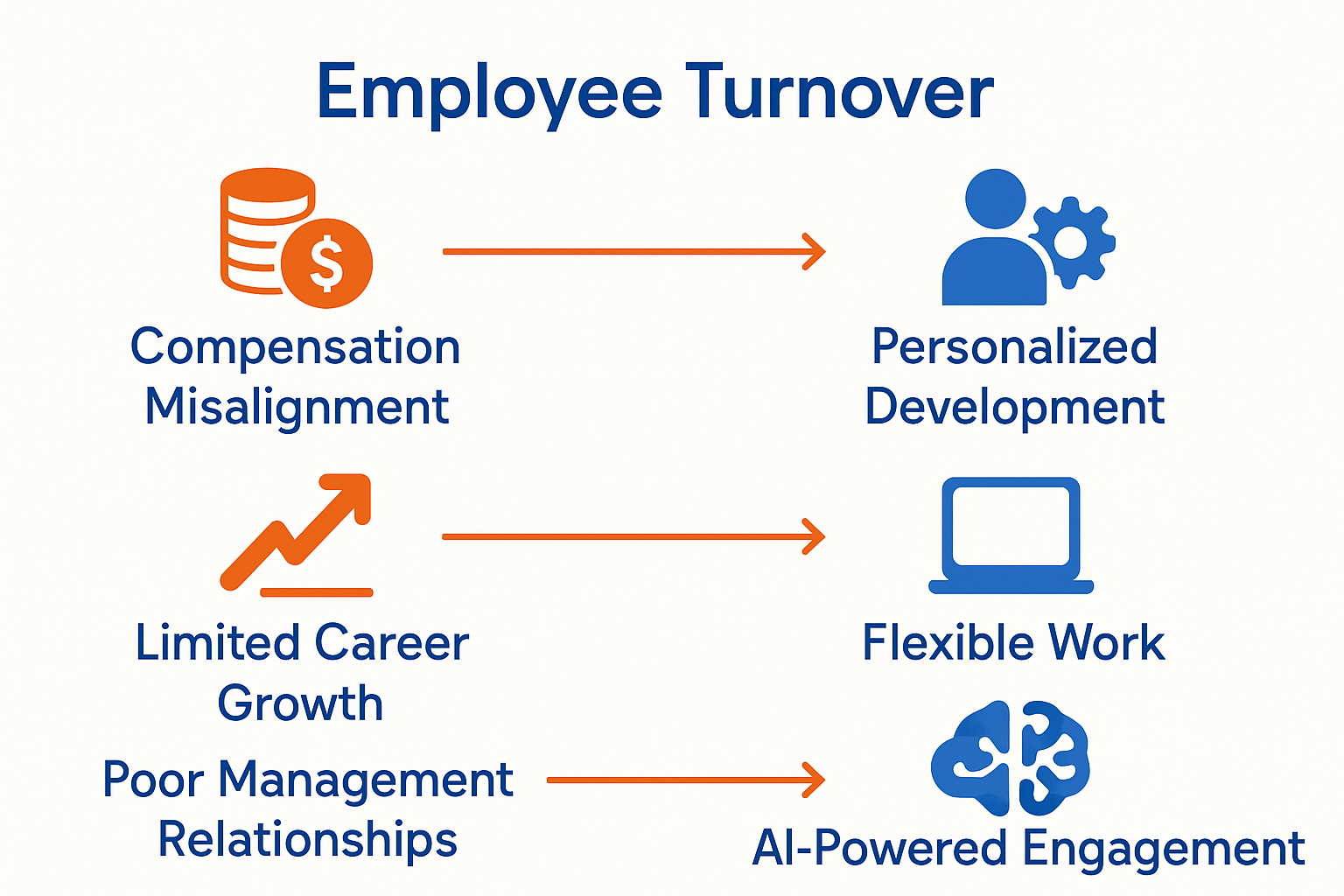
Innovative Retention Strategies for 2025
The best retention strategies for 2025 are not generic programs. They are targeted, practical, and built around earlier visibility.
Strong strategies include:
– Identifying retention risk before resignation
– Improving manager-employee alignment
– Creating personalized growth paths
– Addressing team friction early
– Supporting workload sustainability
– Recognizing meaningful contribution
– Understanding values alignment
– Strengthening onboarding
– Reviewing hiring fit before adding people to a team
– Acting quickly on employee feedback
The key shift is from reactive retention to proactive retention.
Reactive retention waits until employees complain, disengage visibly, or resign.
Proactive retention asks:
– Who may be quietly disengaging?
– Where is manager friction affecting commitment?
– Which employees feel blocked from growth?
– Which teams look stable but may be under pressure?
– What are we learning too late from exit interviews?
In 2025, retention strategy needs to be more precise. Broad surveys and general engagement programs are not enough if leaders still cannot see who may be at risk.
Role of AI and Data in Retention Solutions
AI and data are becoming more important in employee retention because leaders cannot rely only on gut instinct.
Managers may miss early risk because employees often keep performing while quietly disengaging. Engagement surveys may show averages that hide individual problems. Exit interviews explain the loss after it is already too late.
Useful retention data should help leaders see:
– Who may be at risk of disengaging
– Where manager-employee misalignment exists
– Where team friction is forming
– Whether values alignment is weak
– Whether growth paths are unclear
– Whether workload pressure is creating risk
– Where intervention may be needed first
AI should not replace leadership judgment. It should sharpen it.
The goal is not to label employees. The goal is to give leaders earlier visibility into patterns they may otherwise miss.
The best retention technology helps leaders move from guessing to knowing where attention is needed.
Critical Risks of Ignoring Retention Issues
Ignoring retention issues is expensive because the damage often starts before the resignation.
When employees begin disengaging, the business may already be losing productivity, focus, ideas, trust, and momentum. By the time someone leaves, the team may have been absorbing the cost for months.
Risks of ignoring retention issues include:
– Lost institutional knowledge
– Lower productivity
– Customer relationship disruption
– Delayed execution
– Increased workload for remaining employees
– Lower morale
– Reduced trust in leadership
– Higher hiring and onboarding costs
– Increased risk of additional resignations
– Damage to employer reputation
What looks like stability is often just a lack of visibility.
A team may appear fine because people are still showing up and doing the work. But if commitment is weakening underneath, leaders may not see the problem until the resignation makes it obvious.
The real risk is not only turnover. It is seeing the risk too late.
See Retention Risk Before 2025 Turnover Trends Hit Your Team
Employee retention trends in 2025 make one thing clear: leaders need earlier visibility.
A team can look stable while disengagement, manager-employee misalignment, values disconnect, or hidden friction is already building beneath the surface. By the time someone resigns, the company is already reacting.
OpenElevator helps CEOs, founders, senior leaders, and managers detect retention risk, team misalignment, and hidden friction before they become costly resignations. The platform uses a short, bias-free team scan and a proprietary algorithm to reveal where leaders may need to act earlier.
Start with a free team scan for up to 10 team members and see what may be hidden inside your own team.
Frequently Asked Questions
What are the biggest employee retention trends for 2025?
The biggest employee retention trends for 2025 include earlier visibility into retention risk, manager-employee alignment, personalized growth paths, workload sustainability, AI-driven insights, and stronger focus on values alignment and team friction.
Why is employee retention important in 2025?
Employee retention is important in 2025 because turnover can disrupt productivity, customer relationships, institutional knowledge, morale, and business growth. Leaders need to identify risk before strong employees leave.
What causes employee turnover today?
Common causes of employee turnover include poor manager relationships, lack of growth, values misalignment, team friction, workload pressure, burnout, low recognition, compensation concerns, and loss of trust in leadership.
How can leaders improve employee retention in 2025?
Leaders can improve retention by identifying risk earlier, improving manager alignment, creating growth paths, addressing team friction, recognizing meaningful contribution, supporting workload sustainability, and acting quickly on signs of disengagement.
How does AI help with employee retention?
AI can help with retention by detecting patterns in engagement, alignment, team friction, and risk signals that leaders may miss. It should support leadership judgment, not replace it.
Why are engagement surveys not enough for retention?
Engagement surveys are not enough because they often show averages that hide individual risk. A team can look stable while specific employees are quietly disengaging or becoming misaligned.
How does OpenElevator help with employee retention trends?
OpenElevator helps leaders detect retention risk, team misalignment, and hidden friction before they become costly resignations. It gives CEOs, founders, senior leaders, and managers clearer visibility into where they may need to act earlier.
Is there a free way to try OpenElevator?
Yes. OpenElevator offers a free team scan for up to 10 team members so leaders can see retention risk, alignment gaps, and hidden friction inside their own team.