
Engaged employees are not always aligned employees.
A team can be enthusiastic, motivated, and busy while still moving in the wrong direction. That creates a hidden retention risk: people may work hard, feel frustrated when their effort does not connect to company goals, and eventually disengage or leave.
Engagement measures how much energy someone brings to the work. Alignment measures whether that energy is pointed at the right priorities.
This guide explains the difference between engaged and aligned employees, why engagement alone can hide risk, and how leaders can build both before misalignment turns into turnover.
Table of Contents
-
Building both: Practical steps to foster engagement and alignment
-
Why the old playbook fails: Engagement is not enough for 2026
Key Takeaways
| Key Point | What Leaders Should Know |
|---|---|
| Engagement and alignment are different | Engaged employees bring energy and commitment; aligned employees connect their work to company goals. |
| Engagement alone can hide risk | A motivated employee can still become frustrated if their effort is not connected to the right priorities. |
| Misalignment wastes effort | Teams can work hard and still miss strategic goals if direction is unclear. |
| Hybrid teams need clearer signals | Distributed teams require visible goals, alignment conversations, and stronger feedback loops. |
| Leaders need both metrics | Measuring engagement and alignment separately helps reveal hidden retention risk earlier. |
Defining engagement and alignment: What leaders must know
Let’s start with the basics, because the words get used interchangeably so often that their distinct meanings have blurred. Employee engagement refers to the level of commitment, enthusiasm, and discretionary effort a person brings to their work. An engaged employee doesn’t just clock in and out. They care. They go the extra mile. They’re the ones sending thoughtful follow-up emails at 9 PM because they actually want the project to succeed.
Employee alignment, on the other hand, is about direction. It’s whether an employee understands the company’s goals and values and is actively working toward them. An aligned employee isn’t just working hard. They’re working on the right things, in the right direction, for the right reasons.
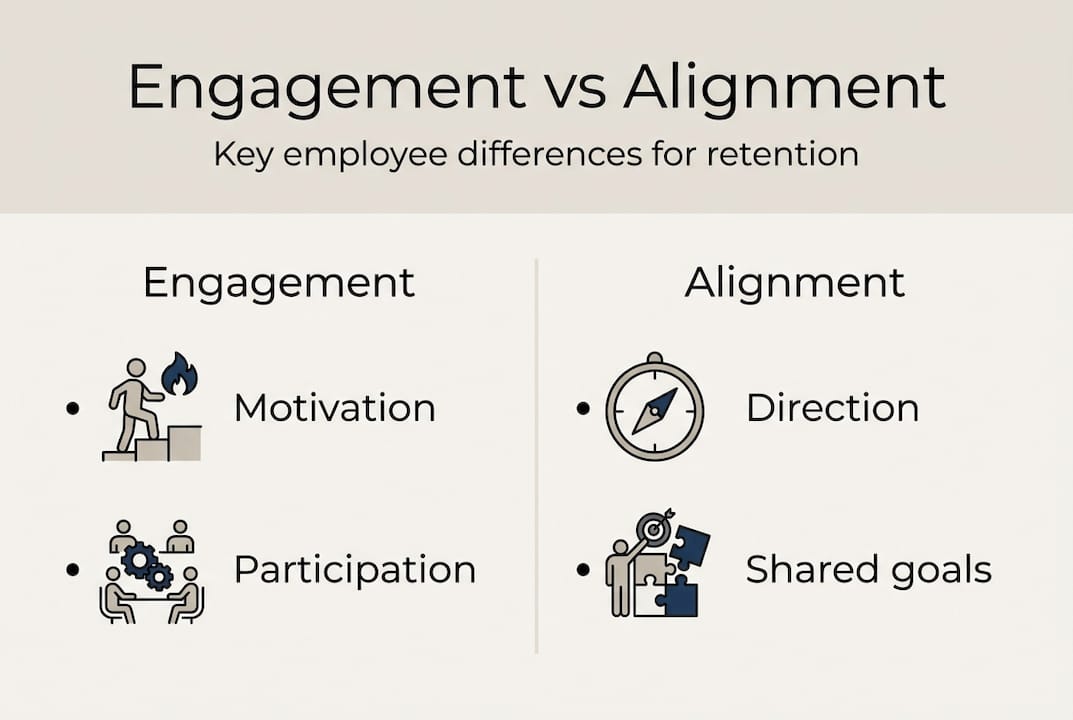
Here’s where it gets interesting. You can have one without the other, and the gap between them is where turnover quietly grows.
When you have engaged but misaligned employees, you tend to see:
-
High individual output that doesn’t connect to team or company KPIs
-
Enthusiasm for projects that aren’t strategic priorities
-
Frustration when their hard work doesn’t seem to move the needle
-
Burnout from effort that goes unrecognized because it wasn’t pointed in the right direction
-
Eventually, resignation, because they feel unseen despite giving everything
The emerging reality in hybrid and AI-driven workplaces makes this even more urgent. When teams are distributed and workflows are increasingly automated, Gallup emphasizes engagement as a core driver, but engagement without directional clarity becomes noise. You need both signals working together.
The good news is that strong employee retention strategies address both dimensions, not just one.
Pro Tip: Don’t assume that because your team scores high on engagement surveys, they’re also aligned with your strategic priorities. These are separate measurements that require separate attention.
Key differences: Engagement vs alignment in action
With definitions in hand, let’s see how engagement and alignment actually diverge on the ground. The clearest way to understand this is side by side.
| Dimension | Engagement | Alignment |
|---|---|---|
| Definition | Emotional commitment and discretionary effort | Understanding and acting toward company goals |
| Key outcome | Higher productivity and morale | Strategic focus and goal achievement |
| Risk when missing | Apathy, absenteeism, quiet quitting | Misdirected effort, missed KPIs, strategic waste |
| How to measure | Pulse surveys, eNPS, participation rates | Goal tracking, OKR reviews, alignment surveys |
Think about a sales team that is genuinely excited about their work. They’re hitting their individual call numbers, they love the product, they show up early and stay late. But the company has pivoted to focus on enterprise accounts, and this team is still grinding through SMB leads with the same enthusiasm they always had. That’s alignment as an evolved metric for workforce effectiveness, and it’s being ignored.
Engaged but misaligned employees can enthusiastically go in the wrong direction, and they’ll do it with a smile right up until the moment they burn out or walk out.
Now flip it. An aligned but disengaged employee knows exactly what the company needs, understands the strategy, and has no emotional investment in making it happen. They’re going through the motions. That’s a different problem, but still a costly one.
Here’s how to spot misalignment hiding behind high engagement:
-
Output doesn’t connect to priorities. The work is good, but it’s not moving the metrics that matter.
-
Employees can’t articulate the company’s top three goals. Ask them. The answers are often surprising.
-
Effort feels invisible to leadership. Engaged employees start to feel unrecognized, even though they’re working hard.
-
Team projects pull in different directions. Collaboration breaks down not because of conflict, but because of directional confusion.
For leaders focused on lowering turnover, recognizing these patterns early is the difference between a retention problem and a retention crisis.

The risks of engagement without alignment
Knowing the differences, it’s vital to recognize what’s at stake if alignment is ignored. And the stakes are higher than most leaders realize.
When organizations pour resources into engagement programs without addressing alignment, they create a specific kind of organizational dysfunction. It feels fine. Morale looks good. Survey scores are solid. And then, suddenly, a wave of resignations hits, or a major strategic initiative fails, and no one saw it coming. This is exactly the “feels fine until it suddenly isn’t” pattern that catches leaders off guard.
Engaged-but-misaligned waste is a growing concern post-2024, particularly as companies navigate rapid strategic pivots, hybrid structures, and AI-driven workflow changes. The cost isn’t just financial. It’s the opportunity cost of talented, motivated people working on the wrong things.
Common scenarios where this plays out:
-
A product team builds features customers love but that don’t support the company’s revenue model
-
Marketing creates campaigns that generate buzz but don’t drive the customer segments leadership is targeting
-
High performers leave because their personal goals and the company’s direction never actually converged
-
Managers celebrate team energy without ever checking whether that energy is pointed at the right outcomes
The risk compounds over time. As engagement programs grow more sophisticated, they can actually mask misalignment by keeping people happy enough to stay while the strategic gap widens underneath.
Pro Tip: Build a visible alignment check into every team review. Ask not just “what did we accomplish?” but “how did this connect to our top priorities?” It takes five minutes and surfaces drift before it becomes a crisis.
For companies serious about reducing employee turnover, this is the layer of visibility that most HR tools simply don’t provide.
Building both: Practical steps to foster engagement and alignment
Understanding the risks of tunnel-vision on engagement, here’s how to build both dimensions for real workplace success.
Step 1: Diagnose where you actually are. Before you can fix anything, you need an accurate picture. Run alignment-specific surveys alongside your standard engagement pulse checks. Hold one-on-ones where you ask employees to describe the company’s top three priorities in their own words. The gaps you find will tell you more than any dashboard.
Step 2: Separate your levers. Engagement and alignment require different interventions.
| Lever | Boosts engagement | Drives alignment |
|---|---|---|
| Recognition programs | ✓ | |
| Transparent goal-setting | ✓ | |
| Manager quality and support | ✓ | |
| OKR visibility and tracking | ✓ | |
| Team social events | ✓ | |
| Strategic planning involvement | ✓ | |
| Career development conversations | ✓ | ✓ |
Notice that career development conversations appear in both columns. That’s intentional. When you connect an employee’s growth path to the company’s strategic direction, you’re building engagement and alignment at the same time.
Step 3: Build alignment into hybrid team rhythms. For distributed teams, alignment doesn’t happen by osmosis. It requires deliberate structure. Here are the three practices that matter most:
-
Weekly priority anchoring. Start every team meeting with a one-sentence reminder of the quarter’s top goal. It sounds simple. It works.
-
Visible OKR tracking. Make progress on strategic objectives visible to everyone, not just leadership. When people can see how their work connects to the bigger picture, alignment follows naturally.
-
Quarterly alignment conversations. Separate from performance reviews, these are conversations specifically about whether an employee’s role and contributions still feel connected to where the company is going.
Alignment-focused cultures show lower turnover and stronger results, even in hybrid environments. That’s not a soft claim. It’s a measurable outcome that shows up in retention data, goal attainment, and team effectiveness scores.
If you’re looking for alignment solutions that connect these practices to real retention metrics, the tools exist. The question is whether you’re using them.
Why the old playbook fails: Engagement is not enough for 2026
While the Gallup engagement era gave us something valuable, it also created a false sense of confidence around retention risk. We learned to measure how people feel about their work. We did not learn to measure whether that feeling is likely to change, or may already be changing, from satisfied to disengaged.
That is the risk of measuring engagement alone.
High engagement scores feel like good news. But they can miss the signs of misalignment, manager friction, values mismatch, or team strain that may already be changing sentiment below the surface.
Culture change in 2026 requires new metrics. Leaders who are rethinking retention have stopped asking only, “Are our people happy?” They are also asking, “Are our people still aligned, still connected, and still moving in the right direction?”
That shift in question changes everything.
How OpenElevator Helps Leaders See Retention Risk Earlier
Measuring engagement is useful. Seeing what is already changing below the surface is more valuable.
Engagement surveys, turnover data, and exit interviews are lagging indicators. They often explain the problem after retention risk has already formed.
OpenElevator helps CEOs, founders, senior leaders, and managers see what is happening now: shifting sentiment, hidden disengagement, manager-employee misalignment, values misalignment, and team friction before those issues become surprise resignations or disrupt performance.
Get your free OpenElevator team scan to experience the platform, gain real retention-risk visibility, and see what may be hidden below the surface — with zero cost and zero risk.
Frequently asked questions
What is the difference between engaged and aligned employees?
Engaged employees are motivated, committed, and willing to put energy into their work. Aligned employees understand company goals and direct their effort toward the right priorities. Strong teams need both.
Can an employee be engaged but not aligned?
Yes. An employee can be enthusiastic and hardworking while focusing on the wrong priorities. This can lead to wasted effort, frustration, burnout, or turnover if their work does not feel connected to meaningful company goals.
Why does engagement alone miss retention risk?
Engagement surveys are lagging indicators. They show how employees felt at a point in time, but they may miss whether sentiment, alignment, manager fit, or team dynamics are already changing below the surface. That is why leaders need earlier visibility into what is happening now.
How can leaders improve employee alignment?
Leaders can improve alignment by making goals visible, connecting individual work to company priorities, holding regular alignment conversations, and checking whether employees understand how their role contributes to the bigger picture.
How does OpenElevator help with alignment risk?
OpenElevator helps leaders detect retention risk, hidden disengagement, manager-employee misalignment, values misalignment, and team friction earlier. The free team scan lets leaders experience the platform with zero cost and zero risk while gaining real visibility into hidden team risk.