
Engagement and retention are related, but they are not the same problem.
An employee can feel engaged in parts of their work and still become a retention risk. They may like their colleagues, care about the mission, and perform well, while quietly losing trust in their manager, feeling misaligned with the company, or no longer seeing a future inside the team.
That is why engagement tools alone do not prevent turnover.
Engagement tools help leaders understand sentiment. Retention systems need to help leaders see where hidden disengagement, manager-employee friction, values misalignment, and team instability are forming before costly resignations happen.
For CEOs, founders, senior leaders, and managers, the goal is not to collect more scores. The goal is to see risk early enough to act.
This article explains the difference between engagement tools and retention systems, why confusing the two creates blind spots, and how leaders can build earlier visibility into retention risk.
Table of Contents
Key Takeaways
| Point | Details |
|---|---|
| Engagement and retention are different | Engagement shows how employees may feel. Retention visibility shows where people may be at risk of leaving. |
| Engagement tools can create false confidence | Good survey scores may hide manager friction, values misalignment, or hidden disengagement. |
| Retention systems must show risk | Leaders need to see where resignation risk is forming before employees mentally check out. |
| Action matters more than scores | Data only helps if leaders know where to intervene and why. |
| Earlier visibility protects stability | Leaders reduce turnover by seeing fit, alignment, and team friction before resignations happen. |
Engagement Tools vs. Retention Systems: The Core Difference
Engagement tools and retention systems answer different questions.
Engagement tools usually ask: “How do employees feel?”
Retention systems should ask: “Where are we at risk of losing people, and why?”
That difference matters.
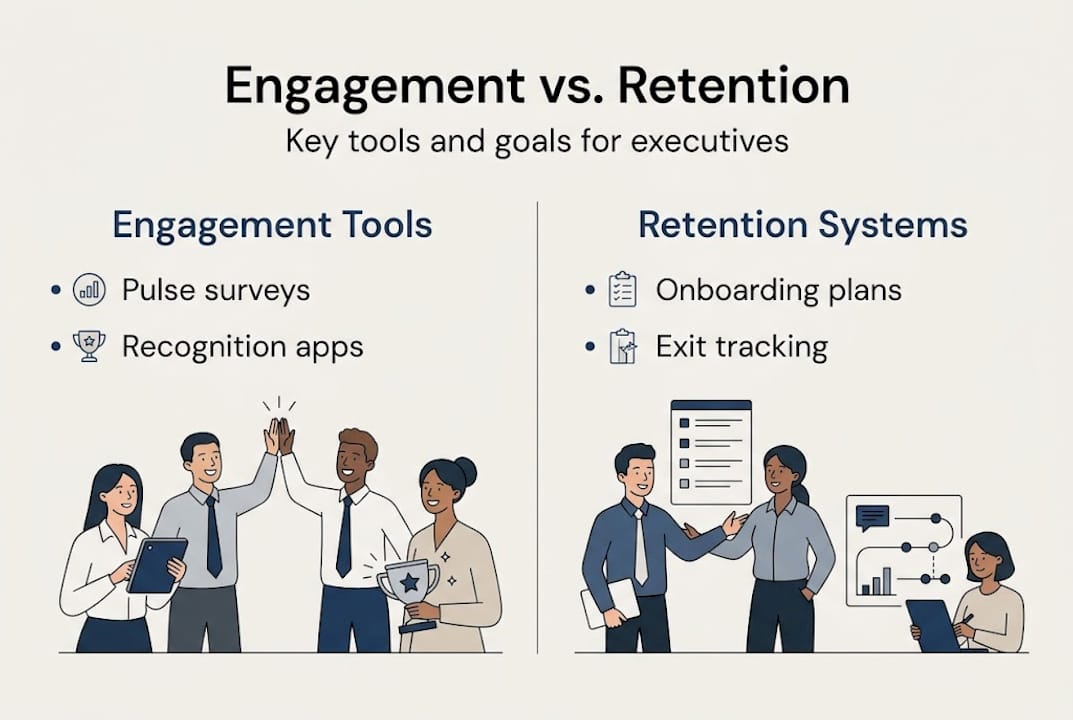
Engagement tools may include surveys, feedback forms, recognition platforms, or dashboards that show morale and sentiment. These can be useful. But they often stop at measurement.
Retention systems need to go further. They should help leaders identify where retention risk is forming, what may be causing it, and what action should happen next.
| Area | Engagement Tools | Retention Systems |
|---|---|---|
| Main question | How do employees feel? | Where are we at risk of losing people? |
| Primary focus | Sentiment and morale | Retention risk and action |
| Typical output | Scores, comments, themes | Risk signals, fit insights, intervention priorities |
| Timing | Often periodic | Earlier detection before resignation |
| Risk if used alone | Leaders measure sentiment but miss turnover risk | Leaders may act without understanding broader sentiment |
Engagement tools can support retention. But they are not a complete retention strategy by themselves.
Why Engagement Scores Do Not Equal Retention Security
A good engagement score does not mean turnover risk is low.
Employees may report acceptable engagement while still feeling stuck, unseen, misaligned, or disconnected from their manager. A team average may look fine while one high performer is quietly preparing to leave.
That is why leaders get surprised.
They see decent survey scores. Managers say things seem fine. Performance has not dropped. Then a strong employee resigns.
Common blind spots include:
-
High performers who still deliver but no longer feel committed
-
Employees who like the work but do not trust their manager
-
Teams with good morale scores but unresolved friction
-
Employees who feel engaged today but do not see a future
-
Values misalignment that does not show in broad survey averages
-
Quiet disengagement between survey cycles
| What Engagement Scores May Show | What Leaders Still Need to Know |
|---|---|
| Employees seem satisfied | Who may still be considering leaving |
| Team morale looks stable | Where hidden friction is building |
| People feel connected to the work | Whether they see a future inside the company |
| Managers receive acceptable ratings | Whether manager-employee fit is weakening |
| Survey averages look fine | Which individuals or teams may be at risk |
The mistake is treating engagement as proof of retention.
It is not.
What Retention Systems Need to Reveal
A useful retention system should help leaders see the risks that usually appear before resignation.
That includes more than engagement.
Leaders need visibility into:
-
Hidden disengagement
-
Manager-employee fit
-
Values alignment
-
Team alignment
-
Team friction
-
Growth frustration
-
Reduced candor
-
Lower initiative
-
Withdrawal from collaboration
-
Employees who still perform but seem less invested
| Retention Signal | What It May Reveal |
|---|---|
| Reduced candor | Employees may no longer believe speaking up matters |
| Weaker manager connection | Trust or communication may be breaking down |
| Values misalignment | Commitment may be weakening |
| Team friction | Collaboration may be draining energy |
| Less interest in growth | Employees may no longer see their future inside the company |
| Quiet high performers | Strong employees may be disengaging beneath the surface |
The point is not to monitor people. The point is to give leaders earlier visibility into what may be hurting commitment, performance, and team stability.
Retention improves when leaders can see risk before resignation becomes the final signal.
How Leaders Can Connect Engagement and Retention Risk
The strongest approach is not engagement tools versus retention systems. Leaders need both, but they need to understand their roles.
Engagement data can show broad sentiment. Retention visibility shows where action is needed.
Leaders should connect:
-
Engagement sentiment
-
Retention risk
-
Manager-employee fit
-
Values alignment
-
Team alignment
-
Growth clarity
-
Hidden friction
-
Follow-through on employee concerns
Better leadership questions include:
| Leadership Question | What It Helps Reveal |
|---|---|
| Are employees engaged, or just still performing? | Performance may be hiding disengagement |
| Who still delivers but seems less invested? | Hidden retention risk |
| Where is manager-employee fit weakening? | Daily friction and trust risk |
| Which teams have unresolved tension? | Team alignment risk |
| Who no longer talks about their future here? | Growth or retention risk |
| What action should happen first? | Prevents scattered retention efforts |
The goal is not more data. The goal is clearer decisions.
If a tool gives leaders a score but no clear path to action, it may measure the problem without helping solve it.
See Retention Risk Before Engagement Scores Explain It Too Late
Engagement tools may help leaders understand how employees feel.
But retention risk often forms beneath the surface before survey scores make the problem obvious.
OpenElevator helps CEOs, founders, senior leaders, and managers detect that risk earlier.
Through a simple five-minute, bias-free survey, OpenElevator gives leaders clearer visibility into retention risk, hidden disengagement, values alignment, manager-employee fit, and team friction.
That means leaders can stop relying only on engagement scores and start seeing where costly turnover risk may already be forming.
Want to see where engagement may be hiding retention risk inside your team? Start with OpenElevator’s free team scan.

Frequently Asked Questions
What is the difference between engagement tools and retention systems?
Engagement tools usually measure how employees feel. Retention systems should help leaders identify where employees may be at risk of disengaging or leaving, and what action may be needed.
Can engaged employees still leave?
Yes. Engaged employees can still leave if they do not see a future, feel misaligned with company values, experience manager friction, or face unresolved team issues.
Why are engagement scores not enough to reduce turnover?
Engagement scores can show broad sentiment, but they may miss hidden disengagement, individual retention risk, manager-employee fit problems, values misalignment, and team friction.
What should a retention system help leaders see?
A retention system should help leaders see retention risk, hidden disengagement, values alignment, manager-employee fit, team alignment, and friction that may lead to costly resignations.
How can leaders connect engagement and retention?
Leaders can connect engagement and retention by using sentiment data alongside fit, alignment, and risk signals. The goal is to understand not only how employees feel, but where turnover risk may be forming.
How does OpenElevator help with engagement and retention?
OpenElevator helps leaders detect retention risk, hidden disengagement, values alignment, manager-employee fit, and team friction through a five-minute, bias-free survey. This gives leaders earlier visibility into risks engagement scores may miss.