
DISC assessments can help leaders understand how people communicate, collaborate, and respond to pressure.
But DISC does not tell leaders whether someone is likely to stay.
And that gap can stay hidden until a strong employee resigns.
A person may have a useful DISC profile, fit the team on paper, and still become a retention risk months later because manager alignment weakens, team friction grows, values feel misaligned, growth stalls, or the role no longer fits what they expected.
Most companies do not fail because they use DISC.
They fail because they treat the assessment as the answer.
DISC can create useful insight at hiring, onboarding, and team development. But retention depends on what happens after the assessment: whether leaders keep visibility into alignment, friction, engagement, and hidden risk over time.
This guide explains where the gap begins between DISC and retention, why behavioral assessments alone do not prevent turnover, and how leaders can use stronger visibility to detect retention risk before costly resignations.
Table of Contents
Key Takeaways
| Point | Details |
|---|---|
| DISC is useful but incomplete | DISC can explain communication style and behavioral preferences, but it does not fully reveal retention risk. |
| Retention depends on fit over time | Manager alignment, values alignment, team dynamics, growth, workload, and recognition affect whether employees stay. |
| The real gap is post-assessment | Many companies run DISC once, then fail to use the insight in daily management and retention decisions. |
| Static assessments miss changing risk | A person may fit well at hiring but become misaligned as roles, managers, teams, or expectations shift. |
| OpenElevator adds retention visibility | OpenElevator helps leaders see retention risk, interpersonal alignment, values alignment, and hidden team friction earlier. |
Why DISC Assessments Gain Traction in Talent Management
DISC assessments are popular because they give leaders a simple language for understanding behavior.
DISC stands for Dominance, Influence, Steadiness, and Conscientiousness. It helps describe how people may communicate, make decisions, approach conflict, and respond to pressure.
That can be useful.
DISC can help with:
| Use Case | Why It Helps |
|---|---|
| Hiring conversations | Leaders can ask better questions about communication, collaboration, and work style. |
| Onboarding | Managers can adapt how they support a new hire. |
| Team alignment | Teams can understand different working styles and reduce unnecessary friction. |
| Coaching | Managers can tailor feedback and development conversations. |
| Communication | Employees get shared language for how they prefer to work. |
The problem is not DISC itself.
The problem is expecting DISC to do more than it was built to do.
DISC can help leaders understand how someone may prefer to operate. It does not show whether that person feels aligned with the manager, connected to the team, clear on growth, recognized for their contribution, or committed to staying.
DISC is a starting point.
It is not a retention system.
Why DISC Does Not Guarantee Retention
A DISC assessment may tell leaders how someone tends to communicate.
It does not tell them whether the employee is quietly disengaging.
That distinction matters.
An employee can have a clear DISC profile and still leave because:
| Retention Risk | Why DISC May Miss It |
|---|---|
| Manager friction | DISC may describe style, but it does not show whether trust or alignment is weakening. |
| Values misalignment | DISC does not reveal whether the employee feels aligned with the company’s environment or direction. |
| Lack of growth | DISC does not show whether the employee sees a future inside the company. |
| Team tension | DISC may explain differences, but it does not show whether friction is affecting commitment. |
| Workload pressure | DISC does not reveal whether the employee is overloaded or quietly burning out. |
| Weak recognition | DISC does not show whether someone feels seen or valued. |
| Poor role fit | DISC may show behavioral preference, but not whether the actual role still fits the person’s strengths and motivation. |
This is where companies make a costly mistake.
They assume that because they assessed behavioral style, they understand retention risk.
They do not.
Retention risk changes over time. A new manager, heavier workload, unclear expectations, stalled growth, or hidden team friction can turn a good hire into a flight risk.
DISC is static.
Retention risk is dynamic.
That is the gap leaders need to close.
Where the Gap Between DISC and Retention Begins
The gap begins after the assessment.
Most companies complete the DISC assessment, discuss the results, and then move on. The insights may be useful for a few conversations, but they rarely become part of how managers lead, support, and retain people.
That is why the expected retention improvement often does not happen.
| Stage | What Should Happen | What Often Happens |
|---|---|---|
| Assessment | Leaders use DISC to understand communication and work preferences. | Results are reviewed once and then filed away. |
| Hiring | DISC supports broader fit evaluation alongside skills, values, manager fit, and role expectations. | DISC is over-weighted or treated as a shortcut for fit. |
| Onboarding | Managers adapt support based on work style and early alignment signals. | Generic onboarding is used for everyone. |
| Day-to-day management | Managers revisit work style, feedback preferences, role fit, and alignment. | Managers revert to instinct and old habits. |
| Retention | Leaders track whether alignment is strengthening or weakening. | Leaders wait until disengagement or resignation becomes visible. |
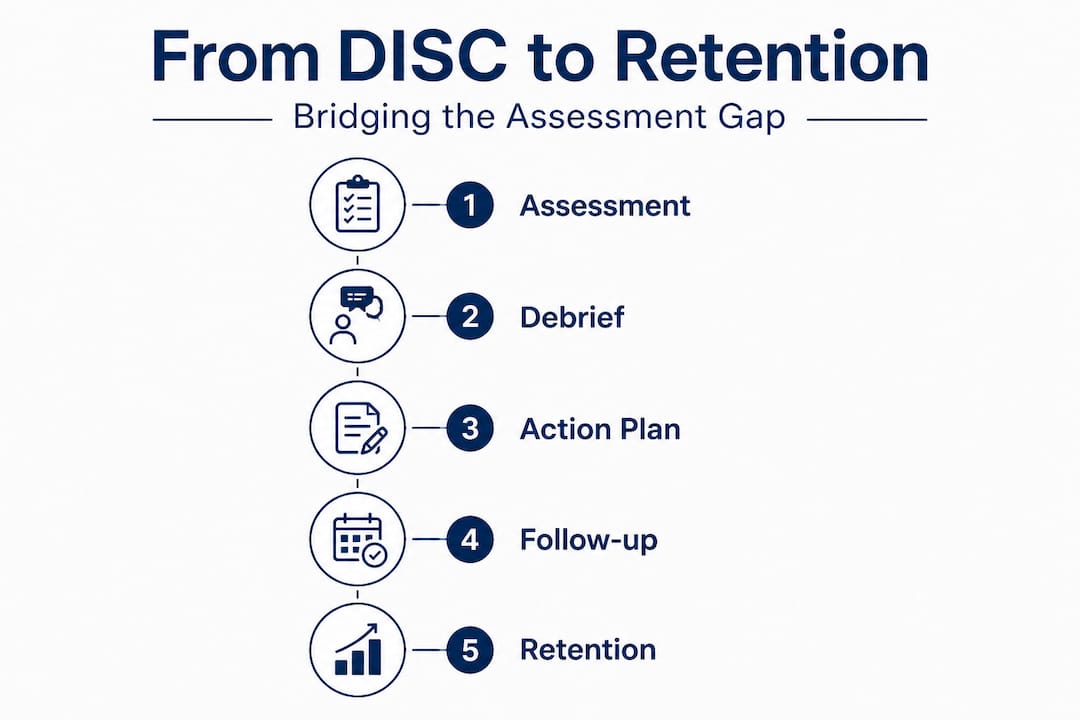
The assessment is not the failure point.
The failure point is the lack of ongoing visibility.
A DISC result may help a manager understand how someone prefers to communicate. But it will not tell the manager that the employee has stopped seeing a future inside the company, feels misaligned with team values, or is losing trust after repeated friction.
Retention requires visibility into what is happening now, not only what a profile said at the time of hire.
Practical Steps to Bridge the Gap From DISC to Retention
DISC becomes more useful when it is connected to ongoing leadership practice.
Do not treat it as a one-time report. Use it as one input inside a broader retention visibility system.
| Step | What to Do | Why It Matters |
|---|---|---|
| 1. Revisit assessment insights after onboarding | Use DISC in 30, 60, and 90-day check-ins. | Early role mismatch or manager friction may show up after the employee starts doing the real work. |
| 2. Connect DISC to manager conversations | Use the profile to ask how the employee prefers feedback, clarity, and support. | Retention often depends on daily manager-employee alignment. |
| 3. Do not confuse style fit with values fit | Assess whether the employee feels aligned with the company’s direction and environment. | Someone can communicate well and still feel values misalignment. |
| 4. Watch for changes over time | Look for reduced initiative, weaker connection, shorter communication, or less interest in growth. | These may signal hidden retention risk. |
| 5. Add team visibility | Look beyond individual style and assess team friction, interpersonal alignment, and belonging. | Retention is shaped by the team environment, not only the individual. |
| 6. Match action to the risk | If the issue is growth, workload, manager friction, or team tension, respond accordingly. | Generic retention actions miss the real cause. |
| 7. Follow up | Check whether alignment, trust, clarity, and connection improved. | One conversation does not solve retention risk. |
DISC can help leaders ask better questions.
But leaders still need to ask the right retention questions:
Does this employee still feel aligned with the role?
Does this employee feel supported by their manager?
Is team friction affecting their commitment?
Do they see a future inside the company?
Is workload pressure creating quiet disengagement?
Are they still connected to the team and company direction?
That is where retention starts becoming visible.
What Most Companies Misuse Assessments For
Most companies misuse DISC when they treat it as proof that they understand the person.
They do not.
They understand one layer of the person’s work style.
That is not the same as understanding retention risk.
The bigger mistake is assuming fit is fixed.
It is not.
A person may be a strong fit at hiring and become misaligned later because:
| Change | How It Can Create Retention Risk |
|---|---|
| A manager changes | Communication, trust, feedback, and expectations may shift. |
| The role changes | The employee may no longer feel their strengths are being used. |
| The team changes | New friction or weak connection may affect belonging. |
| Growth stalls | Strong employees may start looking elsewhere. |
| Workload increases | Burnout risk may rise before performance drops. |
| Recognition fades | Employees may feel invisible or undervalued. |
| Company direction shifts | Values alignment may weaken. |
This is why assessment-only retention strategies are weak.
They put too much weight on what was measured once and not enough weight on what is changing now.
The stronger approach is to use DISC for communication insight, then add ongoing visibility into retention risk, values alignment, interpersonal alignment, and team dynamics.
That is how leaders move from static assessment to live retention intelligence.
See What DISC Cannot Show You
DISC can help leaders understand behavioral style.
But it cannot show the full picture of whether someone is likely to stay.
A team can look stable while manager-employee misalignment, values disconnect, hidden team friction, or quiet disengagement is already forming beneath the surface.
OpenElevator helps CEOs, founders, senior leaders, and managers detect retention risk, values alignment, interpersonal alignment, and hidden team friction before they become costly resignations.
The platform uses a short, bias-complimentary Key Team Stay Survey and a proprietary algorithm to reveal where leaders may need to act earlier.
If you already use DISC, OpenElevator does not replace it. It adds the retention visibility layer DISC was never designed to provide.
Start with a complimentary Key Team Stay Survey for up to 10 team members and see what DISC may be missing inside your own team.
Get your complimentary Key Team Stay Survey
Frequently Asked Questions
Does DISC improve employee retention?
DISC can support retention by helping leaders understand communication styles and behavioral preferences. But DISC alone does not improve retention unless leaders use the insight in ongoing management, feedback, onboarding, and team alignment.
Why does DISC not guarantee lower turnover?
DISC does not guarantee lower turnover because retention depends on more than behavioral style. Manager alignment, values fit, team dynamics, growth, workload, recognition, and trust all affect whether employees stay.
Where does the gap between DISC and retention begin?
The gap begins after the assessment. Many companies review DISC results once, then fail to connect them to daily management, retention risk, team friction, or changing employee experience.
How should managers use DISC after hiring?
Managers should use DISC to adapt communication, feedback, coaching, and onboarding. They should also revisit whether the employee still feels aligned with the role, manager, team, and company direction.
What does DISC miss about retention risk?
DISC can miss values misalignment, manager friction, team tension, workload pressure, lack of growth, weak recognition, and hidden disengagement.
How does OpenElevator go beyond DISC?
OpenElevator helps leaders detect retention risk, values alignment, interpersonal alignment, and hidden team friction. It gives CEOs, founders, senior leaders, and managers clearer visibility into where risk may be forming.
Is there a free way to try OpenElevator?
Yes. OpenElevator offers a complimentary Key Team Stay Survey for up to 10 team members so leaders can see retention risk, alignment gaps, and hidden friction inside their own team.