
Good leaders still get surprised by turnover.
They have regular meetings. They know their teams. They notice performance. They believe they would see the warning signs if someone was becoming disengaged.
Then a strong employee resigns.
The problem is not always poor leadership. The problem is often poor visibility. Turnover risk can build quietly through manager friction, values misalignment, team tension, blocked growth, or declining trust long before an employee says anything directly.
For CEOs, founders, and senior leaders, the question is not, “Why did this person leave?”
The better question is, “What signals were already there, and why did we miss them?”
This article explains why good leaders are still surprised by turnover, where instinct falls short, which disengagement signals are often missed, and how data can help leaders see retention risk earlier.
Table of Contents
Key Takeaways
| Point | Details |
|---|---|
| Good leaders can still miss turnover risk | Employees may disengage quietly while still appearing professional and productive. |
| Instinct is not enough | Manager observation can miss hidden friction, values misalignment, or blocked growth. |
| Disengagement has warning signs | Reduced communication, lower initiative, and withdrawal often appear before resignation. |
| Earlier visibility reduces surprises | Leaders need better signals before turnover becomes visible. |
Turnover Surprises: The Hidden Patterns
Turnover often feels sudden because leaders see the resignation, not the months of risk that came before it.
An employee may look steady on the surface while slowly becoming less connected, less motivated, less open with their manager, or less confident about their future inside the company.
Hidden turnover patterns often include:
-
Quiet disengagement
-
Weak manager-employee fit
-
Values misalignment
-
Team friction
-
Lack of growth clarity
-
Low recognition
-
Burnout or workload pressure
-
Loss of trust in leadership
-
External opportunities becoming more attractive
The warning signs are often subtle. The employee may still attend meetings, complete work, and appear professional. But their connection to the role, manager, or team may already be weakening.
In simple terms: turnover surprises leaders when risk builds faster than visibility.
Why the Surprise Happens
Turnover surprises happen because leaders often rely on visible performance instead of underlying alignment.
If the employee is still producing, leaders may assume everything is fine. But performance can remain acceptable even while engagement is declining.
Common reasons leaders miss turnover risk include:
| What Leaders See | What May Be Happening Underneath |
|---|---|
| The employee is still performing | They may be doing the minimum while emotionally checking out |
| The employee is quiet | They may be withdrawing rather than simply being busy |
| No complaints are raised | They may no longer believe speaking up will change anything |
| The team seems stable | Hidden friction may be affecting trust or motivation |
| The manager relationship seems fine | Working style friction may still be building |
| The employee says they are okay | They may already be considering other options |
A resignation is often the final signal, not the first one.
Where Leadership Instincts Fall Short
Leadership instinct is useful, but it has limits.
A manager may sense that something feels different. A founder may notice lower energy in the room. A senior leader may feel that a team is less engaged than before.
But instinct alone cannot always show what is causing the problem.
Instinct may miss:
-
Quiet disengagement
-
Manager-employee friction
-
Team tension
-
Values misalignment
-
Lack of growth confidence
-
Burnout risk
-
Compensation concerns
-
Work style mismatch
-
Declining trust in leadership
-
Employees who are already job searching
The problem is not gut feel. The problem is gut feel without evidence.
Leaders need clearer signals that show where retention risk may already be forming.

| Approach | What It Helps With | What It Misses |
|---|---|---|
| Manager instinct | Obvious changes in behavior or performance | Quiet disengagement and hidden risk patterns |
| Employee check-ins | Direct conversation and relationship building | Employees may not share what they are really thinking |
| Performance metrics | Output and delivery | Motivation, trust, alignment, and team friction |
| Retention data | Who stayed or left | Risk that is forming right now |
| Visibility data | Early signs of disengagement, fit, and friction | Requires leaders to act on what they see |
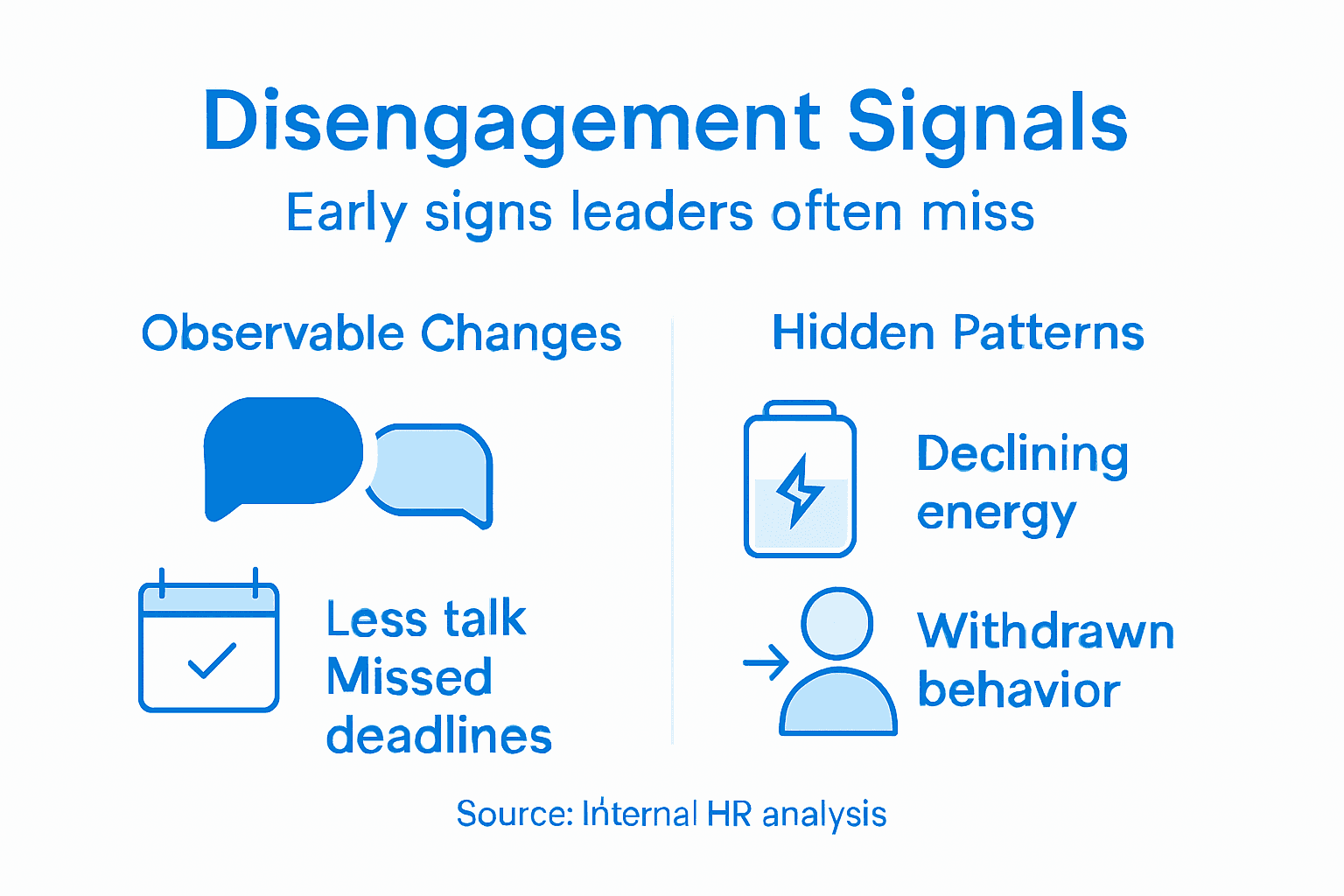
Disengagement Signals Leaders Often Miss
Disengagement often appears before turnover, but it rarely announces itself clearly.
Employees may not say, “I am thinking about leaving.” They may simply become less open, less proactive, less collaborative, or less emotionally invested.
Signals leaders often miss include:
-
Reduced communication
-
Shorter or more transactional responses
-
Lower participation in meetings
-
Less initiative
-
Fewer ideas or suggestions
-
Slower response times
-
Increased absenteeism or lateness
-
Less openness with the manager
-
Lower collaboration with teammates
-
More visible frustration
-
Less interest in growth opportunities
-
A shift from ownership to basic task completion
One signal may not mean someone is leaving. A pattern of signals should get leadership attention.
The better question is not, “Is this person still doing the job?”
The better question is, “Is this person still engaged, aligned, and connected?”
Gaining Predictable Retention With Data
Data helps leaders see what instinct may miss.
The goal is not to turn people into numbers. The goal is to give leaders earlier visibility into the conditions that often lead to avoidable turnover.
Useful retention visibility signals include:
-
Engagement risk
-
Manager-employee fit
-
Values alignment
-
Team trust and communication
-
Growth confidence
-
Recognition and contribution
-
Workload or burnout risk
-
Participation patterns
-
Collaboration quality
-
Early signs of disengagement
When leaders can see these signals earlier, they can stop treating turnover as a surprise event and start treating it as a manageable risk.
Retention becomes more predictable when leaders know where risk is forming, why it may be forming, and what action to take next.
What to Measure
Leaders should measure the signals that appear before turnover, not only the metrics that appear after it.
Useful leading indicators include:
| Signal | What It Helps Leaders See |
|---|---|
| Engagement risk | Whether employees may be emotionally disconnecting |
| Manager-employee fit | Whether relationship friction may be creating retention risk |
| Values alignment | Whether employees feel connected to how the company works |
| Team alignment | Whether collaboration and trust may be weakening |
| Growth confidence | Whether employees see a future inside the company |
| Recognition | Whether employees feel seen and valued |
| Workload pressure | Whether burnout may be affecting motivation |
| Participation patterns | Whether employees are withdrawing from contribution |
The strongest retention strategy is not more reporting. It is earlier visibility followed by targeted action.
Stop Being Surprised by Turnover
Good leaders can still miss turnover risk when the warning signs are hidden.
Employees may still be performing while disengagement, manager friction, values misalignment, team tension, or declining trust is already building underneath the surface.
OpenElevator helps CEOs, founders, senior leaders, and managers see retention risk earlier.
Through a simple five-minute, bias-free survey, OpenElevator gives leaders clearer visibility into values alignment, engagement risk, manager-employee fit, and hidden team friction.
Instead of waiting for resignations, leaders can see where risk may already be forming and take action sooner.
Want to stop being surprised by turnover? Start with OpenElevator’s free team scan.

Frequently Asked Questions
Why are good leaders surprised by turnover?
Good leaders are surprised by turnover because employees may disengage quietly while still performing. The warning signs are often subtle and may not appear in normal meetings or performance data.
What are early signs of turnover risk?
Early signs of turnover risk include reduced communication, lower participation, less initiative, emotional withdrawal, absenteeism, lower collaboration, and less openness with the manager.
Why is manager instinct not enough to predict turnover?
Manager instinct can miss hidden disengagement, values misalignment, team friction, and blocked growth. Leaders need clearer evidence to see where retention risk may be forming.
How can leaders reduce surprise resignations?
Leaders can reduce surprise resignations by tracking leading indicators such as engagement risk, manager-employee fit, values alignment, team alignment, and growth confidence.
What data helps leaders see turnover risk earlier?
Useful data includes engagement risk, values alignment, manager-employee fit, team friction, participation patterns, growth confidence, and early signs of disengagement.
How does OpenElevator help leaders avoid surprise turnover?
OpenElevator helps leaders identify retention risk, values alignment, engagement risk, manager-employee fit, and hidden team friction through a five-minute, bias-free survey.