
Most hiring mistakes do not look like mistakes at first.
The candidate interviews well. The resume looks strong. The manager feels confident. Then, months later, the real issues begin to show: weak manager fit, team friction, low ownership, values misalignment, disengagement, or performance that does not match expectations.
By then, the company has already paid the price.
For CEOs, founders, and senior leaders, the problem is not only making the wrong hire. The bigger problem is that many hiring mistakes stay hidden until they damage productivity, morale, retention, and team stability.
This article explains why hiring mistakes are often invisible at first, the early warning signs leaders should watch for, why traditional hiring tools miss hidden risks, and how defensible insight can help leaders make better hiring and retention decisions.
Table of Contents
Key Takeaways
| Point | Details |
|---|---|
| Hiring mistakes often appear late | Poor fit may not become obvious until months after the hire starts. |
| Fit matters beyond skills | Manager fit, team fit, values alignment, and work style affect long-term success. |
| Disengagement can signal a hiring mistake | A new hire may still perform while motivation, ownership, or connection is already weakening. |
| Better insight reduces costly surprises | Leaders need clearer evidence before and after hiring to detect risk earlier. |
Defining Invisible Hiring Mistakes and Costs
An invisible hiring mistake is a poor-fit hire that looks acceptable at first but creates problems later.
The person may have the right experience, perform well in interviews, and appear capable during onboarding. But over time, the gaps become harder to ignore.
Invisible hiring mistakes often show up as:
-
Weak manager-employee fit
-
Poor team fit
-
Values misalignment
-
Low ownership
-
Communication friction
-
Reduced motivation
-
Slow adaptation to the role
-
Disengagement after the first few months
-
Strong technical skills but weak working style fit
The cost is not only the salary of the wrong hire. The cost includes manager time, team frustration, slower execution, reduced morale, customer impact, and eventual turnover.
In simple terms: a hiring mistake becomes expensive when leaders do not see the fit problem early enough.
The True Cost Behind the Scenes
A hiring mistake creates cost before anyone calls it a hiring mistake.
The team may start working around the person. The manager may spend more time correcting, coaching, or mediating. High performers may become frustrated. Projects may slow down. Trust may weaken.

Common hidden costs include:
| Hidden Cost | How It Shows Up |
|---|---|
| Manager time | More coaching, correction, and follow-up |
| Team productivity | Other employees compensate for weak fit or low ownership |
| Morale | High performers become frustrated by the mismatch |
| Speed | Projects slow down because collaboration is harder |
| Knowledge gaps | The person does not ramp up as expected |
| Customer impact | Delivery quality or continuity may suffer |
| Replacement cost | Recruiting, onboarding, and training start again if the hire leaves |
The mistake is assuming hiring success is confirmed when the offer is accepted.
Hiring success is confirmed when the person fits the role, manager, team, and company environment over time.
Early Warning Signs of Employee Disengagement
Hiring mistakes often reveal themselves through disengagement before they reveal themselves through failure.
A new hire may still attend meetings, complete tasks, and look professional while quietly disconnecting from the role, manager, or team.
Early warning signs include:
-
Lower participation in meetings
-
Reduced initiative
-
Slower response times
-
Less ownership of work
-
More visible frustration
-
Increased absenteeism or lateness
-
Lower collaboration with teammates
-
Less openness with the manager
-
Avoidance of difficult conversations
-
Lack of interest in growth or development
-
A shift from proactive contribution to basic task completion
One warning sign may not mean the hire is failing. A pattern of signs means leaders should pay attention.
The better question is not, “Is this person still doing the job?”
The better question is, “Is this person becoming aligned, engaged, and connected?”
| Warning Signal | What It May Indicate | Leadership Action |
|---|---|---|
| Reduced initiative | Low motivation or weak role fit | Clarify expectations and ownership |
| Lower collaboration | Team friction or poor working style fit | Examine team dynamics |
| Less openness with manager | Weak manager-employee fit | Hold a direct support conversation |
| Slower ramp-up | Role mismatch or unclear expectations | Review onboarding and role fit |
| Emotional withdrawal | Disengagement or values misalignment | Explore what has changed |
| Declining quality | Skill gap, motivation issue, or poor fit | Identify the real cause before assuming |
How Traditional Tools Miss Hidden Risks
Traditional hiring tools often miss the factors that determine whether someone will succeed long term.
Resumes show experience. Interviews show presentation skill. References may confirm past performance. But none of these reliably show whether the person will fit the manager, team, company values, or working environment.
Traditional tools often miss:
-
Manager-employee fit
-
Team working style fit
-
Values alignment
-
Motivation and engagement drivers
-
Adaptability to the actual role
-
Communication friction
-
Potential relationship strain
-
Long-term retention risk
This is why a candidate can look strong during hiring and still become a costly mismatch later.
The issue is not that resumes and interviews are useless. The issue is that they are incomplete.
| Hiring Approach | What It Captures | What It Misses |
|---|---|---|
| Resume screening | Experience, titles, skills, credentials | Fit, motivation, team dynamics |
| Interviews | Communication style and examples | How the person works under real conditions |
| References | Past performance feedback | Future fit with this manager and team |
| Gut feel | Leadership instinct | Hidden bias and unseen risk |
| Fit-based insight | Values alignment, manager fit, team fit, work style | Requires structured measurement |
The Deeper Problem: Surface-Level Assessment
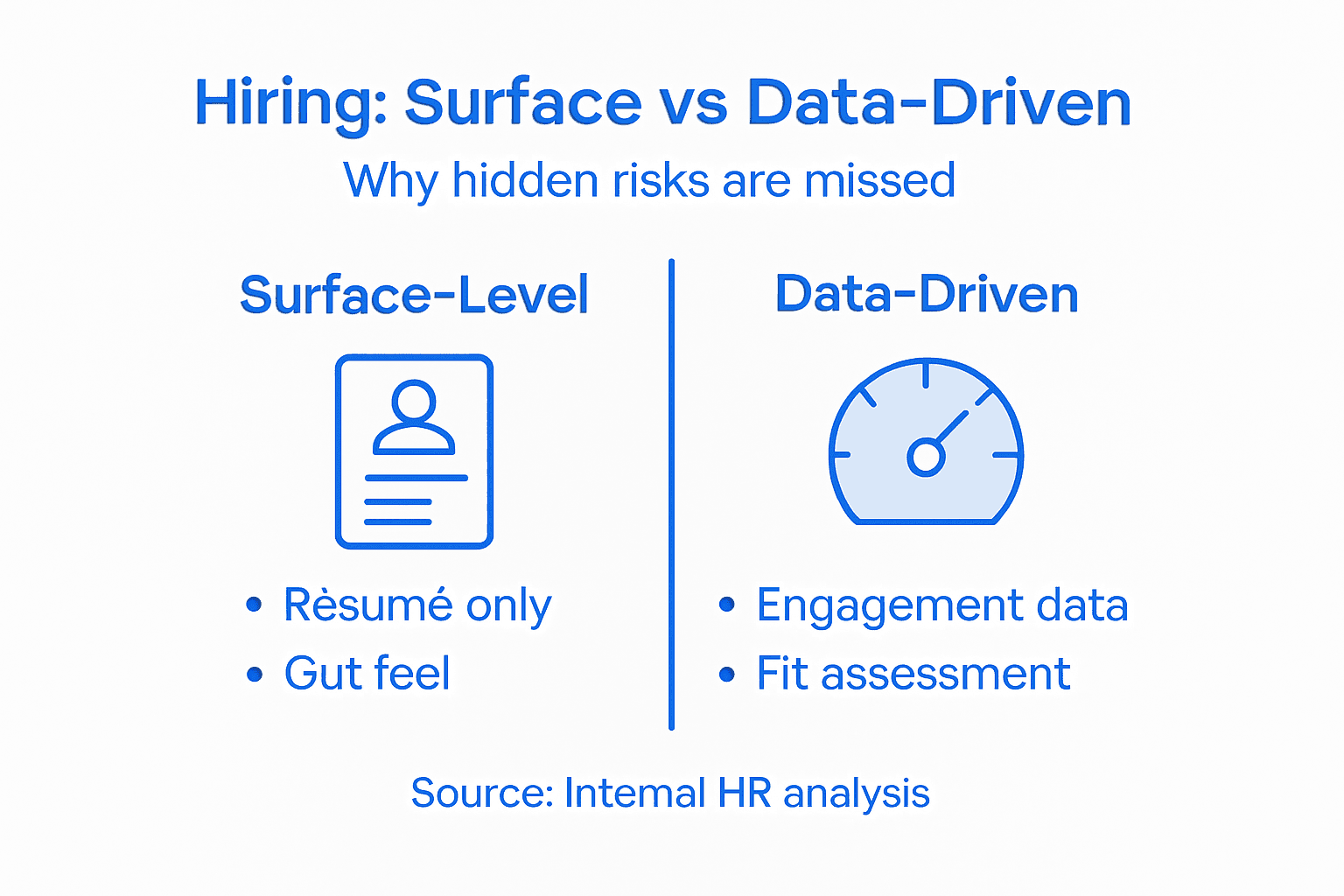
Most hiring processes overvalue what is easy to see and undervalue what is costly to miss.
It is easy to see credentials. It is harder to see whether the person will work well with the manager. It is easy to assess interview answers. It is harder to predict whether the person will stay motivated six months later.
Surface-level hiring creates false confidence.
A candidate can look qualified and still be misaligned with:
-
The company’s values
-
The manager’s style
-
The team’s communication patterns
-
The pace of the role
-
The level of autonomy required
-
The actual expectations of the job
The hidden risk is not always ability. Often, the hidden risk is fit.
Quantifiable Insight for Predicting Retention Risk
Hiring mistakes become less invisible when leaders measure the factors that affect long-term fit.
Quantifiable insight helps leaders see whether a person is likely to align with the role, manager, team, and company environment.
For existing employees, it can also reveal whether a poor fit is turning into retention risk.
Useful signals include:
-
Values alignment
-
Manager-employee fit
-
Team fit
-
Engagement risk
-
Work style fit
-
Communication patterns
-
Growth confidence
-
Collaboration quality
-
Early signs of disengagement
This does not mean reducing people to scores. It means giving leaders clearer evidence before problems become expensive.
The strongest hiring decisions combine human judgment with structured insight into fit.
What Fit Data Can Reveal
Fit data can help leaders understand the risks that interviews often miss.
It can reveal:
-
Whether a candidate may work well with the direct manager
-
Whether the candidate aligns with the company’s values
-
Whether the candidate may strengthen or strain team dynamics
-
What communication patterns may need support
-
Whether the person’s motivations match the role
-
Where onboarding should be personalized
-
Whether an existing employee may be disengaging because of poor fit
The goal is not to predict people perfectly.
The goal is to avoid making expensive people decisions with only partial information.
Transforming Leadership Decisions With Data
Data improves leadership decisions when it turns vague concerns into clearer evidence.
Instead of saying, “I have a bad feeling about this hire,” leaders can ask better questions:
-
Is this a role fit issue?
-
Is this a manager fit issue?
-
Is this a team fit issue?
-
Is this a values alignment issue?
-
Is this a motivation issue?
-
Is this an onboarding issue?
-
Is this a retention risk issue?
That shift matters.
When leaders can name the likely source of risk, they can take targeted action instead of guessing.
Data does not replace leadership judgment. It makes leadership judgment more defensible.
| Decision Type | Gut Feel Version | Defensible Insight Version |
|---|---|---|
| Hiring | “They seem like a good fit.” | “They align with the role, manager, team, and values.” |
| Onboarding | “They just need time.” | “Here is where fit support may be needed.” |
| Retention | “Something seems off.” | “Engagement risk and manager fit need attention.” |
| Team dynamics | “The team feels tense.” | “There may be hidden friction affecting collaboration.” |
| Performance | “They are not working out.” | “We can separate skill gaps from fit issues.” |
See Hidden Hiring Risks Before They Become Expensive
Most hiring mistakes do not become visible right away.
They show up later through weak fit, disengagement, manager friction, team tension, values misalignment, or turnover risk.
OpenElevator helps CEOs, founders, senior leaders, and managers see these risks earlier.
Through a simple five-minute, bias-free survey, OpenElevator gives leaders clearer visibility into values alignment, engagement risk, manager-employee fit, hidden team friction, and hiring fit.
Instead of relying only on resumes, interviews, and gut feel, leaders can make hiring and retention decisions with clearer evidence.
Want to see hidden hiring risks before they become expensive? Start with OpenElevator’s free team scan.
Frequently Asked Questions
What are invisible hiring mistakes?
Invisible hiring mistakes are poor-fit hires that look acceptable at first but create problems later through disengagement, manager friction, team tension, values misalignment, or turnover risk.
Why do hiring mistakes often go unseen?
Hiring mistakes often go unseen because resumes and interviews focus on visible credentials, while long-term success depends on less visible factors such as manager fit, team fit, values alignment, and work style.
What are early warning signs of a hiring mistake?
Early warning signs include low initiative, slow ramp-up, reduced communication, weak collaboration, frustration, lower ownership, and disengagement after the first few months.
How can leaders reduce hiring mistakes?
Leaders can reduce hiring mistakes by assessing skills, values alignment, manager-employee fit, team fit, work style, and long-term retention risk before and after hiring.
How does hiring fit affect retention?
Hiring fit affects retention because employees are more likely to disengage or leave when they are misaligned with the manager, team, role, company values, or working environment.
How does OpenElevator help prevent costly hiring mistakes?
OpenElevator helps leaders identify values alignment, engagement risk, manager-employee fit, team friction, and hiring fit through a five-minute, bias-free survey.