
Most leaders do not lose strong employees without warning.
The warning signs are usually there: lower participation, weaker connection, less initiative, manager friction, values misalignment, team tension, or a quiet shift in energy. The problem is that those signs often stay hidden until resignation makes them obvious.
That is why employee retention is often a visibility problem, not a people problem.
Leaders cannot act on what they cannot see. If a team looks stable on the surface while disengagement is building underneath, the company may not realize there is risk until the employee has already decided to leave.
Retention improves when leaders can see where alignment is weakening, where team friction is forming, and where employees may be quietly pulling away.
This guide explains how team visibility transforms employee retention results, what leaders should measure beyond engagement scores, and how OpenElevator helps companies detect hidden risk earlier.
Table of Contents
Key Takeaways
| Point | Details |
|---|---|
| Retention is a visibility problem | Leaders often miss risk because employees keep performing while quietly disengaging. |
| Surface stability can hide risk | A team may look fine while manager friction, values misalignment, or team tension is already forming. |
| Engagement scores are incomplete | Broad scores can miss individual risk, interpersonal misalignment, and hidden team friction. |
| Trust matters | Visibility should help leaders support people earlier, not create surveillance or micromanagement. |
| OpenElevator adds the missing layer | OpenElevator helps leaders see retention risk, values alignment, interpersonal alignment, and team dynamics earlier. |
Why Employee Retention Is Really a Visibility Problem
Employee retention problems rarely begin on resignation day.
They usually begin earlier, when an employee starts feeling disconnected, unseen, unsupported, misaligned with their manager, or unsure whether they still have a future inside the company.
The problem is that leaders often do not see that shift soon enough.
A strong employee may still:
-
Complete work
-
Attend meetings
-
Respond professionally
-
Avoid raising concerns
-
Keep performance acceptable
-
Stay polite with their manager
From the outside, the team looks stable.
Underneath, risk may already be forming.
That is a visibility problem.
Leaders need to see where the employee experience is weakening before turnover becomes the first clear signal. That includes visibility into:
-
Manager-employee alignment
-
Team friction
-
Values alignment
-
Role fit
-
Growth path clarity
-
Workload sustainability
-
Recognition
-
Trust in leadership
-
Connection to the company’s direction
The mistake is assuming retention is healthy because people have not left yet.
A better question is:
“Where might risk already be forming, even if no one has said it out loud?”
How Team Visibility Improves Retention Decisions
Better visibility helps leaders make better retention decisions.
Traditional retention tools often arrive too late. Exit interviews happen after the employee has already decided to leave. Annual engagement surveys can hide individual risk inside team averages. Manager check-ins depend on whether employees feel safe enough to share what is really happening.
Team visibility gives leaders earlier signals.
It helps leaders understand where:
-
Employees may be disengaging
-
Manager relationships may be weakening
-
Team friction may be draining energy
-
Values alignment may be low
-
Growth paths may be unclear
-
Workload pressure may be creating risk
-
New hires may not be integrating well
This does not mean leaders need more dashboards for the sake of more data.
The goal is not to collect information.
The goal is to make better decisions earlier.
A team visibility tool should help leaders answer:
-
Who may need support before resignation becomes likely?
-
Where is manager-employee alignment weak?
-
Which teams have hidden friction?
-
Which employees may not feel aligned with the company’s values or direction?
-
Where could a targeted intervention reduce avoidable turnover?
Visibility is only valuable when it leads to action.

What Visibility Should Measure Beyond Engagement Scores
Engagement scores can be useful, but they are not enough.
A team average can look healthy while one strong employee is quietly disengaging. A manager may receive decent scores while still struggling with one key employee. A team may appear productive while hidden friction is weakening trust.
Better visibility should measure more than general sentiment.
Leaders need insight into:
| Visibility Area | Why It Matters |
|---|---|
| Retention risk | Helps leaders see who may need earlier support |
| Manager-employee alignment | The manager relationship strongly affects whether people stay |
| Values alignment | Employees are more likely to stay when the work environment fits what matters to them |
| Interpersonal alignment | Low fit between people can create friction, stress, and disengagement |
| Team dynamics | Hidden tension can weaken morale before performance drops |
| Growth clarity | Strong employees may leave if they cannot see a future inside the company |
| Role fit | Employees may disengage if the actual role does not match their strengths or expectations |
| Workload sustainability | Overload can create burnout and quiet withdrawal |
The wrong metrics create false confidence.
If leaders only track performance, they may miss commitment dropping. If they only track engagement averages, they may miss individual risk. If they only track turnover rate, they are already too late.
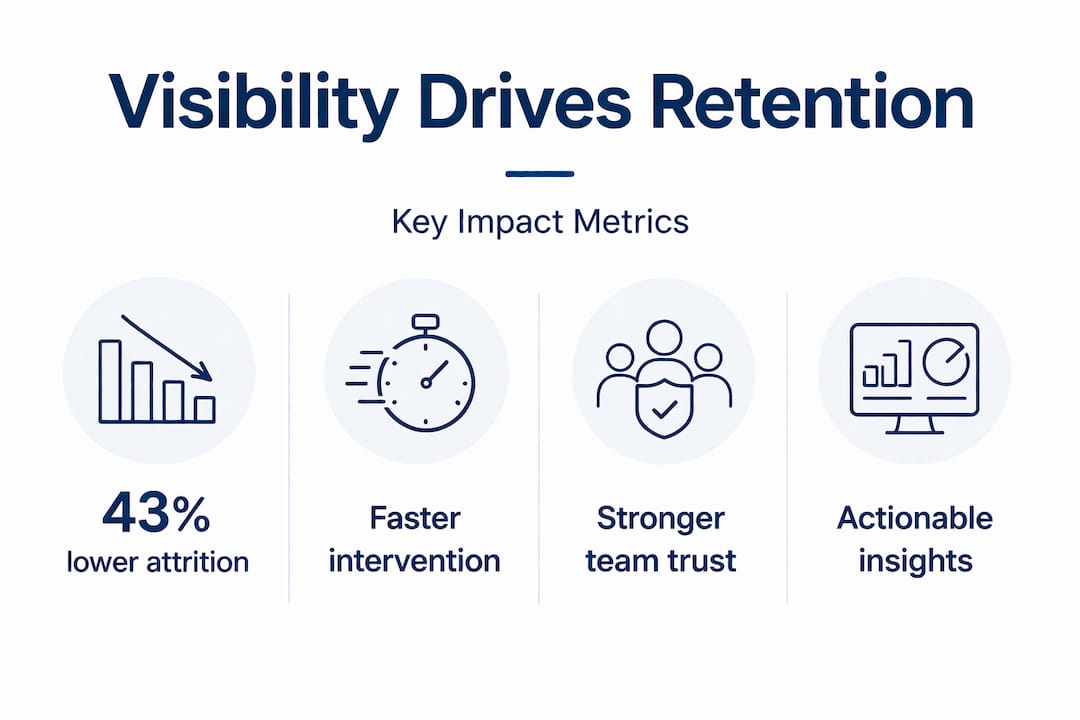
The right visibility helps leaders see where support, alignment, or intervention may be needed before strong employees leave.
How to Build Trust While Improving Visibility
Visibility should not become surveillance.
That is where many companies get this wrong.
Employees do not want to feel watched. They want to feel understood, supported, and treated fairly. If visibility tools are used to micromanage people, trust will drop and retention may get worse.
The right approach is different.
Leaders should use visibility to understand where support is needed, where friction is building, and where alignment may be weak.
To build trust, leaders should:
-
Be clear about why visibility matters
-
Use insights to support people, not punish them
-
Avoid reducing employees to scores
-
Pair data with real conversations
-
Act on the issues the data reveals
-
Follow up to see whether alignment improved
-
Protect psychological safety
A visibility system should help leaders ask better questions.
For example:
-
What feels harder than it should right now?
-
Where do you feel blocked?
-
What part of your role feels most aligned?
-
What part feels least aligned?
-
What support would make your work more sustainable?
-
What would make staying and growing here more valuable?
The goal is not to watch employees.
The goal is to understand the employee experience early enough to prevent avoidable loss.
The Retention Mistake Most Leaders Keep Making
The biggest retention mistake is waiting until employees speak up.
Many employees do not raise concerns early. They may avoid conflict, assume nothing will change, or protect their reputation. Some are already mentally leaving before they ever say something is wrong.
That silence can mislead leaders.
A manager may think everything is fine because the employee is still performing. A senior leader may assume turnover is under control because the numbers still look acceptable. A team may look stable while hidden friction is already building.
Exit interviews do not solve this problem.
They explain the loss after the employee has already decided to leave.
Broad engagement surveys do not fully solve it either.
They can show themes, but they may not reveal the specific manager relationship, team dynamic, or values mismatch creating risk.
The leaders who improve retention will be the ones who stop asking only:
“Who left?”
And start asking:
“Where is risk forming before people leave?”
That is the shift from reactive retention to visibility-driven retention.
How OpenElevator Helps Leaders See Risk Earlier
OpenElevator helps leaders see what is often hidden beneath the surface of a team.
A team can look stable while disengagement, manager-employee misalignment, values disconnect, or hidden friction is already forming. By the time someone resigns, the company is already reacting.
OpenElevator uses a short, bias-free team scan and a proprietary algorithm to reveal retention risk, values alignment, interpersonal alignment, and team dynamics.
That gives CEOs, founders, senior leaders, and managers clearer visibility into where action may be needed earlier.
OpenElevator helps leaders understand:
-
Where retention risk may be forming
-
Where manager-employee alignment may be weak
-
Where team friction may be affecting performance
-
Whether values alignment is strong or weak
-
Where hiring fit may affect future retention
-
Which teams may need support before turnover happens
OpenElevator does not replace leadership judgment.
It gives leaders better visibility so they can act earlier, ask better questions, and reduce avoidable turnover before resignation becomes the first clear signal.
Start with a free team scan for up to 10 team members and see what may be hidden inside your own team.
Frequently Asked Questions
What does it mean that employee retention is a visibility problem?
It means leaders often cannot see retention risk early enough. Employees may be disengaging, misaligned, or frustrated before those issues become obvious through resignation.
How does team visibility improve employee retention?
Team visibility helps leaders see manager-employee misalignment, values disconnect, team friction, workload pressure, and hidden disengagement before employees leave.
Why are engagement scores not enough?
Engagement scores can show broad sentiment, but they may hide individual risk, interpersonal friction, manager misalignment, and team-specific issues.
Is team visibility the same as employee surveillance?
No. Team visibility should help leaders support employees earlier. Surveillance watches activity. Visibility helps leaders understand alignment, friction, and retention risk.
What should leaders measure to improve retention?
Leaders should measure retention risk, manager alignment, values alignment, interpersonal alignment, team friction, growth clarity, role fit, and workload sustainability.
How does OpenElevator help with team visibility?
OpenElevator helps leaders detect retention risk, values alignment, interpersonal alignment, and hidden team friction before they become costly resignations.
Is there a free way to try OpenElevator?
Yes. OpenElevator offers a free team scan for up to 10 team members so leaders can see retention risk, alignment gaps, and hidden friction inside their own team.