
Choosing the right retention solution starts with one question: can it show leaders what is changing before turnover happens?
For companies with 50 to 500 employees, a few surprise resignations can disrupt execution, morale, customer relationships, and institutional knowledge. But many tools only explain the problem after risk has already formed.
Engagement surveys, turnover reports, and exit interviews are lagging indicators. They can be useful, but they are not enough if leaders need to prevent surprise resignations before they disrupt performance.
This guide explains how growing companies should evaluate retention solutions, what types of tools exist, and why earlier visibility into retention risk, manager-employee fit, values alignment, and team friction matters.
Table of Contents
Key Takeaways
| Key Point | What Leaders Should Know |
|---|---|
| Visibility comes first | The right retention solution should show what is changing before turnover happens. |
| Lagging indicators are not enough | Engagement surveys, exit interviews, and turnover reports often explain problems after risk has already formed. |
| Fit matters more than trends | Choose a solution that reveals manager-employee fit, values alignment, team friction, and hidden disengagement. |
| Systems beat isolated tactics | Retention improves when leaders have clear visibility and consistent follow-through, not just perks or policies. |
| A pilot reduces risk | A free or low-risk scan helps leaders experience the platform before committing. |
Define what you need to see before choosing a solution
Before you look at vendors, get clear on what you need to see.
Many companies start with exit interviews, engagement surveys, and turnover reports. Those inputs can be useful, but they are lagging indicators. They often tell leaders what happened after an employee has already disengaged, resigned, or disrupted team performance.
A stronger diagnostic starts with earlier questions:
-
Where might sentiment already be shifting?
-
Which teams look stable but may have hidden disengagement?
-
Where is manager-employee fit strong or strained?
-
Are values still aligned between employees, managers, and the organization?
-
Is team friction forming below the surface?
-
Which surprise resignations would disrupt execution most?
The right retention solution should help leaders answer those questions before turnover becomes visible.
Exit and engagement data can help explain what happened, but they should not be the only starting point for choosing a retention solution. Growing companies need visibility into what is changing before employees disengage or resign: values alignment, manager-employee fit, team friction, long-term engagement, and whether people still feel connected to the work and the team.
Here’s what a stronger diagnostic process looks like in practice:
-
Values alignment: What does each employee value, and are those needs still being met?
-
Manager-employee fit: Where is the relationship strong, strained, or unclear?
-
Interpersonal alignment: Who works well together, and where is collaboration becoming harder?
-
Hidden disengagement: Which employees or teams may look stable while sentiment is already shifting?
-
Team friction: Where are issues forming below the surface before they disrupt performance?
-
Hiring and role fit: Will a candidate or internal transfer work well with the manager, team, and environment?
Once you have that visibility, you can set more useful goals. Are you trying to reduce surprise resignations, strengthen manager-employee fit, improve collaboration, detect hidden disengagement, or make better hiring and internal transfer decisions? The clearer your goal, the easier it becomes to evaluate whether a solution actually fits.
Assess solution types: What’s available and what fits your needs?
Once you know your retention goals and challenges, it’s time to explore which solution types best address those needs. The market is crowded, and every vendor claims to solve everything. They don’t.
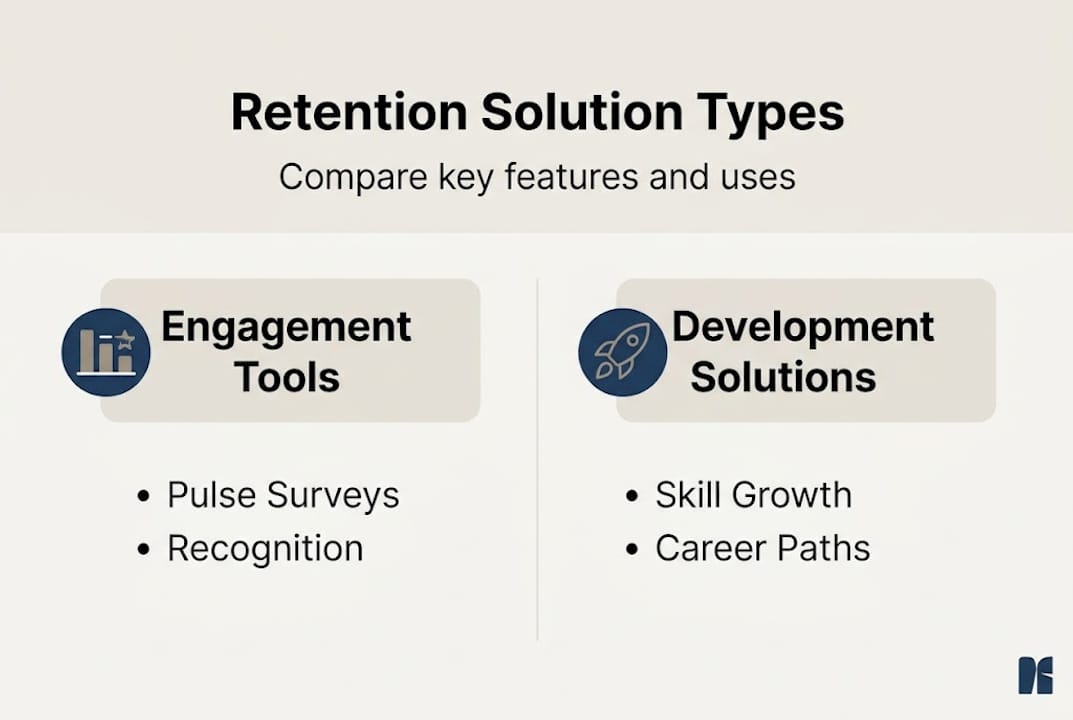
Here’s a breakdown of the main categories and what they’re actually good for:
| Solution type | Best for | Watch out for |
|---|---|---|
| Engagement and recognition | Fast morale lifts, culture reinforcement | Masks deeper issues if used alone |
| Skills-first platforms | Career development, internal mobility | Requires strong L&D infrastructure |
| Manager-employee fit tools | Understanding relationship alignment and collaboration risk | Not all tools measure two-sided fit |
| Survey and diagnostics | Identifying problems early | Data without action breeds cynicism |
| Behavioral and activity tracking | Productivity visibility | Can feel invasive; trust risk |
| Early visibility and alignment risk | Retention risk before it becomes turnover | Newer category; fewer vendors |
The last row is worth pausing on. Most tools in this market are, by design, lagging indicators. Engagement platforms tell you morale is low after it dropped. Exit surveys tell you why someone left after they’re already gone. Recognition tools reward behavior after it happens. The early visibility category, which focuses on alignment risk and team dynamics before problems surface, is where the real gap exists for growing companies.
Some viewpoints on retention solutions prioritize recognition tools like Achievers or Bonusly for quick wins. Others push skills-first platforms like iMocha for development-focused cultures, or performance and check-in tools like 15Five for structured conversations. There’s genuine value in all of them. The key is matching the tool to your diagnosed problem, not the other way around.
When you’re filtering options, ask yourself:
-
Does this solution address the root cause I identified in my diagnostic?
-
Is it built for companies my size, or is it scaled for enterprises?
-
Will leaders get clear, usable insight into values alignment, manager-employee fit, and team friction?
Evaluate vendors and integration requirements
After zeroing in on solution types, you’ll need to compare vendors and consider how they’ll work with your current systems. This is where a lot of companies get tripped up. They fall in love with a demo and forget to ask the hard questions.
Here’s a step-by-step approach that keeps the process honest:
-
Build a shortlist of 3 to 5 vendors based on your solution type and company size. Avoid the temptation to evaluate ten at once.
-
Request a live demo with your actual use case. Don’t let vendors show you their best-case scenario. Show them your messiest problem.
-
Ask about HRIS integration upfront. Integrate with existing HRIS to avoid data silos that undermine your reporting.
-
Build internal consensus before signing anything. HR, finance, and at least one senior manager should weigh in.
-
Negotiate a pilot period before full rollout. Even 60 days with a small team will reveal integration issues that no demo will show you.
Here’s a sample vendor evaluation matrix to guide your conversations:
| Criteria | Weight | Vendor A | Vendor B | Vendor C |
|---|---|---|---|---|
| HRIS integration | High | Strong | Partial | Strong |
| Analytics depth | High | Moderate | Strong | Strong |
| Customization | Medium | Low | High | Medium |
| Customer support | High | Strong | Moderate | Strong |
| Compliance features | Medium | Strong | Strong | Moderate |
| Scalability | High | Strong | Moderate | Strong |
Run a pilot with one department or team before committing to a company-wide rollout. You’ll catch adoption problems, integration gaps, and usability issues early, when they’re still cheap to fix.

Implementation best practices and measuring impact
Once you’ve selected a vendor, focus on implementation. This is where companies often win or lose the retention battle. A great tool, poorly implemented, is just expensive shelf decoration.
Here’s how to give your rollout the best possible chance:
-
Secure stakeholder buy-in early. Your executive team needs to understand the why, not just the what. Connect the investment to real business costs like cost-per-hire and productivity loss.
-
Equip leaders to act on the insights. The goal is not to blame managers or employees, but to help leaders understand where fit, alignment, connection, or collaboration may be weakening.
-
Create a clear communication plan. Employees need to understand what data is being collected, why, and how it benefits them. Transparency builds trust.
-
Set a 90-day review checkpoint. Early data is noisy. Give the system time to generate meaningful signals before drawing conclusions.
-
Track the signals that matter. Retention rate and turnover trends can show outcomes, but the more useful question is whether leaders can see shifting sentiment, manager-employee fit, values alignment, and team friction early enough to act.
What most companies miss about retention solutions
Most mid-sized companies buy a retention tool and expect the tool to solve the problem on its own.
But the real value of a retention solution is not the dashboard. It is the visibility it gives leaders into what they could not see before.
The companies that get better results choose tools that reveal what is changing before resignation risk becomes visible. They look beyond engagement scores, recognition metrics, turnover reports, and exit surveys because those are mostly backward-looking.
The real opportunity is seeing alignment risk early: what employees value, whether those needs are being met, where manager-employee fit is strained, and where team friction may be forming below the surface.
A strong retention solution should help leaders move from guessing to knowing.
How OpenElevator helps leaders see retention risk earlier
Choosing the right retention solution is not about collecting more reports. It is about seeing what is changing early enough to act.
OpenElevator helps CEOs, founders, senior leaders, and managers see what is happening now: shifting sentiment, hidden disengagement, manager-employee misalignment, values misalignment, and team friction before those issues become surprise resignations or disrupt performance.
Engagement surveys, turnover data, and exit interviews are lagging indicators. OpenElevator gives leaders earlier visibility into the risks forming below the surface.
Get your free OpenElevator team scan to experience the platform, gain real retention-risk visibility, and see what may be hidden below the surface — with zero cost and zero risk.
Frequently asked questions
What is the first step to choosing a retention solution?
The first step is deciding what you need to see before turnover happens. Exit interviews, engagement surveys, and turnover reports are useful, but they are lagging indicators. A stronger retention solution should reveal hidden retention risk earlier.
What should a growing company look for in a retention solution?
Growing companies should look for a solution that gives leaders visibility into retention risk, hidden disengagement, manager-employee fit, values alignment, and team friction before those issues become resignations.
Are engagement surveys enough to choose a retention strategy?
No. Engagement surveys show how employees felt at a point in time, but they may miss whether sentiment, manager fit, values alignment, or team dynamics are already changing below the surface.
How can a company reduce the risk of choosing the wrong retention tool?
Start with a low-risk pilot or free scan. This lets leaders experience the platform, see whether the insights are useful, and understand how the solution works before making a larger commitment.
How does OpenElevator help growing companies choose the right retention approach?
OpenElevator helps leaders see what is happening below the surface before turnover data, exit interviews, or engagement surveys reveal the problem too late. The free team scan lets leaders experience the platform with zero cost and zero risk while gaining real visibility into hidden team risk.