
Over half of American companies report that high turnover directly threatens their bottom line. When employees leave, the real cost goes far beyond simple recruiting expenses. Businesses must grapple with lost productivity, weakened team cohesion, and the steep price of replacing talent. This article uncovers why employee churn remains a persistent challenge and highlights practical insights to help any American organization build a more stable and engaged workforce.
Table of Contents
- Defining High Turnover And Its Business Impact
- Types Of Employee Turnover In Organizations
- Key Drivers And Hidden Costs Of Turnover
- Workforce Disruption And Productivity Loss
- Modern Strategies To Reduce Employee Turnover
Key Takeaways
| Point | Details |
|---|---|
| Impact of High Turnover | High employee turnover incurs significant costs, affecting productivity, morale, and organizational knowledge retention. |
| Types of Employee Turnover | Turnover can be voluntary, involuntary, functional, or dysfunctional, each requiring different management strategies. |
| Drivers of Turnover | Key drivers include job stress, inadequate compensation, and limited career opportunities, necessitating comprehensive interventions. |
| Retention Strategies | Organizations must implement personalized development, competitive pay, and work-life balance to enhance employee satisfaction and retention. |
Defining High Turnover and Its Business Impact
High employee turnover represents a critical challenge for businesses, reflecting the frequency at which workers leave an organization within a specific timeframe. Employee retention solutions are increasingly vital as modern workplaces experience unprecedented workforce mobility.
According to research from the Society for Human Resource Management, high turnover can be devastating, potentially resulting in substantial financial and operational consequences. The typical turnover rate encompasses multiple dimensions, including voluntary departures, involuntary terminations, and internal transfers. When employees exit an organization at accelerated rates, businesses face significant challenges such as:
- Increased recruitment expenses
- Decreased overall productivity
- Potential loss of institutional knowledge
- Disrupted team dynamics
- Reduced employee morale
Financial implications of high turnover are particularly profound. Studies indicate that replacing an employee can cost between 50% to 200% of their annual salary, depending on the role’s complexity and organizational level. Small and medium enterprises often feel these impacts most acutely, as each employee represents a larger percentage of total workforce capacity.
Understanding the nuanced metrics behind turnover requires examining several key indicators. These include voluntary resignation rates, average tenure, performance evaluation trends, and workforce engagement levels. By comprehensively analyzing these factors, business leaders can develop strategic interventions to mitigate potential talent exodus and create more stable, productive work environments.
Types of Employee Turnover in Organizations
Employee turnover is a multifaceted organizational phenomenon with nuanced categories that significantly impact business performance. Workforce dynamics reveal complex patterns of employee movement that extend far beyond simple hiring and departure statistics.
Research indicates that turnover can be comprehensively classified into several critical dimensions. Organizational turnover types fundamentally break down into four primary categories:
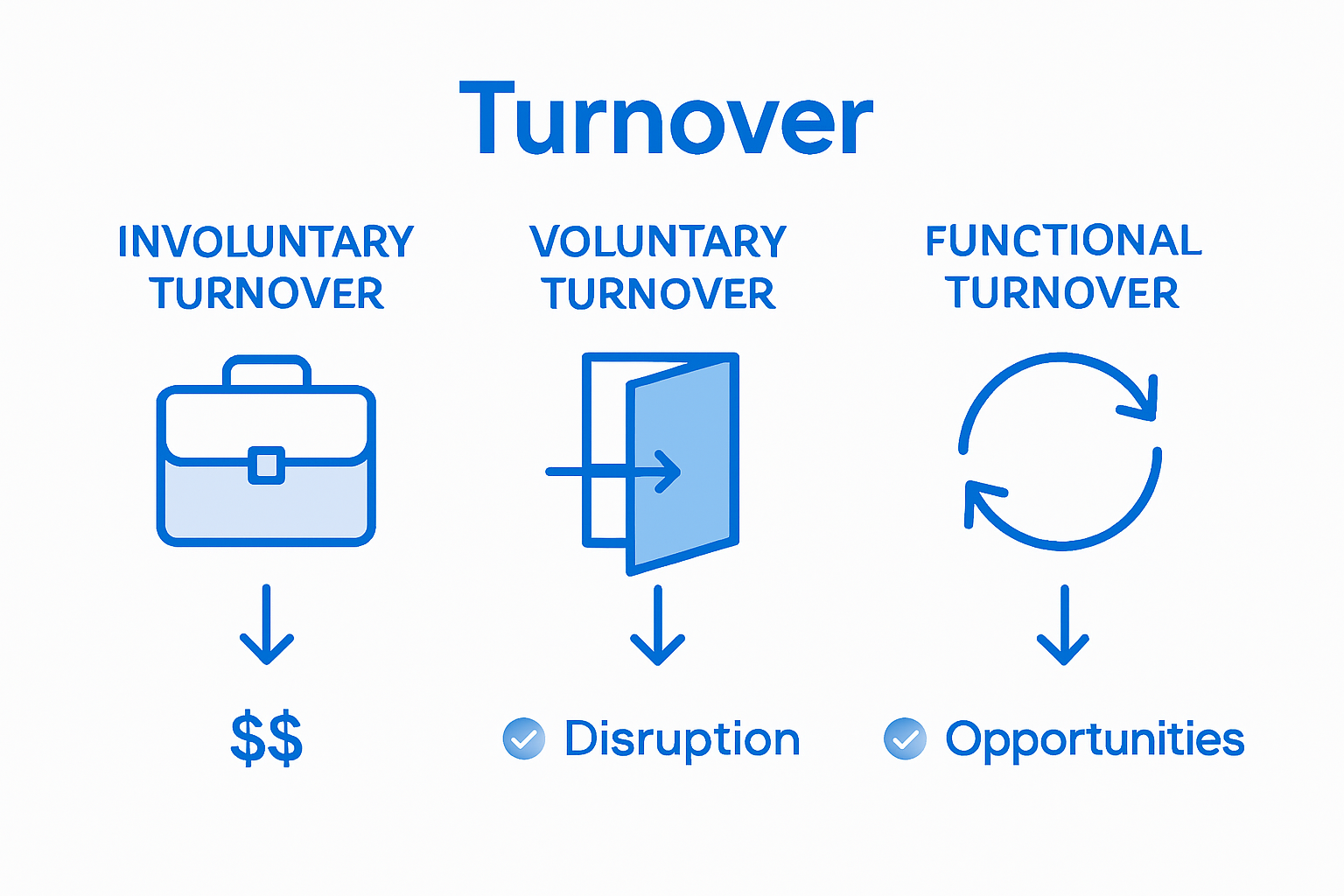
- Voluntary Turnover: Employees choose to leave the organization
- Involuntary Turnover: Employers initiate employee separation
- Functional Turnover: Departures that potentially benefit the organization
- Dysfunctional Turnover: Separations that harm organizational performance
Each turnover type carries distinct strategic implications. Voluntary turnover often signals deeper workplace culture issues, potentially indicating misalignment between employee expectations and organizational realities. Skilled professionals might exit due to limited growth opportunities, inadequate compensation, or poor management practices. Conversely, involuntary turnover can result from performance challenges, organizational restructuring, or economic constraints.
Functional turnover represents a nuanced concept where employee departures might strategically refresh organizational talent. This occurs when low-performing or misaligned employees exit, creating opportunities for more effective talent acquisition. Dysfunctional turnover, however, represents a critical risk – losing high-performing, difficult-to-replace talent that can dramatically disrupt team productivity and institutional knowledge retention.
Key Drivers and Hidden Costs of Turnover
Employee turnover represents a complex challenge that extends far beyond simple workforce replacement. Organizational performance metrics reveal intricate connections between workforce stability and business success.
Key drivers of employee departures encompass a multifaceted range of workplace factors that significantly impact employee retention. These critical elements include:
- Job stress and burnout
- Inadequate compensation structures
- Limited career advancement opportunities
- Poor workplace culture
- Misalignment with organizational values
- Insufficient recognition and rewards
Beyond immediate recruitment expenses, hidden costs of turnover can devastate organizational performance. Workplace disruption costs extend well beyond direct financial implications. Organizations experience profound secondary impacts such as reduced team productivity, diminished institutional knowledge, and increased workload for remaining staff.
The financial ramifications are staggering. Replacing a single employee can cost between 50% to 200% of their annual salary, depending on the role’s complexity. Strategic leaders recognize that high turnover is not just a human resources challenge, but a critical business performance issue that demands comprehensive, proactive intervention. By understanding and addressing the root causes of employee departures, businesses can transform workforce dynamics and create more stable, engaged organizational environments.
Workforce Disruption and Productivity Loss
Workforce stability represents a critical foundation for organizational performance. Employee productivity dynamics reveal intricate connections between team continuity and business success.
High turnover rates create cascading disruptions that extend far beyond simple personnel replacement. The immediate consequences include:
- Increased workload for remaining employees
- Dramatic drops in team morale
- Reduced operational efficiency
- Compromised service quality
- Extended knowledge transfer periods
- Heightened workplace stress
The ripple effects of workforce disruption can decimate team performance. Organizational productivity challenges emerge as remaining team members struggle to absorb additional responsibilities while simultaneously maintaining performance standards. Skilled professionals find themselves stretched thin, handling not just their core responsibilities but also compensating for lost institutional knowledge and training new team members.

Measurable productivity loss typically ranges between 20% to 50% during transition periods, with some industries experiencing even more dramatic declines. Strategic leaders recognize that workforce disruption is not merely a human resources challenge, but a fundamental business performance issue. By implementing proactive retention strategies and understanding the intricate dynamics of team stability, organizations can mitigate these productivity losses and create more resilient, engaged workplace environments.
Modern Strategies to Reduce Employee Turnover
Employee retention has become a critical strategic priority for forward-thinking organizations. Workforce engagement strategies are evolving rapidly to address the complex dynamics of modern workplace environments.
Career development opportunities represent a fundamental approach to reducing employee turnover. Organizations can implement comprehensive strategies that include:
- Personalized professional growth pathways
- Transparent promotion policies
- Continuous learning and skill development programs
- Competitive compensation structures
- Flexible work arrangements
- Regular performance feedback mechanisms
Effective retention strategies go beyond traditional human resources approaches. The most successful organizations recognize that employee satisfaction stems from a holistic approach addressing multiple workplace dimensions. This means creating environments that prioritize job security, manage workplace stress, and provide meaningful motivation through both financial and non-financial rewards.
Technology and data-driven insights are transforming retention strategies. Progressive companies now leverage advanced analytics to predict potential turnover, identify engagement risks, and proactively develop targeted interventions. By understanding individual employee needs, motivations, and potential friction points, organizations can create more personalized, responsive workplace experiences that significantly reduce the likelihood of unexpected departures and maintain critical institutional knowledge.
Unlock Lasting Workforce Stability with OpenElevator
High employee turnover creates costly disruptions and threatens productivity for businesses across the United States. This article highlights key pain points such as increased recruitment expenses, diminished team morale, and the loss of critical institutional knowledge. If you are struggling with unpredictable workforce departures or searching for ways to pinpoint who might be at risk of quitting, these challenges are directly addressed by OpenElevator.
Experience the power of a proprietary algorithm designed to reveal values alignment and interpersonal fit among your employees. OpenElevator goes beyond guesswork by providing actionable insights from a quick, bias-free survey. This allows you to proactively retain talent and build engaged teams where safety, growth, contribution, and connection are met. Take control of your workforce dynamics today by visiting OpenElevator and discover how our employee retention solutions give your business the advantage it needs in a competitive market.
Frequently Asked Questions
What is high employee turnover?
High employee turnover refers to the rate at which employees leave an organization within a specific timeframe, which can lead to significant challenges for businesses.
What are the financial impacts of high turnover?
The financial implications of high turnover can be substantial, with replacement costs ranging from 50% to 200% of an employee’s annual salary, depending on the role’s complexity.
What are some key drivers that contribute to employee turnover?
Key drivers of employee turnover include job stress, inadequate compensation structures, limited career advancement opportunities, poor workplace culture, and a lack of recognition and rewards.
How does high turnover affect team productivity and morale?
High turnover creates disruptions that can lead to increased workloads for remaining employees, drops in team morale, reduced operational efficiency, and potential declines in overall productivity, sometimes between 20% to 50% during transition periods.