Understanding the types of employee turnover helps leaders separate normal workforce movement from avoidable business risk.
Not every employee departure is a crisis. Some turnover is expected, and some may even help the company improve fit. But losing strong employees the business wanted to keep is different. That kind of turnover can damage execution, morale, customer relationships, and institutional knowledge.
The problem is that avoidable turnover often starts before leaders can clearly see it.
A team may look stable while disengagement, manager-employee friction, values misalignment, or lack of growth is already forming beneath the surface. By the time someone resigns, leaders are usually reacting to a problem that started much earlier.
This guide explains the major types of employee turnover, what drives each one, how each type affects the organization, and how leaders can reduce avoidable turnover by seeing risk earlier.
Table of Contents
Key Takeaways
| Point | Details |
|---|---|
| Not all turnover is the same | Voluntary, involuntary, functional, dysfunctional, avoidable, and unavoidable turnover each require different leadership responses. |
| Dysfunctional turnover is the most costly | Losing strong employees the company wanted to keep can damage execution, morale, and customer continuity. |
| Avoidable turnover often starts early | Risk may build through disengagement, manager friction, team tension, lack of growth, or values misalignment. |
| Turnover affects more than headcount | Departures can disrupt team trust, institutional knowledge, productivity, and business momentum. |
| Earlier visibility reduces risk | Leaders need to see which turnover risks are forming before resignation becomes the signal. |
Employee Turnover Defined and Common Myths
Employee turnover is the rate at which employees leave a company and are replaced by new employees.
But turnover is more than a number. It is a signal about workforce health, team stability, leadership effectiveness, and whether employees still see a future inside the company.
The biggest myth is that turnover starts when someone resigns.
It does not.
Turnover often starts earlier, when employees begin to disengage, feel misaligned with their manager, lose trust, stop seeing growth, or quietly question whether they belong.
Common myths include:
– All turnover is bad
– Low turnover means employees are committed
– Employees always speak up before leaving
– Compensation is the only reason people resign
– Exit interviews reveal the full story
– Turnover is only an HR problem
– Engagement surveys catch the risk early enough
Some turnover is normal. Some turnover is healthy. But avoidable turnover of strong employees is expensive because it often could have been addressed earlier.
The goal is not to eliminate all turnover. The goal is to understand which turnover risks matter most and which ones leaders can still influence.
Major Types of Employee Turnover Explained
Employee turnover can be divided into several types. Each type tells leaders something different about the business.
Voluntary Turnover
Voluntary turnover happens when an employee chooses to leave.
Common reasons include:
– Better external opportunity
– Poor manager relationship
– Lack of growth
– Compensation concerns
– Team friction
– Values misalignment
– Burnout
– Loss of trust in leadership
This is often the type of turnover leaders wish they had seen earlier.
Involuntary Turnover
Involuntary turnover happens when the company ends the employment relationship.
This may happen because of:
– Poor performance
– Role mismatch
– Misconduct
– Restructuring
– Layoffs
– Business changes
Involuntary turnover may be necessary, but it still creates cost and disruption.
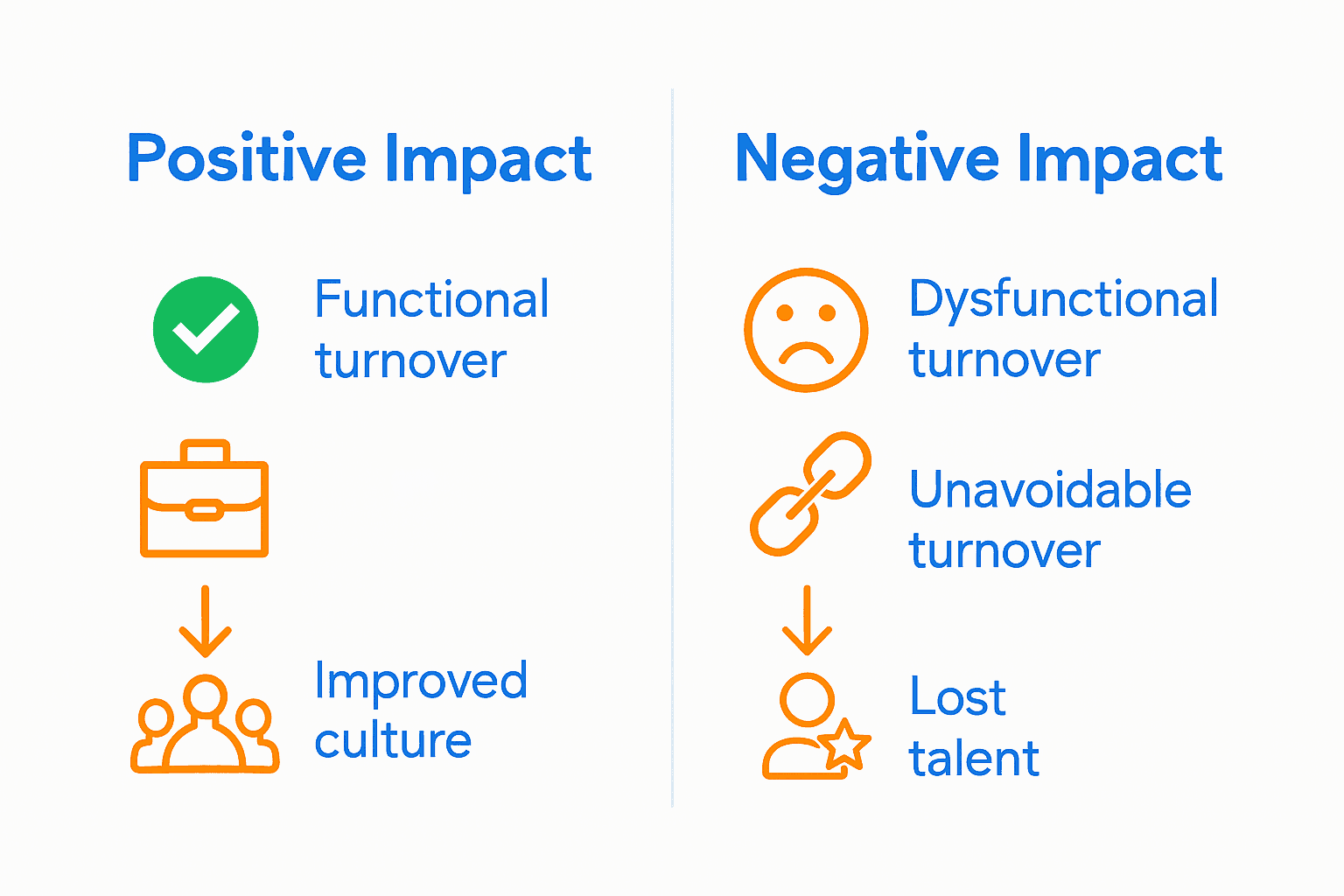
Functional Turnover
Functional turnover happens when an employee departure may benefit the company. For example, an underperforming or deeply misaligned employee leaves and the company replaces them with someone better suited to the role.
Functional turnover can create room for stronger fit.
Dysfunctional Turnover
Dysfunctional turnover happens when the company loses a strong employee it wanted to keep.
This is the dangerous type.
It can lead to:
– Lost knowledge
– Lower morale
– Customer disruption
– Delayed execution
– Increased workload for remaining employees
– Manager distraction
– Higher hiring and onboarding costs
Avoidable Turnover
Avoidable turnover happens when the company could have taken action earlier to reduce the chance of resignation.
This may involve addressing manager friction, growth concerns, workload pressure, team tension, recognition gaps, or values misalignment.
Unavoidable Turnover
Unavoidable turnover happens for reasons the company may not be able to control, such as relocation, retirement, major life changes, or family needs.
Leaders should not treat every departure as failure. The real issue is whether the company is losing strong people for reasons it could have seen and addressed earlier.

Key Drivers Behind Each Turnover Type
Different types of employee turnover have different drivers.
Voluntary turnover is often driven by issues that build quietly over time. Employees may leave because they feel unsupported, unseen, underused, misaligned, or uncertain about their future inside the company.
Common drivers of voluntary turnover include:
– Weak manager relationship
– Lack of career growth
– Low recognition
– Poor team dynamics
– Values disconnect
– Unclear expectations
– Workload pressure
– Compensation concerns
– Loss of trust in leadership
Involuntary turnover is usually driven by performance, role fit, conduct, or business conditions.
Common drivers include:
– Poor performance
– Skills mismatch
– Role misalignment
– Business restructuring
– Cultural mismatch
– Compliance or conduct issues
Dysfunctional turnover is often driven by preventable issues that leaders did not see early enough.
A realistic scenario: a high-performing employee is still delivering results, but they no longer volunteer ideas, avoid long-term planning conversations, and seem less connected to their manager. Nothing looks urgent yet. But the risk is already forming.
Most companies assume employees will tell them when something is wrong. That is why they miss early signals.
The driver that matters most is not always the one mentioned in the resignation conversation. It is often the one that started months earlier.
Impact of Turnover Types on Your Organization
Different turnover types affect the organization in different ways.
Functional turnover may improve team fit if the person leaving was underperforming or misaligned. But dysfunctional turnover can create serious disruption because the company loses someone it wanted to keep.
When strong employees leave, the impact can include:
– Lost institutional knowledge
– Customer relationship disruption
– Delayed projects
– Lower team morale
– Increased workload for remaining employees
– Lower trust in leadership
– Reduced execution speed
– Higher hiring and training costs
– Risk of additional resignations
The damage is not limited to the open role.
A resignation can send a signal to the rest of the team. People may wonder why the person left, whether the company is stable, or whether they should consider other options too.
This is why avoidable turnover is so expensive. It does not just remove one employee. It can weaken the system around them.
Leaders should ask:
– Which departures would create the most disruption?
– Which employees carry knowledge that would be hard to replace?
– Which teams look stable but may be under pressure?
– Where is manager-employee friction increasing risk?
– What are we learning too late from resignations?
The more clearly leaders understand turnover type, the better they can decide where to act.
Minimizing Turnover Risks and Mitigation Strategies
Reducing turnover risk does not mean trying to keep every employee forever.
It means identifying avoidable turnover before it becomes expensive and protecting the strong employees the company wants to keep.
Effective mitigation strategies include:
– Identifying retention risk before resignation
– Improving manager-employee alignment
– Addressing team friction early
– Clarifying expectations
– Creating personalized growth paths
– Recognizing meaningful contribution
– Supporting workload sustainability
– Understanding values alignment
– Reviewing hiring fit before adding people to a team
– Acting quickly on employee feedback
The most important shift is moving from reactive to proactive.
Reactive companies wait for exit interviews.
Proactive companies look for the signs earlier: disengagement, misalignment, lack of growth, manager friction, workload pressure, and declining connection.
Two diagnostic questions matter:
1. Which employees would be most costly to lose?
2. Which of them may be at risk without saying it out loud?
Turnover risk becomes manageable when leaders stop treating resignations as the first clear signal.
See Which Turnover Risks Are Forming Before People Leave
Understanding the types of employee turnover helps leaders know what kind of risk they are dealing with. But classification is not enough. Leaders also need visibility into where avoidable turnover may already be forming.
A team can look stable while disengagement, manager-employee misalignment, values disconnect, or hidden friction is building beneath the surface. By the time someone resigns, the company is already reacting.
OpenElevator helps CEOs, founders, senior leaders, and managers detect retention risk, team misalignment, and hidden friction before they become costly resignations. The platform uses a short, bias-free team scan and a proprietary algorithm to reveal where leaders may need to act earlier.
Start with a free team scan for up to 10 team members and see what may be hidden inside your own team.
Frequently Asked Questions
What are the main types of employee turnover?
The main types of employee turnover are voluntary turnover, involuntary turnover, functional turnover, dysfunctional turnover, avoidable turnover, and unavoidable turnover. Each type has different causes and business implications.
What is voluntary turnover?
Voluntary turnover happens when an employee chooses to leave the company. It may be caused by better opportunities, lack of growth, manager friction, team tension, compensation concerns, or values misalignment.
What is involuntary turnover?
Involuntary turnover happens when the company ends the employment relationship. This may happen because of poor performance, role mismatch, restructuring, layoffs, misconduct, or business changes.
What is dysfunctional turnover?
Dysfunctional turnover happens when a company loses a strong employee it wanted to keep. This type of turnover can be costly because it may damage productivity, morale, customer relationships, and institutional knowledge.
What is avoidable turnover?
Avoidable turnover happens when an employee leaves for reasons the company could have addressed earlier, such as poor manager alignment, lack of growth, unclear expectations, workload pressure, or team friction.
How does employee turnover affect an organization?
Employee turnover can affect productivity, morale, customer relationships, team trust, institutional knowledge, manager focus, hiring costs, and execution speed. The impact is larger when strong employees leave unexpectedly.
How can leaders reduce employee turnover risk?
Leaders can reduce turnover risk by identifying retention risk earlier, improving manager-employee alignment, addressing team friction, creating growth paths, recognizing contribution, and acting on early signs of disengagement.
How does OpenElevator help with employee turnover?
OpenElevator helps leaders detect retention risk, team misalignment, and hidden friction before they become costly resignations. It gives CEOs, founders, senior leaders, and managers clearer visibility into where they may need to act earlier.
Is there a free way to try OpenElevator?
Yes. OpenElevator offers a free team scan for up to 10 team members so leaders can see retention risk, alignment gaps, and hidden friction inside their own team.