Employee retention does not usually fail on resignation day. It fails earlier, when disengagement, manager friction, unclear growth, workload pressure, or team misalignment starts building beneath the surface.
A strong employee may still attend meetings, complete work, and avoid raising concerns while their commitment is already weakening. By the time they resign, leaders often realize the signs were there. Improving employee retention is not about adding another perk or reacting after turnover rises. It is about seeing retention risk early enough to understand what is driving it and act before avoidable turnover becomes expensive.
This guide explains how leaders can improve employee retention by diagnosing hidden risk, building a recurring retention rhythm, acting on the right retention levers, using exit interviews more effectively, and creating stronger visibility into the employee experience before people leave.
Table of Contents
Key Takeaways
| Point | Details |
|---|---|
| Retention risk starts early | Employees may begin disengaging, losing trust, or becoming misaligned before they resign. |
| Leaders need visibility | Turnover data and exit interviews explain what happened too late. Leaders need earlier signals. |
| Manager alignment matters | Trust, feedback, clarity, recognition, and support from managers strongly affect whether employees stay. |
| Generic retention programs miss risk | Different employees leave for different reasons, so leaders need targeted action. |
| OpenElevator helps leaders act earlier | OpenElevator helps detect retention risk, values alignment, interpersonal alignment, and hidden team friction before costly resignations. |
Diagnose Hidden Retention Risks and Signals
Improving employee retention starts with seeing where risk is already forming. Many companies rely on signals that arrive too late: turnover rate, exit interviews, annual surveys, or manager opinions after someone resigns.
Those can be useful, but they often explain the loss after the damage has already happened. Leaders need to look earlier.
Hidden retention risk may show up as:
– Lower participation in meetings
– Reduced initiative
– Shorter communication
– Less interest in growth
– Weaker connection with a manager
– More visible frustration
– Team friction
– Values misalignment
– Workload pressure
– Declining trust in leadership
The work may still get done, which is why leaders miss the risk. But acceptable performance is not the same as commitment. Leaders should diagnose retention risk by looking across teams, managers, roles, tenure groups, and employee experience signals.
The goal is not to label employees as flight risks. The goal is to understand where support, alignment, or intervention may be needed before resignation becomes the first clear signal.
Sample retention metrics to track
| Metric | What It Shows | Why It Matters |
|---|---|---|
| Voluntary turnover rate | Who has already left | Useful, but lagging |
| Regrettable turnover | Whether strong employees are leaving | More useful than total turnover alone |
| Manager-employee alignment | Quality of the daily employee experience | Poor manager alignment can drive disengagement |
| Team friction | Hidden tension or weak collaboration | Friction can build before performance drops |
| Values alignment | Whether employees feel aligned with the company environment | Values disconnect can quietly increase turnover risk |
| Growth clarity | Whether employees see a future inside the company | Strong employees may leave when growth feels blocked |
| New hire retention | Whether hiring and onboarding fit are working | Early exits often reveal expectation or role mismatch |
Build a Retention Operating Rhythm
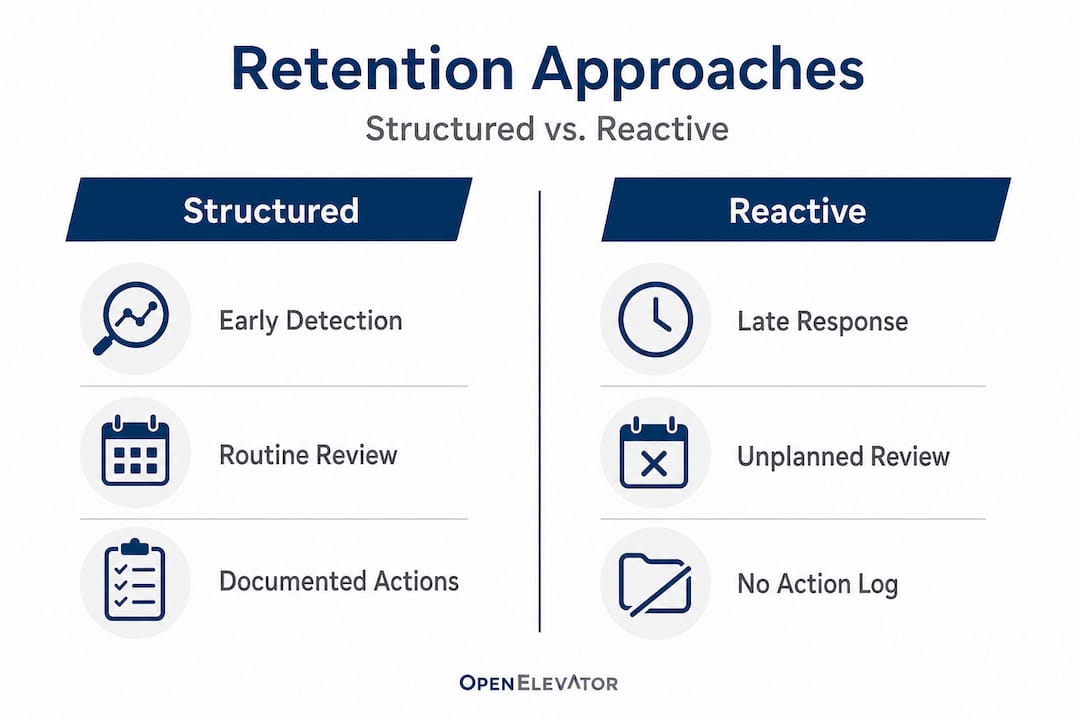
Retention should not be handled only when turnover spikes.
Leaders need a recurring rhythm that helps them see risk, act on it, and check whether the action worked.
A simple retention rhythm includes three steps:
Diagnose
Look for hidden risk across manager alignment, team dynamics, growth clarity, workload pressure, values alignment, and role fit.
Act
Match the intervention to the actual issue. Do not treat every retention problem the same.
Review
Check whether trust, clarity, connection, and alignment improved.
This rhythm matters because retention risk changes over time.
A team that looked stable last quarter may now be under pressure. A strong employee may become misaligned after a manager change. A new hire may realize the role is not what they expected.
Leaders who improve retention do not wait for resignation data. They build a habit of looking beneath the surface before people leave.

| Step | What Leaders Should Do | Why It Matters |
|---|---|---|
| Diagnose | Look for hidden risk across manager alignment, team dynamics, values alignment, growth, workload, and role fit | Reveals issues before resignation |
| Act | Match the intervention to the real cause of risk | Prevents generic fixes that miss the problem |
| Review | Check whether clarity, trust, connection, and alignment improved | Keeps retention work from becoming a one-time conversation |
| Repeat | Revisit risk regularly across teams and managers | Retention risk changes as teams, roles, and expectations change |
Use High-Impact Retention Levers
The best retention levers are not generic perks. They address the issues that cause strong employees to disengage or leave.
Leaders should focus on the areas most likely to affect commitment:
Role clarity: Employees are more likely to stay when expectations are clear and the role fits their strengths.
Manager alignment: Trust, feedback, recognition, and support from a manager strongly shape retention.
Growth clarity: Strong employees need to see a future inside the company. If they cannot, they may look elsewhere.
Team dynamics: Hidden friction can drain energy and weaken commitment before performance drops.
Values alignment: Employees are more likely to stay when the company environment fits what matters to them.
Workload sustainability: Overload can create burnout and quiet withdrawal long before resignation.
Recognition: Employees are more likely to stay when their contribution is seen and valued.
The key is matching the retention lever to the actual risk. A growth problem needs a growth conversation. A manager-alignment problem needs better communication and expectations. A workload problem needs priority changes. A values mismatch needs a deeper conversation about whether the environment can realistically change.
| Retention Lever | What It Solves | Better Leadership Action |
|---|---|---|
| Role clarity | Confusion, mismatched expectations, poor role fit | Clarify responsibilities, success measures, and priorities |
| Manager alignment | Weak trust, unclear feedback, poor support | Improve communication, recognition, and expectation-setting |
| Growth clarity | Employees leaving for opportunity elsewhere | Create visible development paths and next-step conversations |
| Team dynamics | Hidden friction and weak connection | Address tension directly and improve collaboration |
| Values alignment | Quiet disconnect from company environment | Understand whether the employee still feels aligned with the company direction |
| Workload sustainability | Burnout and withdrawal | Rebalance priorities and remove unnecessary load |
| Recognition | Invisible contribution | Recognize specific work and connect it to business impact |
Use Exit Interviews Without Waiting Too Long
Exit interviews can be useful, but they are too late to save the employee who is leaving. They may reveal patterns, but they do not prevent that resignation. That is why leaders should use exit interviews as a diagnostic tool, not as the main retention strategy.
The better question is not only: “Why did this person leave?”
The better question is: “What did we learn too late, and where might the same risk already be forming?”
Exit interviews should help leaders identify recurring themes such as: – Manager friction – Lack of growth – Workload pressure – Values misalignment – Team tension – Weak recognition – Role mismatch – Loss of trust in leadership
But the real retention opportunity is finding those themes before the next employee leaves. If exit interviews keep revealing the same issues, the company does not have an exit interview problem. It has a visibility problem.
| Exit Interview Theme | What It May Reveal | Earlier Signal Leaders Should Watch |
|---|---|---|
| Lack of growth | Employee did not see a future internally | Reduced interest in development or future conversations |
| Manager friction | Trust or communication was weak | Shorter communication, less openness, lower connection |
| Workload pressure | Burnout or overwhelm built over time | More frustration, lower energy, reduced initiative |
| Values misalignment | Employee no longer felt aligned with the company | Lower commitment, less belief in direction, disengagement |
| Team tension | Hidden friction affected belonging | Withdrawal from team conversations or collaboration |
| Weak recognition | Contribution felt invisible | Lower motivation, less ownership, reduced discretionary effort |
Why Retention Is a Leadership Visibility Problem
Improving retention is not just an HR program. It is a leadership visibility problem. Leaders cannot retain strong people if they cannot see where risk is forming. A company may have competitive pay, decent benefits, and good intentions while still losing people because manager friction, values misalignment, team tension, or disengagement stayed hidden too long.
The biggest mistake is assuming people will speak up before they leave. Many do not. They stay professional. They keep performing. They avoid conflict. They quietly decide whether the company still fits. That is why retention cannot depend only on annual surveys, exit interviews, or manager instinct. Leaders need clearer visibility into the employee experience while there is still time to act.
The companies that improve retention will not be the ones with the most programs. They will be the ones that see hidden risk earlier and act on the right issue before resignation becomes the signal.
See Retention Risk Before It Becomes Turnover
Improving employee retention starts with seeing what is happening beneath the surface. A team can look stable while disengagement, manager-employee misalignment, values disconnect, or hidden friction is already forming.
By the time someone resigns, the company is already reacting. OpenElevator helps CEOs, founders, senior leaders, and managers detect retention risk, values alignment, interpersonal alignment, and hidden team friction before they become costly resignations. The platform uses a short, bias-free team scan and a proprietary algorithm to reveal where leaders may need to act earlier.
Start with a free team scan for up to 10 team members and see what may be hidden inside your own team.

Frequently asked questions
How can leaders improve employee retention?
Leaders can improve employee retention by identifying risk earlier, improving manager alignment, addressing team friction, clarifying growth paths, recognizing contribution, and acting before employees decide to leave.
What causes employees to leave?
Employees may leave because of manager friction, lack of growth, values misalignment, workload pressure, weak recognition, poor role fit, team tension, or loss of trust in leadership.
Why are exit interviews not enough to improve retention?
Exit interviews happen after the employee has already decided to leave. They can reveal patterns, but they rarely help leaders prevent that specific resignation.
What are early signs of retention risk?
Early signs can include lower participation, reduced initiative, shorter communication, weaker manager connection, less interest in growth, visible frustration, and pulling back from team conversations.
Why does manager alignment matter for retention?
Manager alignment matters because managers shape trust, clarity, feedback, workload, recognition, and whether employees feel supported enough to stay.
How can companies reduce avoidable turnover?
Companies can reduce avoidable turnover by seeing hidden risk earlier, understanding the cause, and matching action to the specific issue instead of using generic retention programs.
How does OpenElevator help improve retention?
OpenElevator helps leaders detect retention risk, values alignment, interpersonal alignment, and hidden team friction before they become costly resignations.
Is there a free way to try OpenElevator?
Yes. OpenElevator offers a free team scan for up to 10 team members so leaders can see retention risk, alignment gaps, and hidden friction inside their own team.