
Hidden resignation risks often go undetected in teams where output appears steady but engagement quietly erodes. Many retention management tools require lengthy contracts, lack transparent pricing, or focus on broad engagement programs instead of giving leaders an early and objective risk signal. This comparison shows how six top retention platforms differ on visibility, cost structure, and actionability so you can confidently choose which fits your organization’s need for early intervention before turnover begins.
Table of Contents
OpenElevator
At a Glance
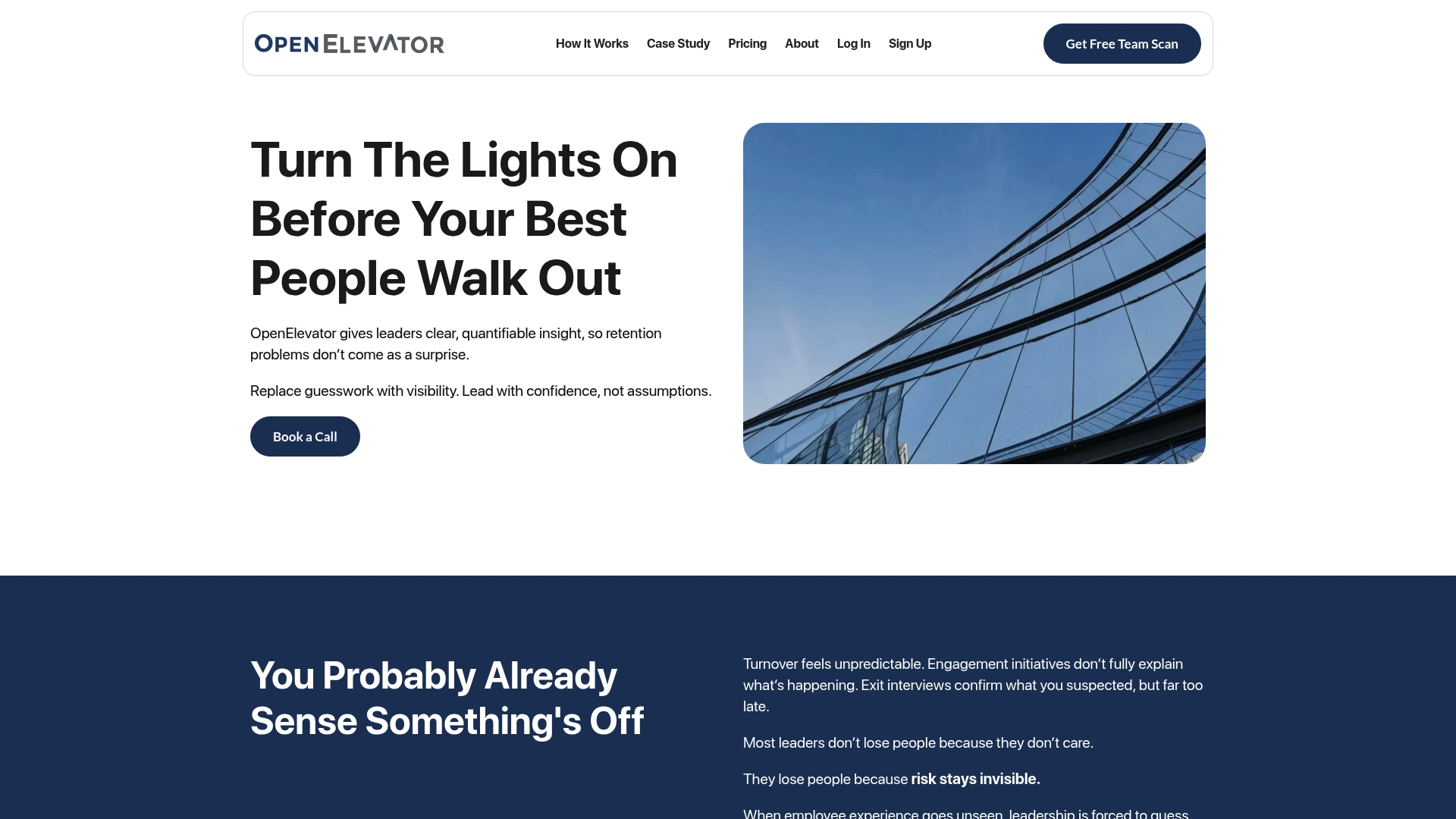
OpenElevator helps CEOs, founders, senior leaders, and managers detect retention risk, hidden disengagement, manager-employee misalignment, values misalignment, and team friction before those issues become costly resignations.
The platform is built for leadership visibility. It helps leaders see where risk may be forming while the team still looks stable on the surface.
Core Features
OpenElevator uses short, bias-complimentary Key Team Stay Surveys to surface measurable signals around:
- Retention risk
- Hidden disengagement
- Manager-employee fit
- Values alignment
- Team friction
- Interpersonal alignment
- Hiring and role fit
The goal is to help leaders see where attention is needed before the problem becomes obvious.
Key Differentiator
OpenElevator’s key differentiator is early leadership visibility.
Many retention tools focus on broad engagement programs, exit interviews, rewards, or HR analytics. OpenElevator focuses on helping leaders detect hidden risk before resignation day, when there is still time to intervene.
The resignation is not the beginning of the problem. It is often the final signal.
Pros
- Gives leaders earlier visibility into retention risk and hidden disengagement
- Focuses on manager-employee fit, values alignment, and team friction
- Designed for CEOs, founders, senior leaders, and managers
- Uses a short stay survey instead of a heavy engagement rollout
- Offers straightforward pricing at $150 per employee
Fit Considerations
OpenElevator is built for early leadership visibility into retention risk, hidden disengagement, manager-employee fit, values alignment, and team friction.
It is not meant to replace a full HRIS, payroll system, rewards platform, or enterprise workforce-planning suite. Larger organizations may use OpenElevator alongside those systems when they need clearer visibility into team-level risk.
Who It’s For
OpenElevator is best for leaders of growing companies who cannot afford to be surprised by preventable turnover.
It is especially useful when:
- A team looks stable, but trust or alignment may be weakening
- Managers are relying too heavily on intuition
- High-value employees may be disengaging quietly
- A few unexpected resignations would disrupt execution
- Leaders need a clearer view of retention risk before it becomes visible
Unique Value Proposition
OpenElevator gives leaders a faster way to see where retention risk may already be forming.
Instead of waiting for exit interviews, annual surveys, or broad engagement reports, leaders get clearer visibility into manager fit, values alignment, hidden disengagement, and team friction while there is still time to act.
Real-World Use Case
A growing company has a team that appears stable. People are attending meetings, hitting deadlines, and staying professional. But the leader senses that motivation and trust may be weakening.
An OpenElevator scan helps reveal where retention risk, manager-employee misalignment, or hidden friction may be forming. Leadership can then focus manager coaching, role clarity, or one-on-one conversations before the issue turns into a resignation.
Pricing
OpenElevator lists pricing at $150 per employee and offers a complimentary Key Team Stay Survey for up to 10 people. The free offer reduces rollout friction so you can validate risk signals on a pilot group before committing to a broader roll out.
Website: https://openelevator.com
WorkStep
At a Glance
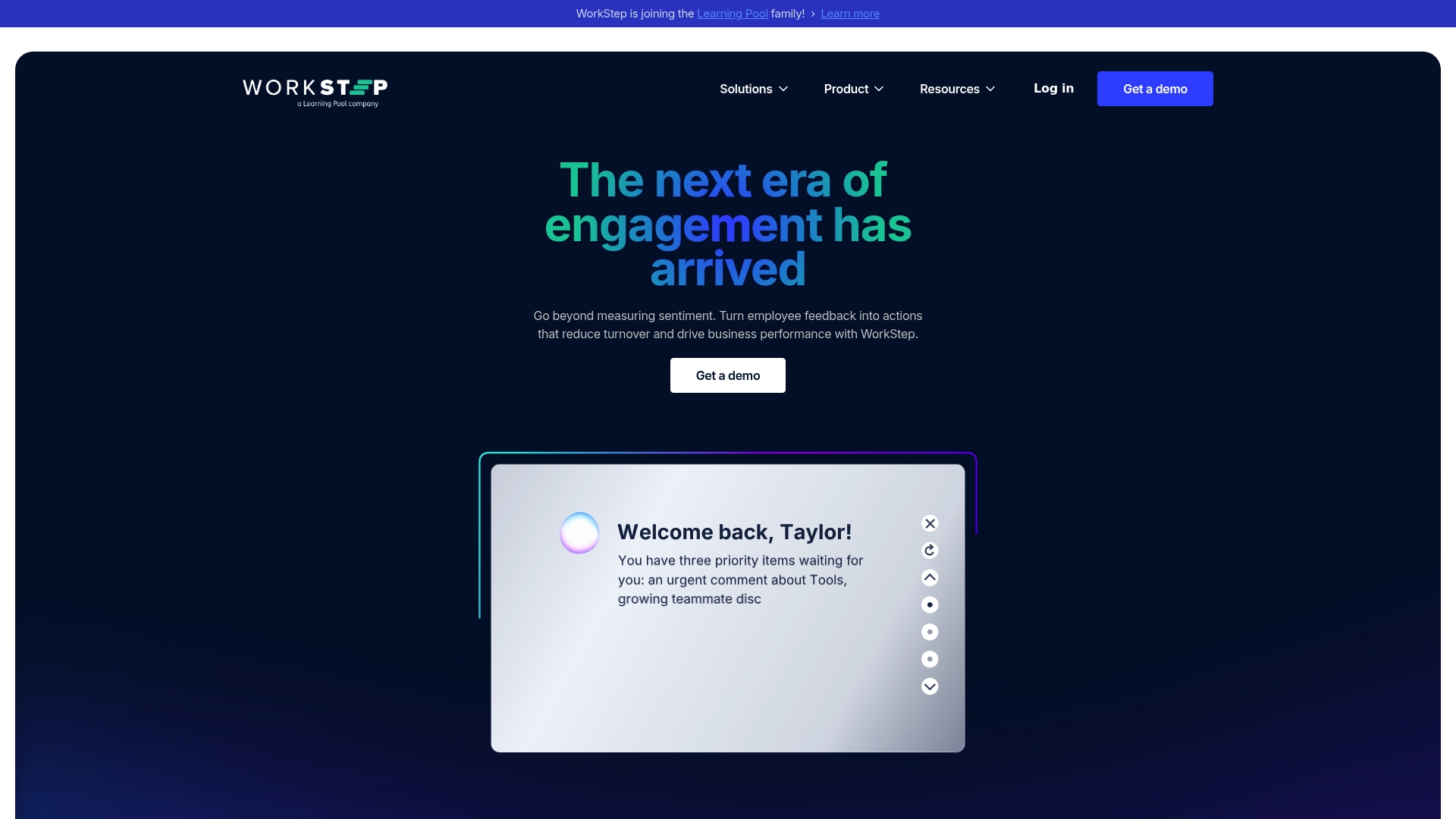
WorkStep’s marketing emphasizes AI-driven predictive insights and multi-channel feedback collection focused on frontline teams rather than office-based workforces.
That narrow focus aims to give supervisors real-time signals from shop floors, warehouses, and retail stores where app installation is impractical.
Core Features
WorkStep centers on fast feedback loops and AI triage across channels.
- Listen: short surveys delivered by SMS, email, or shared devices to capture frontline sentiment without a dedicated app.
- Analyze: AI-assisted analysis that flags engagement risk and recurring themes in free text.
- Act: AI-guided recommendations and targeted messages to managers to address issues before they escalate.
Key Differentiator
The vendor advertises predictive insights tailored to frontline operations, not generic employee pulse tools.
That emphasis on real-time, multi-channel reach and prescriptive next steps is the product’s defining angle.
Diagnostic questions for leaders to ask now:
- Are your site supervisors getting early warnings about team disengagement or only resignation notices?
- Which frontline roles carry hidden churn risk because they are hard to survey by app?
Pros
- Specialized for frontline scenarios where workers lack company devices; survey channels work over SMS or shared kiosks so reach is practical.
- Predictive modeling and text analysis aim to surface patterns before turnover becomes visible to managers.
- AI-guided recommendations reduce the time managers spend deciding what to do with a ticket of concerns; that is useful where supervisors are stretched.
- Multi-site visibility lets operations leaders compare signals across plants or stores and prioritize interventions by severity and location.
Cons
- Limited independent reviews make it hard to validate the vendor’s effectiveness across industries; most evidence is company-provided.
- Pricing is not public, which complicates cost-benefit planning for budget cycles and pilots.
- The product data lists no integrations with core HRIS or workforce management systems, so expect manual work or custom integrations when tying signals to payroll or scheduling.
When It May Not Fit
If your organization demands transparent, published pricing for quick procurement, WorkStep will slow vendor selection because cost estimates require direct engagement.
If you need out-of-the-box HRIS or scheduling integrations, the current data shows gaps that could increase implementation time and engineering effort.
Who It’s For
Frontline HR and operations leaders in manufacturing, logistics, retail, and healthcare who need reach to distributed hourly teams and want earlier visibility into retention risk.
Not aimed at headquarters-only people analytics teams that rely on broad integrations and centralized single sign-on by default.
Real World Use Case
A multi-site manufacturer uses WorkStep to run short SMS checks after night shifts. Supervisors receive AI flags for growing safety concerns in one line.
Their overall output stayed constant while a single crew showed rising disengagement in comments. That early flag allowed a targeted supervisor visit and schedule adjustment before resignations affected delivery.
Pricing
Pricing is not publicly listed and the vendor requires direct contact for quotes. That approach means procurement cycles should budget time for discovery calls and a scoped pilot before contract negotiation.
Website: https://workstep.com
Retensa
At a Glance
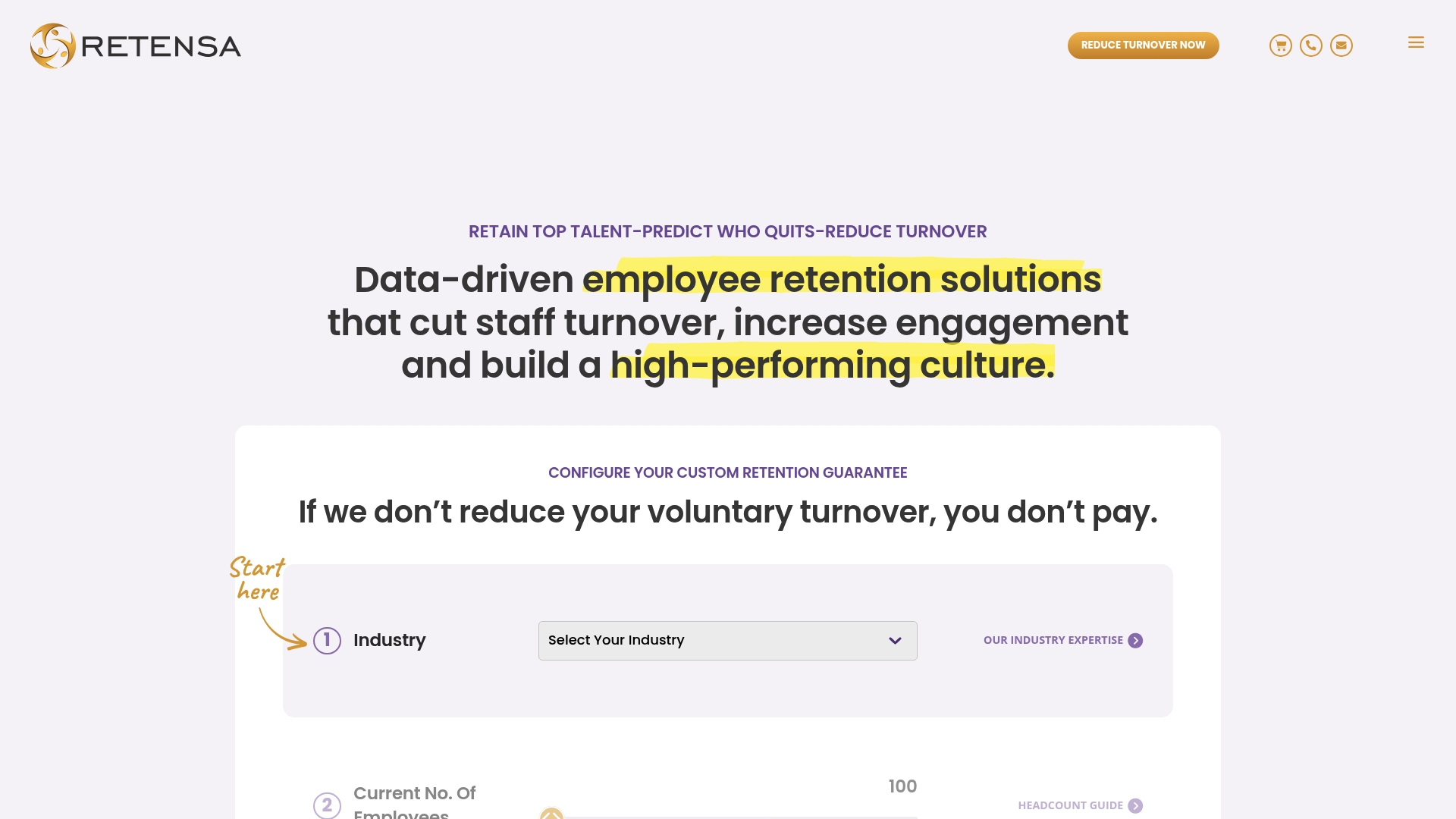
Retensa’s marketing materials claim a 98% success rate for retention programs and report 25 years operating across 59 countries and 22 languages. That contract-backed guarantee is the clearest signal this offering sells measurable, consultancy-style programs rather than a lightweight tool.
Core Features
- Predictive analytics that flag who is most likely to leave and when, feeding prioritized risk lists for action.
- Diagnostic assessments and customized retention playbooks tailored to industry and role.
- Real-time employee feedback via TalentPulse and structured exit analysis through ExitPro.
- Manager training modules and ongoing performance tracking tied to intervention outcomes.
Key Differentiator
Retensa pairs predictive models with contract-backed retention programs. The vendor leans into legally framed guarantees and industry templates to convert predictions into deliverable interventions. That makes it a program-first solution for teams that want vendor accountability instead of just visibility dashboards.
Pros
- Contract-backed commitment reduces vendor risk and forces a vendor-client delivery cadence for measurable results.
- The blend of predictive signals and managed training closes the gap between insight and execution; you get both the forecast and the remediation plan.
- Industry templates shorten deployment for regulated sectors like healthcare and finance where role-level nuance matters.
- Tools for continuous feedback and structured exit interviews give more signal than ad hoc pulse surveys.
- Global delivery and multi-language capability support enterprise rollouts across regions with a single vendor relationship.
Cons
- Public user reviews are limited, which makes third-party validation sparse for buyers who rely on peer references.
- No free trial or freemium tier is available; initial evaluation typically requires commercial engagement.
- The model is relatively complex and often demands dedicated internal sponsorship and change management investment.
- Cost and contractual structure can put Retensa out of reach for smaller teams or for leaders seeking a quick proof of concept.
When It May Not Fit
If you need fast, leader-level visibility rather than program delivery, this is probably not the best match. Retensa is designed for teams ready to run a vendor-managed retention program, not for leaders who want a lightweight scan to spot emerging risk.
Who It’s For
Retensa targets enterprise and mid-market organizations that accept vendor accountability for outcomes and have the budget to run a multi-month program. Typical buyers are senior HR leaders, workforce planners, and executive managers focused on measurable turnover reduction.
Two diagnostic leadership questions to ask before engaging:
- Are you prepared to assign a senior sponsor and a 3 to 6 month implementation cadence for retention interventions?
- Do you need vendor guarantees for budget approval, or would you prefer an internal visibility tool that surfaces early warning signs?
Real World Use Case
The vendor describes an international hospital chain using Retensa’s analytics and programs to cut nurse turnover by double digits within six months, which the company cites as delivering multi-million dollar savings and higher morale. That case illustrates the outcome focus: measurable, contract-driven change rather than a DIY analytics roll out.
A sales org hitting quota can still hide manager churn and misaligned career paths. Targets stay met while institutional knowledge drains quietly. That gap is the exact problem Retensa promises to convert into measurable action through prioritized interventions and manager coaching.
Pricing
Pricing is not published and is likely customized by industry, scope, and contract terms. Expect a commercial engagement model rather than per-seat SaaS billing; smaller teams should budget for setup and program fees in addition to licensing.
Website: https://retensa.com
Nobscot
At a Glance
The vendor reports over 20 years of experience focused on exit interview and retention technology, a longevity claim that shapes its product mix and consulting approach.
Nobscot positions itself as a suite of retention tools that combine survey automation with mentoring and storytelling services to convert attrition data into programs.
Core Features
- WebExit for automated exit interviews and structured departure feedback.
- FirstDays to survey new hires about onboarding quality and early fit signals.
- MentorScout for running and tracking mentoring programs tied to retention goals.
- StoryOlis for storytelling and engagement initiatives that surface cultural signals.
The product set pairs data capture with program management rather than raw people analytics alone.
Key Differentiator
Nobscot’s claim to distinction is its decades-long focus and a bundled product approach specifically for retention and exits. That narrow focus produces workflows and deliverables tuned to HR teams managing large cohorts of employees.
This makes Nobscot narrower than leadership visibility platforms that target CEOs and senior teams. Nobscot centers HR processes and program delivery rather than upstream leadership diagnostics.
Pros
- Deep subject focus. The company emphasizes exit and retention workflows, which speeds time to useful outputs for HR teams.
- Multiple integrated products reduce manual handoffs between surveys, mentoring, and storytelling programs.
- Data tools such as heat maps and trend reports help translate qualitative exit data into prioritized themes for action.
- Strategic consulting and customized action plans come bundled in many engagements, useful when internal capacity to interpret data is limited.
- Industry recognition and awards are part of the vendor narrative, which supports trust when buying program services.
Cons
- Public validation is thin. Limited reviews and visibility on major review platforms make independent vetting harder.
- User sentiment appears mixed in available feedback, suggesting implementation or service experience varies by client.
- The offering skews toward HR delivery. CEOs looking for leader-facing, real-time team visibility may find the scope misaligned.
When It May Not Fit
If your priority is early, leader-level visibility into manager fit, interpersonal alignment, or hidden disengagement, a platform built for executive visibility will serve better.
Nobscot also leans toward program delivery. Organizations that only want raw diagnostics without accompanying consulting will likely find the package heavier than necessary.
Who It’s For
Nobscot is aimed at large organizations and HR teams that need structured exit workflows, onboarding surveys, and mentoring program management backed by vendor guidance.
Ask two leadership diagnostic questions now:
- Are you seeing stable headcount while critical talent quietly declines in discretionary effort?
- Do your managers report strong performance while exit data shows repeat friction with a particular team or leader?
If you answer yes to either, you have a high-risk signal worth investigating.
A common looks-stable-but-isn’t example: retention rates and on-time delivery look fine on a dashboard, yet exit interviews repeatedly cite manager mismatch and lack of growth as reasons for leaving.
Real World Use Case
The vendor reports a healthcare client used WebExit and FirstDays and achieved a reported 20 to 60 percent reduction in turnover within less than a year after targeted interventions. That case highlights how combining exit data with onboarding signals and mentoring programs can surface demographic or role-specific drivers and direct remediation work.
Pricing
Not applicable. The product listing is informational only. Contact Nobscot for program and engagement pricing details tailored to organization size and scope.
Website: https://nobscot.com
Bucketlist Rewards
At a Glance
The vendor advertises a 45% reduction in turnover and higher engagement scores within three months after implementation. That claim anchors several of the platform’s case studies but is a vendor-reported outcome.
Bucketlist Rewards concentrates on peer recognition, points-based redemption, automated milestone awards, and real-time reporting to help HR automate recognition workflows.
Core Features
- Social recognition feed with comments, GIFs, emojis, and tags for visible peer praise across teams.
- Points-based rewards redeemable for gift cards, experiences, swag, donations, or custom perks tied to performance or values.
- Automated milestone awards for birthdays, anniversaries, and service anniversaries that reduce manual admin.
- Goal-driven incentives and dashboards that map rewards to KPIs and show redemption velocity.
Key Differentiator
Bucketlist Rewards positions itself as a recognition platform that combines social recognition, reward redemption, automation, and analytics for frontline and remote workforces. Its focus is narrower than Openelevator: this product helps you run recognition programs, while Openelevator targets early visibility into retention risk and manager fit.
Pros
- The social feed increases visible appreciation — public recognition helps managers identify contributors beyond formal reviews.
- Wide redemption options meet diverse preferences, improving perceived value across a multi-generational workforce.
- Real-time dashboards let you show program adoption and redemption patterns to finance and leadership without manual exports.
- Automated milestone handling saves HR time and removes missed celebrations that quietly erode morale.
- Goal-based incentives align rewards to measurable outcomes, which helps justify program spend to the executive team.
Cons
- Users report inconsistent customer service experiences; support quality appears variable across accounts.
- Execution issues with booked experiences and rewards have occurred, which can damage trust if not managed proactively.
- Communication gaps between vendor operations and clients can cause delays in delivery of certain reward types.
When It May Not Fit
If you need a tool that detects early disengagement signals, this product is not a substitute for leadership visibility platforms that surface manager friction or hidden turnover risk.
A support team hitting targets in public channels while recognition requests, passive complaints, and quiet resignations rise off the record. Recognition alone won’t reveal the manager-employee misalignment under the surface.
Notable Integrations
- Workday, BambooHR, SAP, and ADP for HRIS synchronization.
- Slack, Microsoft Teams, Outlook, and Gmail for recognition delivery and notifications.
These integrations help automate recognition triggers and reduce manual updates during onboarding or service changes.
Who It’s For
HR teams, recognition program owners, and frontline managers in mid to large organizations who need a flexible rewards engine and visible peer recognition.
Diagnostic leadership questions:
- Are you confident you would spot a top performer quietly disengaging before they resign?
- When a manager leaves, do you know which relationships carry the highest retention risk across that manager’s team?
Real World Use Case
A healthcare organization implemented Bucketlist and, according to the vendor, achieved that 45% turnover reduction within three months. That 45% figure is cited in the vendor case material as the outcome of automating milestone celebrations and peer recognition.
Pricing
The vendor lists pricing as informational only. Public pricing is not provided; procurement typically requires a discovery conversation to surface program tiers, reward credits, and integration costs.
Website: https://bucketlistrewards.com
Culture Amp
At a Glance
The vendor reports being trusted by over 6,800 companies worldwide, which positions Culture Amp as a tool built for scale and enterprise complexity.
It combines survey design, performance workflows, and AI guidance aimed at ongoing employee experience measurement rather than one-off engagement checks.
Core Features
- Employee engagement surveys and pulse tools for recurring measurement and bench‑marking across teams.
- Performance review and calibration systems that centralize review cycles and support fairer calibration across managers.
- Continuous feedback and goal management to link day-to-day performance with review outcomes and development plans.
- AI Coach offering real-time, evidence-based prompts for leaders and employees to act on survey signals.
Key Differentiator
Culture Amp weaves organizational psychology with data science and AI to convert survey signals into recommended actions at scale.
That mix aims to reduce guesswork for large HR and leadership teams by surfacing patterns in engagement, performance, and inclusion data.
Pros
- The survey editor is intuitive, so leaders can field targeted pulses quickly and get comparative benchmarks for interpretation.
- Analytics and reporting translate responses into prioritized themes, which helps busy execs focus on the highest-risk teams first.
- Tools for performance and development create a continuous loop between feedback and growth planning, reducing one-off performance shocks.
- Integrations with HR systems and chat platforms simplify rollouts and make data collection less disruptive for managers.
- Vendor support and established security protocols help with enterprise onboarding and compliance requirements.
Cons
- The administrative interface can feel clunky for complex rollouts, increasing the load on ops teams during setup.
- Reporting can struggle with very complex org charts, which blunts visibility when spans of control cross many business units.
- Text analytics are useful but sometimes require customization or outside expertise to extract deeper themes.
- The mobile experience is not as polished as some point solutions, which can lower participation from field or frontline staff.
When It May Not Fit
If your reporting spans dozens of nested legal entities and you need on-the-fly charting of cross‑cutting teams, Culture Amp may require extra implementation work.
If you expect advanced natural language modeling out of the box, be prepared to invest in configuration or third-party analytics for deeper text exploration.
Notable Integrations
- Major HRIS systems such as Workday, SAP, and UKG.
- Collaboration platforms like Slack and Microsoft Teams to nudge participation and share summaries with leaders.
Who It’s For
Large enterprises and HR leadership teams that need a science-backed, scalable platform to run recurring engagement and performance programs.
Diagnostic questions for leaders:
- Are you struggling to spot disengagement before it affects customer delivery or institutional knowledge?
- Do managers lack clear, evidence-based signals to prioritize which team relationships to repair first?
Real World Use Case
A multinational firm used Culture Amp to run quarterly pulses across regions, identify a pattern of manager mismatch in one business unit, and deploy targeted manager coaching. The company discovered retention risk building under professional behavior, which saved months of hiring cycles when addressed early.
An office meeting cadence remained full while engagement scores fell steadily for six months, foreshadowing a wave of resignations not visible in task completion data.
Pricing
Pricing is not publicly listed. The vendor offers custom enterprise pricing and asks organizations to contact sales for quotes and implementation estimates.
Website: https://cultureamp.com
Retention Tools Comparison
Choosing the right solution for addressing employee retention challenges depends on organizational priorities and operational situations. This analysis compares OpenElevator with leading competitors to illuminate differences in capabilities, user profiles, and practical constraints.
Pricing Transparency and Accessibility
OpenElevator stands out with its clear pricing structure of $150 per employee, paired with a complimentary Key Team Stay Survey to foster trust before commitment. This up-front transparency benefits leadership teams seeking simplicity in decision-making. In contrast, competitors such as Retensa and WorkStep require direct contact for quotes, creating additional steps in procurement, which may delay deployment. While Retensa offers substantial program guarantees targeted at medium and large enterprises, this approach involves complex contractual arrangements, potentially excluding smaller teams.
Program Focus and Deployment Flexibility
Retensa excels in offering retention programs supported by their contract-backed guarantees and industry-specific templates. This positions them as a strong contender for organizations demanding measurable interventions and external accountability. On the other hand, OpenElevator’s lightweight diagnostic scan and risk assessment facilitates early visibility without requiring intensive program management, making it an attractive choice for organizations valuing agility and minimal rollout friction. Nobscot finds its niche in combining exit and onboarding signals with structured mentoring workflows but may be less effective for organizations requiring immediate visibility into active retention risks.
Best Fit
- Organizations valuing straightforward pricing with minimal deployment hurdles benefit from OpenElevator.
- Enterprises searching for result-oriented program support underpinned by data with predictive analytics may favor OpenElevator.
- HR departments needing a dedicated toolset for exit interviews and retention workflows find Nobscot a matching solution.
- Teams aiming to enhance multi-site frontline workforce engagement through flexible survey channels could benefit from WorkStep.
Our Pick
OpenElevator’s conversion of bias-minimized stay surveys into metrics allows leaders to anticipate retention risks effectively. For instance, identifying disengagement within a functional team before visible issues occur is a unique benefit not fully replicated by competitors.
Retention Tools Comparison
| Product | Best For | Core Strength | Limitation |
|---|---|---|---|
| OpenElevator | CEOs, founders, senior leaders, and managers who need early visibility into team risk | Detects retention risk, hidden disengagement, manager-employee fit issues, values misalignment, and team friction | Not a full HRIS or rewards platform |
| WorkStep | Frontline, hourly, and distributed workforces | Real-time feedback through SMS, email, and shared devices | Less focused on leadership-level manager-employee alignment |
| Retensa | Larger organizations seeking a consultative retention program | Predictive analytics, diagnostics, and structured retention interventions | Requires more implementation time and vendor involvement |
| Nobscot | HR teams managing exit and onboarding programs | Exit interviews, onboarding surveys, mentoring tools, and turnover analytics | Can feel heavy for leaders needing lightweight visibility |
| Bucketlist Rewards | HR teams building recognition and rewards programs | Peer recognition, milestone awards, and rewards automation | Does not directly detect hidden retention risk or manager friction |
| Culture Amp | Larger organizations running engagement and performance programs | Engagement surveys, benchmarking, performance tools, and AI guidance | Broader HR platform, not focused only on early retention-risk visibility |
See Hidden Retention Risk Before It Hurts Team Stability
A team can look stable while retention risk is already forming.
Employees may still attend meetings, complete work, and appear engaged while trust, manager fit, values alignment, or motivation is weakening underneath the surface. By the time turnover becomes obvious, leaders may already be late.
OpenElevator helps leaders see those signals earlier.
The complimentary Key Team Stay Survey gives CEOs, founders, senior leaders, and managers a clearer view of retention risk, hidden disengagement, manager-employee fit, values alignment, and team friction.
Start your Stay Survey and see what may be hidden below the surface.
Frequently Asked Questions
Is OpenElevator worth it for retention?
OpenElevator is worth considering if leaders need earlier visibility into retention risk, hidden disengagement, manager-employee fit, values alignment, and team friction. It is especially useful when teams look stable but leaders suspect risk may be forming below the surface.
What does OpenElevator help leaders see?
OpenElevator helps leaders see where retention risk, hidden disengagement, manager-employee misalignment, values misalignment, and team friction may be forming before those issues become resignations or performance problems.
How is OpenElevator different from an engagement platform?
Engagement platforms often focus on broad employee sentiment, benchmarking, and HR-led programs. OpenElevator focuses on leadership visibility, helping CEOs, founders, senior leaders, and managers identify hidden risk earlier.
How is OpenElevator different from a rewards platform?
Rewards platforms like Bucketlist Rewards help organizations recognize and reward employees. OpenElevator is different because it focuses on detecting retention risk, manager fit issues, values misalignment, and hidden team friction.
Who should use OpenElevator?
OpenElevator is best for leaders of growing companies who need to protect execution speed, institutional knowledge, customer continuity, and team stability. It is designed for CEOs, founders, senior leaders, and managers.
How much does OpenElevator cost?
OpenElevator lists pricing at $150 per employee and offers a complimentary Key Team Stay Survey for up to 10 people.
Why does early retention-risk visibility matter?
The cost of turnover usually starts before the resignation. A team member may still appear productive while motivation, trust, or alignment is declining. Earlier visibility gives leaders a chance to act before the issue becomes expensive.