
Most leaders can sense when trust is weakening.
Someone goes quiet in meetings. A high performer stops volunteering for hard projects. A manager relationship becomes strained. Team communication becomes more guarded. The energy shifts.
But sensing the problem is not the same as seeing it clearly.
Trust, safety, and fit often break down before performance drops or employees resign. If leaders cannot measure those signals early, they are left reacting to disengagement, team friction, and turnover after the damage is already visible.
For CEOs, founders, senior leaders, and managers, this is not a soft issue. It is a leadership visibility issue.
This article explains why trust, safety, and fit matter, why traditional measurement often misses the real risk, and how leaders can use earlier visibility to detect hidden disengagement, manager-employee misalignment, values misalignment, and team friction before costly resignations happen.
Table of Contents
Key Takeaways
| Point | Details |
|---|---|
| Trust affects retention | Employees are more likely to stay when they trust leaders, managers, and the team environment. |
| Safety affects candor | When employees do not feel safe speaking honestly, leaders lose visibility into problems forming beneath the surface. |
| Fit affects performance and loyalty | Values alignment, manager-employee fit, and team alignment shape whether employees stay engaged. |
| Traditional tools are often too slow | Annual surveys and turnover reports usually show problems after risk has already formed. |
| Earlier visibility changes outcomes | Leaders can act sooner when they can see hidden disengagement, friction, and misalignment before resignation. |
Why trust, safety, and fit matter for retention
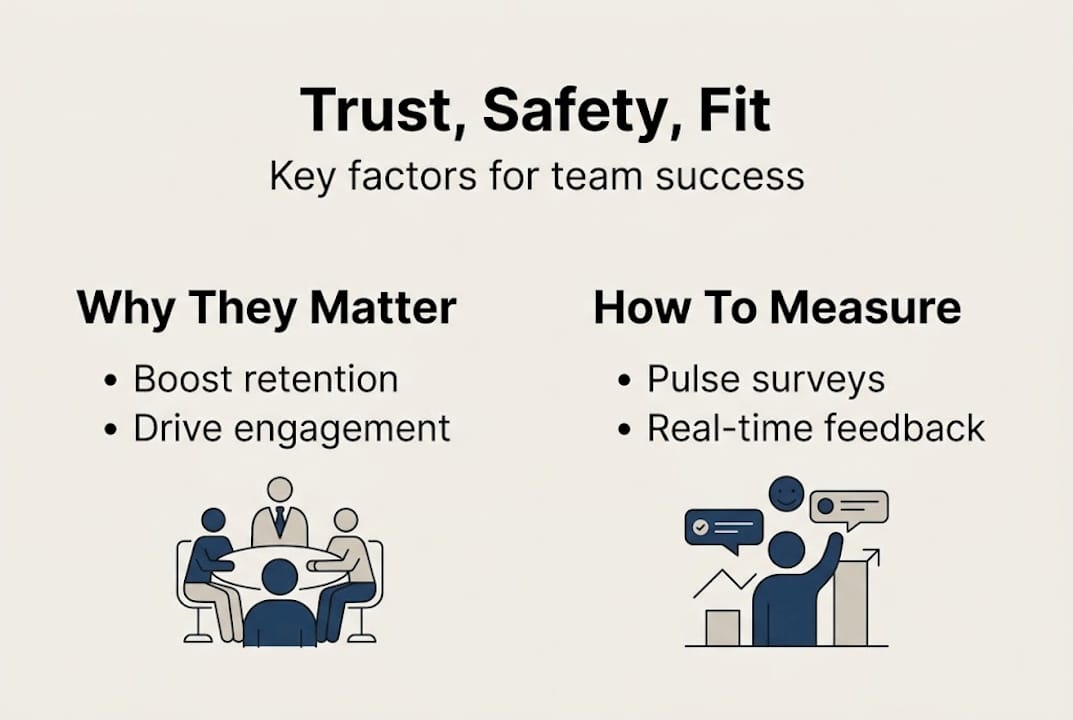
Trust, safety, and fit are not abstract leadership concepts. They affect whether employees stay, contribute, speak honestly, and remain committed.
Trust means employees believe leaders and managers will act with fairness, consistency, and integrity.
Safety means employees feel able to raise concerns, ask questions, challenge decisions, or admit mistakes without being punished or dismissed.
Fit means the employee’s values, working style, role, manager relationship, and team environment support their ability to do strong work.
When these conditions are strong, employees are more likely to speak up, collaborate, solve problems, and stay engaged.
When they weaken, retention risk starts forming.
| Factor | When Strong | When Weak |
|---|---|---|
| Trust | Employees believe leaders and managers will act fairly | Employees become guarded or skeptical |
| Safety | Employees speak honestly and raise concerns early | Employees stay quiet and problems go underground |
| Values alignment | Employees feel connected to how the company operates | Commitment weakens |
| Manager-employee fit | Communication and expectations work well | Friction, confusion, or low trust builds |
| Team fit | Collaboration feels clear and productive | Team friction drains energy |
The warning sign is not always conflict.
Sometimes the warning sign is silence, lower initiative, guarded communication, or a strong employee becoming less invested while still performing.
Why traditional measurement misses the real risk
Most traditional measurement tools are too slow or too broad to reveal trust, safety, and fit problems early enough.
Annual engagement surveys may show general sentiment. Turnover reports show who already left. Exit interviews explain what went wrong after the person has already decided to go.
Those tools can be useful, but they often arrive too late.
| Traditional Tool | What It Shows | What It Misses |
|---|---|---|
| Annual engagement survey | Broad sentiment | Hidden team friction forming between survey cycles |
| Turnover report | Who left | Who may be at risk now |
| Exit interview | Why someone says they left | What leaders could have seen earlier |
| Performance review | Output and goals | Trust, safety, fit, and hidden disengagement |
| Manager observation | What the manager notices | What employees are withholding |
The problem is not a lack of data. The problem is that leaders often measure lagging indicators while the real risk is forming earlier.
A team may look stable while trust is weakening. An employee may look productive while manager-employee fit is breaking down. A high performer may look reliable while quietly deciding whether to leave.
Leaders cannot act early if they cannot see what is changing.

How leaders can measure what used to stay hidden
Trust, safety, and fit can be measured more directly when leaders stop relying only on broad sentiment and start looking at the specific conditions that create retention risk.
Leaders should look for patterns in:
-
Trust in leadership
-
Trust in direct managers
-
Comfort speaking honestly
-
Values alignment
-
Manager-employee fit
-
Team alignment
-
Hidden disengagement
-
Reduced candor
-
Withdrawal from collaboration
-
Unresolved friction
Better measurement questions include:
| Leadership Question | What It Helps Reveal |
|---|---|
| Do employees trust their manager enough to speak honestly? | Manager-employee fit and safety |
| Do employees believe concerns will be acted on? | Trust and silence risk |
| Do employees feel aligned with how decisions are made? | Values alignment |
| Are high performers becoming quieter? | Hidden disengagement |
| Which teams avoid difficult conversations? | Team friction |
| Where are employees still performing but less invested? | Retention risk |
| Where does collaboration feel harder than it should? | Team alignment risk |
This is the shift leaders need to make:
Do not only ask, “Are employees engaged?”
Ask, “Where are trust, safety, and fit weakening before employees disengage or leave?”
Turning visibility into action
Measurement only matters if leaders act on what they see.
Once leaders have clearer visibility into trust, safety, and fit, they need to respond with targeted action instead of generic engagement efforts.
| Signal | What Leaders Should Do |
|---|---|
| Low trust in manager | Improve manager communication, expectations, and follow-through |
| Low safety | Create safer ways to raise concerns and show visible action on feedback |
| Weak values alignment | Clarify how decisions are made and where expectations are mismatched |
| Poor manager-employee fit | Address communication style, feedback patterns, and role expectations |
| Team friction | Surface the issue directly and clarify ownership, collaboration, and decision rights |
| Hidden disengagement | Have earlier conversations before performance drops or resignation happens |
The goal is not to collect more feedback for the sake of it.
The goal is to know where leadership attention is needed before trust erodes, team friction spreads, or strong employees leave.
Earlier visibility gives leaders time to act while the outcome is still changeable.
What most leaders miss about trust, safety, and fit
Most leaders overestimate how much they know about their teams.
They assume that if something were wrong, someone would tell them. They assume open-door policies, one-on-ones, or occasional surveys are enough. They assume performance means commitment.
That is the mistake.
Employees often withhold concerns when trust is weak. High performers may keep delivering while privately reassessing their future. Teams may avoid conflict while friction grows. Managers may not see that the relationship is already strained.
The issue is not that leaders do not care. The issue is that they often lack a clear way to see the signals early.
The strongest leaders do not wait for resignation, conflict, or missed performance to prove there was a problem.
They measure the conditions that create retention risk before those risks become visible damage.
See trust, safety, and fit risk before it becomes turnover
Trust, safety, and fit often weaken before employees leave.
An employee may still look productive while hidden disengagement, values misalignment, manager-employee friction, or team tension is already forming.
OpenElevator helps CEOs, founders, senior leaders, and managers detect these risks earlier.
Through a simple five-minute, bias-free survey, OpenElevator gives leaders clearer visibility into retention risk, hidden disengagement, values alignment, manager-employee fit, and team friction.
That means leaders can stop guessing whether trust, safety, and fit are strong enough and start seeing where costly turnover risk may already be forming.
Want to see where trust, safety, and fit may be affecting retention inside your team? Start with OpenElevator’s free team scan.
Frequently asked questions
Why do trust, safety, and fit matter for retention?
Trust, safety, and fit matter because they shape whether employees feel able to speak honestly, stay engaged, work well with their manager and team, and see a future inside the company.
How can leaders measure trust at work?
Leaders can measure trust by looking at whether employees believe managers communicate clearly, follow through, act fairly, and create space for honest feedback before problems become resignation risk.
What is the difference between safety and fit?
Safety is whether employees feel able to speak honestly without fear or dismissal. Fit is whether the employee’s role, values, manager relationship, and team environment support strong long-term contribution.
Why do traditional engagement surveys miss trust and fit problems?
Traditional engagement surveys often measure broad sentiment at one point in time. They may miss hidden disengagement, manager-employee friction, values misalignment, or team tension forming between survey cycles.
What should leaders watch for if trust or fit is weakening?
Leaders should watch for reduced candor, guarded communication, lower initiative, less collaboration, more unresolved friction, quiet high performers, and employees who still perform but seem less invested.
How does OpenElevator help measure trust, safety, and fit?
OpenElevator helps leaders detect retention risk, hidden disengagement, values alignment, manager-employee fit, and team friction through a five-minute, bias-free survey. This gives leaders earlier visibility into the issues that may lead to turnover.