
Losing strong employees rarely starts with a resignation letter. It usually starts earlier, when a valuable person becomes quieter, less invested, less open with their manager, or less connected to the team.
That is the real risk behind passive turnover.
Passive turnover happens when employees begin moving away from the organization before leaders clearly see the problem. They may still attend meetings, complete their work, and appear “fine” on the surface. But underneath, engagement may be dropping, trust may be weakening, and hidden friction may be building.
For CEOs, founders, and senior leaders, this matters because passive turnover is not just an HR issue. It is a visibility issue. If you cannot see early retention risk, team misalignment, or manager-employee friction soon enough, you are left reacting after damage has already been done.
This article explains what passive turnover is, how it differs from other types of turnover, the warning signs leaders should watch for, and how to reduce the risk before valuable employees mentally check out or leave.
Table of Contents
Key Takeaways
| Point | Details |
|---|---|
| Passive turnover starts before resignation | Employees may begin disconnecting long before leaders see an obvious problem. |
| The risk is often hidden | Quiet disengagement, weak manager fit, values misalignment, and team friction can build beneath the surface. |
| The cost starts early | Productivity, morale, trust, and team stability may decline before the employee officially leaves. |
| Leaders need earlier visibility | CEOs, founders, and senior leaders need ways to detect retention risk before it becomes a resignation. |
Defining Passive Turnover and Common Myths
Passive turnover refers to employee departures that develop quietly over time. The employee may not announce dissatisfaction, ask for help, or clearly signal that they are considering leaving. Instead, the risk builds through subtle disengagement, weakening alignment, unresolved friction, or a growing sense that the employee no longer fits the role, manager, or team environment.
In simple terms: passive turnover is what happens when an employee is drifting away before leadership realizes there is a problem.
This makes passive turnover especially dangerous for growing companies. Leaders often believe they will know when someone is unhappy. But many employees do not openly say they are disconnected. They stay polite. They keep performing well enough. They avoid conflict. Then one day, they resign.
Common myths about passive turnover include:
| Myth | Reality |
|---|---|
| “We would know if someone was unhappy.” | Many employees hide disengagement until they are ready to leave. |
| “Turnover only happens because of pay.” | Pay matters, but misalignment, poor manager fit, lack of growth, and hidden friction often play a major role. |
| “High performers will speak up before leaving.” | Some high performers quietly disengage because they do not believe speaking up will change anything. |
| “Exit interviews tell us what went wrong.” | Exit interviews often happen too late to prevent the loss. |
The key issue is not only whether employees are satisfied. The key issue is whether leaders can see the early signals of retention risk before the employee has already decided to leave.
Types of Turnover and Passive Distinction
Understanding the intricate landscape of employee turnover requires a nuanced approach to categorization. Comprehensive turnover classifications reveal multiple dimensions that go far beyond simple employee departures. Organizations must recognize that turnover is not a monolithic concept, but a complex interplay of organizational and individual dynamics.
Turnover can be strategically categorized across several key dimensions:
-
Internal vs. External Turnover
-
Internal: Employees move within the organization
-
External: Employees leave the organization entirely
-
-
Voluntary vs. Involuntary Turnover
-
Voluntary: Employee initiates departure
-
Involuntary: Organization initiates separation
-
-
Functional vs. Dysfunctional Turnover
-
Functional: Departures that benefit the organization
-
Dysfunctional: Departures that harm organizational performance
-
Passive turnover is different because it often sits beneath the surface. The employee may not be actively disruptive, openly dissatisfied, or visibly checked out. They may still be doing the job. That is why passive turnover can be missed by managers who rely only on performance reviews, informal observation, or annual engagement surveys.
For leadership teams, the risk is clear: by the time passive turnover becomes visible, the employee may already be emotionally gone.
Key Signs and Causes of Passive Turnover
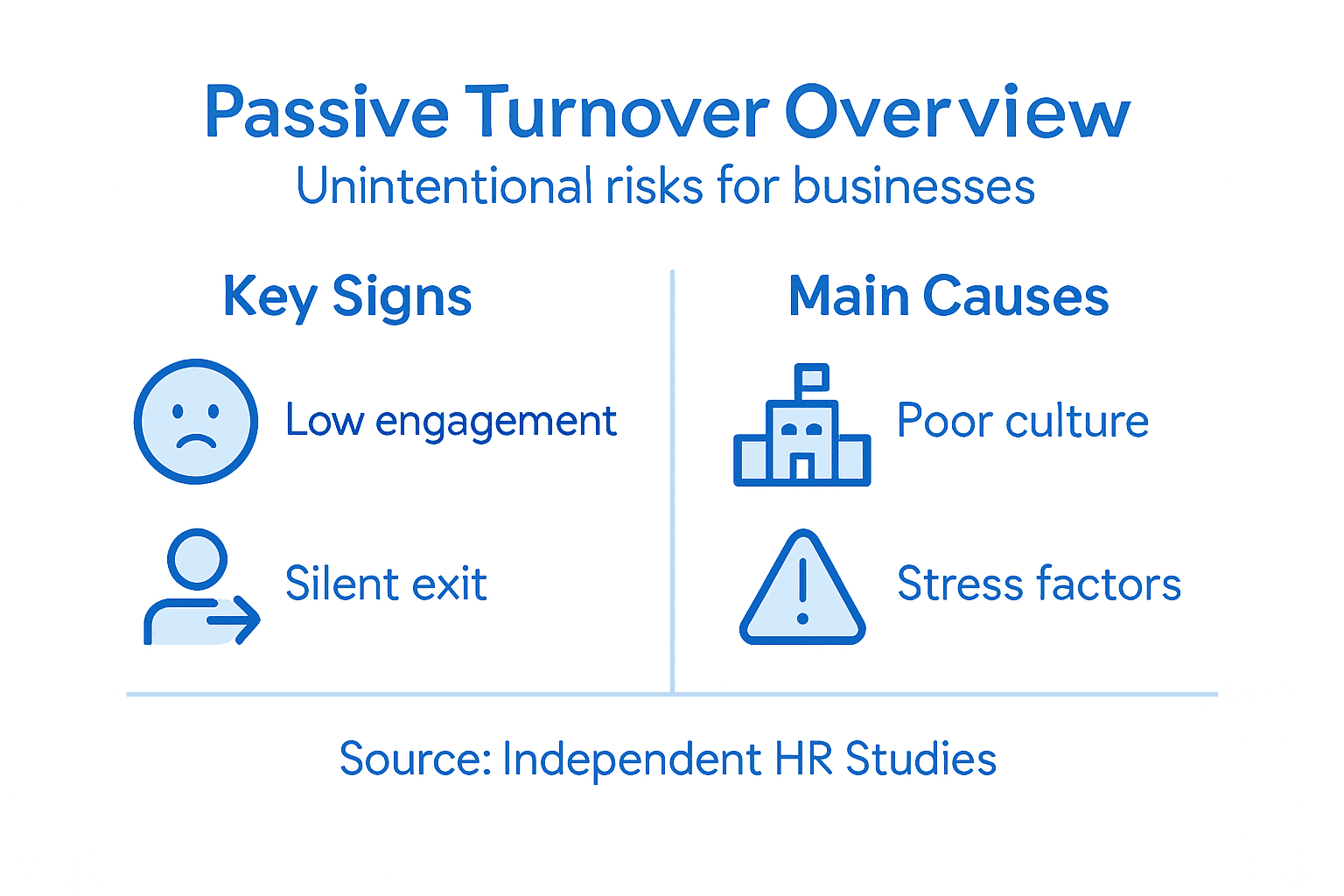
Passive turnover usually gives signals before it becomes a resignation. The problem is that these signals are easy to dismiss as temporary stress, personality, workload, or normal business pressure.
Leaders should watch for patterns, not isolated moments. One quiet meeting does not mean someone is a turnover risk. But a steady change in communication, motivation, participation, or connection may indicate that the employee is pulling away.
Common warning signs of passive turnover include:
-
Lower energy or enthusiasm in meetings
-
Reduced communication with managers or teammates
-
Less participation in team discussions
-
Slower response times or less initiative
-
Decreased ownership of projects
-
Increased absenteeism, lateness, or withdrawal
-
Less interest in growth, development, or future opportunities
-
More visible friction with a manager or team member
-
A shift from proactive contribution to basic task completion
The most dangerous sign is not always poor performance. Often, the bigger warning sign is emotional distance. The employee is still present, but no longer fully invested.
The root causes of passive turnover are multifaceted and deeply interconnected. Organizations frequently experience passive turnover due to several key factors:
-
Insufficient Career Development Opportunities
-
Poor Management Practices
-
Inadequate Compensation Structures
-
Limited Recognition and Feedback
-
Non-Inclusive Workplace Culture
Psychological disengagement is one of the clearest drivers of passive turnover. It happens when an employee remains physically present but mentally and emotionally starts to detach from the company.
This can happen when employees feel unseen, misaligned, undervalued, unsupported, or stuck. It can also happen when the relationship with a manager or team member creates ongoing friction that is never addressed.
The employee may not say, “I am disengaged.” They may simply stop contributing at the same level. They may stop offering ideas. They may stop seeing a future inside the company.
That is why passive turnover is a leadership visibility problem. If leaders cannot detect disengagement, values misalignment, or interpersonal friction early, they cannot intervene early.
Passive turnover occurs when employees mentally check out long before they physically leave the organization.
Contextual factors play a significant role in driving passive turnover. Job stress, misalignment between personal values and organizational culture, and unmet professional aspirations can silently erode an employee’s commitment. Workplace engagement research emphasizes that these underlying issues require proactive, nuanced intervention.

Pro tip: Conduct regular, confidential stay interviews to uncover potential disengagement signals before they transform into unexpected departures.
Business Impacts and Cost Considerations
Passive turnover is expensive because the cost starts before the employee leaves.
By the time a resignation happens, the company may have already lost months of full contribution, trust, momentum, knowledge sharing, and team stability. The visible cost is replacement. The hidden cost is everything that was already declining before the resignation became official.
For CEOs and founders, this is where passive turnover becomes a business performance issue, not a people operations issue.
Direct Cost Components of passive turnover include:
-
Recruitment expenses
-
Onboarding and training investments
-
Temporary productivity losses
-
Potential recruitment agency fees
-
Administrative processing costs
The financial burden of replacing employees varies dramatically across different roles and industries. Workforce replacement research suggests that replacing a worker can range from 20% to 150% of their annual salary, depending on the position’s complexity and organizational level.
Indirect Cost Dimensions prove even more challenging to quantify:
Here’s a comparison of direct and indirect costs associated with passive turnover:
| Cost Area | What Happens | Business Impact |
|---|---|---|
| Productivity loss | The employee contributes less before leaving | Slower execution and weaker output |
| Manager time | Leaders spend time reacting to problems late | Less time for strategy and growth |
| Team morale | Remaining employees absorb uncertainty and extra work | Higher stress and possible disengagement |
| Knowledge loss | Context leaves with the employee | Slower onboarding and repeated mistakes |
| Customer impact | Relationships or service quality may suffer | Lower trust and weaker delivery |
| Replacement cost | Recruiting, hiring, and training take time and money | Direct financial strain |
| Culture damage | Employees see issues go unresolved | Lower confidence in leadership |
Proactive Strategies to Reduce Passive Turnover
Reducing passive turnover requires earlier visibility. Leaders need to know where retention risk is forming before it becomes a resignation, a performance issue, or a team conflict.
Traditional approaches often come too late. Annual engagement surveys, exit interviews, and informal manager check-ins may miss the employees who are quietly disengaging but not speaking up.
The goal is not to guess who might leave. The goal is to identify the patterns that increase retention risk.
Effective ways to reduce passive turnover include:
-
Identify early signs of disengagement before they become visible performance issues
-
Measure whether employees feel aligned with the company’s values and working environment
-
Understand manager-employee fit, especially where communication or trust may be strained
-
Look for team-level friction that could be affecting motivation and productivity
-
Create clear career paths for employees who may feel stuck
-
Train managers to spot withdrawal, not just underperformance
-
Use stay conversations before employees reach the point of leaving
-
Take action on hidden friction before it becomes resignation risk
The strongest retention strategies are not reactive. They help leaders see where alignment is weakening early enough to do something about it.
The following table summarizes key interventions with their primary benefits:
| Intervention | What It Helps Leaders See | Why It Reduces Passive Turnover |
|---|---|---|
| Stay conversations | What employees are not saying in normal meetings | Surfaces concerns before resignation |
| Alignment measurement | Whether employees feel connected to the company’s values and environment | Reveals hidden retention risk |
| Manager-employee fit analysis | Where friction may exist between employees and managers | Helps address relationship-based disengagement |
| Team visibility tools | How people are working together across the team | Detects collaboration issues earlier |
| Career path clarity | Whether employees see a future inside the company | Reduces silent job-search behavior |
| Recognition practices | Whether employees feel seen and valued | Strengthens commitment and motivation |
Pro tip: Develop a comprehensive employee engagement dashboard that tracks leading indicators of potential passive turnover, enabling proactive intervention.
See Passive Turnover Risk Before It Becomes a Resignation
Passive turnover is difficult to manage because the warning signs are often hidden. Employees may look fine on the surface while engagement, alignment, or trust is already weakening underneath.
OpenElevator helps CEOs, founders, senior leaders, and managers detect retention risk earlier.
Through a simple five-minute, bias-free survey, OpenElevator gives leaders clearer visibility into the factors that often sit behind passive turnover, including values alignment, engagement risk, interpersonal fit, and hidden team friction.
Instead of guessing who is disengaged or waiting for someone to resign, leaders can see where risk may already be forming and take action sooner.
Want to know where passive turnover risk may be hiding in your team? Start with OpenElevator’s free team scan.
Frequently Asked Questions
What is passive turnover?
Passive turnover is when an employee gradually disconnects from the organization before leaders clearly see the risk. The employee may still be working, attending meetings, and appearing professional, but their engagement, alignment, or commitment may already be declining.
Why is passive turnover hard to detect?
Passive turnover is hard to detect because many employees do not openly say they are disengaged or thinking about leaving. They may become quieter, less proactive, less connected to the team, or less open with their manager before they eventually resign.
What are the signs of passive turnover?
Common signs of passive turnover include reduced communication, lower participation, decreased enthusiasm, less initiative, more absenteeism, weaker connection with the manager, and a shift from active contribution to basic task completion.
What causes passive turnover?
Passive turnover can be caused by poor manager fit, limited growth opportunities, lack of recognition, values misalignment, team friction, low trust, unclear expectations, or a workplace environment where employees do not feel seen or supported.
How can leaders reduce passive turnover?
Leaders can reduce passive turnover by detecting retention risk earlier, understanding where employees may be misaligned, addressing manager-employee friction, improving team communication, and having stay conversations before employees mentally check out.
How does OpenElevator help with passive turnover?
OpenElevator helps leaders identify hidden retention risk, values alignment, interpersonal fit, and team friction through a five-minute, bias-free survey. This gives CEOs, founders, senior leaders, and managers earlier visibility into where passive turnover risk may already be forming.