Losing a good employee never feels like a small thing. But here’s what stings even more: most resignations were preventable. Turnover costs between 50 and 200% of an employee’s annual salary, and yet leadership teams across the country keep getting blindsided. The frustrating truth is that the warning signs were almost always there, quietly building for months before anyone handed in a notice. This guide walks through why resignations keep catching companies off guard, what the data is actually telling you, and what you can do right now to get ahead of the next one.
Table of Contents
- Why leaders miss the signs: Common root causes
- The hidden triggers: What most data reveals too late
- Why one-size-fits-all retention fails: The system vs. policy gap
- Catching resignations before they happen: Actionable retention tactics
- What most leaders ignore about resignations
- See resignations before they cost you: Next steps with OpenElevator
- Frequently asked questions
Key Takeaways
| Point | Details |
|---|---|
| Unexpected resignations are predictable | Most departures show signs in advance if you know where to look. |
| Policies must fit your team | Generic rules rarely address the real, system-level issues that drive turnover. |
| Cost of inaction is high | Losing good people costs far more than their salaries when you factor in hidden impacts. |
| Data is your early warning system | Targeted analytics can reveal retention risks before resignations happen. |
Why leaders miss the signs: Common root causes
With the high cost of missed resignations set, let’s examine why they keep catching leadership off guard. It’s rarely one dramatic moment. It’s more like a slow leak nobody noticed until the ceiling caved in.
Here are the most common reasons companies miss the signals:
- Communication gaps between frontline workers and leadership. When there’s no reliable channel for employees to surface frustrations, those frustrations go underground. They don’t disappear. They compound.
- Reluctance to address burnout. Managers often know their teams are stretched thin, but raising the alarm feels risky. Nobody wants to be the one who says the workload is unsustainable.
- Over-reliance on generic policies. A company-wide wellness initiative sounds good in a board meeting. It does very little for the night-shift supervisor who hasn’t had a weekend off in six weeks.
- Cultural blind spots. When hierarchy slows feedback from reaching the top, leaders make decisions based on an incomplete picture. By the time the picture clears, someone’s already out the door.
This last point matters more than most organizations admit. Middle managers are leaving at alarming rates, with 75% reporting they feel overwhelmed, especially in the wake of company-wide layoffs. These are the people closest to your frontline teams. When they burn out, the signal chain breaks entirely.
“The manager is the messenger. When they go quiet, you’ve lost your early warning system.”
Exploring retention solution strategies that account for this layer of the organization is not optional anymore. It’s foundational.
Pro Tip: Don’t wait for exit interviews to hear what middle managers are experiencing. Build a regular, low-stakes check-in specifically for them. Ask what’s getting harder, not just what’s going wrong. You’ll be surprised what surfaces.
The hidden triggers: What most data reveals too late
Understanding root causes, it’s critical to spot the triggers hiding in company data before it’s too late. Most companies track the obvious stuff: exit interview themes, salary benchmarks, headcount reports. The problem is that by the time those metrics move, the damage is already done.
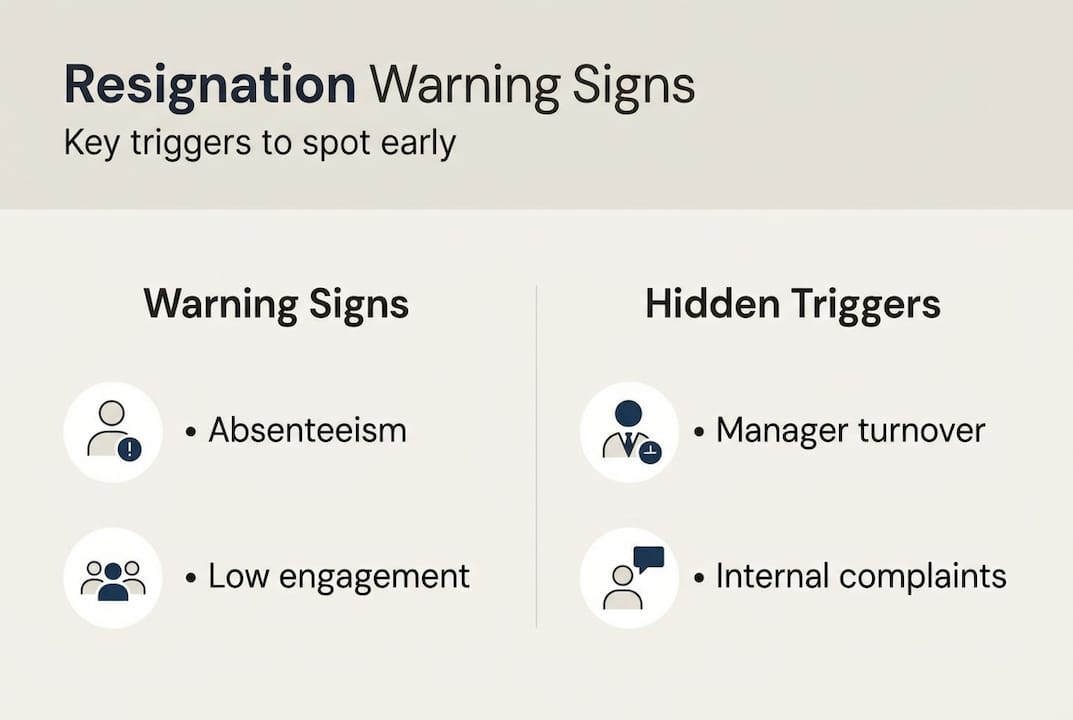
Surface-level data is a rearview mirror. You need to be looking through the windshield.
Deskless and service-sector workers are especially vulnerable here. Deskless workers experience 1.6 times higher turnover than their office-based counterparts, and the triggers are often invisible in standard HR dashboards.
Here are four early warning data patterns that tend to appear before a resignation wave:
- Rising absenteeism. When people start calling in more frequently, it’s rarely about the flu. It’s often a sign of disengagement, dread, or a job search already underway.
- Increased internal complaints. A spike in HR tickets, manager escalations, or anonymous feedback submissions is a flare going up. Treat it like one.
- Sudden productivity drops. Not gradual decline, but a noticeable shift in output from previously reliable performers. This is often the moment someone has mentally checked out.
- Changes in engagement scores. If your pulse survey scores drop even modestly across a team, that’s not statistical noise. That’s a pattern worth investigating immediately.
| Warning signal | What it often means | How quickly to act |
|---|---|---|
| Rising absenteeism | Active disengagement or job searching | Within 2 weeks |
| Spike in internal complaints | Team friction or leadership breakdown | Immediately |
| Productivity drop in top performers | Mental checkout or burnout threshold | Within 1 week |
| Declining engagement scores | Systemic morale issue | Within 2 weeks |
The service worker churn data tells a consistent story: companies that wait for the exit interview have already lost. Forecasting resignations requires getting upstream of those lagging indicators.
Why one-size-fits-all retention fails: The system vs. policy gap
Spotting the triggers, we next need to ask: why do classic retention policies keep failing? Because most of them were designed to look good on paper, not to solve the actual problem in front of you.

Here’s a direct comparison:
| Generic retention policy | System-driven retention strategy |
|---|---|
| Annual engagement survey | Continuous, real-time feedback loops |
| Company-wide pay review | Role-specific compensation analysis |
| Blanket wellness program | Targeted support based on team-level data |
| Manager training workshops | Predictive alerts for at-risk managers |
| Standard onboarding process | Fit-based onboarding tailored to team dynamics |
The benefits of moving to a system-based approach are real and measurable:
- Adaptability. Systems respond to what’s actually happening, not what happened last year.
- Predictive insight. You can see risk building before it becomes a resignation.
- Targeted support. Resources go where they’re needed, not where they’re easiest to deploy.
Research analyzing site-specific scheduling fixes across 280 million shifts found that tailored, data-informed scheduling changes reduced turnover far more effectively than broad policy adjustments. The lesson is clear: structural problems need structural solutions.
Human-centric approaches, explored in depth through human-centric AI in retention research, show that blending analytics with genuine people focus outperforms tech-only solutions every time. Exploring system-driven retention approaches is where this shift starts.
Catching resignations before they happen: Actionable retention tactics
With system-driven solutions shown to outperform blanket policies, let’s focus on what you can do to actually get ahead of unwanted resignations. Here’s a practical leadership checklist:
- Build real-time feedback loops. Don’t rely on annual surveys. Create channels where employees can flag concerns frequently and anonymously. The cadence matters as much as the content.
- Adopt human-centric analytics. Human-centric AI solutions consistently outperform tech-only approaches because they account for the messy, human side of work. Use tools that translate data into people-centered action.
- Foster transparent career paths. Ambiguity about growth is one of the quietest resignation triggers. When people can’t see a future, they start building one somewhere else.
- Tackle workload imbalances proactively. Don’t wait for a burnout crisis. Review workload distribution regularly, especially after headcount reductions or leadership transitions.
- Watch your middle managers closely. Middle manager turnover is a leading indicator of broader team instability. Support them before they become a retention problem themselves.
Pro Tip: Pulse checks work best when they’re short, frequent, and genuinely anonymous. Three questions every two weeks beats a 40-question survey once a year. Employees are more honest when they trust the format.
“56% of C-suite executives plan to leave their organizations within two years, citing workload and stress as primary drivers. Retention isn’t just a frontline challenge. It starts at the top.”
You can also get a sharper sense of how this plays out in real teams by watching this short video:
Who on your team will quit?. It reframes how you think about the people already sitting across from you.
Using data-driven retention tools to operationalize this checklist is what separates companies that react to resignations from those that rarely see them coming.
What most leaders ignore about resignations
Here’s the uncomfortable truth I keep coming back to: most organizations treat resignations as HR failures. Someone didn’t get paid enough. A manager was difficult. The benefits weren’t competitive. Fix those things, the thinking goes, and the problem goes away.
But that framing is too narrow, and it lets the real culprit off the hook.
Resignations are usually structural signals dressed up as individual decisions. When people leave, they’re often responding to something systemic: a culture that doesn’t reward candor, a hierarchy that buries feedback, an operational pace that leaves no room to breathe. Blaming pay or a single manager is like treating a fever without asking what’s causing it.
The leaders I respect most treat every resignation, especially the ones that sting, as a data point. Not just “how many” but “why now, why this person, why this team.” That shift from reactive blame to strategic curiosity is where real change begins. It’s not comfortable. But it’s honest. And honest is the only place worth starting from.
See resignations before they cost you: Next steps with OpenElevator
Having reframed how you approach resignations, here’s how you can take action today.
Most retention tools tell you what already happened. OpenElevator shows you what’s building right now, before it becomes a departure you didn’t see coming.

As an employee retention platform, OpenElevator gives leaders clear, quantifiable insight into retention risk, team dynamics, and hiring fit. You get early warning signals, targeted recommendations, and predictive data on how new candidates will fit within your existing teams. It doesn’t replace your HR systems. It gives them the visibility layer they’ve always been missing. If you’re tired of finding out too late, this is where you start.
Frequently asked questions
What are the top early warning signs of employee resignation?
Key indicators include rising absenteeism, sudden drops in engagement, increased internal complaints, and managers showing signs of burnout. Absenteeism and burnout are consistently linked to higher turnover across industries.
Why do generic retention policies typically fail?
Generic policies overlook local context and the unique triggers affecting specific teams or roles. Tailored retention systems address root causes far more effectively than broad, one-size-fits-all approaches.
How much does employee turnover really cost companies?
Replacing an employee typically costs between 50 and 200% of their annual salary. Turnover and poor management cost U.S. businesses over $500 billion annually.
What’s the role of data analytics in reducing unexpected resignations?
Data analytics can surface high-risk teams, flag early warning patterns, and enable proactive retention actions weeks before a resignation lands. Site-specific analytics have been shown to reduce turnover more effectively than policy-level changes alone.