
Team breakdown rarely starts with open conflict.
It usually starts quietly. Communication becomes thinner. People stop raising concerns. Collaboration feels harder. Meetings become more guarded. Strong employees become less engaged, but performance may not drop immediately.
That is why team breakdown is easy to miss.
By the time leaders see obvious dysfunction, the real damage may already be underway. Hidden disengagement, manager-employee friction, values misalignment, and team tension may have been building for months.
For CEOs, founders, senior leaders, and managers, team breakdown is not just a morale problem. It is a leadership visibility problem.
This article explains the early signals of team breakdown, how to separate normal pressure from deeper instability, and how leaders can act before hidden friction turns into costly resignations.
Table of Contents
Key Takeaways
| Point | Details |
|---|---|
| Team breakdown starts quietly | The first signs are often reduced candor, weaker collaboration, guarded communication, and lower initiative. |
| Performance may hide the problem | A team can still deliver while trust, alignment, and motivation are weakening. |
| Friction creates retention risk | Unresolved team tension can push strong employees toward disengagement or resignation. |
| Leaders need earlier visibility | Waiting for conflict, missed deadlines, or turnover means leaders are already late. |
| Action must match the signal | Team breakdown requires targeted intervention, not generic engagement activities. |
Understanding Team Breakdown and Its Early Signals
Team breakdown is the gradual weakening of trust, communication, collaboration, and shared commitment.
It does not always look like conflict. In many cases, the team still appears functional. Work still gets done. Meetings still happen. Employees remain polite.
But beneath the surface, alignment may be weakening.
Early signs of team breakdown include:
-
Less open communication
-
Fewer questions or constructive challenges
-
More guarded conversations
-
Slower information sharing
-
Increased misunderstandings
-
Reduced collaboration across roles or departments
-
More frustration with decisions
-
Lower ownership of shared outcomes
-
Strong employees becoming quieter
-
More “that is not my job” behavior
The danger is that leaders may not see team breakdown until it affects output. By then, hidden disengagement and team friction may already be creating retention risk.
| Early Signal | What It May Mean |
|---|---|
| Less candor in meetings | Employees may not trust that honesty is welcome |
| More siloed work | Collaboration is weakening |
| Repeated miscommunication | Expectations or ownership may be unclear |
| Lower initiative | Employees may be withdrawing effort |
| Quiet high performers | Strong employees may be disengaging |
| Increased frustration | Team friction may be building |
| Fewer ideas | People may no longer believe input matters |
Team breakdown usually does not arrive suddenly. It builds through small signals leaders often dismiss.
How to Tell Normal Pressure From Team Breakdown
Every team experiences pressure. Deadlines, growth, change, client demands, and workload spikes can create temporary stress.
That is not the same as team breakdown.
Healthy teams may feel pressure, but they recover. They communicate more clearly, solve problems directly, and stay connected to shared goals. Teams in breakdown become more guarded, fragmented, and less willing to address issues openly.
| Normal Team Pressure | Team Breakdown |
|---|---|
| Communication increases during stress | Communication becomes guarded or reduced |
| Conflict is addressed directly | Conflict is avoided or becomes personal |
| People pull together | People retreat into silos |
| Morale dips temporarily | Disengagement becomes persistent |
| Trust remains intact | Trust starts to erode |
| Recovery happens after pressure eases | Tension continues after the deadline passes |
Leaders should pay attention to duration and pattern.
A difficult week is not team breakdown. But repeated withdrawal, unresolved friction, lower candor, and declining trust over several weeks are warning signs.
The key question is not, “Is the team under pressure?”
The better question is, “Is the team still able to communicate, recover, and work through pressure together?”
 What Team Breakdown Reveals About Retention Risk
 What Team Breakdown Reveals About Retention Risk
Team breakdown matters because it often creates turnover risk before leaders recognize the problem.
Employees do not always leave because of one dramatic event. They may leave because day-to-day friction keeps draining trust, energy, and motivation.
Team breakdown can reveal:
-
Hidden disengagement
-
Weak manager-employee fit
-
Unclear ownership
-
Values misalignment
-
Low trust
-
Poor communication habits
-
Unresolved interpersonal friction
-
Workload imbalance
-
Weak connection to team goals
| Breakdown Pattern | Retention Risk |
|---|---|
| Employees stop speaking openly | Concerns go underground |
| High performers pull back | Top talent may be reassessing whether to stay |
| Collaboration weakens | Team stability declines |
| Managers avoid hard conversations | Friction continues unresolved |
| People protect their own work | Shared ownership disappears |
| Trust declines | Resignation risk increases |
The real risk is not only lower engagement. It is that leaders may not see team instability until people start leaving.
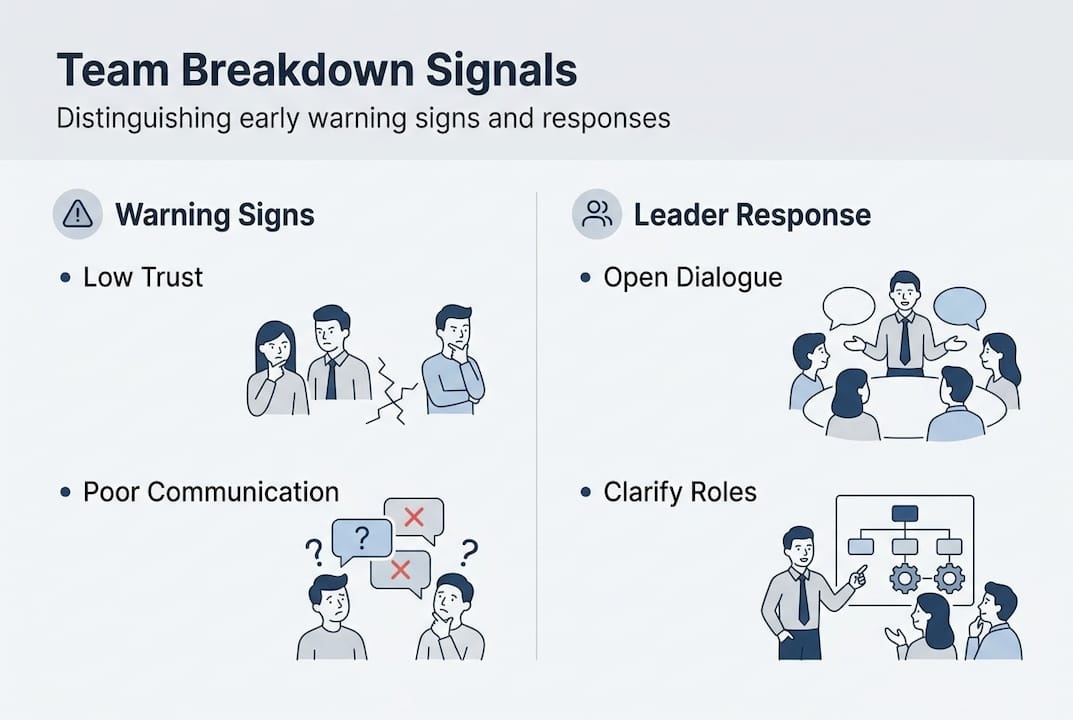
Practical Steps to Prevent and Reverse Team Breakdown
 Practical Steps to Prevent and Reverse Team Breakdown
Leaders cannot fix team breakdown with a generic engagement initiative.
They need to identify what is breaking and act directly.
Practical steps include:
-
Clarify roles, ownership, and decision rights
-
Address team friction directly instead of hoping it fades
-
Watch for changes in candor, initiative, and communication
-
Check whether managers are avoiding difficult conversations
-
Create regular spaces for honest discussion
-
Look for patterns across teams, not isolated complaints
-
Support high performers before they disengage
-
Measure team alignment and retention risk before turnover appears
Better leadership questions include:
| Leadership Question | What It Helps Reveal |
|---|---|
| Where has communication become guarded? | Low trust or hidden tension |
| Which teams are working in silos? | Weak team alignment |
| Who used to contribute more but now says less? | Possible hidden disengagement |
| Where are decisions creating repeated frustration? | Values or leadership misalignment |
| Which managers are seeing more withdrawal? | Manager-employee fit risk |
| Where is friction affecting execution? | Team breakdown before performance loss |
The goal is not to force harmony. The goal is to see where friction, misalignment, and disengagement are forming early enough to prevent damage.
See Team Breakdown Risk Before It Becomes Turnover
Team breakdown becomes expensive when leaders see it too late.
A team may still look functional while hidden disengagement, manager-employee friction, values misalignment, or collaboration problems are already weakening performance and retention.
OpenElevator helps CEOs, founders, senior leaders, and managers detect these risks earlier.
Through a simple five-minute, bias-free survey, OpenElevator gives leaders clearer visibility into retention risk, hidden disengagement, values alignment, manager-employee fit, and team friction.
That means leaders can stop waiting for missed deadlines, conflict, or resignations to reveal the problem and start seeing where team breakdown may already be forming.
Want to see where team breakdown risk may be hiding in your company? Start with OpenElevator’s free team scan.
Frequently Asked Questions
What are the early signs of team breakdown?
Early signs of team breakdown include reduced communication, less candor, fewer ideas, more siloed work, repeated misunderstandings, lower initiative, unresolved friction, and high performers becoming quieter.
How is team breakdown different from normal workplace stress?
Normal workplace stress is temporary and teams usually recover. Team breakdown is more persistent. Communication weakens, trust declines, collaboration suffers, and employees become less willing to address problems openly.
Why does team breakdown increase turnover risk?
Team breakdown increases turnover risk because employees may become frustrated, disengaged, or disconnected from the team. If friction continues unresolved, strong employees may start looking for a more stable environment.
What causes team breakdown?
Team breakdown can be caused by poor communication, unclear roles, weak manager-employee fit, values misalignment, unresolved conflict, workload imbalance, lack of trust, or hidden friction between team members.
How can leaders prevent team breakdown?
Leaders can prevent team breakdown by detecting early warning signs, clarifying ownership, addressing friction directly, improving manager conversations, measuring team alignment, and acting before disengagement becomes resignation.
How does OpenElevator help identify team breakdown?
OpenElevator helps leaders detect retention risk, hidden disengagement, values alignment, manager-employee fit, and team friction through a five-minute, bias-free survey. This gives leaders earlier visibility into team breakdown risk before it becomes turnover.