
Remote work can improve flexibility, focus, and employee satisfaction. It can also make retention risk harder to see.
When employees work remotely or in hybrid teams, disengagement does not always show up clearly. A person may attend video calls, respond to messages, and complete tasks while becoming less connected to their manager, team, or future inside the company.
For CEOs, founders, and senior leaders, remote work and retention are visibility issues. If leaders cannot see where engagement is weakening, where manager-employee friction is forming, or where team connection is breaking down, they may only discover the problem when someone resigns.
This article explains how remote work affects retention, the main remote and hybrid work models, the drivers of remote engagement, and how leaders can use data and alignment to detect retention risk earlier.
Table of Contents
Key Takeaways
| Point | Details |
|---|---|
| Remote work can hide retention risk | Employees may disengage quietly while still appearing productive online. |
| Connection matters more in distributed teams | Manager fit, team trust, communication, and values alignment affect whether remote employees stay. |
| Flexibility alone is not enough | Remote employees still need growth, recognition, clarity, and belonging. |
| Earlier visibility improves retention | Leaders need to detect disengagement, friction, and misalignment before remote employees leave. |
Remote Work and Employee Turnover Fundamentals
Remote work changes how retention risk appears.
In an office, leaders may notice changes in energy, body language, informal conversations, or team dynamics. In remote and hybrid teams, those signals are harder to see.
A remote employee may be disengaging while still attending meetings, answering messages, and completing assigned work. The risk can build quietly through weaker connection, unclear growth, manager friction, values misalignment, or isolation from the team.
Common remote retention risks include:
-
Lower connection to the team
-
Less informal communication
-
Weaker manager-employee trust
-
Reduced visibility into disengagement
-
Unclear growth paths
-
Lower recognition
-
Team friction that stays hidden
-
Burnout from blurred work-life boundaries
-
Reduced sense of belonging
In simple terms: remote work does not automatically cause turnover. But it can make early retention risk easier to miss.
Key Types of Remote and Hybrid Work Models
Different remote and hybrid work models create different retention risks.
The best model is not simply the one with the most flexibility. The best model is the one that supports performance, connection, manager effectiveness, and team alignment.
Common work models include:
| Work Model | What It Means | Retention Risk to Watch |
|---|---|---|
| Fully remote | Employees work remotely most or all of the time | Isolation, weak belonging, hidden disengagement |
| Hybrid fixed | Employees work set days remotely and set days in office | Coordination friction, uneven team experience |
| Hybrid flexible | Employees choose when to work remotely or in office | Inconsistent communication and visibility gaps |
| Remote-first | Company systems are designed around remote work | Requires strong communication and intentional culture |
| Office-first with remote options | Office remains the default, with some remote flexibility | Remote employees may feel less included |
The model matters less than the visibility leaders build around it.
Remote and hybrid teams need clear expectations, strong manager habits, and better signals for detecting disengagement before employees quietly disconnect.

Essential Drivers for Remote Employee Engagement
Remote employee engagement does not happen automatically.
Without daily in-person contact, leaders need to be more intentional about communication, recognition, trust, and alignment. Otherwise, employees may begin to feel disconnected before anyone notices.
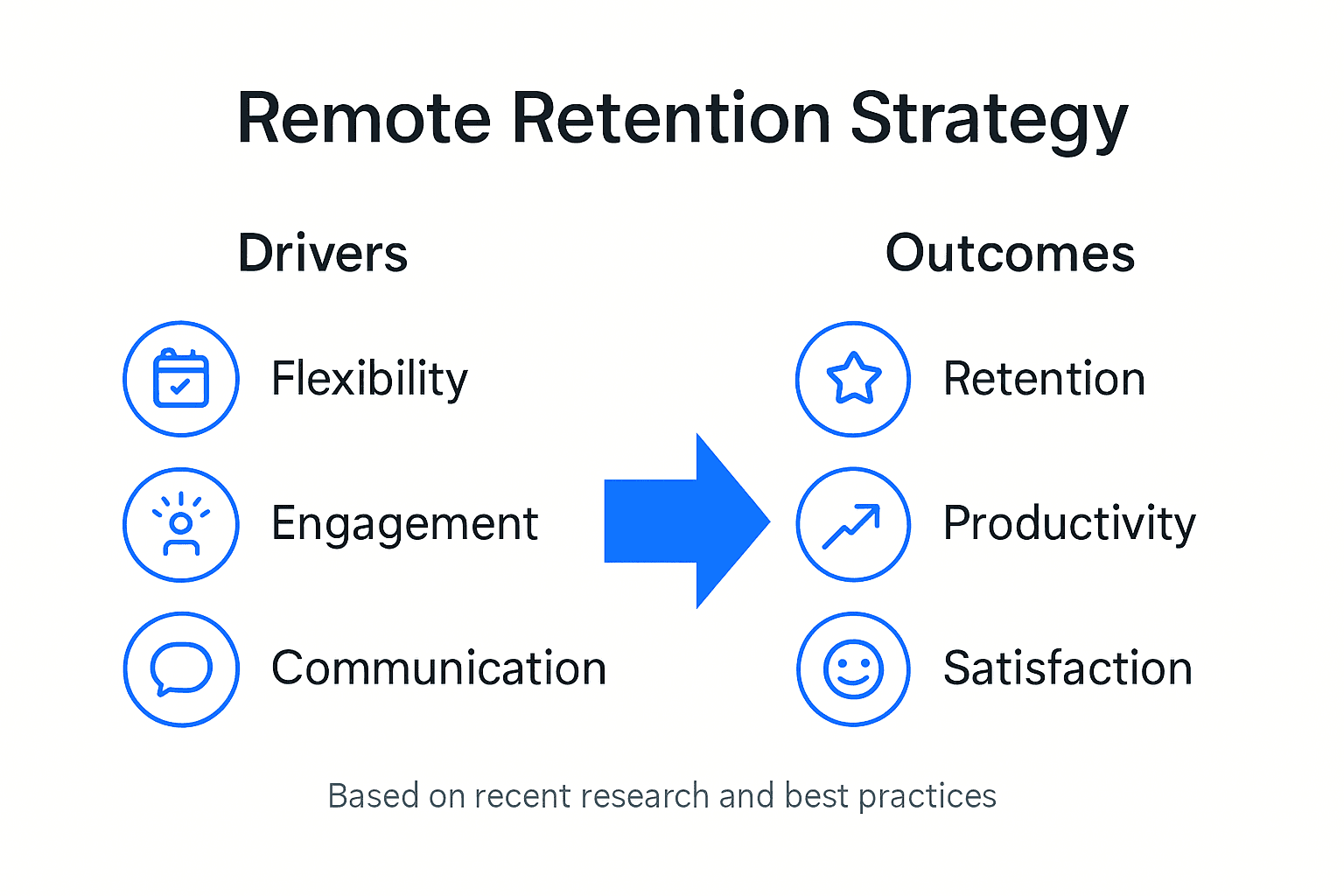
The strongest drivers of remote engagement include:
-
Clear communication
-
Strong manager-employee fit
-
Values alignment
-
Team trust
-
Recognition of contribution
-
Career growth clarity
-
Psychological safety
-
Reasonable workload boundaries
-
Regular feedback
-
Sense of belonging
-
Visibility into how work matters
Remote employees are more likely to stay when they feel connected to the company, supported by their manager, aligned with the team, and clear about their future.
Remote retention breaks down when employees feel invisible.
| Driver | What It Helps Prevent | Example Practice |
|---|---|---|
| Clear communication | Confusion and isolation | Regular team updates and explicit expectations |
| Manager-employee fit | Relationship friction | Structured check-ins and working style alignment |
| Recognition | Feeling invisible | Specific acknowledgment of contribution |
| Growth clarity | Silent job searching | Clear development conversations |
| Team connection | Remote isolation | Intentional collaboration and team rituals |
| Workload boundaries | Burnout | Clear norms around availability and response time |
Building Retention Through Data and Alignment
Remote retention improves when leaders can see where employees are engaged, aligned, and at risk.
In distributed teams, leaders cannot rely only on observation. They need clearer signals that show whether employees feel connected to the company, supported by their manager, and aligned with the team.
Useful remote retention signals include:
-
Engagement risk
-
Manager-employee fit
-
Values alignment
-
Team trust and communication
-
Growth confidence
-
Recognition and contribution
-
Workload pressure
-
Participation patterns
-
Collaboration quality
-
Sense of belonging
The goal is not more dashboards for the sake of reporting. The goal is earlier visibility into the conditions that make remote employees stay or leave.
When leaders can see where alignment is weakening, they can act before disengagement becomes turnover.
Common Pitfalls in Remote Retention Strategy
Remote retention strategies fail when leaders assume flexibility alone is enough.
Remote employees may value flexibility, but they still need connection, growth, trust, recognition, and alignment. If those pieces are missing, remote work can hide disengagement until it becomes a resignation.
Common remote retention mistakes include:
-
Assuming productivity means engagement
-
Relying only on annual engagement surveys
-
Missing weak manager-employee fit
-
Letting remote employees become invisible
-
Failing to create clear growth paths
-
Ignoring team friction because it is less visible online
-
Using too many meetings instead of better communication
-
Not recognizing remote contributions clearly
-
Allowing burnout through unclear availability expectations
-
Treating remote retention as a policy issue instead of a visibility issue
The better question is not, “Are remote employees getting their work done?”
The better question is, “Are remote employees still engaged, aligned, connected, and likely to stay?”
See Remote Retention Risk Before Employees Disconnect
Remote work can make disengagement harder to see.
Employees may still attend calls and complete tasks while manager friction, values misalignment, team isolation, or retention risk is already building underneath the surface.
OpenElevator helps CEOs, founders, senior leaders, and managers see remote retention risk earlier.
Through a simple five-minute, bias-free survey, OpenElevator gives leaders clearer visibility into values alignment, engagement risk, manager-employee fit, and hidden team friction.
Instead of guessing whether remote employees are engaged, leaders can see where risk may already be forming and act sooner.
Want to see where remote retention risk may be hiding? Start with OpenElevator’s free team scan.

Frequently Asked Questions
How does remote work affect employee retention?
Remote work can improve retention by offering flexibility, but it can also make disengagement harder to see. Employees may appear productive while becoming less connected to their manager, team, or company.
What causes remote employees to disengage?
Remote employees may disengage because of isolation, unclear communication, weak manager fit, lack of recognition, limited growth, values misalignment, burnout, or weak team connection.
What are the early signs of remote retention risk?
Early signs include reduced participation, shorter communication, lower initiative, less collaboration, slower responses, lower openness with the manager, and declining interest in growth opportunities.
How can leaders improve remote retention?
Leaders can improve remote retention by strengthening communication, recognizing contribution, clarifying growth paths, understanding manager-employee fit, measuring values alignment, and detecting hidden team friction earlier.
Why is remote retention harder to manage?
Remote retention is harder to manage because leaders have fewer informal signals. Disengagement, team friction, and manager-employee misalignment can build quietly behind normal online productivity.
How does OpenElevator help with remote retention?
OpenElevator helps leaders identify remote retention risk, values alignment, engagement risk, manager-employee fit, and hidden team friction through a five-minute, bias-free survey.