
Leadership affects retention long before an employee resigns.
Employees are more likely to stay when they trust their manager, feel recognized, see a future inside the company, and believe their work matters. They are more likely to leave when leadership misses disengagement, manager friction, values misalignment, blocked growth, or declining trust.
For CEOs, founders, and senior leaders, the role of leadership in retention is not only about inspiring people. It is about seeing where commitment may already be weakening.
The risk is that employees often look fine on the surface while quietly becoming less engaged, less connected, or less likely to stay.
This article explains the role of leadership in retention, the leadership behaviors that support commitment, the costs of ineffective leadership, and how data-informed leaders can detect retention risk earlier.
Table of Contents
Key Takeaways
| Point | Details |
|---|---|
| Leadership shapes retention | Employees are more likely to stay when leadership creates trust, clarity, recognition, and growth. |
| Manager fit matters | Weak manager-employee fit can create friction, disengagement, and turnover risk. |
| Poor leadership is expensive | Ineffective leadership can damage morale, productivity, trust, and team stability. |
| Earlier visibility improves retention | Leaders need to detect disengagement, misalignment, and team friction before employees leave. |
Defining Leadership’s Impact on Retention
Leadership affects whether employees feel connected, supported, trusted, and committed to staying.
Strong leadership helps employees understand where the company is going, how their work matters, and how they can grow. Weak leadership creates uncertainty, frustration, disengagement, and avoidable turnover risk.
Leadership influences retention through:
-
Manager-employee fit
-
Communication clarity
-
Trust and psychological safety
-
Recognition of contribution
-
Career growth support
-
Values alignment
-
Team culture
-
Workload expectations
-
Conflict resolution
-
Early visibility into disengagement
In simple terms: leadership does not only affect performance. It affects whether employees want to keep investing in the company.
The leadership risk is assuming employees are committed because they are still performing.
Essential Leadership Styles and Approaches
No single leadership style solves retention.
Employees stay when leadership creates the conditions for trust, alignment, contribution, and growth. That requires more than charisma or occasional encouragement.
The most useful leadership approaches for retention include:
| Leadership Approach | What It Creates | Retention Impact |
|---|---|---|
| Clear leadership | Employees understand expectations and priorities | Reduces confusion and frustration |
| Trust-building leadership | Employees feel safe raising concerns | Surfaces risk before resignation |
| Development-focused leadership | Employees see a future inside the company | Reduces silent job searching |
| Recognition-based leadership | Employees feel seen for their contribution | Strengthens motivation |
| Alignment-focused leadership | Employees connect with values and goals | Reduces hidden misalignment |
| Data-informed leadership | Leaders see risk patterns earlier | Supports targeted retention action |
Leadership style matters less than leadership consistency.
Employees do not stay because leaders say the right things once. They stay when leadership behavior repeatedly creates clarity, trust, and meaningful growth.
How Leaders Foster Employee Engagement
Leaders foster engagement by creating the conditions where employees feel connected, valued, and able to contribute.
Engagement is not created through slogans or one-time programs. It is shaped through daily leadership behavior, especially the relationship between employees and their direct manager.
Leaders strengthen engagement when they:
-
Communicate clearly
-
Recognize specific contribution
-
Support career growth
-
Create psychological safety
-
Follow through on concerns
-
Give useful feedback
-
Address team friction early
-
Clarify how work connects to company goals
-
Respect different working styles
-
Watch for signs of disengagement
Engagement weakens when employees feel unseen, unsupported, misaligned, or unsure about their future.
The better leadership question is not, “Are employees performing?”
The better question is, “Are employees still engaged, aligned, and likely to stay?”
Risks and Costs of Ineffective Leadership
Ineffective leadership creates retention risk before employees leave.
When leaders fail to communicate clearly, recognize contribution, address friction, or support growth, employees may begin to disengage quietly. They may still do the work, but their trust, motivation, and commitment may already be weakening.
Common costs of ineffective leadership include:
| Leadership Risk | How It Shows Up | Business Impact |
|---|---|---|
| Weak manager-employee fit | Low trust, friction, reduced openness | Higher disengagement and turnover risk |
| Poor communication | Confusion, duplicated work, frustration | Slower execution |
| Low recognition | Employees feel invisible | Lower motivation |
| Lack of growth support | Employees see no future | Silent job searching |
| Avoided conflict | Team tension continues | Lower collaboration |
| Poor workload awareness | Burnout builds unnoticed | Productivity and morale decline |
| Late intervention | Risk is seen after resignation | Higher replacement cost |
Poor leadership is expensive because the cost begins before turnover appears.

Data-Informed Retention Strategies for Leaders
Good leaders still need better visibility.
Instinct, experience, and regular conversations matter, but they do not always reveal hidden disengagement, weak manager fit, values misalignment, or team friction.
Data-informed leadership helps leaders see where retention risk may be forming before employees leave.
Useful retention signals include:
-
Engagement risk
-
Manager-employee fit
-
Values alignment
-
Team trust and communication
-
Growth confidence
-
Recognition and contribution
-
Workload pressure
-
Participation patterns
-
Collaboration quality
-
Early signs of disengagement
The goal is not to replace leadership judgment. The goal is to give leaders clearer evidence so they can act earlier and more precisely.
Retention improves when leaders stop guessing where commitment is weakening and start seeing the risk signals soon enough to intervene.
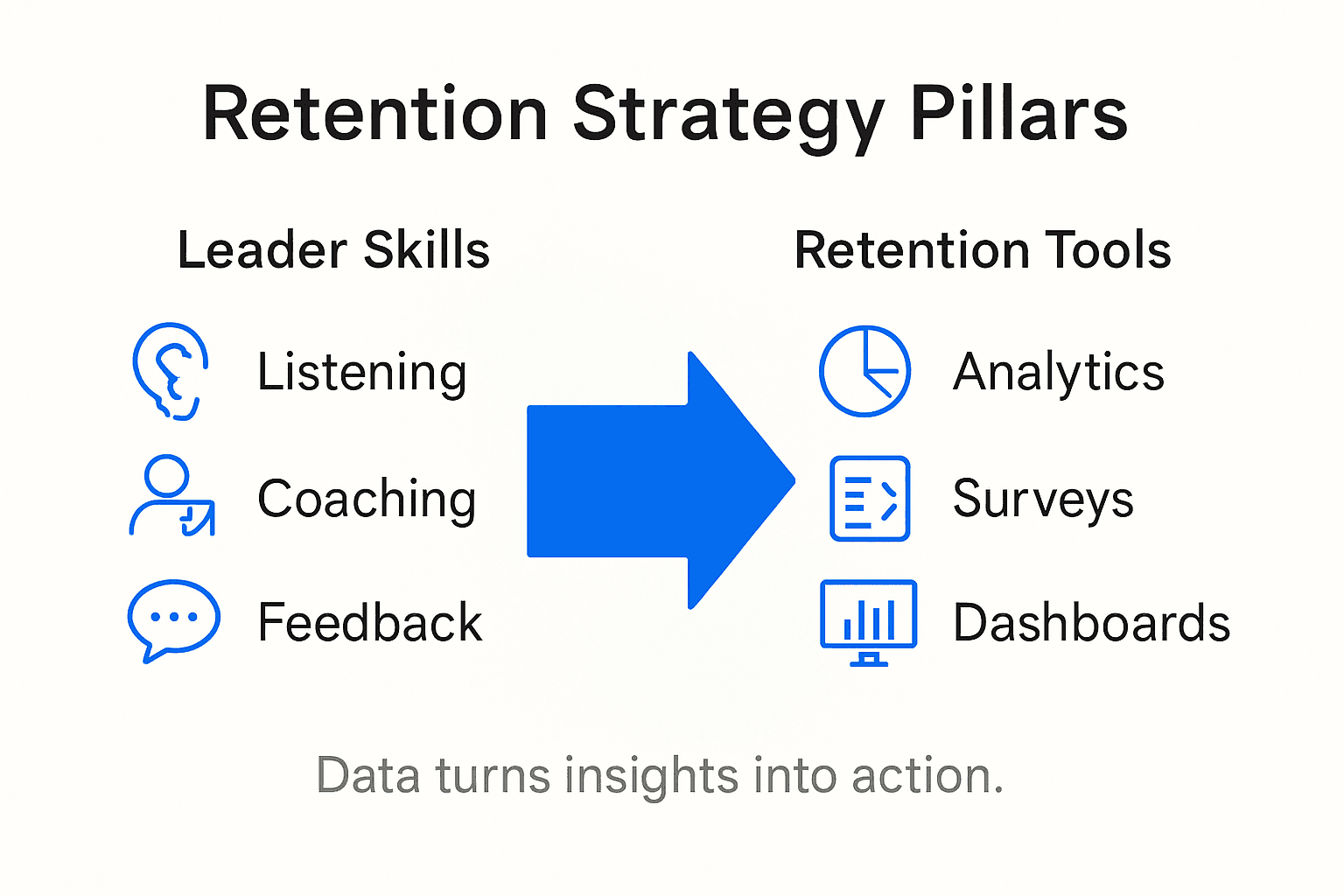
Lead Retention Before Employees Disconnect
Leadership has a direct impact on retention, but leaders cannot fix what they cannot see.
Employees may still be performing while disengagement, manager friction, values misalignment, team tension, or declining trust is already building underneath the surface.
OpenElevator helps CEOs, founders, senior leaders, and managers see retention risk earlier.
Through a simple five-minute, bias-free survey, OpenElevator gives leaders clearer visibility into values alignment, engagement risk, manager-employee fit, and hidden team friction.
Instead of waiting for turnover or relying only on instinct, leaders can see where commitment may already be weakening and act sooner.
Want to see where leadership-related retention risk may be forming? Start with OpenElevator’s free team scan.

Frequently Asked Questions
What is the role of leadership in retention?
The role of leadership in retention is to create trust, clarity, recognition, growth, and alignment so employees remain engaged and committed to staying.
How does leadership affect employee turnover?
Leadership affects turnover through manager-employee fit, communication, trust, recognition, growth support, workload management, and the ability to detect disengagement early.
What leadership behaviors improve retention?
Leadership behaviors that improve retention include clear communication, specific recognition, career development support, psychological safety, useful feedback, and early action on team friction.
Why does poor leadership increase retention risk?
Poor leadership increases retention risk because employees may feel unseen, unsupported, misaligned, overworked, or unable to grow. These issues can lead to disengagement and eventual turnover.
How can leaders detect retention risk earlier?
Leaders can detect retention risk earlier by tracking engagement risk, manager-employee fit, values alignment, team trust, growth confidence, workload pressure, and early signs of disengagement.
How does OpenElevator support leadership retention strategies?
OpenElevator helps leaders identify retention risk, values alignment, engagement risk, manager-employee fit, and hidden team friction through a five-minute, bias-free survey.