Replacing an employee can cost up to 33% of their salary, yet most leaders don’t see the departure coming until the resignation letter is already on the table. That’s the uncomfortable truth about turnover: it rarely feels urgent until it suddenly is. The warning signs were there, quietly stacking up over weeks and months, but they looked like normal fluctuations, a tired week, a distracted afternoon, a quieter-than-usual meeting. This guide is about learning to see what’s actually happening below the surface, not what you think is happening, and acting before the music stops.
Table of Contents
- Understanding hidden signals of disengagement
- Behavioral shifts to watch for
- Communication patterns hinting at disengagement
- Addressing and mitigating early warning signs
- Our views on proactive retention: What most leaders overlook
- How OpenElevator helps you prevent turnover
- Frequently asked questions
Key Takeaways
| Point | Details |
|---|---|
| Hidden signs matter | Disengagement signals can appear months before an employee exits, often unnoticed by leadership. |
| Behavioral changes are key | Sudden drops in collaboration or initiative are strong indicators of turnover risk. |
| Communication shifts signal trouble | Changes in responsiveness and reduced feedback highlight increasing disengagement. |
| Early action works | Proactive check-ins and open feedback reduce employee departure risk by up to 40 percent. |
| Systemic checks beat intuition | Routine engagement checks uncover risk more effectively than relying on instincts alone. |
Understanding hidden signals of disengagement
Here’s something most leadership teams don’t want to admit: by the time an employee hands in their notice, you’ve probably already missed a dozen chances to intervene. Disengagement doesn’t announce itself. It creeps in slowly, like water finding cracks in a wall, and by the time you notice the damage, the structural problem has been building for a while.
Employees begin showing reduced initiative, less participation in meetings, and subtle changes in body language up to six months before they actually leave. Six months. That’s a long runway of missed signals.
The tricky part is that these early signs don’t look like disengagement. They look like a person having a rough patch. And because most leaders are managing full plates of their own, they extend grace, assume it will pass, and move on. That instinct is human and understandable. It’s also how good people quietly slip out the door.
Some of the most commonly overlooked early indicators include:
- Reduced initiative: The employee stops volunteering for stretch assignments or new projects without being asked.
- Quieter in group settings: They contribute less in team meetings, even in areas where they used to lead the conversation.
- Subtle punctuality shifts: Arriving later, leaving earlier, or taking longer breaks in ways that feel minor but represent a pattern.
- Decreased follow-through: Tasks get done, but the extra mile disappears. Good enough becomes the new standard.
“The gap between what leaders think is happening and what is actually happening on their teams is often wider than anyone is comfortable admitting. Visibility isn’t a luxury. It’s the job.”
The reason leadership teams miss these cues isn’t negligence. It’s that most employee retention strategies are built around lagging indicators: exit interviews, engagement surveys sent once a year, turnover rates reviewed quarterly. By the time those numbers shift, the problem has already matured. What you need is the ability to read the room in real time.
Behavioral shifts to watch for
Once you know what subtle signals look like, you can better differentiate them from everyday fluctuations that every team member goes through. The key is pattern recognition, not overreaction to a single off day.
A sudden drop in collaboration and volunteering for projects is one of the clearest behavioral signals that an employee may be mentally preparing to leave. It’s not always dramatic. Sometimes it’s just a person who used to raise their hand first, now waiting to see if someone else will.

Here’s a practical comparison to help you tell the difference between normal fluctuations and genuine warning signs:
| Behavior | Normal fluctuation | Concerning pattern |
|---|---|---|
| Missing one meeting | Occasional, with explanation | Repeated, without follow-up |
| Quieter in a team discussion | Tied to a specific stressful week | Consistent across multiple weeks |
| Slower email responses | During a heavy project sprint | Ongoing and unexplained |
| Declining a project | Once, with a clear reason | Repeatedly, without engagement |
| Less social with colleagues | Short-term after a hard week | Sustained withdrawal over time |
The numbers in the left column are noise. The patterns in the right column are signal. The difference is duration and context.
To identify employee risk accurately, consider tracking these behavioral shifts over time:
- Frequency of voluntary contributions in meetings and project discussions.
- Quality and depth of work compared to their personal baseline, not the team average.
- Social engagement with peers, both in formal settings and informal ones.
- Response to feedback, whether they engage with it or seem indifferent.
Pro Tip: One incident means nothing. Three incidents in three weeks means something. Train yourself and your managers to look for clusters of behavior, not isolated moments.
Communication patterns hinting at disengagement
Beyond behaviors, altered communication styles are a major indicator that often go unnoticed, partly because communication changes feel personal and awkward to address directly.
Employees planning to leave often communicate less proactively, avoid giving feedback, and show declining openness over time. What this looks like in practice is subtle: shorter replies, less initiative in starting conversations, a kind of emotional flatness in their tone that wasn’t there before.
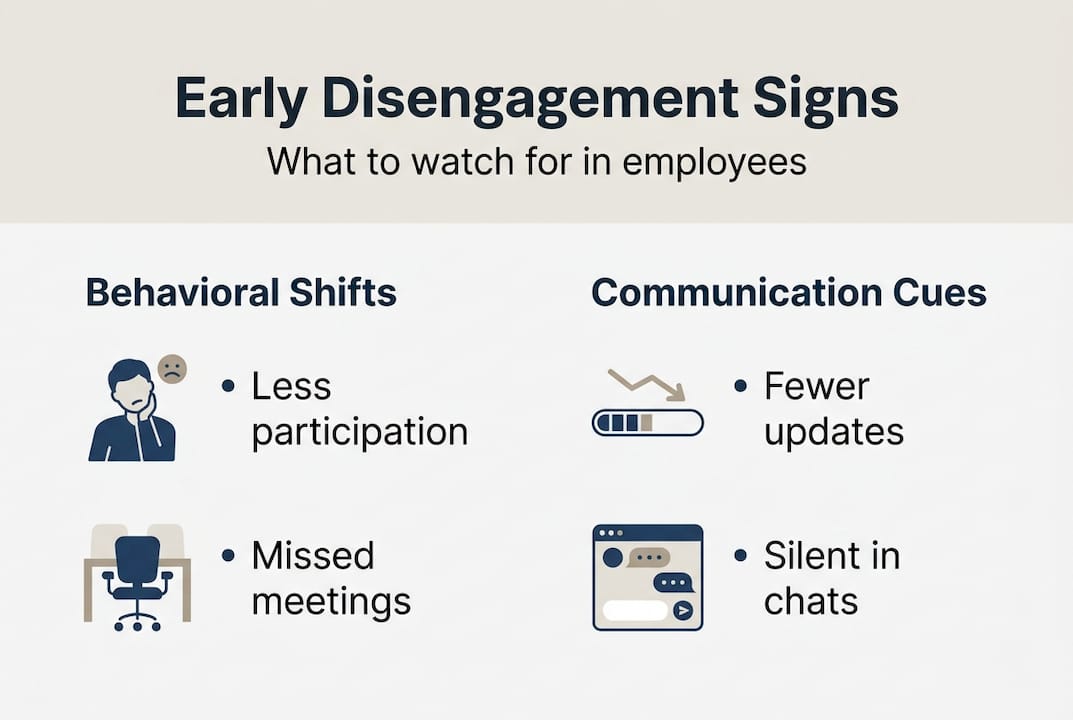
Think about the last time a strong team member stopped pushing back on ideas. That silence might have felt like agreement. It might have actually been withdrawal.
Here’s a simple framework for assessing communication-based retention communication frameworks risk across three dimensions:
| Dimension | Healthy signal | At-risk signal |
|---|---|---|
| Frequency | Regular updates, proactive check-ins | Delayed responses, minimal outreach |
| Tone | Engaged, curious, constructive | Flat, brief, non-committal |
| Initiative | Raises ideas, asks questions | Waits to be asked, avoids opinions |
Some specific communication red flags to watch for:
- Vague status updates that technically answer the question but offer no real insight.
- Avoidance of one-on-ones, or showing up to them with nothing to discuss.
- Stopped sharing ideas or opinions in channels where they used to be active.
- Shorter written responses over time, even when the topic warrants more depth.
- Absence from informal conversations, the kind that happen in Slack threads or before a meeting starts.
None of these alone is a fire alarm. Together, they paint a picture. The challenge for most leaders is that they’re reading each signal in isolation, when the real story only emerges when you look at them as a whole.
Addressing and mitigating early warning signs
Spotting signs is only half the battle. Acting quickly and thoughtfully turns insight into retention results. And here’s where a lot of well-meaning leaders get stuck: they see the signals, they feel the concern, and then they wait, hoping things will improve on their own.
They usually don’t.
Timely intervention with direct communication, check-ins, and clear pathways for growth can reduce the risk of departure by up to 40%. That’s not a small number. That’s nearly half of your at-risk employees, retained, simply because someone had the right conversation at the right time.
Here’s a practical sequence for responding when you notice early warning signs:
- Start with curiosity, not confrontation. Open the conversation with something like, “I’ve noticed you seem a bit less engaged lately, and I want to make sure I’m supporting you well.” That framing puts you on the same side.
- Ask about their experience, not their performance. Performance conversations can feel like evaluations. Experience conversations feel like care. You want the latter.
- Identify what’s changed. Sometimes disengagement is situational: a project that lost meaning, a team dynamic that shifted, a personal circumstance. You can’t fix what you don’t understand.
- Co-create a path forward. Whether that’s a new challenge, a clearer growth trajectory, or just more regular check-ins, the employee needs to feel like the conversation led somewhere real.
- Follow through visibly. If you said you’d revisit something in two weeks, revisit it in two weeks. Nothing signals genuine care like follow-through.
Pro Tip: Document these conversations, not to build a paper trail, but to track whether things are improving. If you have three check-ins and nothing shifts, that’s important information too. Use effective check-in methods that create a record of engagement over time, not just a one-off conversation.
Our views on proactive retention: What most leaders overlook
Here’s a perspective that might be uncomfortable: most leaders are actually pretty good at noticing when something is off. The problem isn’t awareness. It’s the gap between what they sense and what they can actually act on with confidence.
Surface behavior is a poor proxy for real engagement. An employee can look fine in meetings, hit their deadlines, and still be emotionally checked out in ways that won’t show up until they’re gone. That’s the insidious part. Disengagement doesn’t always look like disengagement. Sometimes it looks like quiet competence.
What we’ve seen consistently is that intuition-based retention, the “I think Sarah seems okay” kind, misses a significant portion of at-risk employees. Not because leaders are inattentive, but because human beings are good at masking, and leaders are often too close to their teams to see the full picture clearly.
Systematic engagement checks, the kind that measure actual patterns rather than impressions, surface risks that gut feel simply can’t catch. The leaders who retain their best people aren’t necessarily more empathetic or more experienced. They’re more informed. They have retention solution insights grounded in data, not just instinct, and that changes the quality of every decision they make.
The shift from reactive to proactive isn’t a personality trait. It’s a visibility problem. And visibility is solvable.
How OpenElevator helps you prevent turnover
If this article has shifted how you think about retention, even slightly, that’s the point. But insight without action is just interesting reading.
OpenElevator was built for exactly the gap this article describes: the space between what leaders sense and what they can actually see and act on. Our platform gives C-level executives and department heads in mid-sized U.S. companies a clear, quantifiable view of retention risk, team dynamics, and hiring fit, before problems become departures. No more relying on annual surveys or exit interviews that arrive too late. If you’re ready to move from reactive to informed, explore custom retention solutions that fit where your team actually is right now.
Frequently asked questions
What is the most common early sign of an employee planning to leave?
Decreased initiative and reduced engagement in meetings are typically the earliest indicators, often appearing up to six months before an employee actually resigns.
How soon before departure do employees start showing warning signs?
Behavioral and communication changes can surface up to six months before an employee leaves, which is why building a habit of early observation matters so much.
Can regular check-ins and feedback reduce turnover risk?
Yes. Proactive check-ins paired with direct communication can reduce departure risk by up to 40%, making consistent one-on-ones one of the highest-return investments a leader can make.
Are surface behaviors enough to predict disengagement?
Rarely. Surface behaviors often mask deeper disengagement, and systematic engagement checks consistently outperform intuition-based assessments when it comes to identifying at-risk employees early.