Most employees do not leave without warning.
The warning signs are usually there, but they are often quiet. A strong employee may stop offering ideas, pull back from team conversations, avoid future-focused discussions, or become less connected to their manager.
The work may still get done, which is why leaders miss the risk.
By the time someone resigns, the signs often make sense in hindsight. The employee had been disengaging for weeks or months, but no one had enough visibility to act earlier.
That is why early turnover signals matter.
Leaders do not need to wait for a resignation to understand that retention risk is forming. They need to know what to watch for, how to interpret the signals, and how to respond before avoidable turnover becomes expensive.
This guide explains the early turnover signals most companies miss, why they are often overlooked, and how leaders can use better visibility to protect retention.
Table of Contents
Key Takeaways
| Point | Details |
|---|---|
| Turnover risk starts early | Employees may begin disengaging long before they resign. |
| Performance can hide risk | A strong employee may keep delivering work while quietly pulling away. |
| Behavior matters | Lower participation, shorter communication, and reduced initiative can signal hidden risk. |
| Context is critical | The same signal can come from burnout, manager friction, lack of growth, or values misalignment. |
| Visibility improves retention | Leaders need to see hidden risk early enough to act before resignation. |
Why Early Turnover Signals Are Often Missed
Early turnover signals are often missed because leaders look for the wrong evidence.
They expect employees to speak up. They expect disengagement to be obvious. They expect performance to drop before risk becomes serious.
That is not always how turnover develops.
A strong employee may keep performing while becoming less committed. They may stay polite, attend meetings, answer messages, and avoid raising concerns while privately questioning whether they still see a future inside the company.
Leaders often miss early risk because they rely on lagging indicators such as:
-
Resignations
-
Exit interviews
-
Turnover rate
-
Annual engagement surveys
-
Performance reviews
-
Manager opinion alone
Those signals can help, but they often arrive too late.
Earlier signals are usually more subtle:
-
Lower participation
-
Less initiative
-
Shorter communication
-
Weaker connection to the manager
-
Less interest in growth
-
Reduced team involvement
-
More visible frustration
-
Avoidance of future-focused conversations
The mistake is assuming that silence means stability.
Sometimes silence means the employee is still deciding whether to stay.
Behavioral Changes That Can Signal Retention Risk
Early turnover signals often show up as small behavioral changes.
One change by itself may not mean much. Someone may be quiet because they are busy. They may miss a meeting because of a deadline. They may communicate less because they are focused.

The risk becomes more meaningful when several signals appear together or continue over time.
Common behavioral signals include:
| Signal | What It May Indicate |
|---|---|
| Lower participation in meetings | The employee may be less engaged or less invested |
| Reduced initiative | They may no longer feel ownership or motivation |
| Shorter communication | The relationship may be becoming more transactional |
| Less interest in growth | They may no longer see a future inside the company |
| Avoiding future-focused conversations | They may already be considering other options |
| Weaker manager connection | Manager-employee alignment may be declining |
| Pulling back from team interaction | Team connection or belonging may be weakening |
| More visible frustration | Workload, values alignment, or team friction may be creating risk |
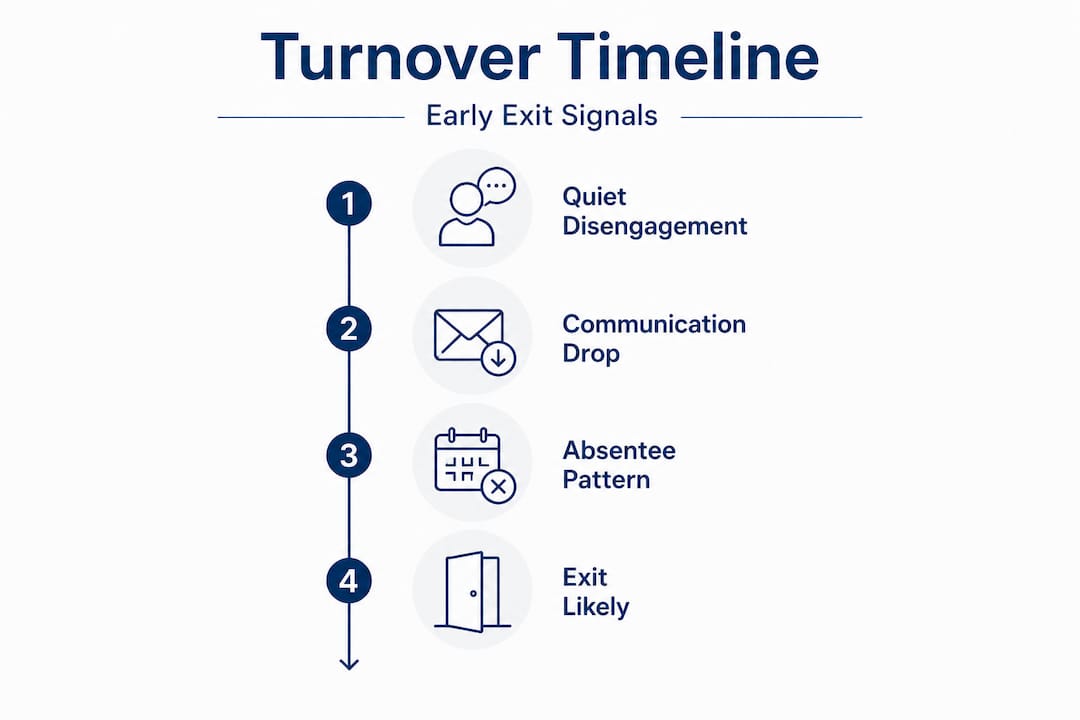
The key is pattern recognition.
A realistic scenario: a high performer is still completing work, but they no longer volunteer ideas, skip optional conversations, and stop talking about future goals. The manager assumes they are busy. In reality, the employee may already be disengaging.
Performance can stay acceptable while commitment is dropping.
That is why leaders need visibility into more than output.
Why Gut Instinct Is Not Enough
Gut instinct can be useful, but it is not enough.
Many leaders sense when something is off. They notice a shift in energy, communication, or team connection. But instinct alone does not always explain what is happening or what action to take.
A leader may sense risk, but not know whether the issue is:
-
Burnout
-
Manager friction
-
Team tension
-
Lack of growth
-
Values misalignment
-
Workload pressure
-
Poor role fit
-
Weak recognition
-
Loss of trust in leadership
This is where better visibility matters.
Leaders need a way to see patterns across employee experience, manager alignment, values alignment, interpersonal fit, and team dynamics. Without that visibility, they may either ignore the signal or act on the wrong assumption.
For example, if an employee is disengaging because of manager friction, a generic wellness benefit will not solve the problem. If the issue is lack of growth, a team lunch will not fix it. If the issue is values misalignment, a pay increase may only delay the resignation.
The goal is not to replace leadership judgment.
The goal is to sharpen it.
Better visibility helps leaders move from:
“I think something is off.”
To:
“I know where risk may be forming and what conversation needs to happen next.”
How to Turn Early Signals Into Retention Action
Spotting early turnover signals only matters if leaders act on them.
The action should match the cause.
Do not use the same retention response for every employee. Different risks require different interventions.
Use this framework:
Step 1: Identify the signal
Look for repeated changes in participation, initiative, communication, manager connection, team involvement, or growth interest.
Step 2: Look for the likely cause
Do not assume. Try to understand whether the issue is workload, growth, manager alignment, values fit, role clarity, team friction, or recognition.
Step 3: Ask better questions
Avoid vague questions like “How are things going?”
Ask:
-
What feels harder than it should right now?
-
Where do you feel blocked?
-
What part of your role feels most aligned?
-
What part feels least aligned?
-
What support would make your work more sustainable?
-
What would make staying and growing here more valuable?
Step 4: Match the action to the issue
| If the issue is… | Better action |
|---|---|
| Workload pressure | Clarify priorities or redistribute work |
| Lack of growth | Create a visible development path |
| Manager friction | Improve communication and alignment |
| Team tension | Address the source of friction directly |
| Values misalignment | Explore whether the role or environment can realistically change |
| Poor role fit | Revisit expectations, strengths, and responsibilities |
| Weak recognition | Recognize specific contribution and impact |
Step 5: Follow up
One conversation is not enough. Leaders need to check whether clarity, trust, alignment, and connection improved.
Retention improves when leaders act while the employee is still reachable, not after the resignation has already happened.
The Retention Edge: Seeing What Others Miss
The real retention edge is not another broad program.
It is seeing what other companies miss.
Most companies wait for obvious signals: resignation, performance drop, exit interview, or turnover trend. By then, the risk has usually been building for a while.
Stronger leaders pay attention earlier.
They look for the quiet signals:
-
A strong employee stops raising ideas
-
A team becomes less connected after a manager change
-
A new hire seems polite but uncertain
-
A high performer stops discussing growth
-
A manager relationship becomes more transactional
-
A team has tension that no one names directly
-
An employee appears stable but no longer seems invested
These signals are easy to explain away.
That is the danger.
A leader may say, “They are just busy.” A manager may say, “Everything is fine.” A team may keep producing while trust is weakening underneath.
Retention improves when leaders stop waiting for proof and start looking for patterns.
The goal is not to overreact to every small change.
The goal is to see enough, early enough, to ask better questions before turnover becomes the signal.
How OpenElevator Helps Leaders Detect Risk Earlier
OpenElevator helps leaders see early turnover signals before they become resignations.
A team can look stable while disengagement, manager-employee misalignment, values disconnect, or hidden friction is already forming beneath the surface. By the time someone leaves, the company is already reacting.
OpenElevator uses a short, bias-free team scan and a proprietary algorithm to reveal retention risk, values alignment, interpersonal alignment, and team dynamics.
That gives CEOs, founders, senior leaders, and managers clearer visibility into where action may be needed earlier.
OpenElevator helps leaders understand:
-
Where retention risk may be forming
-
Where manager-employee alignment may be weak
-
Where team friction may be affecting performance
-
Whether values alignment is strong or weak
-
Where hiring fit may affect future retention
-
Which teams may need support before turnover happens
The point is not to label employees.
The point is to help leaders see hidden risk early enough to act.
Start with a free team scan for up to 10 team members and see what may be hidden inside your own team.
Frequently Asked Questions
What are early turnover signals?
Early turnover signals are changes that may appear before an employee resigns, such as reduced participation, lower initiative, shorter communication, weaker manager connection, less interest in growth, or visible frustration.
Why do companies miss early turnover signals?
Companies miss early turnover signals because they often rely on lagging indicators such as resignation, turnover rate, exit interviews, or performance decline. By then, the risk may have been building for months.
Can employees be at risk of leaving while still performing well?
Yes. A strong employee can continue producing acceptable work while becoming less committed, less connected, or less likely to stay.
What should managers ask when they notice early turnover signals?
Managers should ask what feels harder than it should, where the employee feels blocked, what feels aligned or misaligned, what support would help, and what would make staying more valuable.
How can leaders reduce avoidable turnover?
Leaders can reduce avoidable turnover by seeing risk earlier, understanding the cause, improving manager alignment, addressing team friction, creating growth paths, and acting before resignation becomes likely.
How does OpenElevator help detect early turnover signals?
OpenElevator helps leaders detect retention risk, values alignment, interpersonal alignment, and hidden team friction before they become costly resignations.
Is there a free way to try OpenElevator?
Yes. OpenElevator offers a free team scan for up to 10 team members so leaders can see retention risk, alignment gaps, and hidden friction inside their own team.