
Most resignations do not arrive without warning.
Before someone leaves, something often shifts below the surface: sentiment weakens, values alignment drifts, manager-employee fit strains, collaboration becomes harder, or the employee no longer feels connected to the team.
The problem is that these signals can be easy to miss while work still gets done.
Engagement surveys, turnover data, and exit interviews are lagging indicators. They explain what already happened. OpenElevator’s lens is different: retention risk is often alignment risk that stayed invisible too long.
This guide explains how hidden misalignment shows up before employees leave, why traditional tools miss it, and how leaders can see what is changing early enough to act.
Table of Contents
-
Understanding hidden misalignment: What it is and why it matters
-
Early signals: How misalignment shows up before people leave
-
Why traditional surveys and performance reviews miss alignment drift
-
Who’s at risk: High performers, remote teams, and teams under pressure
-
Connect alignment strategies to actionable employee retention
Key Takeaways
| Point | Details |
|---|---|
| Misalignment often starts quietly | Employees may keep performing while sentiment, values alignment, or connection is already shifting. |
| Surface stability can hide risk | Quiet agreement, reduced contribution, or smooth output does not always mean long-term commitment. |
| Surveys arrive late | Engagement surveys, turnover data, and exit interviews are lagging indicators. |
| Fit matters | Manager-employee fit, interpersonal alignment, values alignment, and team friction shape retention risk. |
| Visibility changes timing | Leaders need to see alignment risk before surprise resignations disrupt performance. |
Understanding hidden misalignment: What it is and why it matters
Hidden misalignment is not the same as open conflict. When two executives argue in a board meeting, that’s visible. Fixable, even. Hidden misalignment is quieter. It’s the team that keeps nodding in meetings but never executes. The manager who says “sounds good” and then routes resources elsewhere. The high performer who stops raising concerns and starts updating their LinkedIn.
Open conflict has an obvious trigger. Hidden misalignment doesn’t. It builds underneath normal-looking behavior, which is exactly what makes it so dangerous.
The business cost is real and it compounds fast. Leadership alignment debt causes decisions to unravel, creates “agree to disagree” norms that go nowhere, and leaves employees spending hours per week on work that doesn’t connect to strategy. That alone can erode significant revenue. And when cultural misalignment takes hold, you start seeing slower approvals, talent hoarding between departments, and the kind of silos that outlast leadership changes.
Here’s what hidden misalignment actually looks like on the ground:
-
Silent disengagement: employees completing tasks but withdrawing from anything discretionary
-
Repeated communication complaints: the same friction showing up in every retrospective
-
Sudden consensus: teams that stop debating and start agreeing too quickly
-
Invisible silos: departments that coordinate on paper but don’t actually collaborate
The most dangerous dysfunction isn’t the argument in the boardroom. It’s the conversation that never happens.
Here’s a quick snapshot of how misalignment hits organizations across multiple dimensions:
| Impact area | Typical effect |
|---|---|
| Performance | Work slows because people are no longer moving in the same direction |
| Collaboration | Team friction increases and smooth collaboration becomes harder |
| Retention | Employees may begin looking elsewhere before leaders realize risk is forming |
| Decision speed | Decisions take longer because alignment is weaker |
| Engagement | Participation, contribution, and connection may quietly decline |
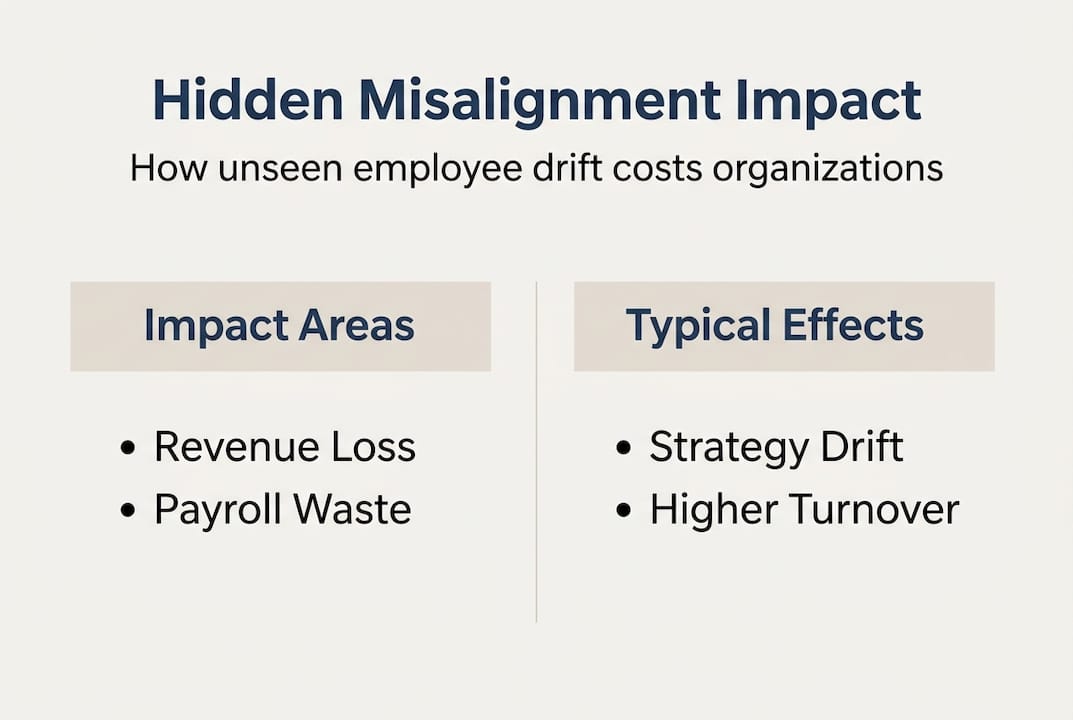
The issue is not that leaders do not care. The issue is that alignment risk can stay invisible until it has already started to affect collaboration, commitment, and retention.
Early signals: How misalignment shows up before people leave
So now that you understand the cost, here’s the question that keeps most leaders up at night: how do you actually spot it before someone walks out?
The reality is that the signals may be there. They’re just not easy to see. A quieter employee in meetings? Maybe they’re focused. Less pushback from a high performer? Maybe they’ve finally bought in. Sudden consensus in a room that used to debate everything? That feels like progress.
It rarely is.

Common early behavioral shifts include: declining participation in meetings, withdrawal from discretionary efforts like mentoring or cross-functional projects, reduced idea-sharing in team settings, and sudden agreement with little to no pushback. None of these feel alarming in isolation. Together, they’re a pattern.
Silent vs. vocal disengagement: Know the difference
| Signal type | Vocal disengagement | Silent disengagement |
|---|---|---|
| Communication | Complaints, challenges | Quiet compliance |
| Meeting behavior | Debates, friction | Minimal input |
| Feedback style | Pushes back openly | Agrees, then disengages |
| Visibility to leaders | High | Low |
| Risk level | Manageable | High, often missed |
Silent disengagement is the one that catches organizations off guard. It correlates with 40% higher turnover and often means up to 20% of payroll is being spent on work that’s running on autopilot.
Here’s how the signal sequence typically unfolds over a two to four week cluster:
-
Drop in meeting participation: fewer questions, shorter contributions
-
Reduced idea-sharing: stops volunteering solutions or improvements
-
Increased agreement: says yes without engaging, no follow-through questions
-
Communication pullback: fewer messages, shorter responses, less informal connection
-
Absence from discretionary work: skips optional meetings, mentoring, or collaboration
OpenElevator helps leaders move from gut feel to measurable clarity by showing where values alignment, manager-employee fit, interpersonal alignment, and team friction may already be creating retention risk.
The goal is not to read vague warning signs. The goal is to quantify alignment risk early enough to act before misalignment becomes resignation.
Why traditional surveys and performance reviews miss alignment drift
Here’s the frustrating truth. Most organizations already have some form of employee feedback mechanism. Annual engagement surveys, performance reviews, town halls, maybe a quarterly pulse check. And yet, misalignment still sneaks through. Why?
Because traditional tools are built to capture how people felt in the past, not how they’re drifting right now. An annual survey administered in April doesn’t tell you that your senior project manager started quietly disengaging in February. By the time results are compiled and shared, the window to act has long since closed.
The gaps in traditional methods are worth naming directly:
-
Timing: annual or semi-annual surveys miss gradual drift entirely
-
Honesty: employees self-censor in surveys they don’t trust are truly anonymous
-
Scope: most surveys measure satisfaction, not alignment across purpose, communication, and learning
-
Action lag: even when issues are identified, the average response cycle is months long
-
Signal blending: aggregate scores mask individual and team-level drift
The better approach is earlier alignment visibility. Leaders need to see where values alignment, manager-employee fit, interpersonal alignment, and team friction may already be shifting before resignation risk becomes visible.
Traditional tools were built to summarize employee sentiment. They were not built to quantify alignment risk before it becomes a surprise resignation.
Who’s at risk: High performers, remote teams, and teams under pressure
Not every employee shows misalignment in the same way.
High performers may keep delivering while quietly losing connection to the role, the team, or the organization. Because their output still looks strong, leaders may assume everything is fine.
Remote and hybrid employees can also become disconnected without obvious visible signals. There may be fewer informal conversations, fewer moments of spontaneous collaboration, and fewer chances for leaders to notice when sentiment is shifting.
Teams under pressure are another high-risk group. When priorities change quickly, workload increases, or expectations become unclear, small alignment gaps can become larger. Values alignment, interpersonal alignment, and manager-employee fit can weaken before the team shows obvious performance problems.
Groups to watch include:
-
High performers who stop sharing ideas or raising concerns
-
Remote or hybrid employees who become less connected to the team
-
Employees whose values no longer match what the role or organization delivers
-
Teams experiencing fast change, restructuring, or shifting priorities
-
New hires whose hiring or role fit may not match the real working environment
The goal is not to label anyone as a problem. The goal is to see where alignment risk may be forming so leaders can act before a surprise resignation disrupts performance.
Why most leaders miss hidden misalignment
Most leaders who miss hidden misalignment are not oblivious. They are working with incomplete visibility.
They may see performance, attendance, meeting participation, or engagement survey results. But those signals do not always show whether values alignment, manager-employee fit, interpersonal alignment, or team-level working alignment is weakening below the surface.
The reliance on lagging indicators makes the problem worse. Exit interviews, turnover data, engagement surveys, and performance reviews often explain what already happened.
By the time those tools reveal a problem, misalignment may already have disrupted collaboration, trust, commitment, or performance.
Leaders do not need more generic feedback loops. They need earlier visibility into where alignment risk is forming and what action to take before disengagement becomes resignation.
How OpenElevator helps leaders see alignment risk earlier
Hidden misalignment becomes expensive when leaders only see it after someone resigns.
OpenElevator quantifies alignment risk early so leaders can see what is happening below the surface: shifting sentiment, hidden disengagement, values alignment, manager-employee fit, interpersonal alignment, team friction, smooth collaboration, and hiring or role fit.
Engagement surveys, turnover data, and exit interviews are lagging indicators. OpenElevator gives leaders earlier visibility into where misalignment is creating friction and what action to take before disengagement disrupts performance.
Get your free OpenElevator team scan to experience the platform, gain real retention-risk visibility, and see what may be hidden below the surface — with zero cost and zero risk.
Frequently asked questions
What is hidden misalignment?
Hidden misalignment happens when an employee’s values, priorities, working style, manager relationship, or team fit no longer matches what they need to stay engaged and committed. It often forms below the surface before performance or turnover data makes the risk obvious.
How does hidden misalignment show up before someone resigns?
It may show up as reduced idea-sharing, quieter participation, less discretionary effort, shorter communication, weaker collaboration, or a shift from active contribution to quiet compliance. The employee may still be doing the job while commitment is already changing.
Why do leaders miss hidden misalignment?
Leaders often miss it because surface performance can look stable. Engagement surveys, turnover data, and exit interviews are lagging indicators, so they may explain the problem only after alignment risk has already formed.
Is hidden misalignment a manager problem?
Not usually. OpenElevator does not frame this as bad managers or bad employees. The issue is often manager-employee fit, values alignment, interpersonal alignment, or team-level working alignment. The same management style can work well for one employee and create friction for another.
How does OpenElevator help leaders spot hidden misalignment?
OpenElevator quantifies alignment risk early so leaders can see where sentiment, values alignment, manager-employee fit, interpersonal alignment, team friction, and hiring or role fit may be creating retention risk before surprise resignations disrupt performance.