
Turnover prediction is not about guessing who will quit.
It is about giving leaders earlier visibility into the conditions that often come before resignation, including disengagement, manager friction, values misalignment, team tension, blocked growth, and declining trust.
By the time an employee leaves, the organization may have already lost months of productivity, motivation, and team stability.
For CEOs, founders, and senior leaders, turnover prediction is a leadership visibility tool. It helps leaders see where retention risk may already be forming so they can act before the resignation happens.
This article explains what turnover prediction means, the types of turnover risk leaders should understand, which indicators matter, and how predictive insight can support stronger retention and team alignment.
Table of Contents
Key Takeaways
| Point | Details |
|---|---|
| Turnover prediction supports earlier visibility | It helps leaders detect retention risk before employees resign. |
| Risk signals are often hidden | Disengagement, weak manager fit, values misalignment, and team friction can build quietly. |
| Prediction needs the right indicators | Useful signals include engagement risk, manager-employee fit, values alignment, growth confidence, and team alignment. |
| Data supports better leadership action | Predictive insight helps leaders target retention conversations and interventions earlier. |
What Turnover Prediction Actually Means
Turnover prediction is the process of identifying which employees, teams, or roles may be at higher risk of departure before resignation happens.
The goal is not to label people or treat them like numbers. The goal is to help leaders see where retention risk may already be forming.
Turnover prediction looks at signals that may indicate rising risk, such as:
-
Engagement risk
-
Manager-employee fit
-
Values alignment
-
Team trust and communication
-
Career growth confidence
-
Recognition and contribution
-
Workload pressure
-
Participation patterns
-
Collaboration quality
-
Early signs of disengagement
In simple terms: turnover prediction helps leaders move from “we found out too late” to “we can see where risk may be forming now.”
Types of Employee Turnover Risks Identified
Not all turnover risk looks the same.
Some employees may leave because they do not see a future inside the company. Others may disengage because of manager friction, team tension, values misalignment, burnout, or lack of recognition.
Common types of turnover risk include:
| Turnover Risk Type | What It Means | What Leaders Should Watch |
|---|---|---|
| Voluntary turnover risk | Employee may choose to leave | Lower motivation, job searching, reduced commitment |
| Regrettable turnover risk | Strong employee may leave | Loss of critical skill, knowledge, or customer context |
| Avoidable turnover risk | Departure could likely be prevented | Missed warning signs or delayed intervention |
| Manager-related risk | Relationship with manager may be strained | Low trust, poor communication, reduced openness |
| Team-related risk | Team dynamics may be weakening | Friction, exclusion, lower collaboration |
| Values misalignment risk | Employee may not feel connected to how the company works | Quiet withdrawal or lower commitment |
| Growth-related risk | Employee does not see a future inside the company | Less ambition, silent job searching |
Turnover prediction is useful only when it helps leaders understand what kind of risk is forming and why.
How Predictive Models and Algorithms Work
Predictive models look for patterns that may signal retention risk.
They can combine different types of information, such as engagement responses, work patterns, manager-employee fit, values alignment, team dynamics, and previous turnover patterns.
A strong predictive approach can help leaders see:
-
Where disengagement may be forming
-
Which teams may have hidden friction
-
Where manager-employee fit may need attention
-
Whether values alignment is weakening
-
Whether growth confidence is low
-
Whether retention risk is isolated or part of a wider pattern
Predictive models should not be treated as final judgments about employees.
They should be used as early warning systems that help leaders ask better questions, have better conversations, and take targeted action sooner.

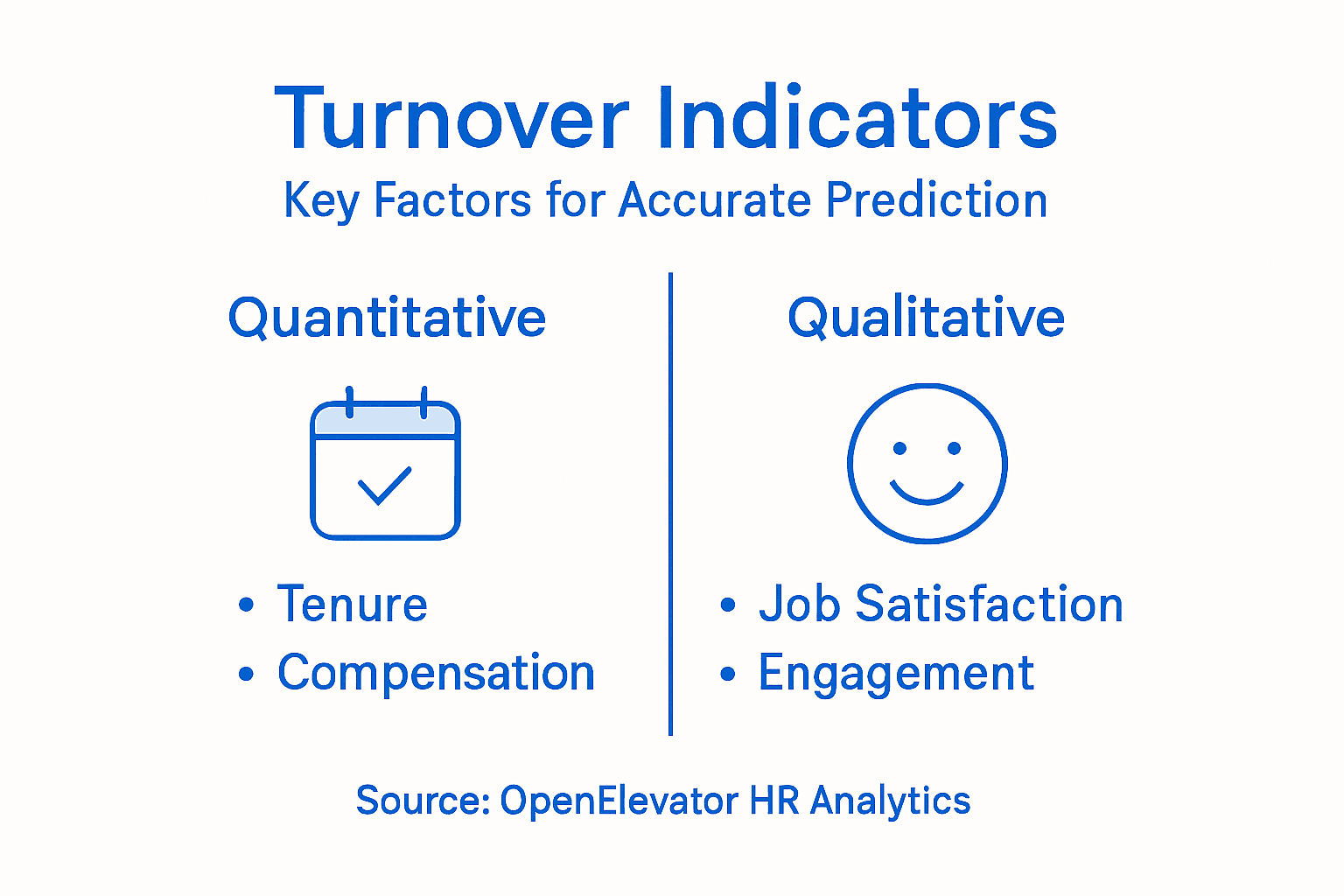
Key Data and Indicators for Accurate Forecasting
Turnover prediction is only as useful as the signals it measures.
If the data only tracks performance or attendance, leaders may still miss the deeper causes of turnover risk. A person can still be productive while quietly disengaging.
Useful turnover prediction indicators include:
| Indicator | What It Helps Leaders See |
|---|---|
| Engagement risk | Whether employees may be emotionally disconnecting |
| Manager-employee fit | Whether relationship friction may be creating risk |
| Values alignment | Whether employees feel connected to how the company works |
| Team alignment | Whether collaboration and trust may be weakening |
| Growth confidence | Whether employees see a future inside the company |
| Recognition | Whether employees feel seen and valued |
| Workload pressure | Whether burnout may be affecting motivation |
| Participation patterns | Whether employees are withdrawing from contribution |
| Collaboration quality | Whether team connection is weakening |
The strongest turnover prediction does not only ask, “Who might leave?”
It asks, “What conditions may be causing retention risk to rise?”
Practical Impact on Retention and Team Alignment
Turnover prediction matters only if it leads to better action.
When leaders can see retention risk earlier, they can act before employees mentally check out or resign.
Predictive insight can help leaders:
-
Prioritize stay conversations
-
Support managers where relationship friction exists
-
Address hidden team tension
-
Clarify growth paths
-
Recognize employees who may feel unseen
-
Identify values misalignment
-
Reduce avoidable turnover
-
Protect team stability
-
Make stronger hiring and retention decisions
For leadership teams, the value is not more reporting. The value is knowing where to focus before the cost of turnover appears.
Common Pitfalls and Improving Prediction Accuracy
Turnover prediction fails when leaders treat the model as the answer instead of a signal.
Data can show patterns, but leaders still need to interpret those patterns responsibly and act with context.
Common pitfalls include:
| Pitfall | What Goes Wrong | Better Practice |
|---|---|---|
| Over-relying on scores | Employees are reduced to risk labels | Use scores to guide conversations |
| Measuring the wrong data | Performance is tracked, but motivation is missed | Include engagement, alignment, and fit signals |
| Acting too late | Leaders wait until risk is obvious | Intervene when early patterns appear |
| Ignoring manager context | Relationship friction is overlooked | Measure manager-employee fit |
| No follow-up process | Data is collected but not used | Build clear action steps after insights |
| Treating everyone the same | Generic retention efforts miss the real issue | Match intervention to risk driver |
Prediction accuracy improves when leaders use the right signals, review patterns regularly, and connect insight to action.
Predict Turnover Risk Before Employees Leave
Turnover prediction only matters if it helps leaders act earlier.
Employees may still be performing while disengagement, manager friction, values misalignment, team tension, or declining trust is already weakening their commitment.
OpenElevator helps CEOs, founders, senior leaders, and managers see retention risk earlier.
Through a simple five-minute, bias-free survey, OpenElevator gives leaders clearer visibility into values alignment, engagement risk, manager-employee fit, and hidden team friction.
Instead of waiting for exit interviews or lagging turnover reports, leaders can see where risk may already be forming and act sooner.
Want to see turnover risk before employees leave? Start with OpenElevator’s free team scan.

Frequently Asked Questions
What is turnover prediction?
Turnover prediction is the process of identifying employees, teams, or roles that may be at higher risk of departure before resignation happens.
What signals are used in turnover prediction?
Useful turnover prediction signals include engagement risk, manager-employee fit, values alignment, team alignment, growth confidence, recognition, workload pressure, and early signs of disengagement.
Why is turnover prediction useful for leaders?
Turnover prediction helps leaders detect retention risk earlier so they can act before employees disengage further or resign.
Can turnover prediction prevent every resignation?
No. Turnover prediction cannot prevent every resignation, but it can help leaders reduce avoidable turnover by identifying risk signals earlier.
What mistakes should leaders avoid with turnover prediction?
Leaders should avoid reducing employees to scores, measuring only performance, ignoring manager fit, acting too late, or collecting data without a clear follow-up process.
How does OpenElevator support turnover prediction?
OpenElevator helps leaders identify retention risk, values alignment, engagement risk, manager-employee fit, and hidden team friction through a five-minute, bias-free survey.