
Nearly half of american businesses cite employee turnover as a top challenge affecting growth and stability. When workers leave, companies lose critical knowledge, momentum, and resources. Misunderstandings about what drives turnover can waste time and create missed opportunities. Separating myth from fact is key for leaders who want to maintain strong teams and adapt to changing workplace needs. This guide shines a light on what employee turnover really means, why it matters, and how understanding the real story can strengthen your organization.
Table of Contents
- Employee Turnover Defined And Common Myths
- Major Types Of Employee Turnover Explained
- Key Drivers Behind Each Turnover Type
- Impact Of Turnover Types On Your Organization
- Minimizing Turnover Risks And Mitigation Strategies
Key Takeaways
| Point | Details |
|---|---|
| Understanding Turnover Types | Employee turnover is categorized into voluntary, involuntary, functional, dysfunctional, avoidable, and unavoidable types, each with unique implications for organizational health. |
| Impact on Culture and Performance | Different turnover types impact organizational culture, financial stability, and team dynamics, necessitating a strategic approach to management. |
| Drivers of Turnover | Key factors influencing turnover include job satisfaction, career development, and workplace relationships, highlighting the importance of a supportive environment. |
| Proactive Retention Strategies | Organizations should implement strategies like fair compensation, professional development, and work-life balance to minimize turnover risks and enhance retention. |
Employee Turnover Defined and Common Myths
Employee turnover represents the organizational heartbeat – tracking how professionals move through and away from companies. According to CIPD, turnover is technically defined as the rate at which employees leave an organization and are subsequently replaced. But it’s far more than just a mathematical calculation.
Turnover isn’t a monolithic concept. It encompasses voluntary departures, involuntary terminations, and strategic workforce transitions. Research from PubMed reveals that understanding turnover has evolved dramatically over a century, shifting from simplistic reduction strategies to nuanced theoretical frameworks that examine complex human dynamics.
Let’s bust some common myths:
- Myth 1: High Turnover Always Means Bad Management
Reality: Sometimes turnover reflects healthy organizational evolution. Some departures signal positive workforce development, not dysfunction. - Myth 2: Money is the Only Retention Factor
Reality: Compensation matters, but workplace culture, growth opportunities, and meaningful work often trump salary alone. - Myth 3: All Turnover is Negative
Reality: Strategic turnover can refresh talent pools, introduce new perspectives, and prevent organizational stagnation.
Understanding these nuances transforms turnover from a scary statistic into a strategic workforce management tool. Smart leaders view employee movement as a dynamic process – not a problem to be feared, but an opportunity to continuously optimize talent strategies.
Major Types of Employee Turnover Explained
Employee turnover is a complex landscape with multiple dimensions, far beyond a simple departure from an organization. According to QIC-WD, organizations can categorize turnover through several critical lenses that reveal deeper insights into workforce dynamics.
Voluntary vs. Involuntary Turnover represents the foundational classification. Voluntary turnover occurs when employees choose to leave independently – perhaps for career growth, better opportunities, or personal reasons. Involuntary turnover, conversely, happens when the organization initiates the separation through layoffs, performance-related terminations, or restructuring.
Research from ABJournals further distinguishes turnover into additional nuanced categories:
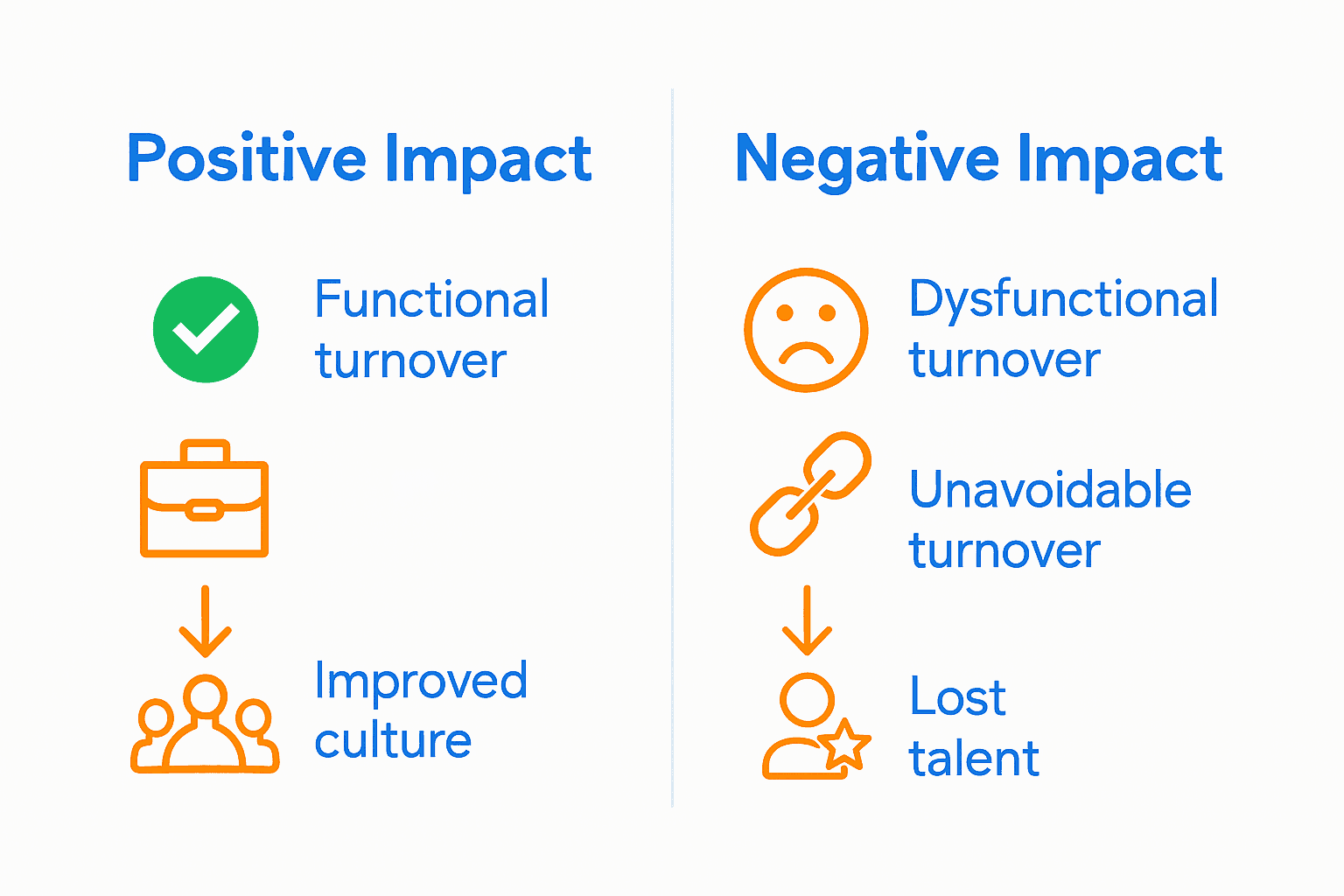
- Functional Turnover: Departures of low-performing employees that potentially benefit the organization
- Dysfunctional Turnover: Loss of high-performing, critical talent that damages organizational effectiveness
- Avoidable Turnover: Separations that could have been prevented through better management strategies
- Unavoidable Turnover: Natural workforce transitions due to retirement, relocation, or significant life changes
Understanding these turnover types transforms them from mere statistics into strategic insights. Each departure tells a story – not just about an individual employee, but about your organization’s health, culture, and potential areas of improvement.
 Smart leaders don’t just track turnover; they decode its underlying messages.
Key Drivers Behind Each Turnover Type
Understanding the intricate landscape of employee turnover requires deep insight into its underlying drivers. According to EJBMR, multiple interconnected factors influence why employees choose to stay or leave an organization.
Voluntary Turnover Drivers often stem from complex psychological and professional motivations. These typically include:
- Lack of career progression opportunities
- Insufficient compensation or recognition
- Poor workplace relationships
- Misalignment with organizational culture
- Limited professional development
Involuntary Turnover presents a different set of catalysts. Organizational restructuring, performance issues, economic constraints, and strategic shifts can trigger these separations. While sometimes necessary, these transitions can significantly impact team morale and operational continuity.
The research highlights critical emotional and professional factors that significantly influence turnover. Job stress, job satisfaction, and work environment emerge as pivotal determinants. Employees don’t just leave jobs – they leave experiences that no longer serve their professional or personal growth trajectories.
Smart organizations recognize that turnover isn’t just a human resources challenge. It’s a strategic opportunity to reassess workplace dynamics, culture, and employee engagement strategies. By understanding these nuanced drivers, leaders can transform potential departure points into moments of organizational learning and improvement.
Impact of Turnover Types on Your Organization
Employee turnover isn’t just a number on a spreadsheet – it’s a complex phenomenon with profound organizational implications. According to News WP Carey, a century of research demonstrates that different turnover types can dramatically reshape an organization’s performance, culture, and bottom line.
Financial Impact represents the most immediate consequence of workforce transitions. Each employee departure carries hidden costs beyond simple replacement expenses:
- Recruitment expenses
- Training investment for new hires
- Productivity gaps during transition periods
- Potential knowledge loss
- Disrupted team dynamics
Research from University of Nebraska reveals that organizational stability can be significantly challenged by collective turnover, especially when multiple key personnel exit simultaneously. Functional turnover might refresh talent pools, while dysfunctional turnover can create devastating ripple effects across departments.
Beyond immediate financial metrics, turnover profoundly impacts organizational culture. High-performing teams experience momentum disruption, institutional knowledge evaporates, and remaining employees may experience increased stress and uncertainty. The psychological impact can be as significant as the financial one – creating a cycle of disengagement that compounds existing challenges.
Strategic leaders understand that turnover is not a problem to be solved, but a dynamic to be managed. By treating each departure as an opportunity for reflection, learning, and potential improvement, organizations can transform what seems like a loss into a strategic reset for growth and innovation.
Minimizing Turnover Risks and Mitigation Strategies
Employees are not just resources – they’re the living, breathing engine of organizational success. According to Coursera, proactive strategies can dramatically reduce turnover risks and transform workplace dynamics.
Strategic Retention Approaches require a multi-dimensional perspective. Key mitigation strategies include:
- Compensation Alignment: Ensuring competitive and fair market-rate salaries
- Professional Development: Creating clear career progression pathways
- Cultural Investment: Building inclusive, supportive work environments
- Regular Feedback: Implementing continuous performance dialogue
- Work-Life Balance: Offering flexible working arrangements
Research from QIC-WD emphasizes that understanding turnover requires more than surface-level interventions. Organizations must develop targeted, data-driven approaches that address both individual and systemic factors contributing to employee departures.
Predictive Retention Tactics involve anticipating potential turnover before it occurs. This means developing robust talent management systems that can:
- Identify early warning signs of disengagement
- Proactively address potential retention risks
- Create personalized engagement strategies
- Develop meaningful professional development plans
- Build trust through transparent communication
Smart leaders recognize that retention is not about preventing all turnover, but about creating an environment where top talent chooses to stay, grow, and contribute meaningfully to organizational success.
Take Control of Employee Turnover with Data-Driven Solutions
Struggling to decode the complex causes of voluntary and involuntary turnover can drain your organization’s energy and resources. The article highlights key pain points like identifying high-risk employees and addressing avoidable turnover before it disrupts your team. Understanding these turnover types is just the first step. What if you could predict who might leave next and take action to retain your top talent effectively
OpenElevator offers a proprietary algorithm designed to solve these exact challenges by quickly identifying employees at risk of quitting. Our platform provides targeted retention strategies that align with your company’s unique culture and goals. Don’t let hidden turnover costs undermine your success. Discover how OpenElevator helps organizations worldwide—from startups to Fortune 500s—transform turnover from a challenge into a growth opportunity. Start preventing costly separations today with OpenElevator’s proven employee retention solutions and turn workforce insights into action.
Frequently Asked Questions
What are the main types of employee turnover?
The main types of employee turnover are voluntary turnover, involuntary turnover, functional turnover, dysfunctional turnover, avoidable turnover, and unavoidable turnover. Each type serves different organizational dynamics and brings unique implications.
How does employee turnover impact organizational culture?
Employee turnover can disrupt team dynamics, erode trust among remaining employees, and lead to increased stress and uncertainty, which may eventually affect overall employee engagement and morale.
What are some common drivers of voluntary turnover?
Common drivers of voluntary turnover include lack of career progression opportunities, insufficient compensation, poor workplace relationships, misalignment with organizational culture, and limited professional development opportunities.
What strategies can leaders implement to minimize turnover risks?
Leaders can minimize turnover risks by ensuring competitive compensation, providing clear career development paths, fostering an inclusive culture, implementing regular feedback mechanisms, and promoting work-life balance through flexible arrangements.