
Long-term employee retention is not driven by perks alone.
Employees stay when the work environment continues to meet what they value: safety, purpose, growth, connection, and a strong fit with the people they work with every day. When those needs stop being met, sentiment can begin shifting long before anyone resigns.
That is why many leaders are surprised by turnover. They may be tracking engagement surveys, turnover reports, or exit interviews, but those are lagging indicators. They explain what happened after retention risk has already formed.
This article breaks down what actually drives long-term employee retention, what wastes time and budget, and why leaders need earlier visibility into what is changing below the surface.
Table of Contents
Key Takeaways
| Key Point | What Leaders Should Know |
|---|---|
| Retention is personal | Employees do not all value the same things. Growth, purpose, stability, recognition, and connection matter differently to different people. |
| Perks do not reveal risk | Benefits and one-off perks may improve experience, but they do not show where retention risk is forming. |
| Manager-employee fit matters | People skills are not one-size-fits-all. The same leadership style can create trust with one employee and friction with another. |
| Lagging indicators arrive too late | Engagement surveys, turnover data, and exit interviews often explain problems after risk has already formed. |
| Visibility changes retention | Leaders need to see shifting sentiment, hidden disengagement, values misalignment, and team friction before surprise resignations disrupt performance. |
What actually keeps employees for the long haul
Career growth now outranks trust in leadership as the primary reason employees choose to stay with a company long term. Not pay. Not perks. Not even their relationship with their manager, though that matters too. Growth.
This is worth sitting with for a moment, because most retention conversations in SMBs still center on compensation benchmarking and benefits packages. Those things matter at the hiring stage. But once someone is in the door and settled, what keeps them engaged is whether they can see a future for themselves inside your organization.
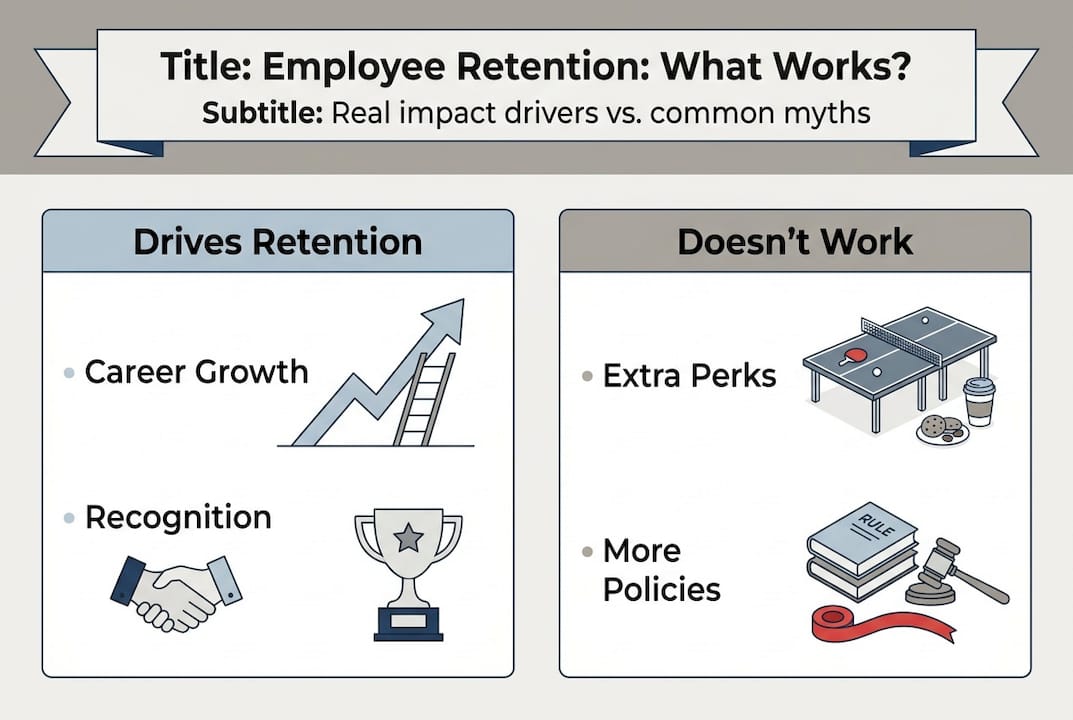
Here is a quick look at how the most common retention drivers actually stack up:
| Retention driver | Impact level | Cost to implement |
|---|---|---|
| Career growth opportunities | Very high | Low to medium |
| Meaningful, purposeful work | Very high | Low |
| Flexible work arrangements | High | Low |
| Frequent, personalized recognition | High | Very low |
| Compensation and benefits | Medium | High |
| One-off perks (ping-pong, snacks) | Low | Medium |
The pattern is clear. The highest-impact drivers are also the most affordable. What they require is not budget. They require attention, consistency, and a willingness to have real conversations.
Recognition is a good example. Regular check-ins and timely, personalized recognition are among the most cost-effective retention tools available to any leader. Yet most organizations still rely on annual performance reviews and end-of-year awards that feel about as personal as a form letter.

The employees who stay long term share a few common traits. They feel seen. They feel challenged. They believe the organization is invested in their future, not just their output.
Key retention factors that research consistently supports:
-
Clear pathways for career progression, even in flat organizations
-
Work that connects to a larger purpose or mission
-
Flexibility in how and where work gets done
-
Frequent, specific, and timely recognition from direct managers
-
A genuine sense of belonging within the team
“The organizations that retain their best people aren’t necessarily the ones paying the most. They’re the ones paying the most attention.”
Pro Tip: Skip the annual “employee of the quarter” plaque. Instead, try a quick, specific shoutout in your next team meeting that names exactly what someone did and why it mattered. That two-minute moment does more for retention than a $500 gift card.
If you want to explore improving retention solutions that go beyond guesswork, the first step is understanding what your team actually needs, not what you assume they need.
What doesn’t work: Common retention myths and mistakes
Knowing what does work is only half the solution. It’s just as vital to stop what doesn’t and redirect resources toward what moves the needle.
The most persistent retention mistake I see in SMBs is what I’d call the “perk reflex.” Something feels off on the team, so leadership responds by adding a new benefit, announcing a team lunch, or rolling out a wellness stipend. These gestures aren’t bad. But they’re treating symptoms while the actual problem, usually stalled growth or a lack of meaningful conversation, keeps building underneath.
Policies alone aren’t enough to retain top talent. What employees need are systems and meaningful conversations that reinforce engagement every week, not just at review time.
Here is how superficial tactics compare to high-impact approaches:
| Superficial approach | High-impact alternative |
|---|---|
| Annual performance review | Monthly or biweekly one-on-ones |
| Generic “great job” recognition | Specific, timely praise tied to impact |
| Ping-pong table or snack bar | Flexible scheduling or remote options |
| Rigid promotion timelines | Visible, accelerated growth pathways |
| Culture deck on the wall | Manager behaviors that model the culture |
A policy is something you can write once and point to. A system of meaningful weekly conversations requires sustained effort from every manager, every week. That’s harder to mandate and harder to measure.
The most common retention mistakes leaders make:
-
Relying on exit interviews to understand why people leave, which is like reading the autopsy report to improve patient health
-
Assuming that because nobody is complaining, everyone is engaged
-
Treating retention as an HR problem rather than a leadership behavior
-
Investing in perks before understanding manager-employee fit
-
Waiting for annual review cycles to have career development conversations
For long-term employee retention, the shift is from reactive to proactive. It’s not about adding more programs. It’s about building the everyday habits that make people feel genuinely valued.
Pro Tip: If you haven’t had a direct conversation with each of your direct reports about their career goals in the last 90 days, that’s where to start. Not a survey. A conversation.
Edge cases: Retaining teams with unique challenges
Beyond common approaches, leaders must address the unique needs of at-risk teams. And there are a few groups where the standard retention playbook falls short.
Remote employees and Gen Z workers are two of the most misunderstood groups in the retention conversation. Remote and Gen Z employees report isolation rates between 41 and 44 percent, a figure that should stop any leader cold. Isolation isn’t just a wellness issue. It’s a retention risk that compounds quietly over time.
“Belonging isn’t a culture initiative. It’s a daily practice. And for remote teams, it requires deliberate, consistent effort from leadership.”
For remote workers, the absence of casual hallway conversations, spontaneous collaboration, and visible team energy creates a slow erosion of connection. By the time someone on a remote team feels truly disconnected, they’ve often already started looking elsewhere.
Practical strategies for retaining high-risk groups:
-
For remote employees: Schedule regular video check-ins that aren’t just about work status. Ask about energy levels, workload balance, and what’s getting in the way.
-
For Gen Z workers: Prioritize micro-wins and visible progress. This group tends to disengage fast when growth feels invisible or stalled.
-
For high-turnover roles (customer service, retail, entry-level): Use scheduling analytics to reduce burnout triggers. Predictable schedules and small autonomy wins reduce churn significantly.
-
For “peacekeeping” roles: These are the reliable, steady performers who never complain and rarely get attention. They’re often the most at risk of quiet quitting because their stability gets mistaken for satisfaction.
The common thread across all of these edge cases is that standard retention programs weren’t designed with them in mind. A one-size-fits-all engagement survey won’t surface the isolation a remote developer is feeling. A generic recognition program won’t address the boredom of a high-performing ops manager who’s been doing the same role for three years.
Building retention strategies for teams with unique challenges means asking different questions, more often, and actually listening to the answers.
From ideas to action: Retention systems that scale
Understanding what works for retention is one thing. Turning that understanding into sustainable action is where most leaders get stuck.
Best-in-class retention systems combine weekly manager-employee conversations, structured recognition pillars, and data-powered career paths. That sounds like a lot, but in practice, it breaks down into a handful of repeatable habits.
A practical retention system for SMB leaders:
-
Weekly or biweekly one-on-ones with every direct report. Not status updates. Actual conversations about how they’re doing, what’s frustrating them, and where they want to grow.
-
A simple recognition rhythm. One specific, public recognition per team member per week. It doesn’t need to be elaborate. It needs to be real.
-
Quarterly career conversations. Not performance reviews. Conversations about what the employee wants to learn, where they see themselves in 12 months, and what you can do to help.
-
Pulse surveys every 60 to 90 days. Short, focused, and actually acted on. If you survey and don’t respond visibly to the results, you’ve made things worse.
-
Manager-employee visibility. Track whether these conversations are actually happening, not just whether the policy exists.
Common traps to avoid as you implement:
-
Launching a recognition program without training managers on how to use it
-
Treating pulse survey results as data to file rather than signals to act on
-
Skipping one-on-ones during busy periods, which is exactly when they matter most
-
Measuring retention by turnover rate alone, rather than tracking early warning signals
“Retention isn’t a destination. It’s a daily decision that leaders either make intentionally or make by default.”
For scalable retention solutions that give you visibility into what’s actually happening inside your teams, the key is moving from intuition to insight. Systems that surface early warning signals let you act before disengagement becomes departure.
Why retention advice often backfires—and what actually works
Retention programs often fail because they are built around generic advice instead of real visibility into what employees value and where risk is forming. Most retention advice is written for large enterprises with dedicated HR teams, robust L&D budgets, and the organizational bandwidth to run multi-track engagement programs. It gets recycled into listicles and applied to SMBs where none of those conditions exist.
So leaders copy the perks. They implement the survey. They announce the new policy. And then six months later, someone they really needed walks out the door, and it feels like it came from nowhere.
It didn’t come from nowhere. It came from a slow accumulation of unaddressed signals that no one had the visibility to see.
The leaders who retain their best people are not always running the most sophisticated programs. They are paying closer attention to what each person values, how manager-employee fit is changing, and where hidden disengagement or team friction may already be forming.
If you want to know whether your retention approach is working, don’t look at your turnover rate from last year. Ask yourself: do you know, right now, which of your team members are at risk of leaving? If the answer is “I think so” or “probably not the good ones,” that’s the gap. Visibility, not intention, is what separates leaders who retain their best people from those who are perpetually surprised by departures.
Retention isn’t about having the right policy. It’s about having the right information, early enough to act on it.
How OpenElevator helps leaders see retention risk earlier
Long-term retention depends on seeing what is changing before it becomes turnover.
OpenElevator helps CEOs, founders, senior leaders, and managers see what is happening now: shifting sentiment, hidden disengagement, manager-employee misalignment, values misalignment, and team friction before those issues become surprise resignations or disrupt performance.
Engagement surveys, turnover data, and exit interviews are lagging indicators. OpenElevator gives leaders earlier visibility into the risks forming below the surface.
Start your Stay Survey to experience the platform, gain real retention-risk visibility, and see what may be hidden below the surface — with zero cost and zero risk.
Frequently asked questions
What drives long-term employee retention?
Long-term retention is driven by whether employees continue to feel aligned with the work, the manager, the team, and the environment. Growth, purpose, stability, recognition, connection, and manager-employee fit all matter, but different employees value them differently.
Why do perks fail to retain employees long term?
Perks can improve employee experience, but they do not reveal whether someone is becoming disengaged, misaligned, or disconnected. If the deeper issue is manager-employee friction, values misalignment, lack of growth, or shifting sentiment, perks will not solve it.
Why are engagement surveys not enough?
Engagement surveys are lagging indicators. They show how employees felt at a point in time, but they may miss whether sentiment, alignment, manager fit, or team dynamics are already changing below the surface.
How can leaders improve long-term retention?
Leaders can improve long-term retention by understanding what each employee values, holding regular one-on-one conversations, creating visible growth paths, recognizing meaningful contributions, and tracking early signs of hidden disengagement or team friction.
How does OpenElevator help with long-term retention?
OpenElevator helps leaders see what is happening below the surface before turnover data, exit interviews, or engagement surveys reveal the problem too late. The complimentary Key Team Stay Survey lets leaders experience the platform with zero cost and zero risk while gaining real visibility into hidden team risk.