
Every resignation has a cost. But the real cost of retention problems often starts long before someone leaves.
When a strong employee becomes disengaged, misaligned with their manager, disconnected from the team, or uncertain about their future, the company may already be paying the price. Productivity slows. Trust weakens. Managers spend more time reacting. Other team members absorb the pressure. Then, when the resignation finally arrives, leadership sees only the final event, not the months of hidden risk that came before it.
That is why understanding retention cost matters.
Retention cost is not just what a company spends to keep employees. It is the full business cost of maintaining team stability, reducing avoidable turnover, and detecting retention risk early enough to act.
For CEOs, founders, and senior leaders, retention cost is not a soft HR metric. It is a leadership visibility metric. If you cannot see where disengagement, misalignment, or team friction is forming, you cannot control the real cost of turnover.
This article explains what retention cost is, what drives it, how it affects profitability, and how leaders can manage it before team stability breaks down.
Table of Contents
Key Takeaways
| Point | Details |
|---|---|
| Retention cost is more than compensation | It includes the investment needed to keep employees engaged, aligned, productive, and committed. |
| The real cost starts before resignation | Disengagement, hidden friction, and manager-employee misalignment can reduce performance before someone leaves. |
| Turnover risk is often invisible | Leaders may not see retention problems until productivity, morale, or trust has already declined. |
| Earlier visibility lowers cost | The sooner leaders detect retention risk, the more effectively they can protect team stability. |
Defining Retention Cost in the Workplace
Retention cost is the total investment an organization makes to keep valuable employees engaged, productive, and committed to staying.
This includes obvious expenses such as compensation, benefits, training, and development. But it also includes less visible costs tied to team stability, manager effectiveness, employee alignment, and the time leaders spend preventing avoidable turnover.
In simple terms: retention cost is the price of keeping the right people in the business and reducing the risk that they leave.
For leadership teams, the mistake is treating retention cost as a budget line. It is not just about spending more on salaries or perks. It is about knowing where retention risk is forming and investing in the right interventions before problems become expensive.
Retention cost may include:
-
Compensation and benefits
-
Training and professional development
-
Manager coaching and leadership support
-
Employee engagement initiatives
-
Career development and internal mobility
-
Team alignment and communication work
-
Tools that help identify disengagement or retention risk earlier
-
Time spent resolving conflict, friction, or performance decline
The most expensive retention problem is not always the employee who leaves. It is the employee who was at risk for months while leadership did not see it.
Types of Retention Costs and Key Drivers
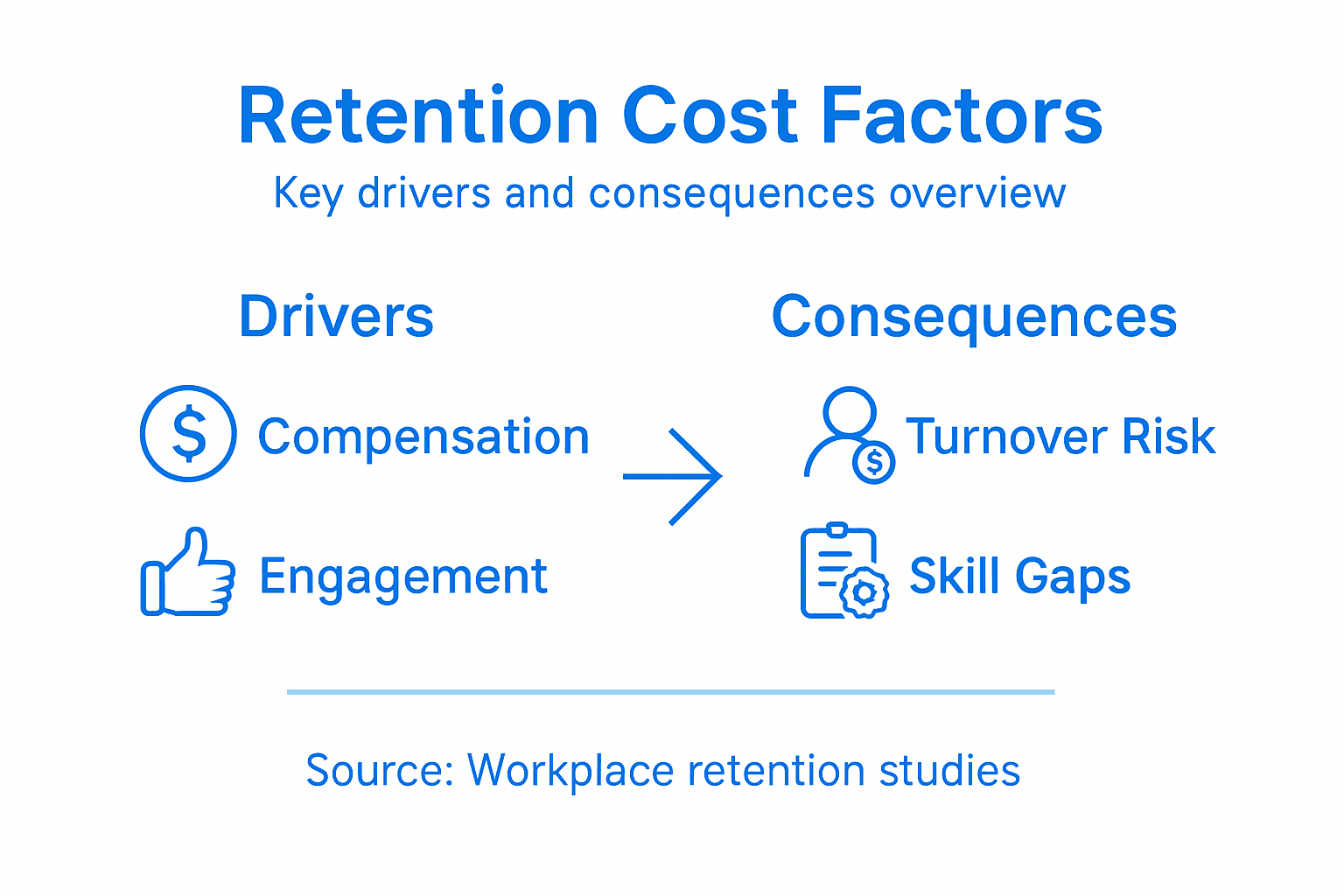
Retention cost has two sides: what leaders intentionally invest to keep employees, and what the business quietly pays when retention risk is not addressed early enough.
That second category is where many companies underestimate the damage.
A company may track salary increases, training budgets, and benefit costs. But it may not track the cost of disengagement, manager friction, declining trust, slow execution, or the extra pressure placed on the rest of the team when someone mentally checks out.
| Type of Retention Cost | What It Includes | Why It Matters |
|---|---|---|
| Financial retention cost | Compensation, benefits, bonuses, development programs | Helps employees feel fairly rewarded and supported |
| Leadership time cost | Manager check-ins, conflict resolution, coaching, retention conversations | Shows how much leadership capacity is spent stabilizing people issues |
| Productivity cost | Reduced output, slower execution, lower ownership | Reveals the performance impact of disengagement |
| Team stability cost | Morale decline, extra workload, team friction | Shows how one retention issue can affect the wider team |
| Knowledge continuity cost | Loss of context, client knowledge, process memory | Protects the business from repeated mistakes and slow transitions |
| Visibility cost | Missed warning signs, late intervention, surprise resignations | Shows the cost of not detecting retention risk early enough |
Key drivers of retention cost include:
-
Manager-employee fit
-
Values alignment
-
Career growth opportunities
-
Team trust and communication
-
Workload and burnout risk
-
Recognition and contribution
-
Compensation fairness
-
Hidden friction between team members
-
Whether leaders can see disengagement early enough to act
Retention cost is not only driven by what a company spends. It is also driven by what leaders fail to see.
How Retention Cost Impacts Profitability
Retention cost affects profitability because people issues create business drag.
When employees are aligned, engaged, and working well with their managers and teams, execution improves. When employees are disengaged, misaligned, or quietly considering leaving, the business pays for it through lower productivity, slower decisions, weaker collaboration, and more management time spent reacting.
The financial impact often appears in several areas:
| Profitability Area | How Retention Cost Shows Up |
|---|---|
| Productivity | Disengaged employees produce less and contribute less proactively |
| Manager capacity | Leaders spend more time solving avoidable people problems |
| Hiring costs | Replacing employees increases recruiting, onboarding, and training expenses |
| Team performance | Remaining employees absorb stress, uncertainty, and extra workload |
| Customer delivery | Service quality, continuity, and relationship trust may decline |
| Growth execution | Leadership attention shifts from scaling the business to stabilizing the team |
The key point: retention cost is not just the cost of keeping employees. It is the cost of keeping the business stable enough to perform.
For CEOs and founders, this makes retention cost a strategic issue. If avoidable turnover keeps happening, the business is not just losing people. It is losing speed, knowledge, and leadership focus.
Calculating and Tracking Retention Cost Metrics
To calculate retention cost properly, leaders need to track both direct spending and hidden business impact.
A basic retention cost calculation may include:
-
Compensation adjustments
-
Benefits and incentives
-
Training and development
-
Manager time spent on retention conversations
-
Engagement programs
-
Tools used to measure retention risk or team alignment
But this only gives part of the picture. Leaders should also track the indicators that show whether retention risk is rising.
Important retention cost metrics include:
| Metric | What It Reveals |
|---|---|
| Voluntary turnover rate | How many employees are choosing to leave |
| Regrettable turnover | Whether the company is losing people it wanted to keep |
| Time to productivity | How long it takes new hires to become fully effective |
| Absenteeism or withdrawal patterns | Whether disengagement may be increasing |
| Manager-employee alignment | Whether relationship friction may be creating retention risk |
| Team alignment | Whether collaboration issues are affecting stability |
| Engagement risk | Whether employees are emotionally disconnecting |
| Cost per replacement | The direct cost of replacing a departing employee |
The strongest retention cost tracking does not only answer, “What did turnover cost us?”
It answers, “Where is retention risk building right now?”

Comparing Retention and Turnover Costs for Leaders
Retention cost and turnover cost are connected, but they are not the same.
Turnover cost is what the company pays after someone leaves. Retention cost is what the company invests to reduce the likelihood of that loss happening in the first place.
| Category | Retention Cost | Turnover Cost |
|---|---|---|
| Timing | Before a resignation | After a resignation |
| Purpose | Keep strong employees engaged and aligned | Replace employees who have left |
| Leadership posture | Proactive | Reactive |
| Business impact | Protects stability and performance | Disrupts stability and performance |
| Main risk | Spending without knowing where risk is | Discovering the risk too late |
The better leadership question is not, “Can we afford retention efforts?”
The better question is, “What is avoidable turnover already costing us because we did not see the risk early enough?”
Retention investment is only useful when it is targeted. Generic perks, broad engagement campaigns, and occasional check-ins may not reduce risk if leaders still cannot see where disengagement, misalignment, or hidden friction exists.
Optimizing Retention Costs Through Earlier Visibility
To optimize retention cost, leaders need to stop treating retention as a broad program and start treating it as a visibility problem.
Many companies spend money on retention without knowing which employees are at risk, which manager relationships are strained, which teams have hidden friction, or where values alignment is weakening. That leads to wasted effort.
Better retention cost optimization starts with earlier insight.
Leaders can reduce wasted retention spend by:
-
Identifying where disengagement is forming
-
Seeing where manager-employee fit may be weak
-
Understanding team friction before it damages performance
-
Separating compensation problems from alignment problems
-
Supporting managers with clearer people data
-
Taking action before resignation risk becomes visible
-
Measuring whether retention efforts are aimed at the right issues
The goal is not to spend endlessly on retention. The goal is to spend intelligently because leadership knows where the actual risk is.
Reduce Retention Cost by Seeing Risk Earlier
Retention cost becomes expensive when leaders are forced to react too late.
By the time a valuable employee resigns, the company may have already paid for months of disengagement, reduced contribution, team friction, and lost momentum.
OpenElevator helps CEOs, founders, senior leaders, and managers detect retention risk before it becomes a resignation.
Through a simple five-minute, bias-free survey, OpenElevator gives leaders clearer visibility into values alignment, engagement risk, manager-employee fit, and hidden team friction. That means leaders can stop guessing where retention problems may be forming and start taking targeted action earlier.
Want to understand where retention cost may already be building inside your team? Start with OpenElevator’s free team scan.

Frequently Asked Questions
What is retention cost?
Retention cost is the total investment a company makes to keep employees engaged, productive, aligned, and committed to staying. It includes compensation, benefits, development, manager time, engagement efforts, and tools used to reduce turnover risk.
Why does retention cost matter?
Retention cost matters because avoidable turnover affects productivity, morale, team stability, hiring expenses, customer delivery, and leadership focus. The real cost often starts before someone resigns.
What is included in retention cost?
Retention cost may include compensation, benefits, training, career development, manager coaching, engagement initiatives, retention tools, team alignment work, and the time leaders spend resolving disengagement or friction.
How is retention cost different from turnover cost?
Retention cost is the investment made to keep employees and reduce the risk of departure. Turnover cost is the expense that occurs after someone leaves, including recruiting, onboarding, training, lost productivity, and disruption to the team.
How can leaders reduce retention cost?
Leaders can reduce retention cost by detecting disengagement, values misalignment, manager-employee friction, and team issues earlier. Earlier visibility helps leaders take targeted action instead of spending broadly or reacting after resignations.
How does OpenElevator help reduce retention cost?
OpenElevator helps leaders identify hidden retention risk, values alignment, engagement risk, manager-employee fit, and team friction through a five-minute, bias-free survey. This helps leadership teams see where retention cost may already be building and act earlier.