Top talent rarely leaves without warning.
The signals are usually there first: less initiative, fewer ideas, shorter communication, reduced curiosity, or a quiet shift in energy. But because high performers often keep delivering, leaders can mistake surface stability for real commitment.
That is the visibility gap where retention risk grows.
Engagement surveys, turnover data, and exit interviews are lagging indicators. They explain the problem after risk has already formed. This guide explains what leaders often miss before losing key people and how to see what is changing below the surface early enough to act.
Table of Contents
-
Why policies aren’t enough: The case for systemic talent practices
-
When growth stalls: How hidden misalignment pushes top talent away
Key Takeaways
| Key Point | What Leaders Should Know |
|---|---|
| Top talent often withdraws quietly | High performers may keep delivering while motivation, ambition, or alignment is already changing. |
| Surface performance can hide risk | Strong output does not always mean someone is still committed long term. |
| Growth conversations matter | Employees may leave when they cannot see a meaningful future inside the organization. |
| Fit and alignment shape retention | Manager-employee fit, values alignment, and team friction can quietly influence whether top talent stays. |
| Visibility changes timing | Leaders need to see shifting sentiment before resignation risk disrupts performance. |
Recognizing the real signals before top talent exits
The warning signs we’re trained to spot, showing up late, missing deadlines, visible disengagement, rarely apply to high performers. Your strongest people don’t flame out. They fade. Quietly, professionally, and often without a single complaint.
This is what researchers call silent ambition withdrawal, where strong employees “lean out” without visible friction. They stop raising their hands for stretch projects. They ask fewer questions in strategy sessions. They show up, do good work, and say nothing. From the outside, it can look like stability.
High performers withdraw ambition silently, and leaders misread it as stability, missing the real signal until it’s too late.
So what does this actually look like in practice? Watch for these behavioral shifts:
-
Declining optional challenges. They used to volunteer for cross-functional projects. Now they politely pass.
-
Fewer questions in meetings. Curious people stop being curious when they’ve mentally moved on.
-
Less informal connection. The hallway conversations dry up. Lunch invites get declined more often.
-
Shorter, more transactional communication. Emails become functional. The warmth disappears.
None of these signals scream “I’m leaving.” That’s exactly the problem. They whisper. And in a busy quarter, whispers get drowned out by noise.
The gap between what leaders think is happening and what is actually happening is rarely dramatic. It’s subtle. A high performer who once sent you ideas unprompted now waits to be asked. That shift feels fine, until suddenly it isn’t, and you’re reading a resignation letter that genuinely surprises you.
Building strategies to retain key staff starts with learning to read these quieter signals before they become departures. The most practical first step is deceptively simple.
Pro Tip: Schedule regular one-to-ones with your top performers specifically to invite ambition. Ask what they want to be working on six months from now. Not what they’re working on now. Where they want to go. That single question opens more honest conversations than most formal review processes.
Why policies aren’t enough: The case for systemic talent practices
Once you’re watching for the real signals, the next instinct is to respond with a policy fix. A new wellness benefit. Flexible Fridays. A revamped bonus structure. These feel like meaningful action. They rarely are.
The core mistake many SMEs make is treating retention like a product problem, something you can solve by adding features. In reality, it’s a systems problem. Integrated talent practices consistently achieve better retention outcomes than isolated employee policies, no matter how generous those policies are.
Here’s a comparison that makes this concrete:
| Policies (add-ons) | Systems (integrated) |
|---|---|
| Wellness stipend | Structured onboarding with 90-day check-ins |
| Remote work option | Continuous development pathways |
| Annual bonus | Transparent promotion criteria |
| Ping-pong table | Regular team feedback loops |
| Flexible hours | Succession planning conversations |
The left column isn’t worthless. But it doesn’t build the kind of environment where talented people feel genuinely invested in. The right column does, because it signals that the organization is thinking about their future, not just their present comfort.
Effective talent systems share a few common elements:
-
Structured onboarding that connects new hires to purpose, not just process
-
Continuous development with clear milestones and manager support
-
Transparent growth pathways so people know what advancement actually looks like
-
Regular engagement touch-points that go beyond annual surveys
-
Psychological safety embedded into team norms, not just stated in a policy doc
Building systemic approaches to talent management takes more upfront effort than rolling out a new perk. But the payoff is compounding. People stay when they can see a future. They leave when they can’t, regardless of how nice the office snacks are.
Pro Tip: Run a quarterly check-in specifically to audit your talent systems. Ask your team leads: are our development conversations actually happening? Are growth pathways clear? You’ll find gaps faster than any engagement survey will tell you.
When growth stalls: How hidden misalignment pushes top talent away
Top performers need to see a future.
When that future becomes unclear, their sentiment can begin changing long before they say anything directly. They may still perform well, support the team, and stay professional, but their commitment may already be weakening below the surface.
This is not always because a leader is intentionally blocking someone’s growth. Often, the issue is misalignment.
The employee may value growth more than the leader realizes. The manager may believe the person is satisfied because performance still looks strong. The organization may assume stability means commitment, when it may only mean the employee has not resigned yet.
Common growth and alignment risks include:
-
A high performer no longer seeing a path forward
-
A manager assuming silence means satisfaction
-
Growth expectations that were never discussed clearly
-
Values or priorities shifting without being noticed
-
A role that once felt energizing starting to feel limiting
-
A leader relying on gut feel instead of data on what the employee values
The risk is not simply “job hugging.” The deeper issue is that leaders often do not see when an employee’s values, goals, or sense of fit are changing.
That is why top talent can seem steady right up until resignation day.

Actionable frameworks to preempt silent turnover
With both the signals and the systemic gaps now visible, the question becomes: what do you actually do? Here’s a practical sequence.
-
Diagnose. Map your current talent practices against the systems framework above. Where are the gaps between what you offer and what genuinely retains people?
-
Listen. Use structured one-to-ones, pulse surveys, and candid skip-level conversations to surface what isn’t being said in regular meetings.
-
Act. Prioritize two or three systemic changes over adding a new policy. Depth over breadth.
-
Repeat. Retention is not a project with a finish line. Build the review cadence into your leadership rhythm.
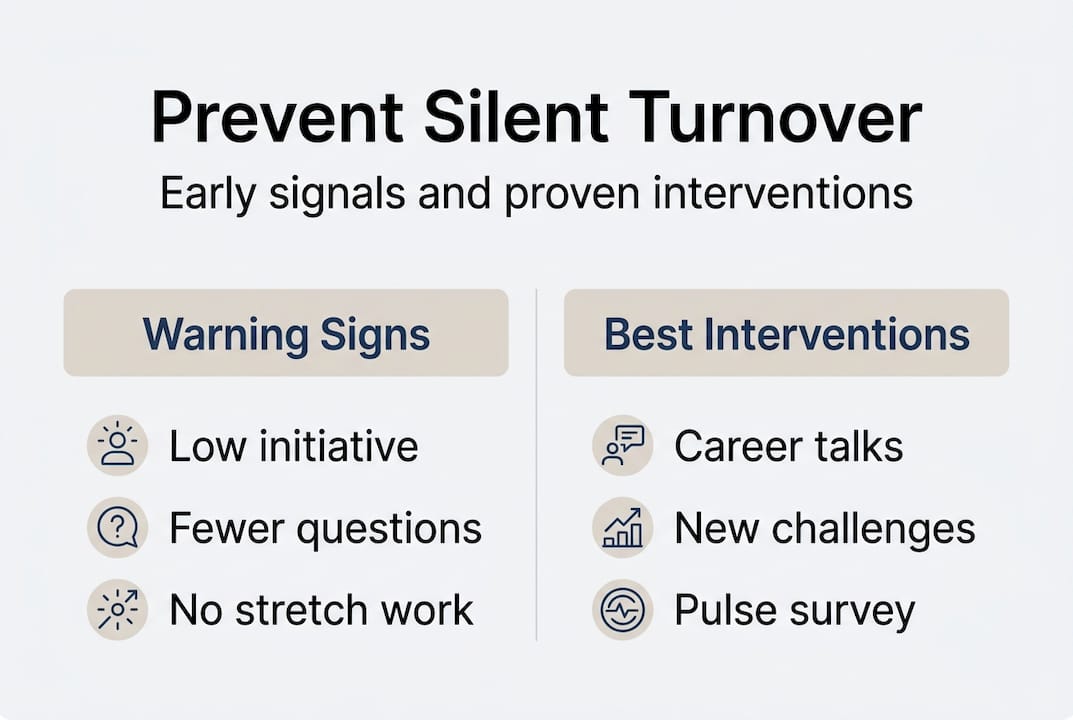
Here’s a quick reference for matching warning signs to interventions:
| Warning sign | Recommended intervention |
|---|---|
| Declining initiative | Career path conversation, new stretch assignment |
| Fewer questions in meetings | One-to-one focused on curiosity and future goals |
| Reduced informal connection | Team dynamics check, manager relationship review |
| Transactional communication | Engagement audit, psychological safety assessment |
| Repeated role stagnation | Succession planning, internal mobility conversation |
The research is consistent: systemic practices around onboarding, development, and engagement outperform standalone policies every time. The leaders who retain top talent aren’t the ones with the best perks. They’re the ones who built the best visibility into what their people actually need.
Pro Tip: Use anonymous pulse surveys quarterly, not just annually. The most important data often lives in what people won’t say to your face but will type into a survey at 10pm. That’s where the real picture lives.
Losing key people isn’t about pay or perks
I’ve seen leaders respond to resignation letters by immediately asking, “Was it the salary?” Almost always, the answer is no. Or at least, not entirely. Compensation matters. But it’s rarely the reason someone who was genuinely engaged decides to leave.
What actually moves the needle is harder to package. It’s whether a leader listened when it mattered. Whether the organization made space for growth or quietly closed the door on it. Whether the systems in place sent the message “we’re invested in you” or “we need you where you are.”
The uncomfortable truth is that most turnover is a leadership habit problem, not a policy problem. Self-awareness, honest listening, and integrated practices are the real retention tools. Before you update another policy, ask yourself: when did I last have a genuinely candid conversation with my best performer about where they want to go? That question, asked sincerely, does more than any perk ever will.
How OpenElevator helps leaders see retention risk earlier
Losing top talent is rarely about one missed conversation. It is usually the result of signals leaders could not see clearly enough, early enough.
OpenElevator helps CEOs, founders, senior leaders, and managers see what is happening now: shifting sentiment, hidden disengagement, manager-employee misalignment, values misalignment, and team friction before those issues become surprise resignations or disrupt performance.
Engagement surveys, turnover data, and exit interviews are lagging indicators. OpenElevator gives leaders earlier visibility into the risks forming below the surface.
Get your free OpenElevator team scan to experience the platform, gain real retention-risk visibility, and see what may be hidden below the surface — with zero cost and zero risk.
Frequently asked questions
What do leaders miss before top talent leaves?
Leaders often miss subtle changes in initiative, curiosity, communication, ambition, and connection. High performers may keep producing strong work while motivation or alignment is already weakening below the surface.
Why is top talent harder to identify as a retention risk?
Top talent is often professional enough to keep delivering even when commitment is changing. Strong output can make leaders assume everything is fine, even when sentiment, manager fit, or values alignment is shifting.
Why do high performers leave even when they seem engaged?
High performers may leave when they no longer see growth, feel disconnected from the direction of the company, experience manager-employee misalignment, or feel their work no longer fits what they value.
Are engagement surveys enough to prevent losing top talent?
No. Engagement surveys are lagging indicators. They show how employees felt at a point in time, but they may miss whether sentiment, values alignment, manager fit, or team dynamics are already changing below the surface.
How does OpenElevator help leaders retain top talent?
OpenElevator helps leaders see what is happening below the surface before turnover data, exit interviews, or engagement surveys reveal the problem too late. The free team scan lets leaders experience the platform with zero cost and zero risk while gaining real visibility into hidden team risk.